
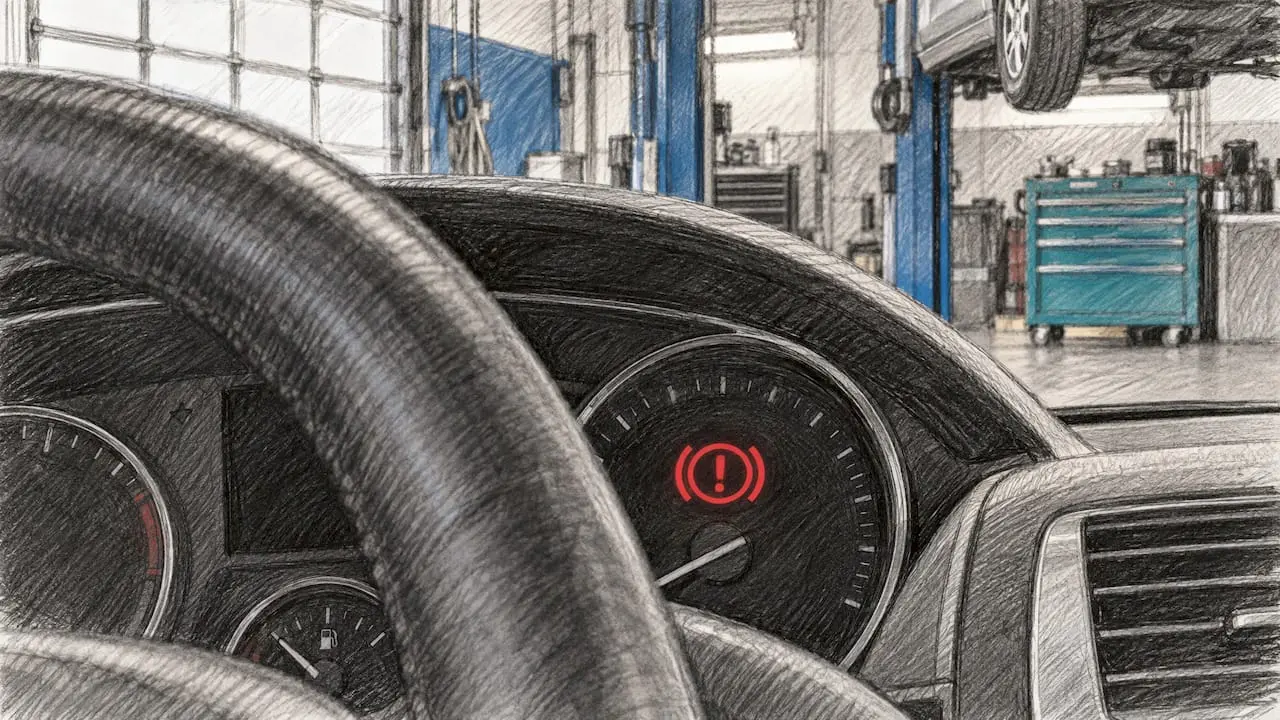
A brake warning light that stays on after the parking brake is fully released should be treated as a brake system fault until a technician rules it out. Common causes include low brake fluid, a sensor or wiring fault, and a problem in the ABS or brake-force control system. Some of these can affect stopping power, so the safe move is to park, check the basics and arrange an inspection or a tow rather than keep driving.
TL;DR
- A red brake light can simply mean the parking brake is applied. If it stays on after the brake is fully released, the system needs inspection.
- One manufacturer’s manual states that driving with the brake system light on is dangerous because the brakes could fail at any time.
- Low brake fluid, a worn-pad fluid drop, a leak, a failing switch or sensor, and ABS faults are the usual suspects.
- A soft pedal, a visible leak or a brake light plus an ABS light together are reasons to stop and arrange a tow.
- Integrity Auto in Portland, Oregon, diagnoses brake warning lights on Toyota, Lexus, Subaru and Honda vehicles.
What the brake warning light means
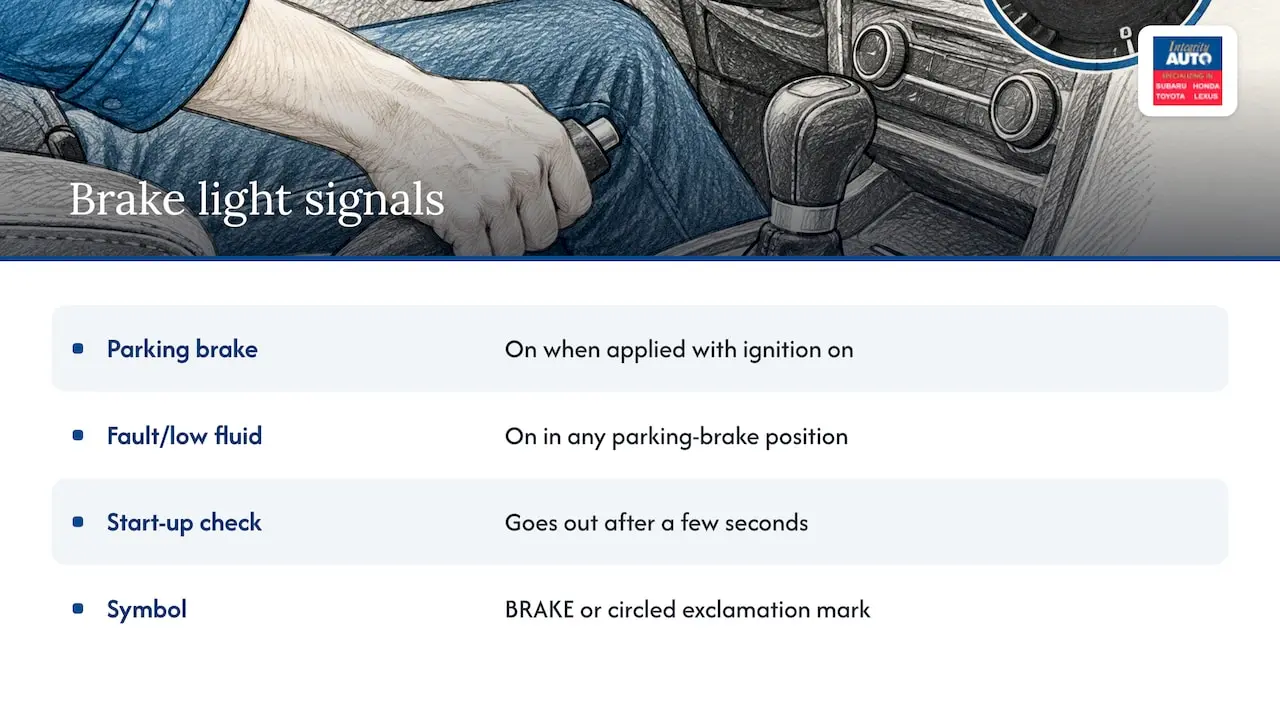
The brake light is not a single-purpose signal. According to Ford’s owner support page, the brake system warning lamp serves two functions. It comes on when the parking brake is applied with the ignition on. It also comes on when the vehicle has a brake fault or a low brake fluid level, whatever position the parking brake is in.
That is why the same red symbol can be harmless in one moment and urgent in the next. The symbol usually appears as the word BRAKE, or as an exclamation mark inside a circle, depending on the vehicle.
A brief light at start-up is normal. A parts manufacturer’s guide explains that when the ignition is turned on and before the engine starts, all of the dashboard warning lights, brake light included, illuminate and should go out after a few seconds. This confirms the bulbs and circuits work.
First checks when the light comes on
These steps take a minute and are safe to do once the car is parked in a safe spot.
- Release the parking brake completely. Lever-style brakes can sit one notch short of fully released. Foot-pedal and electronic versions can also stick or fail to disengage. Toyota owners with a stuck or misbehaving parking brake can find background on the system in the guide to Toyota emergency brake and parking brake cable issues.
- Look at the light again. If it goes out, the parking brake was the cause.
- Check the pedal feel. With the car stopped, press the pedal firmly. According to AutoZone’s DIY guide, the pedal should hold its pressure and not sink toward the floor.
- Look for other warnings. An ABS light on at the same time changes the picture, as described below.
- Look under the car for fluid on the ground near the wheels or under the engine bay.
If the light remains on after step 2, the Mazda owner’s manual guidance applies: after confirming the parking brake is fully released, have the brakes inspected immediately.
Is it safe to drive with the brake light on?
Not as a routine. The 2026 Mazda3 owner’s manual says not to drive with the brake system warning light illuminated, and describes it as dangerous because the brakes may not work at all or could fail at any time. The 2018 Mazda CX-5 manual adds that braking effectiveness may diminish with the light on, so the driver may need to press the pedal harder than normal.
The Mazda3 manual makes one more point: if the brake and ABS lights are on together, the rear wheels could lock more quickly in an emergency stop than under normal circumstances. A Hyundai owner’s manual similarly states that with both lights on, the braking system does not work normally. It advises avoiding high speeds and abrupt braking and having the vehicle inspected.
If the light comes on while driving
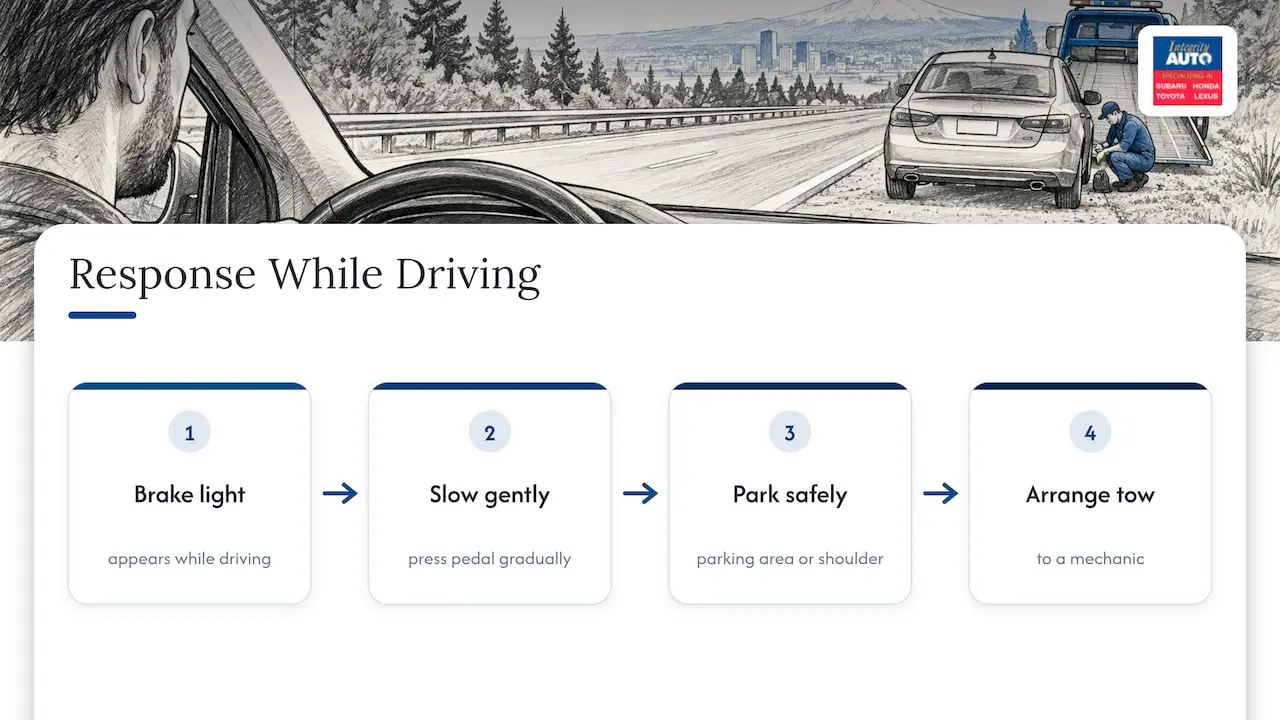
Vehicles generally have two separate hydraulic brake circuits. According to the Parts Matter guide, that means a problem in one circuit still lets the vehicle be brought to a stop, though it may take longer. The same guide advises getting to a parking area or the shoulder as safely as possible while pressing the pedal gradually.
AutoZone’s guide gives the same sequence: stay calm, drive to a safe place, slow with gentle pedal pressure, and call a tow truck to take the car to a mechanic.
When a tow is the right call
Towing is the sensible choice when any of these show up with the light on:
- The pedal feels soft, sinks or needs more effort than usual.
- Fluid is visibly leaking.
- The ABS light is on as well.
- Stopping takes noticeably longer.
- Several warning lights (brake, ABS, stability control) appear together at start-up. NHTSA recall guidance for one such software-related case advised not driving the vehicle in that condition.
A NHTSA safety recall document on a brake fluid loss problem explains why: as the reservoir empties, drivers may notice a change in pedal travel and feel and increased pedal effort. Substantial fluid loss can reduce front brake function, lengthen stopping distance and raise crash risk.
Common causes of a brake light that stays on
| Cause | What it often looks like | Urgency |
|---|---|---|
| Parking brake not fully released or switch fault | Light on, brakes feel normal | Low to moderate; confirm and inspect the switch |
| Low brake fluid | Light on, possibly a soft pedal | High; a leak is possible |
| Brake fluid leak | Fluid near wheels, sinking pedal | Urgent; do not drive |
| Failing fluid level sensor or wiring | Light flickers or stays on with a full reservoir | Moderate; needs diagnosis |
| ABS or brake-force control fault | Brake and ABS lights together | High; rear wheels may lock sooner |
| Electronic parking brake fault | Light on with an electric parking brake | Moderate to high |
Low brake fluid and worn pads
AutoZone’s guide lists low fluid below the sensor level, ABS trouble and wiring or sensor faults among the usual causes, and notes that low fluid most likely points to a leak. Worn pads complicate this. As pads thin, caliper pistons extend and the reservoir level drops slightly, which by itself does not prove a leak. A low level still deserves a check of the whole system, because a true leak can let the reservoir run low enough to introduce air and reduce braking. Pad wear is easier to understand with the guide to brake pad wear patterns.
The light is on but the fluid looks full
A full reservoir does not clear the warning. A truck manufacturer’s manual states that when the parking brake is off and the fluid is at the full mark, the light can point to a possible hydraulic malfunction or a brake booster problem detected by the ABS and stability system. In that case the light stays on until the condition is corrected. Mazda’s CX-5 manual describes another path: if the electronic brake force distribution unit finds a component working incorrectly, it can light the brake and ABS lights together.
Two related situations have their own guides: what to check when an ABS light is on, and how to tell air in the lines from a bad master cylinder when the pedal feels soft.
What a shop does with a brake warning light
A proper diagnosis follows the symptom rather than guessing at parts:
- Confirms the parking brake mechanism and switch are working.
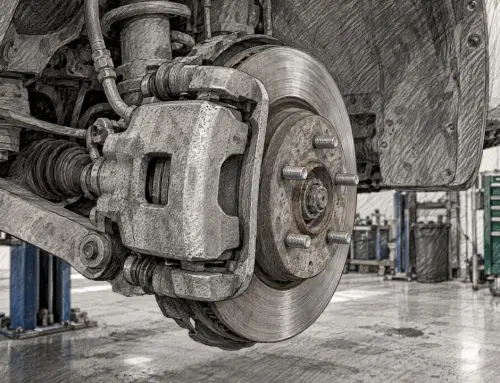
- Checks fluid level, condition and any sign of leaks at the lines, calipers, wheel cylinders and master cylinder.
- Measures pad and rotor wear.
- Scans for ABS and stability control codes.
- Tests the fluid level sensor and inspects wiring and connectors.
- Road tests to confirm pedal feel and stopping behavior.
The diagnostic process, and how estimates are handled for Toyota and Lexus vehicles, is outlined on the diagnosis and estimates page. Hybrid owners with a brake warning on a Prius can also review Prius brake actuator symptoms, since that component can trigger brake and ABS warnings.
Brake service for Toyota, Lexus, Subaru and Honda in Portland
Integrity Auto is an independent shop in Portland, Oregon, specializing in Toyota, Lexus, Subaru and Honda vehicles. Its services include brakes, struts and shocks, diagnosis, and complimentary multipoint inspections. Its stated approach combines ASE certified technicians, OEM parts and longer warranties than dealership repairs.
Owners can find the relevant service pages here:
- Independent Toyota service and repair
- Independent Lexus service and repair
- Honda service and repair
- Subaru service and repair, including the Subaru brake repair cost and service guide
A brake light that will not go out is best handled before it becomes a roadside problem. Scheduling a diagnosis through the Integrity Auto website is the practical next step.
FAQ
Why is my brake light on even though the parking brake is off?
The usual causes are low brake fluid, a faulty fluid level sensor or parking brake switch, wiring trouble, or an ABS or brake-force control fault. A hydraulic problem or a brake booster issue can also keep the light on even with a full reservoir. An inspection is needed to tell which one applies.
Is it safe to drive with the brake warning light on?
Manufacturer manuals advise against it. One states that the brakes may not work at all or could fail at any time. If the light comes on while driving, the practical steps are to pull over safely, slow gradually and arrange a tow or inspection.
What does it mean if the brake light and ABS light are on together?
The two lights together point to a problem beyond a simple parking brake or fluid issue. One manual warns that the rear wheels could lock more quickly in an emergency stop. Driving should be limited and the vehicle inspected promptly.
Can a brake light come on and then go off?
Yes. Brake fluid sloshing near a marginal level, a failing sensor or a loose connection can cause an intermittent light. An on-then-off light still has a cause, so it is worth having checked, particularly if the pedal feels different.
Sources
- Ford: what the dashboard lights mean
- Parts Matter: dashboard brake light on
- AutoZone: why is my brake light on
- 2026 Mazda3 owner’s manual: warning light turns on
- 2018 Mazda CX-5 owner’s manual: warning lights and sounds
- 2026 Hyundai owner’s manual: warning and indicator lights
- NHTSA noncompliance recall FAQ, 2020
- NHTSA safety recall 22V150, 2022