
Car ignition problems are defined as any malfunction within the ignition system that prevents the engine from starting or running reliably. The ignition system includes the ignition switch, ignition control module (ICM), ignition barrel, battery, and spark delivery components. A dead battery causes approximately 40% of all no-start events, making it the single most common trigger. Ignition system faults range from straightforward electrical failures to mechanical issues inside the ignition barrel itself. Recognizing the difference early saves time, money, and the risk of being stranded.
What causes car ignition problems?
The four most common sources of ignition system failure are a dead battery, a faulty ignition switch, a failed ignition control module, and a jammed ignition barrel. Each one produces distinct symptoms, and confusing them leads to unnecessary parts replacements.
Dead or weak battery. Low battery voltage can power dashboard lights but still fail to crank the engine. This fools many drivers into blaming the starter motor when the real problem is a battery that cannot deliver enough current under load.

Faulty ignition switch. The ignition switch can fail electrically while the mechanical barrel still turns the key normally. The result is a car that cranks but produces no electrical response to the start command, or one that loses power to accessories mid-drive.
Ignition control module failure. The ICM manages spark timing and distribution. Heat exceeding 185°F, poor thermal compound application, and inadequate mounting torque are the leading causes of ICM failure. Symptoms include a solid check engine light, random misfires, and sudden stalls.
Jammed ignition barrel. A key that refuses to turn is often caused by the steering lock engaging, not a broken barrel. Forcing the key in this situation risks snapping it or damaging the barrel pins.
Common ignition system faults and their symptoms:
- No crank, no start: Battery is discharged or has a failed connection
- Key turns, no start: Ignition switch electrical failure or ICM fault
- Intermittent stalling: ICM overheating or loose ignition switch wiring
- Check engine light with misfires: OBD-II codes P0300–P0399 pointing to ICM
- Key won’t turn: Steering lock engaged or worn ignition barrel
- Accessories lose power while driving: Faulty ignition switch contact
Pro Tip: If your dashboard lights come on but the engine won’t crank, test the battery voltage with a multimeter before replacing any other component. A reading below 12.4 volts at rest indicates a weak battery.
How do you diagnose ignition system faults?
Accurate diagnosis follows a logical sequence. Skipping steps wastes money on parts that are not the actual problem.
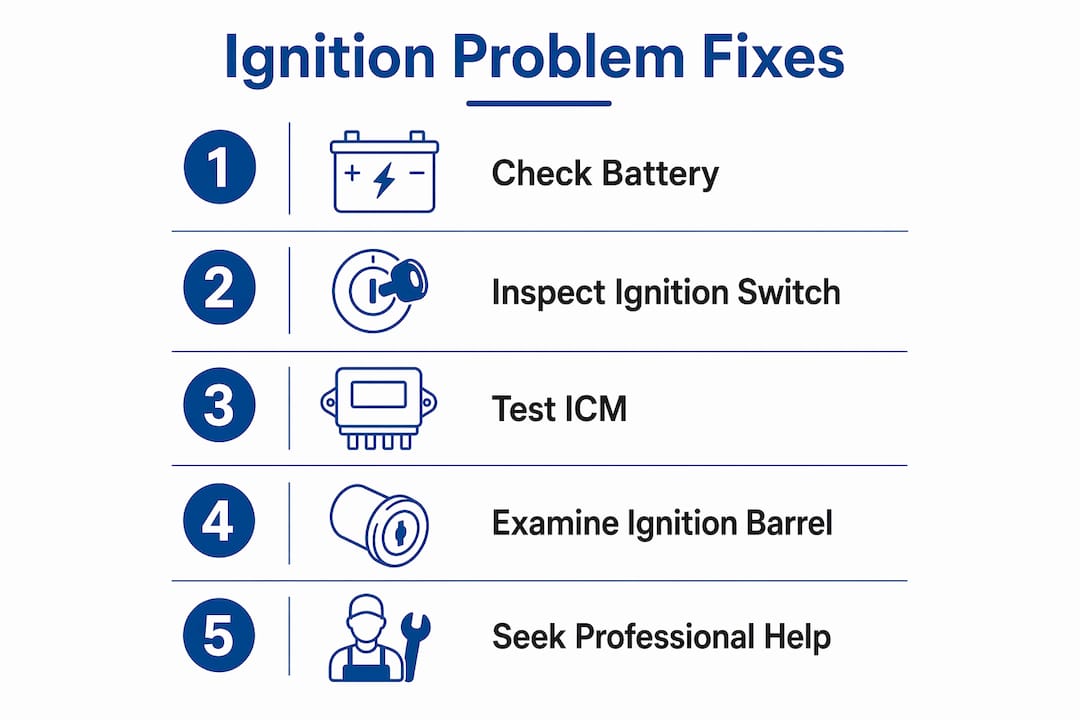
- Check battery voltage. Use a multimeter set to DC voltage. A fully charged battery reads 12.6 volts at rest. Anything below 12.0 volts under no load suggests the battery needs professional battery testing before you proceed further.
- Scan for OBD-II trouble codes. Connect an OBD-II scanner to the diagnostic port under the dashboard. Codes in the P0300–P0399 range indicate ignition control module or misfire issues. Cross-reference codes with live data to confirm the fault. Integrityautoinc uses professional-grade scanners that read manufacturer-specific codes beyond the generic OBD-II set.
- Test ignition switch electrical output. Turn the key to the “on” position and use a test light or multimeter to check for voltage at the ignition switch output terminals. No voltage with the key turned confirms an electrical ignition switch fault, even if the barrel turns freely.
- Inspect spark delivery. Remove one spark plug wire and insert a spare plug. Ground it against the engine block and crank the engine. A strong blue spark confirms the ICM is firing. A weak orange spark or no spark points to ICM or coil failure.
- Check ICM ground resistance. Ground resistance below 0.1 ohms is required for reliable ICM operation. High resistance at the ground connection causes erratic module behavior that mimics sensor failures.
- Inspect the ignition barrel. Try gently rocking the steering wheel while turning the key. If the key then turns, the steering lock was engaged, not the barrel itself.
Pro Tip: Never clear OBD-II codes before recording them. The freeze-frame data stored alongside each code shows the engine conditions at the moment of failure, which is critical for accurate diagnosis. You can review check engine light codes with a specialist if the codes are unclear.
How do you fix battery, ignition switch, ICM, and barrel problems?
Each ignition system component requires a different repair approach. Treating them the same way leads to repeat failures.
Battery
A battery that fails a load test needs replacement, not a recharge. Corroded battery cables add resistance that mimics a dead battery even when the battery itself is healthy. Clean the terminals with a wire brush and baking soda solution before condemning the battery. Always verify the charging system output after replacement. A failing alternator will drain a new battery within days.
Ignition switch
An ignition switch that fails electrically requires replacement of the electrical contact assembly. On most Toyota, Lexus, Subaru, and Honda models, the electrical switch separates from the mechanical barrel, so the barrel does not need replacement. Confirm the fault by testing voltage at the switch output terminals. No voltage with the key in the “start” position confirms the switch, not the barrel.
Ignition control module
ICM replacement demands attention to two details that most DIY guides omit. First, apply a fresh layer of thermal compound between the module and its heat sink. Replacing an ICM without adequate heat-sink compound causes the new module to overheat beyond 200°F and fail prematurely. Second, verify ground resistance after installation. A reading above 0.1 ohms at the ground connection will cause the new module to fail within weeks.
Ignition barrel
A barrel that jams because of the steering lock is not broken. Applying gentle pressure to the steering wheel while turning the key releases the lock without damaging the barrel pins or the key. A barrel that jams regardless of steering wheel position, or one where the key feels loose and sloppy, needs professional inspection. Forcing a jammed key risks snapping it inside the barrel, which turns a simple fix into an expensive extraction job.
| Component | Key symptom | Repair complexity |
|---|---|---|
| Battery | Lights on, no crank | Low. Test and replace. |
| Ignition switch | Key turns, no electrical response | Moderate. Electrical assembly swap. |
| Ignition control module | Misfires, stalls, P0300–P0399 codes | Moderate to high. Thermal compound required. |
| Ignition barrel | Key won’t turn or feels loose | Moderate. Steering lock check first. |
Pro Tip: When replacing an ICM on a Toyota or Lexus, use OEM-specification torque values for the mounting bolts. Over-tightening cracks the module housing and creates new heat paths that accelerate failure.
When should you seek professional help for ignition problems?
Preventive maintenance catches ignition system faults before they strand you. A few consistent habits make a measurable difference in system reliability.
- Inspect battery terminals every six months for corrosion and loose connections
- Test battery load capacity annually, especially before winter
- Have the ignition switch checked if accessories flicker or cut out while driving
- Schedule a full ignition system inspection after any no-start event, even if the car starts again
- Avoid hanging heavy keychains from the ignition key. The weight stresses the barrel and wears the electrical contacts in the switch
Certain situations require professional diagnosis rather than a DIY approach. If the key turns but the engine does not start, the fault could be the ignition switch, ICM, immobilizer, or fuel system. Testing each one in sequence without the right equipment wastes time and risks misdiagnosis. Integrityautoinc uses manufacturer-level diagnostic tools to isolate the exact fault on Toyota, Lexus, Subaru, and Honda vehicles.
Recurring ignition system malfunctions after a repair are a clear signal that the root cause was not addressed. An ICM that fails twice in a year almost always has an unresolved heat or ground issue. A battery that dies repeatedly points to a charging system fault. Chasing symptoms without fixing the underlying cause costs far more than a thorough professional diagnosis from the start.
Pro Tip: If your car starts fine when cold but stalls after reaching operating temperature, suspect the ICM first. Heat-related ICM failure is a classic pattern on older Toyota and Honda models, and it is frequently misdiagnosed as a fuel or sensor problem.
Key takeaways
Ignition system failures follow predictable patterns, and accurate diagnosis of the battery, ignition switch, ICM, and barrel prevents repeat repairs and unnecessary costs.
| Point | Details |
|---|---|
| Battery is the top culprit | A dead or weak battery causes approximately 40% of all no-start events. |
| Switch and barrel fail differently | The ignition switch can fail electrically while the barrel still turns the key normally. |
| ICM needs thermal compound | Replacing an ICM without heat-sink compound causes the new module to overheat and fail prematurely. |
| Ground resistance matters | ICM ground resistance must stay below 0.1 ohms to prevent erratic operation and early failure. |
| Steering lock mimics barrel faults | Gently rocking the steering wheel while turning the key often releases the lock without any repair needed. |
What I’ve learned from years of ignition misdiagnoses
The most expensive ignition repairs I see are not the ones with genuinely failed parts. They are the ones where the wrong part was replaced first. A driver replaces the starter because the car won’t crank, then replaces the battery because the new starter doesn’t help, and finally discovers the ignition switch was the problem all along. Three parts replaced, one problem fixed.
The pattern that catches people most often is the key-turns-but-no-start scenario. Most drivers assume that if the key turns, the ignition system is working. That assumption is wrong. The mechanical barrel and the electrical switch are separate components. One can work perfectly while the other fails completely. Testing the electrical output of the switch takes two minutes with a multimeter. Skipping that test costs hundreds of dollars.
ICM failures deserve special mention because they mimic so many other faults. A failing ICM produces symptoms that look like a bad oxygen sensor, a clogged fuel injector, or a failing crankshaft position sensor. The heat-related pattern is the giveaway. If the car starts fine in the morning, stalls after 20 minutes of driving, and then restarts after cooling down for 30 minutes, the ICM is the primary suspect. OBD-II codes in the P0300–P0399 range confirm it.
My strongest advice is this: resist the urge to force anything. A key that won’t turn, a car that won’t start, a module that won’t seat. Forcing creates new damage on top of the original fault. Take a systematic approach, test before you replace, and call a specialist when the diagnosis is not clear.
— Kelly
Integrityautoinc: professional ignition diagnostics in Portland
Persistent ignition problems on a Toyota, Lexus, Subaru, or Honda need more than a parts swap. They need a systematic diagnosis with the right tools.
Integrityautoinc specializes in ignition system diagnostics and repair for Toyota, Lexus, Subaru, and Honda vehicles. The team uses manufacturer-level diagnostic equipment to read both generic and OEM-specific trouble codes, test ignition switch electrical output, verify ICM ground resistance, and perform professional battery testing and replacement with a load test, not just a voltage check. If you are dealing with a no-start, intermittent stall, or a check engine light with misfire codes, you can review diagnostic service options and schedule an appointment. Integrityautoinc treats your car as if it were their own.
FAQ
What is the most common cause of a no-start ignition problem?
A dead or discharged battery accounts for approximately 40% of no-start events. Always test battery voltage and load capacity before diagnosing other ignition components.
Can the ignition switch fail without affecting the key?
Yes. The ignition switch can fail electrically while the mechanical barrel still turns the key normally. Testing voltage at the switch output terminals confirms whether the electrical side has failed.
What OBD-II codes indicate an ignition control module fault?
Codes in the P0300–P0399 range indicate ignition control module or misfire-related failures. A solid check engine light combined with these codes points directly to the ICM.
Why does my car start cold but stall when warm?
Heat-related ICM failure causes no-starts and stalls after the engine reaches operating temperature. The module fails when internal temperatures exceed 185°F, then recovers once it cools down.
Is it safe to force a key that won’t turn in the ignition?
Forcing a jammed key risks breaking it inside the barrel or damaging the barrel pins. Gently rocking the steering wheel while turning the key releases the steering lock in most cases without any damage.
Recommended
- Why should you keep your Toyota-Lexus-Subaru-Honda Battery Cables Clean!
- Toyota Owners: What Your Check Engine Light Is Trying To Tell You – Integrity Auto Inc
- Keep Your Vehicle Running Smoothly in Hot Weather – Integrity Auto Inc
- Automotive Repair Tips Blog
- Diagnostic Charges/Estimates For Toyota-Lexus-Scion