
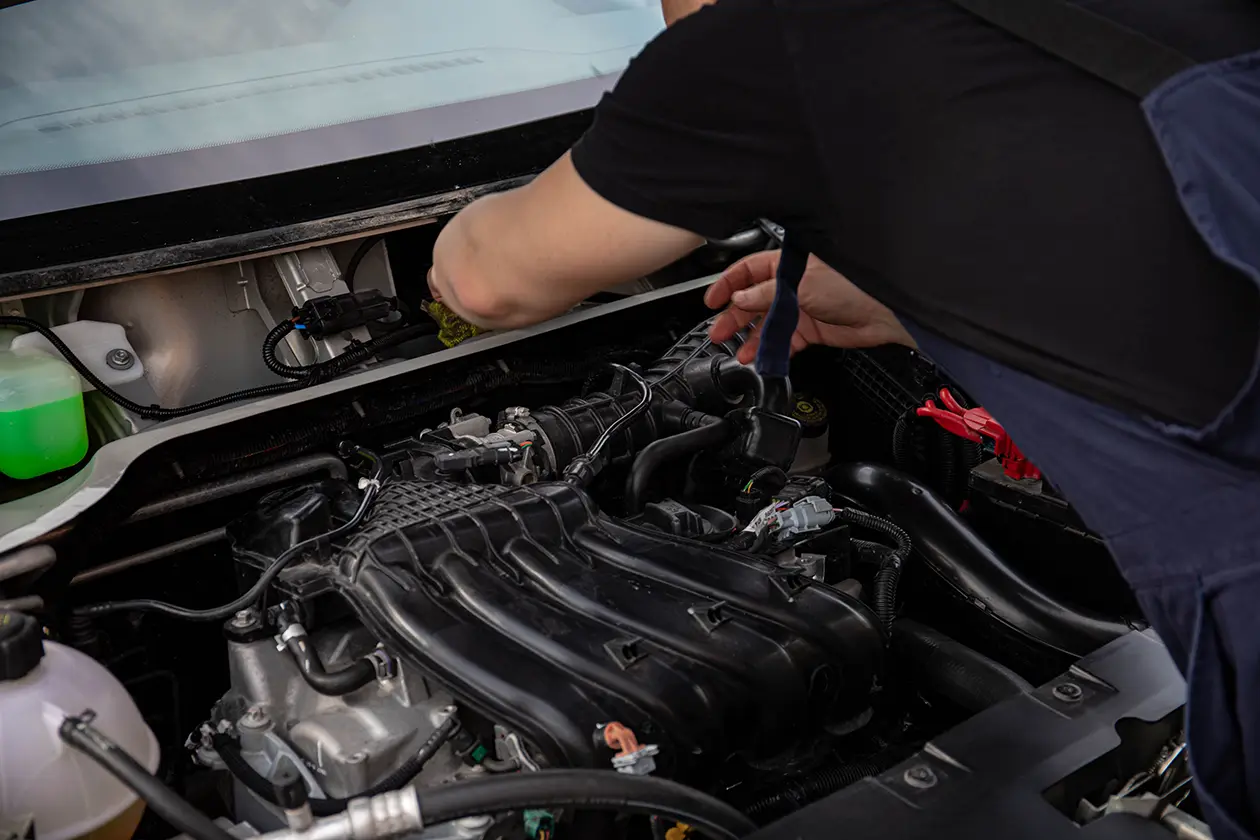
What are your Toyota repair service options?
Toyota owners have two primary paths for vehicle service: factory-authorized dealership service centers and independent repair shops. Each carries real advantages, and the right choice depends on your vehicle’s warranty status, the complexity of the repair, and your budget.
Dealerships offer OEM parts and diagnostics that independent shops often cannot replicate for newer models, along with factory-trained technicians who work exclusively on Toyota vehicles. Warranty repairs and recall work must be performed at a franchised dealer to be covered at no cost. That is a firm requirement, not a suggestion.
Independent shops, particularly those specializing in Japanese brands, deliver comparable service quality at meaningfully lower prices for out-of-warranty vehicles. ASE-certified technicians at reputable independent shops handle everything from oil changes to engine replacements. The key distinction is that independent shops build personal relationships with owners and their vehicles over time.
Key differences at a glance:
- Dealerships: OEM parts, proprietary diagnostic tools, warranty and recall coverage, factory-trained staff
- Independent shops: Lower labor and parts costs, personalized service, flexibility on parts sourcing
- Warranty status: Active factory warranty points to the dealership; expired warranty opens the door to independent shops
- Integrityautoinc serves Portland-area Toyota owners as a trusted independent Toyota specialist with ASE-certified technicians and a focus on long-term owner relationships
How to choose the right Toyota auto repair service
The single most important factor is your vehicle’s warranty status. If your Toyota is still covered under its factory warranty, the dealership is the correct choice for covered repairs. Once that coverage lapses, the calculus shifts toward independent shops for most routine and mid-level work.
Beyond warranty, consider the repair type. Complex electronic issues on late-model Toyotas, including ADAS calibration, ECU flashing, and transmission reprogramming, often require proprietary scan tools that only dealerships carry. For brake jobs, suspension work, timing belts, and most diagnostic work on vehicles five years or older, a qualified independent shop is typically the better value.
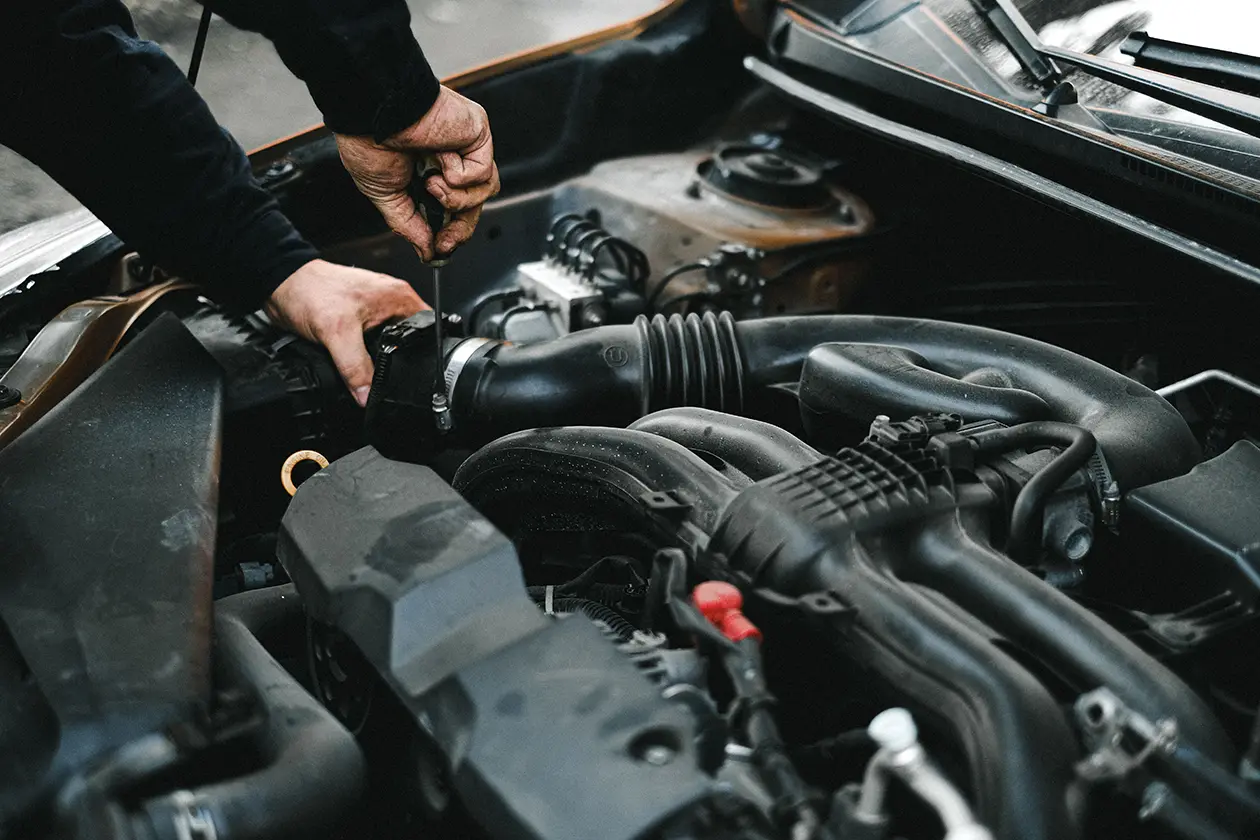
Technician certification matters. Look specifically for ASE certification, which signals that a mechanic has passed standardized competency tests across multiple repair categories. A shop specializing in Japanese vehicles adds another layer of relevant expertise.
Practical criteria to evaluate any shop:
- ASE-certified technicians on staff
- Written estimates provided before work begins
- 12-month/12,000-mile warranty on parts and labor
- Transparent parts sourcing policy (OEM or high-grade aftermarket)
- Verifiable online reviews with specific repair details, not just star ratings
- Willingness to return old parts after major component replacements
Pro Tip: Building a long-term relationship with a trusted independent shop pays off beyond cost savings. Technicians who know your vehicle’s history can detect early wear patterns and flag issues before they become expensive repairs.
Common Toyota repairs and maintenance issues owners should know
Toyota vehicles are among the most reliable on the road, but no vehicle is maintenance-free. Toyota recommends service every six months or 5,000 miles under normal driving conditions, with more frequent attention for severe conditions such as heavy traffic or extreme weather.
Understanding the difference between scheduled maintenance and unplanned repairs helps owners budget accurately. Maintenance is predictable and manufacturer-directed. Repairs are reactive and harder to forecast.
Common scheduled maintenance items for Toyota vehicles:
- Oil and filter changes: Recommended every 5,000–10,000 miles depending on model and oil type
- Tire rotations: Typically every 5,000 miles, often bundled with oil changes
- Brake inspections: Every 5,000 miles; pad replacement when wear indicators trigger
- Fluid inspections: Coolant, transmission fluid, brake fluid, and power steering fluid checked at each service interval
- Spark plug replacement: Varies by model; iridium plugs on many Toyotas last significantly longer than conventional plugs
- Air filter replacement: Usually every 15,000–30,000 miles depending on driving environment
- Multipoint inspections: Recommended at every service visit to catch developing issues early
Common unplanned repairs include oxygen sensor replacement, AC compressor failure, starter motor issues, and battery replacement. On the RAV4, one of Toyota’s best-selling models, battery replacement runs $1,058–$1,080 and starter replacement $478–$650. These are not routine costs, but owners of higher-mileage vehicles should plan for them.
What does Toyota repair and maintenance actually cost?
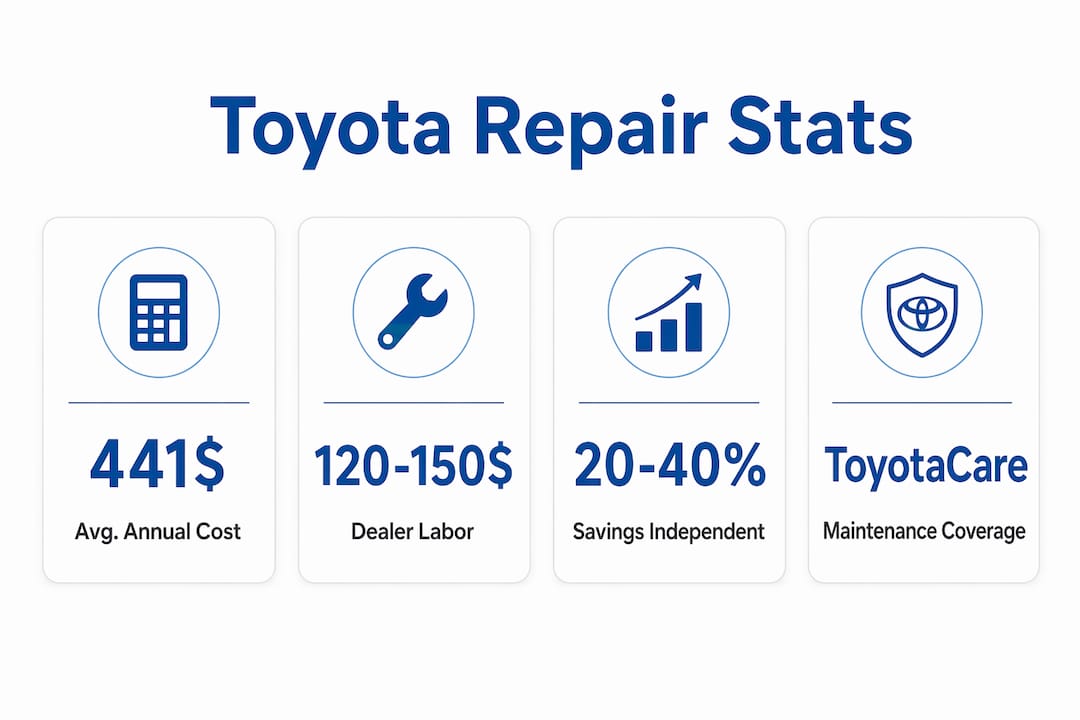
Toyota ownership is genuinely affordable compared to the broader market. Toyota vehicles average $441 annually in maintenance and repair costs, well below the industry average of $652 per year. RepairPal data also show that the average Toyota visits a repair shop approximately 0.3 times per year for unscheduled repairs, compared to 0.4 across all brands.
Dealership labor rates in most U.S. markets run $120–$150 per hour, with parts marked up 30–50% over retail. Independent shops typically charge lower hourly labor rates and have lower parts markups than dealerships On a four-hour job, that labor gap alone can mean $160 or more out of pocket.
New Toyota owners benefit from ToyotaCare, which covers scheduled maintenance including oil changes, tire rotations, fluid inspections, and multipoint checks for two years or 25,000 miles at no cost.
| Service | Estimated Cost (Toyota RAV4) |
|---|---|
| Oil change | Typical oil change costs on RAV4-type models |
| Tire rotation | Typical tire rotation costs on RAV4-type models |
| Front and rear brake pad replacement | Typical brake pad replacement costs on RAV4-type models |
| Spark plug replacement | Typical spark plug replacement costs on RAV4-type models |
| Transmission fluid change | Typical transmission fluid change costs on RAV4-type models |
| Battery replacement | Battery replacement costs can be significant on some models |
| Starter replacement | Starter replacement costs vary by model |
| AC compressor replacement | Air conditioning repairs can be among the costliest |
Costs vary by model, model year, location, and whether the work is performed at a dealership or independent shop. Owners who move their routine service to a qualified independent shop after the ToyotaCare period ends can realize meaningful savings on labor without sacrificing quality.
Integrityautoinc: a trusted independent Toyota service alternative
Toyota owners in the Portland, Oregon area who want dealership-level expertise without dealership pricing have a concrete option in Integrityautoinc. The shop specializes exclusively in Toyota, Lexus, Subaru, and Honda vehicles, which means technicians work on these platforms daily rather than rotating across dozens of makes.
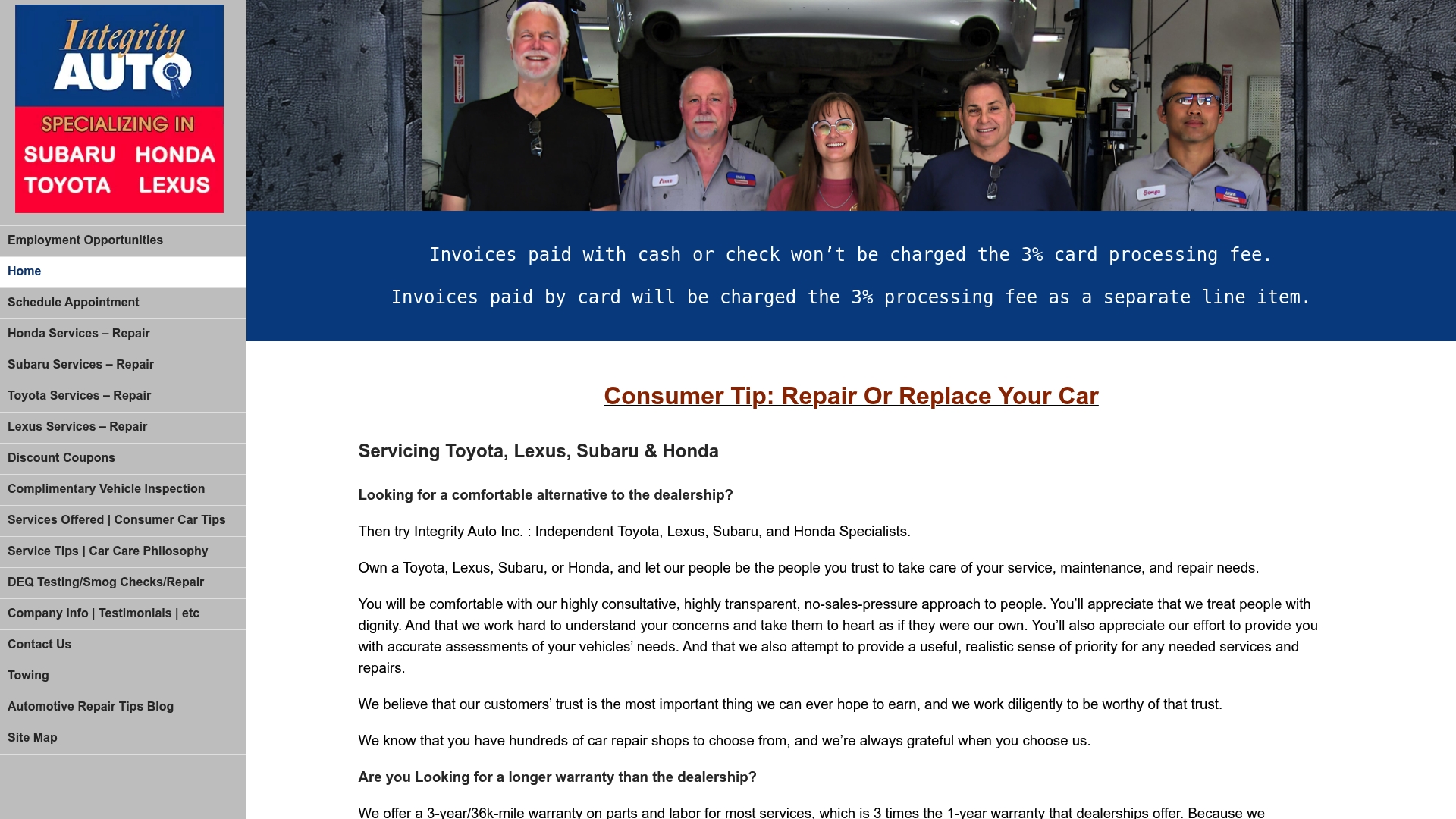
Integrityautoinc uses genuine Toyota parts and high-quality aftermarket components that meet or exceed OEM specifications, giving owners a choice rather than a mandate. The shop also performs factory-scheduled services, including 30K/60K/90K milestone services, diagnostics, brake and suspension work, hybrid vehicle service, and Oregon state emissions testing.
What sets Integrityautoinc apart is its stated commitment to long-term owner relationships built on mutual trust. Technicians track each vehicle’s service history, which allows them to catch wear patterns early and give owners time to plan for upcoming repairs rather than react to sudden failures. That kind of continuity is difficult to replicate at a high-volume dealership service department.
Key Takeaways
Toyota owners who choose a qualified independent shop for out-of-warranty service can save 20–40% on labor without sacrificing repair quality, provided the shop carries ASE-certified technicians and a documented parts warranty.
| Point | Details |
|---|---|
| Annual Toyota repair cost | Toyotas average $441 per year in repair costs, well below the $652 industry average. |
| Dealership vs. independent labor | Dealership labor runs $120–$150/hr; independent shops charge $80–$120/hr for comparable work. |
| Warranty work rule | Warranty repairs and recalls must be performed at a franchised dealer to be covered at no cost. |
| Maintenance schedule | Toyota recommends service every six months or 5,000 miles under normal driving conditions. |
| Integrityautoinc | Portland-area Toyota owners can access ASE-certified independent service with genuine parts and milestone interval coverage. |
FAQ
Are Toyotas expensive to repair?
No. Toyota averages $441 per year in repair and maintenance costs, compared to a $652 industry average, making it one of the more affordable brands to own long-term.
Can you service a Toyota at any mechanic?
Yes, for out-of-warranty work. The Magnuson-Moss Warranty Act prevents manufacturers from voiding a warranty simply because an independent shop performed routine service. Warranty repairs and recalls, however, must be handled at a franchised Toyota dealer to be covered at no cost.
What is the most common issue with Toyota vehicles?
Common repairs vary by model, but oxygen sensor replacement, brake pad wear, battery failure, and starter motor issues appear frequently across Toyota’s lineup. On the RAV4, battery replacement and AC compressor failure are among the costlier unplanned repairs owners encounter.
How much does Toyota charge for a service?
Basic maintenance costs depend on the service type and provider. A standard oil change on a RAV4 runs $136–$165. Independent shops like Integrityautoinc typically charge less for the same work due to lower labor overhead.


