
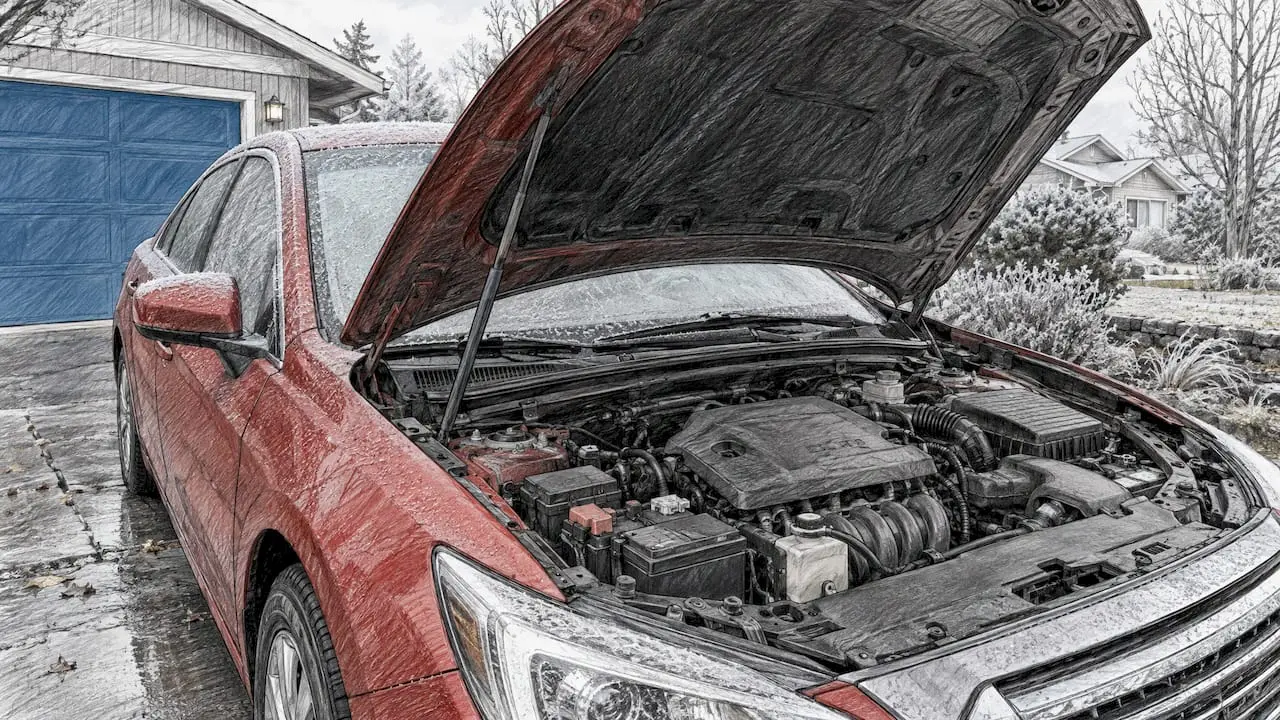
A car that is hard to start when cold most often has a weak battery, but thick oil, aging spark plugs, fuel delivery problems or a faulty sensor can also be behind it. Cold weather exposes parts that are already marginal. The engine may crank slowly, catch after several tries, or run roughly for the first minute and then settle down. This guide explains what is usually happening, which quick checks are safe, and when a professional diagnosis saves time and money.
TL;DR
- Cold cuts battery output sharply. Consumer Reports states that at 0°F a 12-volt battery has only about half the cranking power it has at 80°F.
- Cold also thickens engine oil, so the starter has to work harder with less electrical power available.
- If a car starts hard only in the cold and runs normally afterward, the battery, charging system, spark plugs and fuel system are the first places to check.
- Battery testing before winter is the cheapest prevention. Cold or discharged batteries can also give false test results if they are not warmed first.
- A repeated hard start, a check engine light or a slow crank that gets worse each week is a reason to book a diagnosis rather than wait.
Why cold weather makes starting harder
Two things happen at once when temperatures fall. The battery delivers less current, and the engine needs more of it.
NHTSA’s winter driving guidance explains that battery power drops as temperatures drop, while gasoline and diesel engines take more battery power to start in cold weather. Consumer Reports adds that cold thickens engine oil and slows the chemical reactions inside the battery. That raises resistance for the starter motor and can lead to slow cranking, or to an engine that will not turn over at all.
A healthy battery in good condition usually has enough reserve to cover this gap. A battery that is three or four years old, or one that has been drained by short trips, often does not. That is why many cold-start complaints appear on the first hard frost of the season, even though the underlying weakness developed over months.
For drivers in Portland, the pattern is familiar. Mild, damp weather hides a tired battery for most of the year, and then a single cold snap reveals it.
The most common causes, in the order shops usually check them
1. A weak or aging battery
Battery trouble is the first suspect for good reason. Corroded terminals, loose cable ends and a battery near the end of its life all reduce the power that reaches the starter. AAA advises having the battery and charging system tested by a trained technician, and checking and cleaning battery terminals and cable ends to remove corrosion and ensure tight connections.
Typical signs include a slow, labored crank, dim headlights at startup, and a clicking sound instead of a crank.
2. Thick oil and engine drag
Oil that is too heavy for the temperature, or oil that is overdue for a change, flows slowly at startup. The starter has to turn a stiffer engine. Using the viscosity grade listed in the owner’s manual matters here, because manufacturers choose it with cold starting in mind.
3. Worn spark plugs and ignition parts
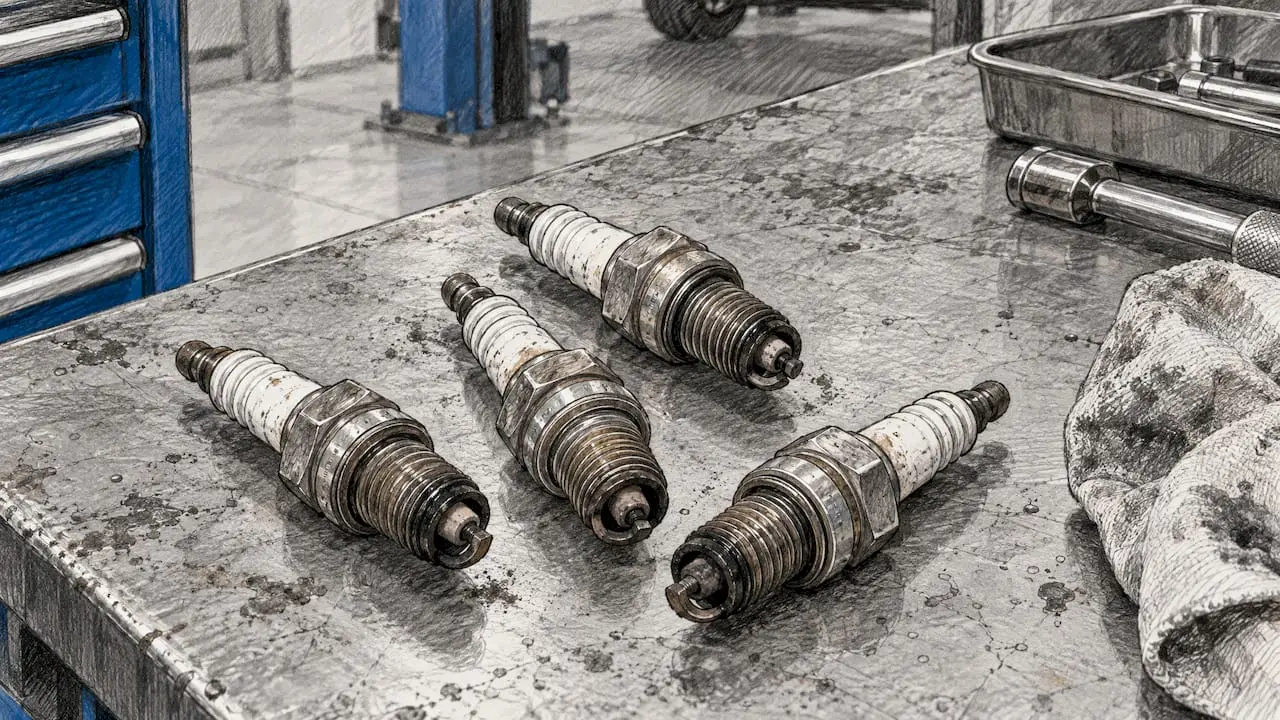
Worn plugs can fire normally on a mild day and then fail to ignite a cold, dense fuel mixture. In that case the engine cranks at normal speed but takes extra seconds to catch, or it stumbles for the first few seconds. Ignition components such as coils can show the same pattern. Integrity Auto covers this in more detail in its guide to car ignition problems, causes and fixes.
4. Fuel delivery problems
A fuel pump that is losing strength, a clogged filter or a fuel pressure regulator that lets pressure bleed off overnight can all make a cold engine slow to start. Moisture in fuel is a known cold-weather problem too. In very low temperatures, water in the fuel system can freeze and block the flow of fuel to the engine.
5. Sensors and idle control
The engine computer relies on the coolant temperature sensor to richen the mixture for a cold start. If that sensor reports the wrong temperature, the engine gets the wrong amount of fuel. A dirty throttle body or idle air control passage can cause rough idle and stalling right after startup. These faults often appear without any warning light at first.
6. Software and fuel quality
Not every cold-start problem is a worn part. A NHTSA-published technical service bulletin for one European engine describes an engine that cuts off after a cold start and needs several attempts, then runs normally with no stored faults. The cause there was attributed to engine software combined with winter fuel quality. The lesson applies broadly: a proper diagnosis can prevent replacing parts that are not the problem.
Cranks slowly, or cranks fine but will not catch?
The sound of the start tells a lot, and it helps narrow the cause before any tools come out.
| What you notice | Most likely area | Next step |
|---|---|---|
| Slow, heavy crank, dim lights | Battery, terminals, starter draw | Battery and charging system test |
| Click, no crank | Battery charge, connections, starter | Check terminals, then professional test |
| Normal crank, takes extra seconds to catch | Spark, fuel pressure, sensors | Scan for codes, inspect plugs and fuel system |
| Starts, then stumbles or stalls for a minute | Idle control, coolant sensor, vacuum leak | Diagnostic inspection |
| Starts hard only after sitting overnight | Fuel pressure bleed-down, weak battery | Fuel pressure test, battery test |
This table is a starting point. Several of these causes overlap, and a battery that is only slightly weak can make a marginal ignition or fuel problem much worse.
What to do on a cold morning
These steps are low risk and often get a stubborn engine going without damage.
- Turn off the radio, heater fan, defroster and headlights before turning the key, so all available battery power goes to the starter.
- Crank in short attempts rather than one long one. Pause between tries so the starter and battery can recover and the engine does not flood with fuel.
- Do not keep cranking if the engine is not responding. Repeated long attempts drain a weak battery and can overheat the starter.
- If the engine will not turn over, a jump start is the usual next step. Follow the instructions in the owner’s manual, and treat the jump as a warning that the battery needs testing.
- Once running, let the engine idle briefly and drive gently until it warms up.
A car that needed a jump should have its battery and charging system tested soon. A jump start fixes the symptom for one morning and leaves the cause in place.
How cold is too cold?
For ordinary gasoline cars in good condition, no single temperature marks the limit. Starting trouble depends on battery health, oil grade and fuel quality as much as on the thermometer. Extreme tests show where the limits lie. In a torture test of a diesel truck reported by The Drive, the engine failed to start at -40°F because the batteries could not supply enough voltage to keep the engine computer running. Those conditions are far outside what Portland drivers normally see, but they show the principle: when the battery runs out of capacity, nothing else matters.
Testing before you replace anything
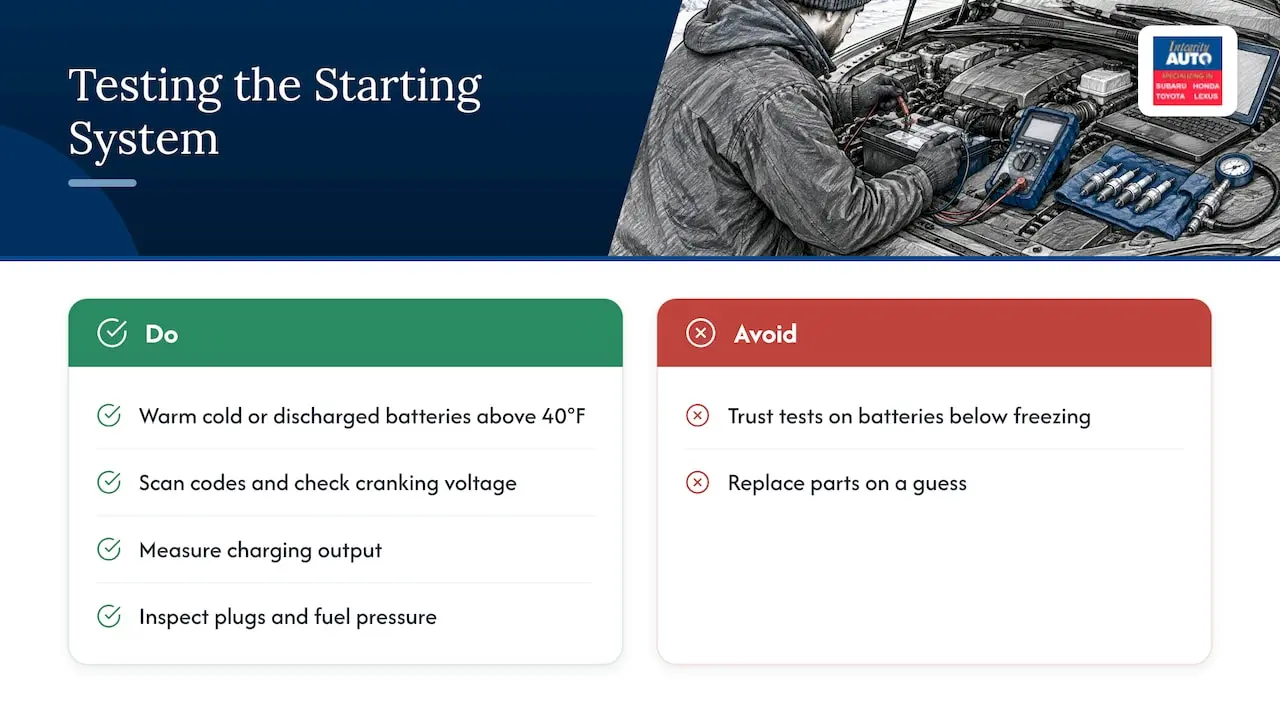
Battery testing has one trap worth knowing. NHTSA technical guidance warns that batteries that are below freezing can falsely fail a test, and that a cold or deeply discharged battery should be warmed before testing and charging, to above 40°F. In practice, a result from a battery that sat outside overnight may not be reliable, and a shop should account for that before recommending a replacement.
The same principle applies to the rest of the starting system. Replacing a battery, plugs or a fuel pump on a guess can cost more than a proper diagnosis. A technician who scans for codes, checks cranking voltage, measures charging output and inspects plugs and fuel pressure can separate a weak battery from a failing starter or a sensor fault. Integrity Auto describes how this works on its diagnosis page.
Prevention before the cold arrives
Several inexpensive habits reduce cold-start trouble.
- Test the battery before winter. Consumer Reports recommends testing battery strength before cold weather arrives, and notes that some auto parts stores offer the test for free. A shop test that also covers the charging system gives a fuller picture.
- Clean and tighten the terminals. Consumer Reports warns that corrosion can occur even outside the warm months and can reduce power transfer from the battery to the car.
- Have belts and hoses checked. NHTSA advises servicing the vehicle at the start of winter and checking for leaks, badly worn hoses and other needed repairs, and having the battery checked for sufficient voltage, amperage and reserve capacity.
- Keep the tank at least half full. Consumer Reports lists this among its cold-weather recommendations, along with parking in a garage when possible.
- Stay on schedule with oil and plug service. Fresh oil in the correct grade and plugs within their service interval remove two common causes of hard starting.
More seasonal advice is in Integrity Auto’s guide to getting Toyota, Lexus, Subaru and Honda vehicles started on cold winter mornings, and Subaru owners can read how to winter-proof a Subaru.
When to see a mechanic
Book an inspection when any of these appear:
- The engine takes noticeably longer to start each week.
- The check engine light comes on, even if the car seems to run well.
- The car needed a jump start, even once.
- The engine stumbles, idles roughly or stalls after starting.
- A starting problem returns after a new battery was installed.
A vehicle that has stopped running entirely needs a mechanic’s estimate first. Owners comparing every route for an older car that will not start can also read about selling a non-running car, but most cold-start problems turn out to be a battery, plug or sensor issue that is far less costly to correct.
Cold-start diagnosis for Toyota, Lexus, Subaru and Honda in Portland
Integrity Auto is an independent shop in the Portland, Oregon area that specializes in Toyota, Lexus, Subaru and Honda vehicles. Its services include diagnostics, check engine light and DEQ diagnosis, tune-ups, scheduled maintenance, hybrid vehicle service and emission testing. The shop states that its technicians are ASE certified and that it uses OEM parts. Battery testing and replacement is described on the battery service page.
Owners whose vehicle starts hard in the cold can request a diagnosis through the Integrity Auto website, where service pages for Toyota, Lexus, Honda and Subaru vehicles list the available services. Prices are not published online, so estimates come after the vehicle is inspected.
FAQ
Why is my car hard to start in cold weather but fine once it is running?
Cold reduces battery output and thickens oil, so the starting system works at its limit. Once the engine runs, the alternator takes over and the oil warms. A battery, spark plug or sensor that is only slightly weak can cause this pattern, so a battery test and a code scan are the usual first steps.
Why does my car struggle to start when cold but not when warm?
A cold engine needs a richer fuel mixture, stronger spark and more cranking power. Anything marginal, such as a worn plug, a weak battery or a coolant temperature sensor reading wrong, shows up at startup. A warm engine is more forgiving, so the same part may seem fine later in the day.
Can a new battery fix a hard cold start?
Often it can, if the old battery was the weak link. If the problem continues, the starter, charging system, plugs or fuel delivery may be involved. Testing the whole starting and charging system before replacement prevents paying for a battery that was not the cause.
Should I keep cranking if the engine will not start?
Short attempts with pauses between them are safer than one long one. Extended cranking drains the battery, can overheat the starter and may flood the engine. If it still does not start after a few tries, a jump start or a professional inspection is the next step.
Sources
- NHTSA: Winter Weather Driving Tips
- NHTSA: Winter Driving Tips
- NHTSA technical bulletin: cold weather and battery testing
- NHTSA technical bulletin: cold start and winter fuel quality
- Consumer Reports: Winter Driving Tips
- Consumer Reports: Best Car Batteries for Cold Weather
- AAA vehicle checkup advice
- The Drive: diesel cold-start torture test
- Selling a non-running car