
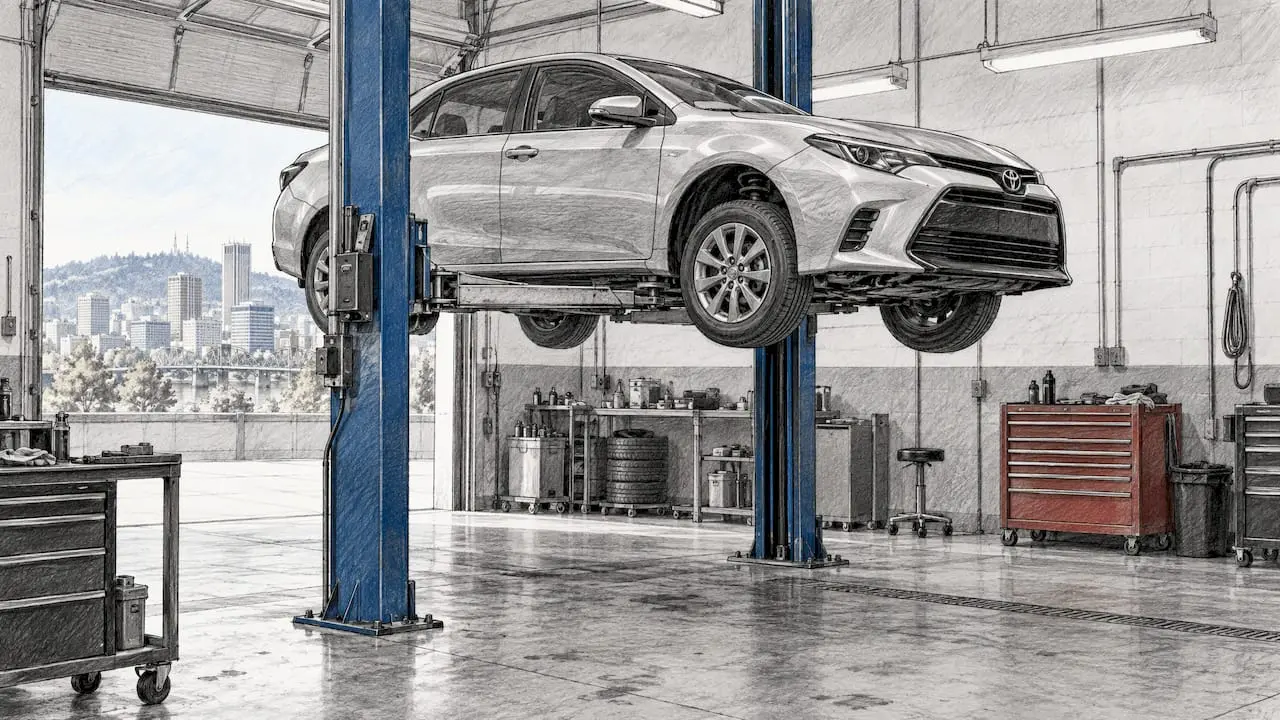
Toyota owners in Portland can have scheduled maintenance and repairs done at a dealership or at an independent specialist. Toyota’s own warranty guide states that any automotive service provider may perform maintenance and repairs, and a warranty claim will not be denied solely because the work was not done at a dealer. Integrity Auto is an independent Toyota, Lexus, Subaru and Honda shop serving the Portland area. This guide covers what a Toyota needs, when, and what to look for in a shop in Multnomah County.
TL;DR
- Many Toyotas are due for service every 5,000 miles or 6 months. The exact schedule for each model and year is in the Warranty & Maintenance Guide or the owner’s account on Toyota’s site.
- Independent shops may service a Toyota without affecting warranty coverage, as long as the work follows the maintenance schedule and is done properly.
- Hybrid owners need to know that high-voltage (orange) wiring is never a do-it-yourself item, and that stored hybrids need periodic battery care.
- Transmission symptoms such as slipping, grinding, delayed shifting or vibration call for an inspection at the first sign.
- Timing belts apply only to certain models and years. Most newer Toyotas use a timing chain.
What a Toyota needs and when
Toyota publishes a personalized schedule for each vehicle. Owners can sign in to a My Toyota account to see the maintenance schedule for their vehicle. Many Toyota vehicles have visits every 5,000 miles or 6 months, with routine inspections and tire rotations, and more comprehensive services at key mileage milestones.
The interval is not identical across the lineup. The guide for the 2024 Camry Hybrid recommends service every 5,000 miles or six months, whichever comes first. The guide for the 86 recommends every 7,500 miles or seven and a half months. Toyota’s Knowledge Center describes the general pattern: routine maintenance most often every 5,000 to 10,000 miles or about six months, with steering and suspension inspections every 15,000 to 30,000 miles.
Driving conditions change the answer. The 2026 Highlander Hybrid guide says engine oil and filter should be changed every 5,000 miles or 6 months when the vehicle is mainly driven on dirt or dusty roads, and after 12 months or 10,000 miles at the latest under normal use.
Keeping records
Toyota’s guide says maintaining the vehicle according to the booklet is required to keep warranty coverage intact. A missing record alone will not cause a claim to be denied, but damage caused by a lack of proper maintenance is not covered. Keeping invoices for every service is the simplest way to show the schedule was followed. Integrity Auto covers the rules for independent shops in its page on independent service warranty rights and shop coverage.
Choosing a Toyota shop in Multnomah County
The options in Portland fall into three types: franchised dealership service departments, general repair shops that work on every make, and independent specialists focused on Japanese brands. The questions below help sort them.
- Brand focus. A shop that works on Toyota, Lexus, Subaru and Honda daily sees the same failure patterns repeatedly and knows the factory intervals.
- Technician credentials. Ask whether technicians are ASE certified. Integrity Auto states that its technicians are ASE certified.
- Parts. Ask which parts are used. Integrity Auto states that it uses OEM parts.
- Written estimates and explanation. A good shop explains what is urgent, what can wait and why, and puts the estimate in writing before work starts.
- Warranty on repairs. Ask how long the shop’s own warranty runs and what it covers. Integrity Auto states that its warranties are longer than those of dealership repairs.
- Diagnostic process. Clear diagnostic charges up front prevent surprises. Integrity Auto explains its approach on its diagnosis and estimates page.
- Convenience. Location, hours and how the shop handles drop-off matter on a weekday in Portland traffic.
Integrity Auto offers complimentary multipoint inspections, which give owners a written picture of the vehicle’s condition and a basis for planning maintenance by priority.
Toyota hybrid service
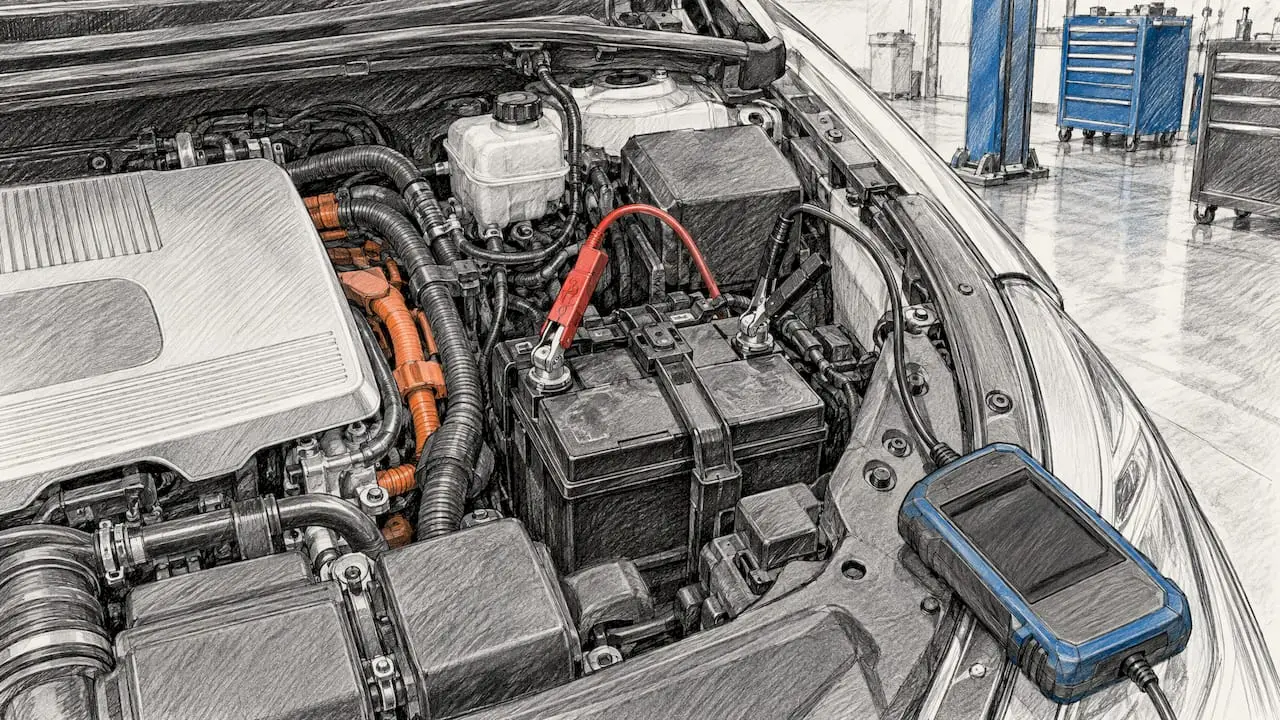
Hybrids add systems that standard maintenance guides treat with care. The 2026 Highlander Hybrid guide explains that the vehicle has high-voltage DC and AC systems as well as a 12-volt system. Both high-voltage systems are dangerous and can cause severe burns, electric shock and fatal injury. Owners should never touch, remove or replace the orange high-voltage wiring and connectors. That work belongs to a trained technician.
Two owner habits protect the battery:
- Periodic charging. Toyota’s 2024 battery bulletin says that periodic charging should be performed every 2 months by keeping the hybrid system on for 30 minutes with the transmission in P. The same bulletin says Toyota does not provide battery warranty coverage for batteries discharged or failed from lack of maintenance.
- Storage. A 2022 Toyota bulletin says that when a hybrid is stored for 30 days or more, the negative terminal of the auxiliary battery should be disconnected to prevent the auxiliary battery from draining.
The 2025 Highlander Hybrid guide adds a routine item: the hybrid battery cooling intake filter should be visually checked every 5,000 miles for dirt or dust and cleaned if necessary. Portland’s wet winters also raise the question of how often to wash a car; this overview of winter car washing frequency explains why waiting too long can be a problem for the underbody and paint.
Integrity Auto lists hybrid vehicle service among its Toyota and Lexus services, along with battery testing and replacement for the 12-volt battery.
Transmission service and repair
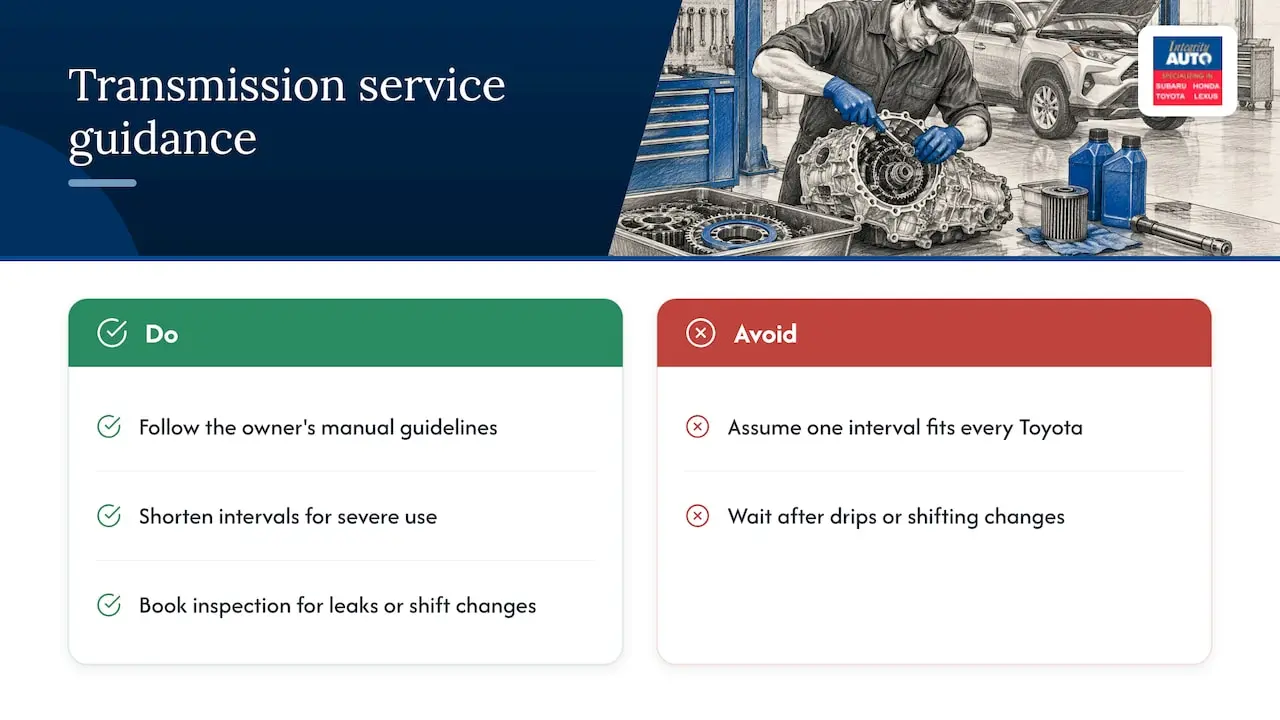
There is no single interval for every Toyota. Toyota’s Knowledge Center says owners should follow the guidelines in the owner’s manual, and that some newer vehicles with lifetime fluid need less frequent changes unless a problem appears. Integrity Auto discusses this in its article on “lifetime” transmission fluid for Toyota owners.
Toyota notes that some conditions justify shorter intervals: towing or hauling, severe weather, stop-and-go traffic, or the first sign of trouble such as gear slippage, grinding noises, delayed shifting and excessive vibration. The same guidance distinguishes a fluid change, which drains the pan, replaces 30 to 40 percent of the fluid and installs a new filter, from a flush, which replaces nearly 100 percent of the old fluid.
The Highlander Hybrid guide also says sealed transmissions, transfer cases and differentials should be inspected for signs of leakage. Drips under the vehicle or a change in how it shifts are reasons to book an inspection rather than wait for the next service. For more detail, see Integrity Auto’s guides to transmission repair in Portland and the signs of transmission failure.
Timing belt or timing chain?
Not every Toyota has a timing belt. Toyota’s support page offers a chart showing whether each model and year uses a belt, chain or gear, and points owners to the Warranty & Maintenance Guide or owner’s manual for change intervals. According to that chart, the Prius (2001-2020), Camry Hybrid (2007-2020), Corolla Hybrid (2020), RAV4 Hybrid (2016-2020), Avalon Hybrid (2013-2020) and Highlander Hybrid (2011-2019) use timing chains. The 2006-2010 Highlander Hybrid V6 uses a belt.
For a belt-equipped Toyota, the interval in the owner’s manual is the number to follow. Replacing the belt on schedule is a planned maintenance cost, and timing belt replacement is among the services Integrity Auto lists.
Toyota service at Integrity Auto
Integrity Auto serves Toyota owners in the Portland area with factory-scheduled maintenance, engine oil service, transmission and engine work, brakes, suspension, diagnostics, check engine light and DEQ diagnosis, and emission testing and repairs. Its approach is consultative: concerns are discussed first, and the work is prioritized so owners can see what is safety-critical and what can be scheduled later.
Owners can review the full list on the independent Toyota service and repair page and schedule a visit through the Integrity Auto website.
Other pages that help with planning include Toyota repair service: what every owner needs to know, wheel alignment for Toyota and Lexus and consumer auto repair tips.
FAQ
Can I take my Toyota to an independent shop in Portland and keep the warranty?
Yes. Toyota’s warranty guide states that maintenance and repairs may be performed by any provider the owner chooses, and a claim will not be denied solely for that reason. Failures caused by improper maintenance or repairs are not covered, so the work must follow the schedule and be done correctly.
How often does a Toyota need service?
Many Toyotas are due every 5,000 miles or 6 months, whichever comes first. Some models, such as the 86, list 7,500 miles or seven and a half months. The owner’s account on Toyota’s site or the Warranty & Maintenance Guide gives the schedule for a specific model and year.
Is a hybrid battery something I can service myself?
Owners can keep the battery healthy by following Toyota’s charging and storage guidance. High-voltage wiring and connectors, marked in orange, must never be touched or removed by owners. Any work on them belongs to a trained technician.
Does my Toyota have a timing belt?
It depends on the model and year. Toyota’s support chart covers model years 1990 to 2020 and shows that many hybrids from the 2000s and 2010s use chains. The owner’s manual lists the replacement interval for belt-equipped engines.
Sources
- Toyota Maintenance Schedule
- Toyota 2024 86 Warranty & Maintenance Guide
- Toyota 2024 Camry Hybrid Warranty & Maintenance Guide
- Toyota 2026 Highlander Hybrid Warranty & Maintenance Guide
- Toyota 2025 Highlander Hybrid Warranty & Maintenance Guide
- Toyota Knowledge Center
- Toyota: How Often Should You Change Your Transmission Fluid?
- Toyota: Does my vehicle have a timing belt or timing chain?
- Toyota bulletin: Maintenance for HV/BEV and Auxiliary Batteries (2024)
- Toyota bulletin: Maintenance for HV and Auxiliary Batteries (2022)
- Winter car washing frequency