
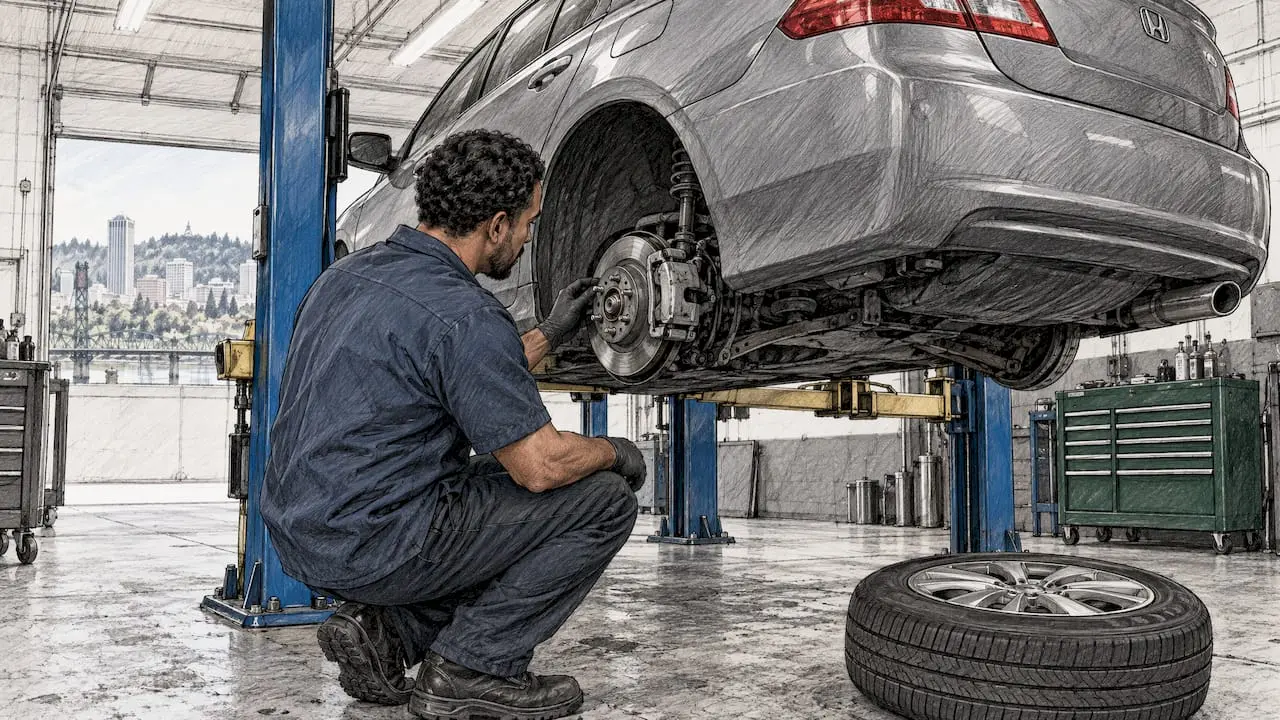
Honda brake service covers more than replacing pads. It includes an inspection of the pads, rotors, hoses, lines and fluid, and it follows the schedule in the owner’s manual. For Portland, Oregon owners, an independent shop that specializes in Hondas, such as Integrity Auto, can perform that work with OEM parts and ASE certified technicians, as an alternative to a dealership service department.
TL;DR
- Honda’s maintenance schedule calls for front and rear brake inspections every 12 months or 7,500 miles under normal conditions, according to ConsumerAffairs.
- Brake fluid is replaced on a time basis, every 3 years if the Maintenance Minder does not call for it sooner, per Honda’s owner materials.
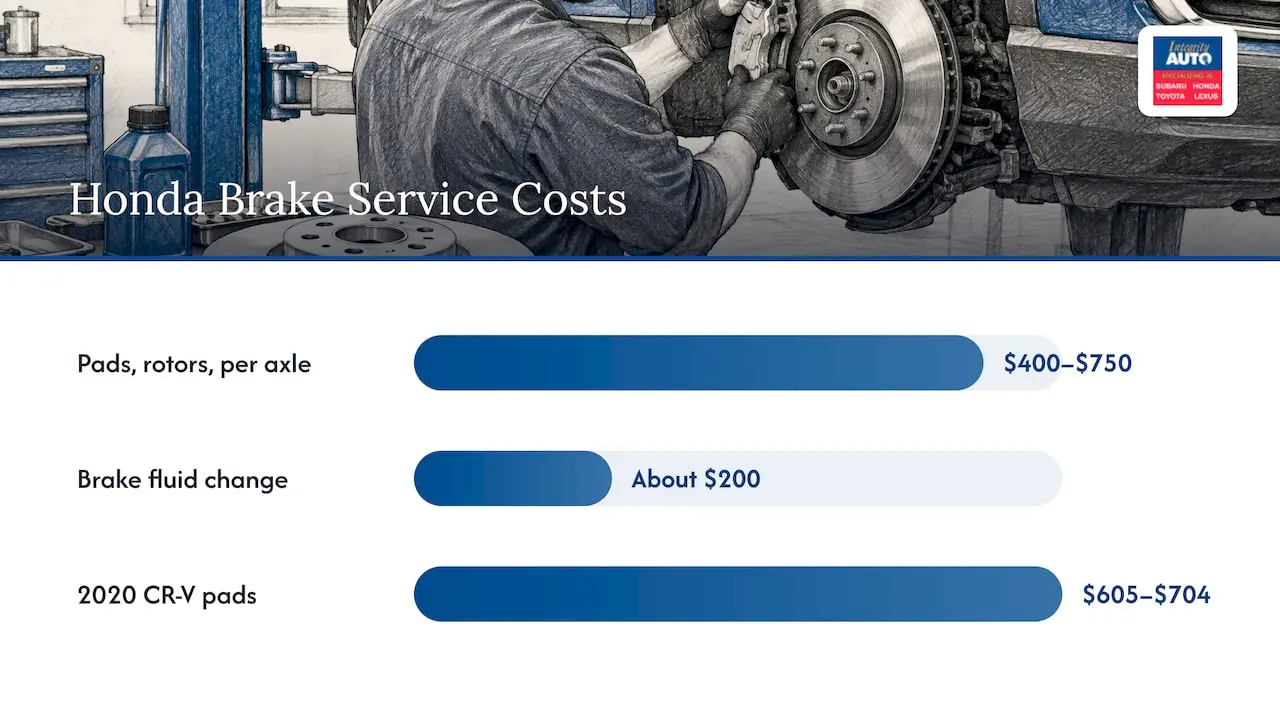
- Car Talk budgets $400 to $750 per axle for pads, rotors, minor parts and labor on a Honda, and about $200 for a fluid change.
- Squealing, grinding, a soft pedal or a pull to one side are reasons to book an inspection promptly.
- Integrity Auto offers complimentary multipoint inspections and brake work on Hondas in the Portland area.
What Honda brake service includes
A brake service is a defined set of checks followed by any repairs the checks justify. Honda’s Maintenance Minder, the dashboard system that tells the driver which service is due, places the brake inspection inside “B service.” According to the Maintenance Minder guide, B service replaces the engine oil and filter and inspects the front and rear brakes. It also inspects:
- Brake hoses and lines, including the ABS and VSA (stability control) parts
- Fluid levels and condition
- Tie rod ends, the steering gear box and boots
- Suspension components and driveshaft boots
- The exhaust system, fuel lines and connections
The inspection result decides what happens next. Pads with plenty of friction material left need nothing. Pads near the minimum thickness are replaced. Rotors (the discs the pads clamp) are measured, and the choice is between resurfacing them and replacing them. Integrity Auto publishes a page on machining drums and rotors versus replacing them that explains how that decision is made.
How often Honda brakes need attention
Honda uses two clocks: mileage and time.
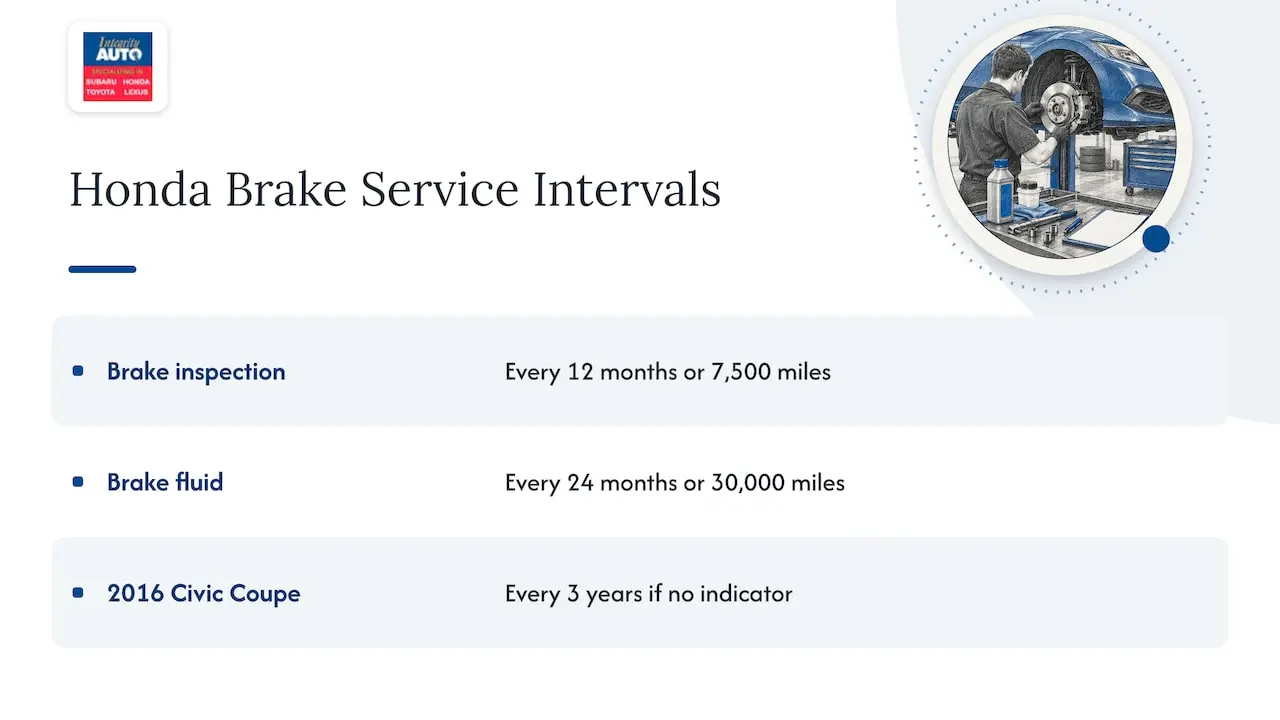
Inspection. Under normal driving conditions, the schedule summarized by ConsumerAffairs lists front and rear brake inspections every 12 months or 7,500 miles. In practice the inspection usually happens during an oil service.
Brake fluid. Brake fluid absorbs moisture over time, so it is replaced by calendar as well as mileage. The same source lists a fluid change every 24 months or 30,000 miles. Honda’s own Maintenance Minder guide for the 2016 Civic Coupe says that if the indicator has not appeared within 36 months of the last reset, the fluid should be changed every 3 years. Intervals differ by model and year, so the owner’s manual for the specific vehicle is the reference.
Pads and rotors. No fixed mileage applies. Wear depends on driving style, load and terrain. Portland’s hills and stop-and-go commuting use brakes differently than steady highway miles, which is why the inspection, not the odometer, determines when pads are replaced.
Signs a Honda needs brake service sooner
The scheduled inspection catches most wear, but some symptoms mean the car should be looked at before the next interval:
- High-pitched squeal when braking. Many pads have a wear indicator that makes this noise when the material runs low.
- Grinding. This often means the pad material is gone and metal is contacting metal, which can damage rotors.
- Pulling to one side. This can point to uneven wear or a caliper that is not releasing properly.
- Vibration in the pedal or steering wheel. This is commonly associated with uneven rotor surfaces.
- A soft or low pedal. This can indicate air or moisture in the fluid or a leak, and the car should be inspected before it is driven further.
- A brake or ABS warning light. A dashboard warning calls for diagnosis rather than waiting.
Brakes are a safety system. A car that loses pedal feel or stopping power should not be driven to the shop; it should be towed or evaluated by a professional right away.
What Honda brake service costs
Prices vary by model, parts and location, so published figures work as ranges for planning, not quotes.
| Service | Published range | Source |
|---|---|---|
| Pads, rotors, minor parts and labor, per axle | $400 to $750 | Car Talk, 2023 |
| Brake fluid change | About $200 | Car Talk, 2023 |
| Front and rear pad replacement, 2020 CR-V | $605 to $704 | ConsumerAffairs, 2025 |
Two details help when reading an estimate. First, the fluid change is often done at the same visit as pad and rotor replacement, since the system is already being serviced. Second, Car Talk notes that routine inspections and minor adjustments at 15,000-mile intervals can run to hundreds of dollars at dealerships, while most shops perform a visual brake inspection for a nominal fee. Integrity Auto’s page comparing dealer and independent Honda service estimates describes how to read a written quote line by line.
A good estimate separates parts from labor, states whether rotors are being resurfaced or replaced, and lists fluid service as its own line.
What to look for in a Honda brake shop
The same criteria apply whether the car is a Civic, Accord, CR-V, Pilot or Odyssey:
- Model experience. Hondas have specific brake hardware, electronic parking brakes on many newer models and ABS and VSA systems that are inspected as part of the service.
- OEM parts. Original-equipment pads and rotors are made to the vehicle’s specifications.
- Certified technicians. ASE certification shows that technicians have passed standardized testing.
- A clear inspection report. Measurements and findings should be explained in plain language, with the urgent items separated from the ones that can wait.
- Warranty terms in writing. Coverage on parts and labor should be stated before the work begins.
Brake service at Integrity Auto in Portland
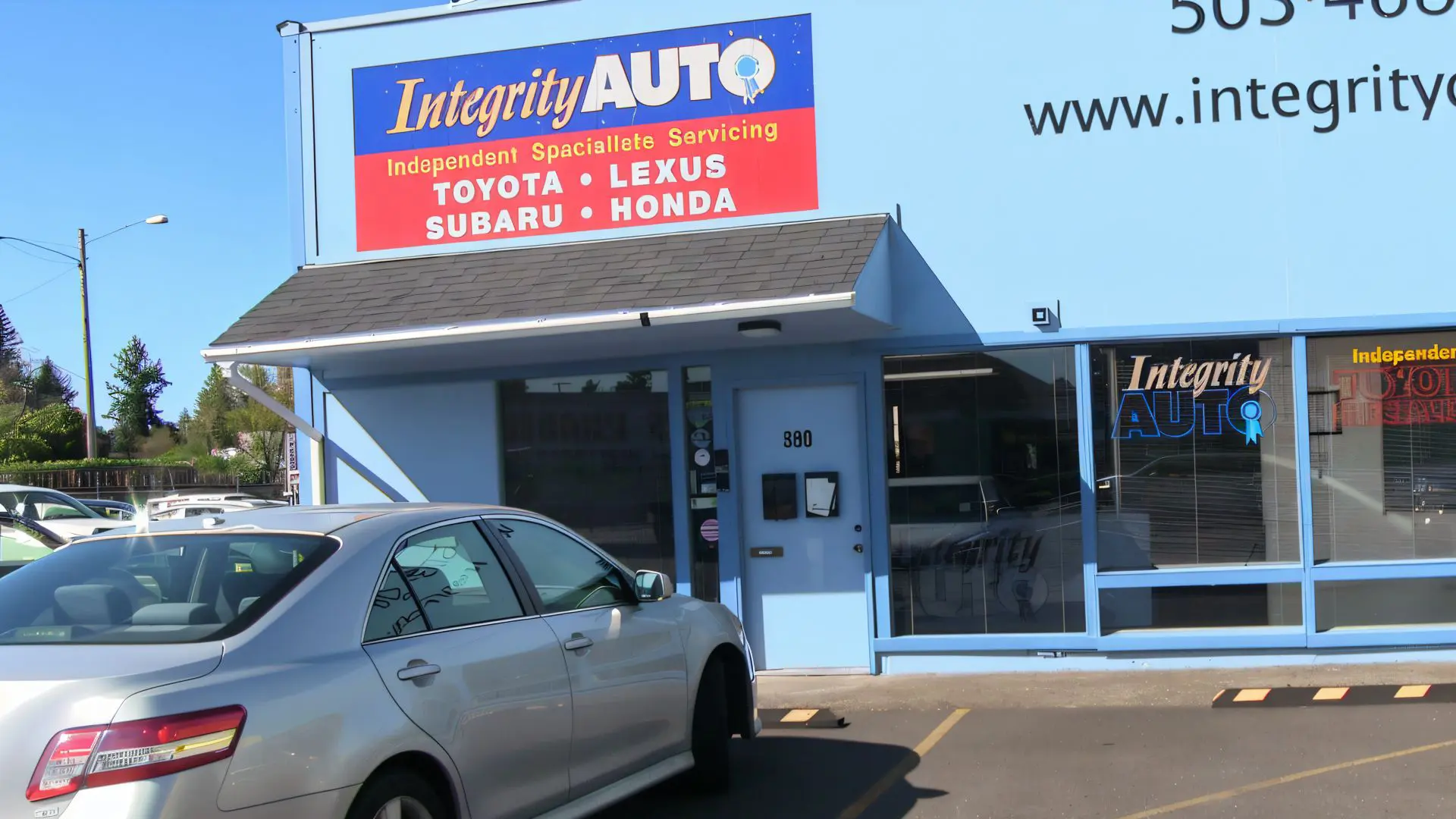
Integrity Auto is an independent Honda, Toyota, Lexus and Subaru specialist in the Portland area. Its Honda service offering lists brakes alongside struts and shocks, manufacturer-recommended scheduled maintenance, oil services, transmission and CVT services, coolant services, timing belts, tune-ups and check engine light diagnosis. The shop states that it uses OEM parts, employs ASE certified technicians and provides longer warranties than dealership repairs.
Complimentary multipoint inspections are part of the service, which gives owners a documented look at pad thickness, rotor condition, fluid and the other items on the B service list before any repair decision is made. Details on the Honda service and repair page cover the full list of maintenance and repair work.
Owners who want a brake inspection or a written estimate for a Honda can schedule through the Integrity Auto website.
Getting the most from each brake visit
- Bring the maintenance history. Knowing when the fluid was last changed prevents duplicate work.
- Mention the symptoms. Noise, timing and conditions (cold start, downhill, highway speed) help technicians find the cause.
- Ask for measurements. Pad thickness and rotor condition give a basis to plan the next replacement.
- Pair services. Fluid service, inspections and oil service can often share one visit.
- Check the warning lights. A brake or ABS light on the dash should be mentioned at booking.
Mileage services also bundle brake checks into larger visits. Integrity Auto’s overview of the Honda 100k service shows how the brake inspection fits into that milestone.
FAQ
How often should a Honda’s brakes be inspected?
Under normal conditions, Honda’s schedule lists a front and rear brake inspection every 12 months or 7,500 miles, according to ConsumerAffairs. Heavy city driving, hills and towing can justify more frequent checks. The Maintenance Minder in the dash also signals when service is due.
How much is a brake job on a Honda?
Car Talk budgets $400 to $750 per axle for pads, rotors, minor parts and labor, with a fluid change around $200 (Car Talk). The final price depends on the model, whether rotors are resurfaced or replaced and the parts used. A written estimate from the shop is the reliable figure.
Is a brake fluid change necessary on a Honda?
Yes, it is on Honda’s schedule. Honda’s Maintenance Minder guide states that if the indicator does not appear within 36 months, the fluid should be changed every 3 years (Honda). Brake fluid takes on moisture over time, which is why the interval is time-based.
Can a Honda brake inspection be done during an oil change?
Yes. Honda’s B service combines an oil and filter change with a front and rear brake inspection, according to the Maintenance Minder guide. That makes the oil service the natural point to check pad and rotor wear.
Sources
- Honda Maintenance Minder, 2017 Civic Si guide
- Honda Maintenance Minder, 2016 Civic Coupe guide
- ConsumerAffairs: Honda maintenance cost, plans and service schedule
- Car Talk: Honda maintenance cost, repairs and schedule