
Toyota transmission repair is defined as the diagnosis and correction of mechanical, hydraulic, or electronic failures within a Toyota vehicle’s transmission system, covering everything from fluid service to full unit replacement. Toyota vehicles use several transmission types: conventional automatics, continuously variable transmissions (CVTs), and the hybrid electric CVT (eCVT) found in the Prius. Each type carries its own failure patterns, diagnostic codes, and repair costs. Catching problems early, before diagnostic codes like P0741, P0868, or P2714 appear, is the difference between a $200 fluid service and a $6,500 replacement. Integrityautoinc specializes in exactly this kind of early, accurate diagnosis for Toyota owners.
What are the common symptoms of Toyota transmission issues?
Transmission problems rarely appear without warning. The trouble is that early symptoms are easy to dismiss as minor annoyances. By the time a driver notices something serious, the damage is often well advanced.
Key warning signs include the following:
- Delayed acceleration or hesitation when pulling away from a stop
- Shuddering or vibration at speeds below 25 mph, especially in CVT-equipped models
- Whining or humming noises that change pitch with vehicle speed
- Burning smell from the transmission area, indicating overheated fluid
- RPM spikes without a corresponding increase in vehicle speed
- Check engine light with stored codes P0741 (torque converter clutch), P0868 (transmission fluid pressure low), or P2714 (pressure control solenoid)
- Limp mode activation, where the transmission locks into a single gear to prevent further damage
CVT-specific problems include belt slippage and pulley bearing failures, particularly in 2018–2022 Toyota C-HR models. These symptoms often begin as subtle hesitation and progress to full limp mode if ignored.
Incorrect diagnosis is a real risk. Modern Toyota vehicles have interconnected electronic systems, and some symptoms that mimic transmission failure actually stem from sensors or solenoids rather than the transmission itself. A reputable shop will explain the diagnostic process thoroughly before recommending any major repair.
Toyota transmission repair options and what they cost
Repair scope falls into three categories: partial repair, full rebuild, and complete replacement. Understanding the difference helps you ask the right questions and avoid paying for more than you need.
Partial repair addresses a single failed component, such as a solenoid, torque converter, or valve body. This is the least expensive path when the rest of the transmission is mechanically sound. Replacing a torque converter without assessing valve body condition, however, often leads to premature failure. Pressure control is critical to transmission health, and a good technician checks both.
Full rebuild means disassembling the unit, replacing worn clutch packs, seals, and bearings, and reassembling to factory spec. This is appropriate when multiple internal components have failed but the transmission case is undamaged.
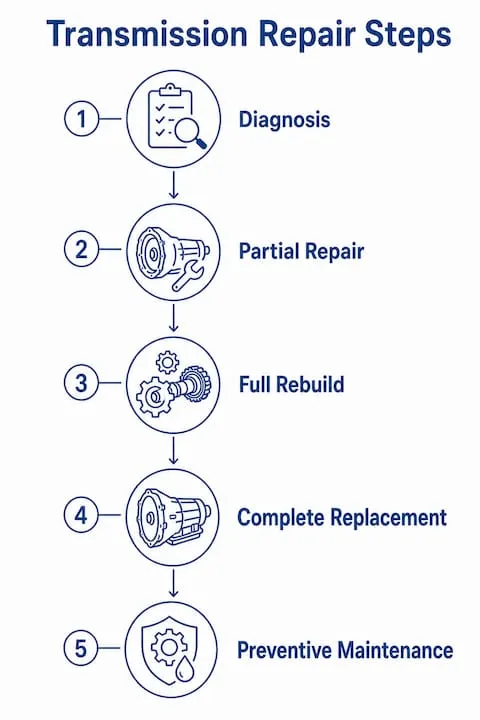
Complete replacement uses a new, remanufactured, or used transmission. Remanufactured units offer a middle ground between cost and reliability. Used units carry lower upfront cost but unknown wear history.
The table below summarizes typical cost ranges as of mid-2026:
| Repair type | Estimated cost range | Notes |
|---|---|---|
| Fluid service (drain and fill) | $150–$200 | Preventive; reduces CVT failure risk significantly |
| Partial repair (solenoid, valve body) | $400–$1,200 | Depends on component and labor rate |
| Full rebuild | $2,500–$4,500 | Labor intensive; quality varies by shop |
| Used transmission replacement | $1,500–$3,000 | Lower cost; wear history unknown |
| Remanufactured replacement | $3,500–$6,500 | Includes $800–$1,600 labor depending on model and location |
Toyota RAV4 transmission replacement typically falls in the $3,500–$6,000 range. Labor rates vary significantly by geographic region, which is why the same job can cost $800 more in a major metro area than in a smaller market.
Pro Tip: Ask your shop for a written breakdown of parts versus labor before authorizing any transmission work. This lets you compare quotes accurately and spot inflated parts markups.
How does preventive maintenance protect your Toyota transmission?
Regular fluid service is the single most effective way to extend transmission life. Toyota has labeled some transmission fluid as “lifetime,” but that claim applies to the life of the fluid under ideal conditions, not the life of the vehicle under real-world driving.
Drain-and-fill fluid changes every 30,000–60,000 miles significantly reduce CVT failure risk. Skipping this service allows fluid to degrade, which accelerates wear on belts, pulleys, and bearings. The cost of neglect is steep: CVT replacement on models like the C-HR runs $4,000–$8,000.
The correct fluid matters as much as the interval. Toyota CVTs require Toyota-specified CVT fluid. Using a generic substitute causes compatibility problems and can void any remaining warranty coverage. For automatic transmission service options specific to Toyota vehicles, Integrityautoinc provides a detailed explanation of flush versus drain-and-fill approaches.
Follow these steps when servicing Toyota transmission fluid:
- Warm the vehicle until the transmission fluid reaches 95°F–113°F. Checking fluid at the wrong temperature produces false readings and risks overfilling or underfilling.
- Cycle through all gear positions (P, R, N, D, and each manual range) before checking the overflow plug level.
- Use only the fluid type specified in your Toyota owner’s manual or confirmed by a qualified technician.
- Replace the drain plug crush washer every time. Reusing a crushed washer causes slow leaks that go unnoticed until low fluid levels cause serious internal damage.
- Inspect the transmission pan gasket for seeping while the pan is accessible. A worn pan gasket is inexpensive to replace and prevents contamination.
Pro Tip: Transmission specialists recommend a gradual drain-and-fill service over a high-pressure flush for older or high-mileage Toyotas. High-pressure flushing can dislodge debris and cause internal damage in transmissions that have not been serviced regularly.
What makes Toyota Prius transmission repair different?
The Toyota Prius does not use a conventional automatic transmission. Its eCVT (electric continuously variable transmission) is a power-split transaxle that blends input from the gasoline engine and two motor-generators. This design has no traditional clutch packs or hydraulic torque converter, which means standard transmission rebuild techniques do not apply.
Common Prius transaxle problems include:
- Motor-generator bearing failure, which produces a grinding or whining noise at low speeds
- Oil seal leaks allowing transmission fluid to contaminate the motor-generator windings
- Inverter-related faults that are often misdiagnosed as mechanical transmission failure
- Planetary gear wear in high-mileage units, typically above 200,000 miles
Prius eCVT replacement costs $2,500–$5,000 on average. Original units are engineered to last 200,000–300,000 miles under normal conditions, so premature failure often points to a specific component fault rather than general wear. Replacement is usually more reliable and cost-effective than an internal rebuild because the specialized skills and tooling required for eCVT disassembly are not widely available.
Finding a qualified hybrid specialist matters more here than with any other Toyota transmission type. A shop that handles conventional automatics daily may lack the diagnostic equipment to distinguish an inverter fault from a mechanical transaxle failure.
Integrityautoinc: Toyota transmission service in Portland, OR
Integrityautoinc is an independent Toyota, Lexus, Subaru, and Honda specialist serving Portland, OR. The shop treats every transmission concern as its own, from the first diagnostic check to the final road test.

For owners weighing repair against replacement, Integrityautoinc offers access to Toyota used transmissions and engines, giving you a cost-effective alternative to new or remanufactured units. The shop also handles clutch assembly service and operates with documented eco-friendly practices, which matters for hybrid owners concerned about responsible parts disposal. Integrityautoinc builds relationships on trust, not upsells. You get a clear explanation of what is wrong, what it will cost, and why the recommended repair is the right one for your vehicle.
Key Takeaways
Toyota transmission repair requires accurate diagnosis first, because many symptoms overlap with sensor or solenoid faults that cost far less to fix than a full rebuild or replacement.
| Point | Details |
|---|---|
| Diagnose before replacing | Codes like P0741 and P0868 may indicate solenoid faults, not full transmission failure. |
| Repair costs vary widely | Full replacement runs $3,500–$6,500; a fluid service costs as little as $150–$200. |
| Fluid service prevents failure | CVT drain-and-fill every 30,000–60,000 miles significantly reduces the risk of costly failure. |
| Prius eCVT is specialized | Hybrid transaxle repair requires a qualified hybrid specialist; replacement is usually preferred over rebuild. |
| Crush washers must be replaced | Reusing drain plug washers causes slow leaks that lead to low-fluid damage over time. |
FAQ
What are the first signs of Toyota transmission trouble?
Delayed acceleration, shuddering below 25 mph, whining noises, and a burning smell are the earliest warning signs. Diagnostic codes P0741, P0868, and P2714 confirm the fault once a scan tool is connected.
How much does Toyota transmission repair cost?
A fluid service costs $150–$200, while full replacement ranges from $3,500 to $6,500 including labor. The final cost depends on the model, transmission type, and whether a new, remanufactured, or used unit is installed.
How often should I change Toyota transmission fluid?
Every 30,000–60,000 miles for CVT-equipped models, regardless of Toyota’s “lifetime fluid” labeling. Conventional automatics benefit from the same interval under normal driving conditions.
Is a Prius transmission repair different from a standard Toyota?
Yes. The Prius uses an eCVT transaxle that requires hybrid-specific diagnostic tools and skills. Replacement is typically more reliable than an internal rebuild due to the complexity of the power-split design.
Can I use any transmission fluid in my Toyota?
No. Toyota CVTs require Toyota-specified CVT fluid, and using a generic substitute causes compatibility problems and accelerates wear. Always confirm the correct fluid specification before any service.