


Most hybrid batteries last 10 to 15 years, and many last the life of the vehicle. Government figures point to 12 to 15 years under normal conditions in moderate climates. Mileage estimates from automotive press are typically 100,000 to 200,000 miles. That covers the Prius, the Camry Hybrid, the RAV4 Hybrid and the Lexus hybrids. Real lifespan depends on heat, driving pattern, and whether small problems are caught early.
TL;DR
- Expect roughly 12 to 15 years from the high-voltage hybrid battery under normal conditions. Replacement before that is uncommon.
- Every Toyota hybrid battery carries a 10-year/150,000-mile limited warranty. Lexus lists the same term for its hybrids.
- Heat, long storage and ignored warning lights shorten battery life. Steady use and early testing extend it.
- The small 12-volt battery is a separate part. A weak one can mimic hybrid battery failure and wears out much sooner.
- High-voltage work belongs with a qualified technician. It is not a DIY job.
How long a hybrid battery lasts
A hybrid battery is not treated like a phone battery. Hybrid systems manage charge in a narrow band, avoiding full charges and deep discharges, and they cool the pack actively. Automotive experts credit thermal management and more robust lithium-ion chemistries for much lower failure rates than the first hybrid generations showed.
No large study tracks hybrid battery longevity directly, so every figure is an estimate. The ranges that appear most often:
| Source type | Typical range |
|---|---|
| U.S. Department of Energy data | 12 to 15 years in moderate climates |
| Automotive press estimates | 100,000 to 200,000 miles |
| Toyota warranty term | 10 years or 150,000 miles |
The warranty is a floor, not a forecast. Warranty coverage is set below what the pack is expected to deliver.
What the warranty covers
Starting with the 2020 model year, Toyota raised hybrid battery coverage from 8 years or 100,000 miles to 10 years or 150,000 miles, whichever comes first. Lexus lists a 10-year/150,000-mile hybrid battery warranty under LexusCare. Older vehicles may sit under the earlier 8-year/100,000-mile term, so the model year matters. Owners of an older Prius or Lexus hybrid should check the exact coverage for the VIN before assuming anything.
An expired warranty does not mean the battery is finished. Many packs keep working well past it. It does mean any future repair is an out-of-pocket cost, which is why testing before a problem grows is cheaper than reacting after one.

What shortens hybrid battery life
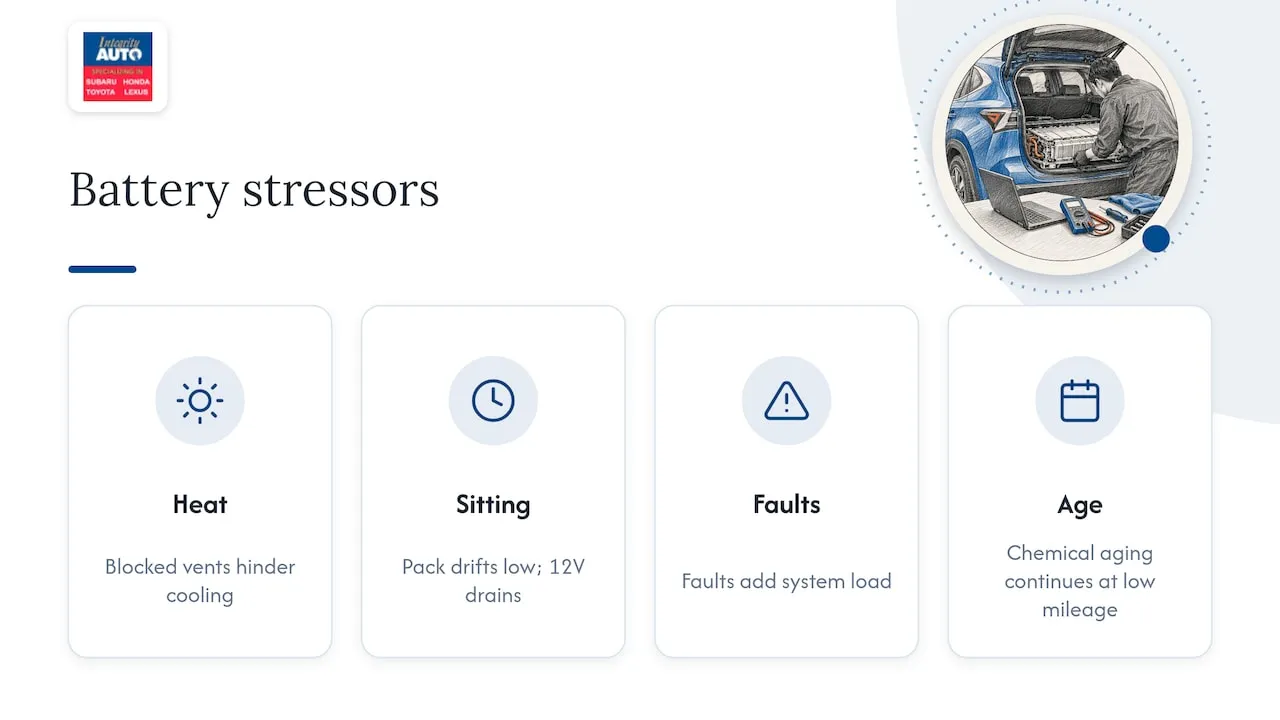
Heat. Cells age faster when they run hot. Blocked or dirty battery cooling vents, often near the rear seat, are a common and avoidable cause. Keeping the intake clear of debris and pet hair helps the cooling fan do its job.
Long periods of sitting. A hybrid that rarely moves lets the pack drift low and the 12-volt battery drain. Regular driving keeps both in balance.
Unaddressed faults. A failing cooling fan, a weak module or a bad 12-volt battery places extra load on the rest of the system. Waiting often turns a small repair into a larger one.
Age rather than miles. Chemical aging continues even when a car is barely driven. A 12-year-old hybrid with low mileage can still show a weak pack.
Hybrids also avoid some wear elsewhere. Regenerative braking recovers energy and reduces brake pad use, a principle explained for another vehicle type in this piece on how regenerative braking works on electric scooters. Hybrids overall also fare well in owner surveys: Consumer Reports found fewer problems than gas-only cars in its reliability survey.
Signs the hybrid battery needs attention
Gradual decline usually gives notice. Watch for:
- Fuel economy that drops noticeably without a change in driving or season.
- The gas engine running more often, or idling more than before.
- A battery charge gauge that swings quickly between high and low.
- A hybrid system warning or check engine light. The page on the hybrid battery warning light explains what each message usually points to.
- Cooling fan noise from the rear cabin that is louder than normal.
None of these proves the pack is dead. Each can come from a sensor, a fan, a single weak module or the 12-volt battery. A scan and a battery health test separate those causes before any large expense. A car that will not enter READY mode, or one showing multiple red warnings at once, should be diagnosed by a technician, not driven until it fails.
The 12-volt battery is a different story
Every Prius and other Toyota hybrid also has a conventional 12-volt battery. It powers the computers and relays that start the hybrid system. If it is weak, the car may not enter READY mode, show several unrelated warning lights, or behave erratically even when the high-voltage pack is healthy.
This battery wears out far sooner than the hybrid pack, in the same way a standard car battery does. Owners often assume the expensive pack has failed when a much cheaper part is the cause. Testing first prevents an unnecessary diagnosis. Details on testing and fitting the correct type are on the battery testing and replacement page, and the guide to the best car battery for Toyota, Lexus, Honda and Subaru covers choices.
The correct battery type and installation sequence matter on a hybrid, because sensitive electronics sit behind the 12-volt system. A wrong-spec battery can cause electrical faults.
Repair, recondition or replace
A weak hybrid pack does not always mean a new pack. Industry guidance treats battery health as a lifecycle, not a working-or-broken switch, and a diagnostic evaluation can show whether a battery can be repaired, refurbished or has truly reached the end of its use. Options generally include replacing a failed module or cooling component, reconditioning the pack, or installing a new or remanufactured one. The page on reconditioning versus replacing a hybrid battery compares them, and the Lexus hybrid battery cost guide covers what Lexus replacement involves.
Full failure is rare. A 2016 to 2023 data review found about 1% of plug-in hybrids needed battery replacement, and most of those were tied to recalls. That figure covers plug-in hybrids, not every hybrid type, but it supports the wider picture that early replacement is the exception.
Safety and disposal
Hybrid packs run at high voltage. The Department of Energy advises that these batteries require specific equipment, training and certified handling for removal and recycling. They must never go into household trash or standard recycling. Owners should not open the pack, cut orange cabling or probe connectors. Any work beyond checking the cooling vent belongs with a technician trained on hybrids.
Habits that help the battery last
- Drive the vehicle regularly. Short gaps between trips keep charge levels balanced.
- Keep the battery cooling intake free of dust, bags and pet hair.
- Park in shade when practical. Portland summers are mild compared with desert climates, which is a point in favor of pack longevity, but heat waves still matter.
- Follow the maintenance schedule. The 30k/60k/90k mileage services guide outlines what each interval covers.
- Do not ignore warning lights. Early diagnosis keeps repairs small.
- Compare running costs honestly. The overview of hybrid versus gas maintenance costs helps set expectations.
Hybrid service in Portland
Integrity Auto is an independent shop in Portland, Oregon, that services Toyota, Lexus, Subaru and Honda vehicles, including hybrids. The work includes diagnostics, scheduled maintenance, battery testing and complimentary multipoint inspections. Toyota hybrid owners can start at independent Toyota service and repair, and Lexus owners at independent Lexus service and repair. A hybrid that shows a warning light, drops in mileage per gallon, or will not go into READY mode can be booked for diagnosis. Diagnostic charges and estimates are explained on that page.
FAQ
How long does a Prius battery last?
Most Prius hybrid batteries last 10 to 15 years, and many go past 150,000 miles. Toyota backs each hybrid battery with a 10-year/150,000-mile limited warranty on 2020 and newer models. Older models fall under earlier terms, so check the VIN.
What is the difference between the hybrid battery and the 12-volt battery?
The hybrid battery is the high-voltage pack that helps move the car. The 12-volt battery runs the electronics and starts the hybrid system. The 12-volt unit fails much sooner, and when it does, it can trigger symptoms that look like hybrid battery trouble.
When should the 12-volt battery in a Prius be replaced?
Replace it when testing shows it is weak, not by guessing. Slow starts, no READY mode, dim lights and several unrelated warning lights are common signs. Testing is advisable as the battery ages, because a failing one can strand the car without warning.
Can the hybrid battery be repaired instead of replaced?
Sometimes. A diagnostic evaluation can show whether a failed module, fan or sensor is the cause, or whether the pack has reached the end of its useful life. Replacing the entire pack is not always required.
Sources
- Electric Vehicle Basics, U.S. Department of Energy
- What’s the Average Life of a Hybrid Car’s Battery?, Car and Driver
- How Reliable Are Gasoline-Electric Hybrid Cars?, Car and Driver
- Toyota Battery Warranty
- Toyota Manuals and Warranties
- LexusCare
- Hybrids Are Still the Most Reliable Cars, Consumer Reports
- Battery collection webinar, U.S. EPA
- PHEV battery replacements rare, Autoblog
- Maintenance and Safety of Electric Vehicles, U.S. Department of Energy