


Subaru AWD owners should focus on three priorities: keep matching tires at the correct pressure, rotate tires on the manufacturer’s schedule, and have drivetrain fluids and boots inspected on time. Model-specific intervals live in the Subaru owner’s manual, and AAA publishes guidance on tire circumference. We at Integrity Auto Inc. can handle the work when it comes due.
TL;DR:
- Subaru lists oil and filter service at 6 months or 6,000 miles, and tire rotation and inspection at 12 months or 12,000 miles; confirm your model’s schedule.
- AAA recommends tire rotations every 5,000 to 7,500 miles, but your owner’s manual sets the interval for your specific model.
- AAA warns that some Subaru AWD systems need tire circumferences within 1/4 inch and tread depths within 2/32 inch across all four tires.
- Transmission, CVT, and differential fluids are often inspection items rather than fixed replacement intervals; towing, mountain driving, or winter commuting may require earlier service.
- Clunking during turns, vibration at highway speed, ABS or traction control warnings, and sudden uneven wear after tire changes warrant prompt shop inspection.
What does the Subaru maintenance schedule look like?
Subaru builds its schedule around mileage and time, whichever arrives first. Owner documentation lists items such as engine oil and filter every 6 months or 6,000 miles, and tire rotation and inspection every 12 months or 12,000 miles, according to Subaru’s maintenance schedule article. Intermediate and major services follow at larger milestones. Exact intervals vary by model. Exact items change by model year and engine, so the manual for your car is the final word. Subaru’s own scheduled maintenance page describes the same routine services.
Typical tasks at each visit include:
- Engine oil and filter replacement at the interval your manual specifies
- Tire rotation and a tire condition inspection
- A multi-point inspection of the suspension, brakes, boots and leaks
- Engine and cabin air filter checks, replaced when dirty or due
- Brake pad and rotor inspection
- Fluid inspections, with replacements where the schedule calls for them
A practical habit: rotate tires at every oil change. AAA notes that rotating at oil-change intervals is a convenient rule of thumb, and it keeps the two services from drifting apart. Keep every receipt, because a dated service record supports warranty claims and resale value.
How should you care for tires on a Subaru AWD?
Tires are the most overlooked part of an AWD system. AAA reports that some Subaru AWD systems are sensitive to a circumference difference of more than 1/4 inch between any of the four tires, and that keeping tread depth within 2/32 inch of all other helps avoid drivetrain damage. A mismatched tire spins at a slightly different rate, which forces the center differential and couplings to work constantly.
Follow these steps:
- Check pressure monthly. Measure when the tires are cold and match the figure on the driver’s door jamb placard, as AAA recommends. Accurate pressure also feeds correct wheel speed data to ABS, traction control and stability control.
- Rotate on schedule. Manufacturers commonly call for rotation every 5,000 to 7,500 miles, per AAA. Confirm the number in your owner’s manual.
- Use a rotation pattern suited to AWD. A cross pattern or front-to-rear swap keeps wear even across all four corners.
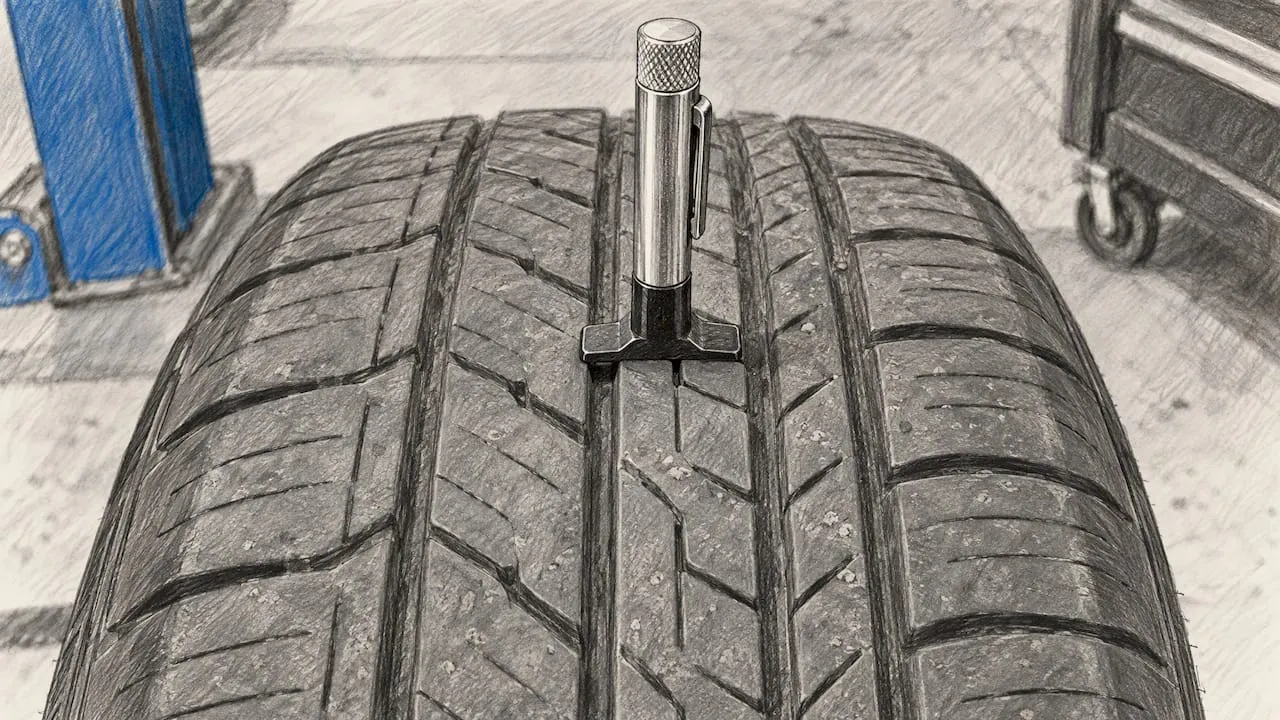
- Measure tread depth on all four tires and compare them before every rotation.
- Replace tires as a set when possible. If a single tire is damaged, a matching tire can be fitted on the rear, or a new tire can be shaved to match the circumference of the others. AAA’s Car Doctor repeats this guidance, noting replacements should be within 1/4 inch of circumference or about 2/32 inch of each other.
Pro Tip: When buying a used replacement tire, check its condition and review the DOT date code on the sidewall.
Winter changes the picture too. Check tire pressure regularly, as AAA recommends, and follow the pressure specified on the driver’s door jamb placard. Our winter-proofing guide for Subarus covers seasonal tire choices in more detail.
Which fluids affect Subaru AWD, and when are they serviced?
Several fluids keep the all-wheel-drive system healthy: transmission or CVT fluid, and the gear oil in the front and rear differentials. Subaru’s schedule typically lists transmission and differential gear oil as “inspect” items, with replacement intervals that vary by model, as the maintenance knowledgebase shows. Models with a CVT and cars used for towing, mountain driving or winter commuting may call for earlier attention, so the manual’s severe-use notes deserve a read.
The center differential, including the viscous coupling unit used on some variants, is not a casual owner task. It depends on matched tires and healthy fluids, and any suspected problem calls for a professional inspection. Variants with X-Mode do not change the basic fluid schedule, but they do rely on accurate wheel speed signals, which brings tire uniformity back into focus.
At a service visit, we suggest asking for the following:
- A written inspection of transmission, front differential and rear differential fluid condition
- Replacement at the interval your model specifies, not a generic mileage
- The owner’s manual page reference for each fluid interval
- Receipts that note each inspection or replacement, with the date and mileage
Dark, burnt-smelling or metallic-looking fluid is worth flagging early. Catching it at an inspection costs far less than repairing a worn gear set later.
What should a multipoint inspection cover?
An inspection at every oil change and rotation catches wear before it becomes a drivetrain repair. Subaru notes that dealer visits include a free multi-point inspection, and we offer a complimentary vehicle inspection as well. Ask that it include:
- CV boots and joints, checking for cracks, tears or grease slung around the wheel well
- Axle boots and their clamps
- Wheel bearings and hubs, checking for play or noise
- Suspension mounts and bushings
- Brake pads, discs and the parking brake
- Tire wear patterns across all four tires
- TPMS operation
- Visible leaks around the differentials and transmission
A torn CV boot lets grease escape and dirt enter, and a joint can fail soon after. Our page on CV joints and boots explains what that repair involves. Any cracked boot or heavy play in a bearing should be repaired right away.
Pro Tip: Ask the shop to measure tread depth on all four tires and to note any circumference differences on the service report.
While the car is in for maintenance, careful washing and blot drying can help protect the paint. This swirl mark prevention guide explains a method.
Which symptoms mean you should see a shop?
Some signs point to AWD or driveline trouble that should not wait:
- Clunking or grinding when turning, often tied to a worn CV joint
- Steady vibration at highway speed
- Traction control or ABS warning lights, which can follow inconsistent wheel speed signals
- Sudden uneven tire wear after a tire change
These symptoms often trace back to a circumference mismatch, a failing CV joint, a differential issue or a transmission problem. Ignoring them lets stress build in components that were designed for four evenly sized tires, and a small repair can grow into a large one.
Bring useful details to the appointment: the service history, any recent tire replacements, and the conditions when the symptom appeared, such as cold starts, tight turns or highway speeds.
How can Integrity Auto Inc. help with Subaru AWD maintenance?

We are independent Subaru specialists in Portland, Oregon, and we perform factory-scheduled maintenance following your owner’s manual. Our Subaru service and repair work covers:
- Scheduled maintenance at the intervals your model specifies
- Multipoint inspections
- Tire rotation, with tread and circumference checks documented
- Transmission, CVT and differential fluid inspections and replacements
To get the most from a visit, bring your service records, mention any recent tire changes, and ask for the tire checks to be written on the report. Schedule a visit when an interval comes due or when you notice any of the symptoms above, and we will take it from there.
FAQ
Is Subaru permanent AWD?
Most Subaru models use a symmetrical all-wheel-drive system that sends power to all four wheels at all times, with the split adjusted by the center differential or clutch pack depending on the transmission. Check your owner’s manual for how your specific model distributes power.
How often should I rotate tires on a Subaru AWD?
Rotation is commonly recommended every 5,000 to 7,500 miles, according to AAA. Subaru’s schedule lists tire rotation and inspection as a regular service item, so confirm the interval for your model in the manual and pair it with oil changes.
Do I have to replace all four tires at once on a Subaru?
A full set is the safest choice because it keeps circumference uniform. If only one tire is damaged, a matching tire can be installed or a new tire shaved to match, and AAA’s Car Doctor advises staying within about 1/4 inch of circumference.
When are differential and CVT fluids serviced?
Subaru’s schedule generally treats these fluids as inspection items, with replacement set by model-specific guidance. Look up your model in the owner’s manual and ask the shop to record each fluid inspection.
Sources
- [What is the maintenance schedule for my 2019 Subaru?
· Customer Self-Service](https://contactus.subaru.com/knowledgebase/article/1001832/en-us) - Tire Rotation: Why It is Important and How to Do It | AAA Automotive


