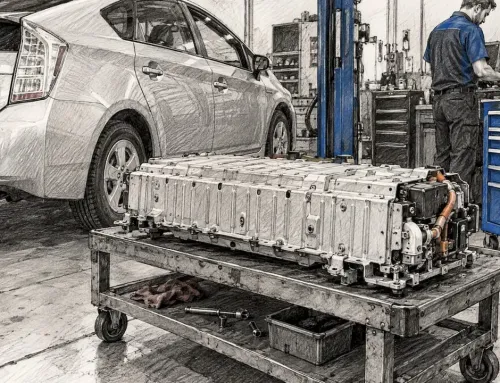


How can a Prius owner tell the brake actuator is failing? The usual signs are a longer or spongy brake pedal, a pump that buzzes or runs far more often than before, and brake, ABS or VSC warning lights that stay on after startup. A continuous buzzer together with a brake warning light is not a normal Prius sound. It means the car should be treated as unsafe to drive and moved by tow for diagnosis.
TL;DR
- Main signs: a long, soft or unusually hard pedal, a squeak or buzz from the engine compartment during braking, and brake-system, ABS or master warning lights that do not go out.
- A light that appears briefly at startup and then goes out is normally a self-check. A light that stays on points to a fault.
- A continuous buzzer with the brake warning light calls for stopping safely and arranging a tow, not a test drive to the shop.
- Pad thickness does not rule out an actuator problem, because the hydraulic assist system and the friction brakes are inspected separately.
- Diagnosis comes before any parts decision, and the cost depends on the model year and the exact fault.
What the brake actuator does on a Prius
On a Prius, braking is partly electronic. The brake actuator (also called the booster pump assembly) builds hydraulic pressure and stores it in an accumulator. That stored pressure provides power assist when the pedal is pressed and feeds the ABS and stability control functions. Toyota’s recall material for the 2010 Prius describes the accumulator as the part that stores the pressure supplied by the booster pump.
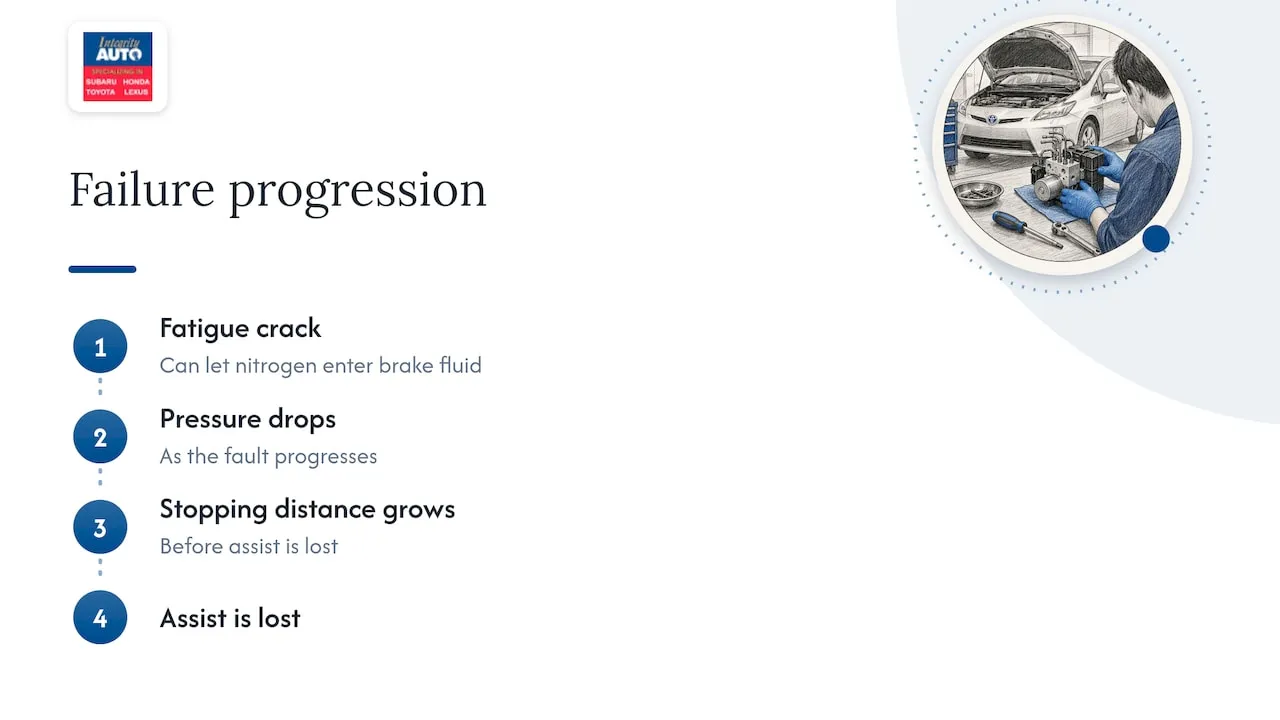
The same document explains one known failure: a fatigue crack in the accumulator can let nitrogen gas into the brake fluid. That recall covered roughly 82,000 US vehicles from the 2010 model year. Not every actuator problem is that specific defect, but it shows why the symptoms below deserve attention. The fault is progressive. Pressure can drop and stopping distance can grow well before assist is lost entirely.
Prius brake actuator symptoms to watch for
A long, spongy or hard pedal
Toyota’s recall information lists a longer pedal stroke and a spongy feel as warning signs. Some owners instead describe a pedal that feels hard, with less assist than usual. Both point to a pressure problem in the hydraulic system, not to worn pads. A pedal that sinks further than it used to, or needs a firmer push to slow the car, should be inspected promptly.
A soft pedal can also come from air in the lines or a failing master cylinder, which is why a structured check matters. The shop’s guide to telling air in the lines from a bad master cylinder covers that side of the question.
Noise from the engine compartment
A squeak from the engine compartment while braking is another sign Toyota lists. Owners also report a whirring, buzzing or pulsing air-like sound while holding the pedal at a stop. The pump is designed to run briefly at times, so a short hum is not proof of failure. The concern is a change: the pump running more often, running longer, or sounding rougher than it did before.
Warning lights that stay on
Brake-system, ABS, VSC and master warning lights are the most common prompt for a visit. Toyota’s quick-reference information notes that a light appearing briefly during startup and then going out is normal self-check behavior, while one that remains on after startup indicates a malfunction needing inspection.
Lights alone do not identify the cause. A weak 12-volt battery, a wheel speed sensor or a pressure sensor can set similar warnings. The shop’s article on an ABS light that appears after a battery change lists what is checked in that situation.
A continuous buzzer
A continuous warning buzzer together with the brake warning light is the most serious sign. Toyota owner information states that if the brake actuator fails while driving, this combination can occur and the brakes may not work normally. At that point the vehicle is not safe to continue driving.
What to do when the signs appear
The response depends on what the car is doing.
| What you notice | Reasonable response |
|---|---|
| Warning light flashes at startup, then goes out | Normal self-check. No action needed. |
| Pump sounds louder or runs more often, braking feels normal | Book a diagnosis soon and mention when the noise occurs. |
| ABS or VSC light stays on, braking feels normal | Schedule diagnosis promptly. Anti-lock and stability functions may be off. |
| Long, spongy or very hard pedal | Limit driving to a short, careful trip to the shop, or arrange a tow. |
| Continuous buzzer with brake warning light, uncertain stopping | Pull over when safe, stop driving, and arrange a tow. |
The practical rule: if the pedal feels different and the car’s stopping performance is uncertain, a tow costs far less than the consequences of a failed stop. Do not clear codes or keep driving to see whether the light returns.
Why good brake pads do not mean a good brake system
A frequent surprise is a Prius with thick pads and clean discs that still has a serious brake-control fault. Toyota’s warranty and maintenance guide calls for inspection of pads, discs, linings, hoses and leaks, and separately lists the brake actuator and the hybrid brake master cylinder among hybrid system components. These are two tracks. Friction hardware needs a visual and measured inspection. The electronically controlled hydraulic assist needs scan-tool diagnosis.
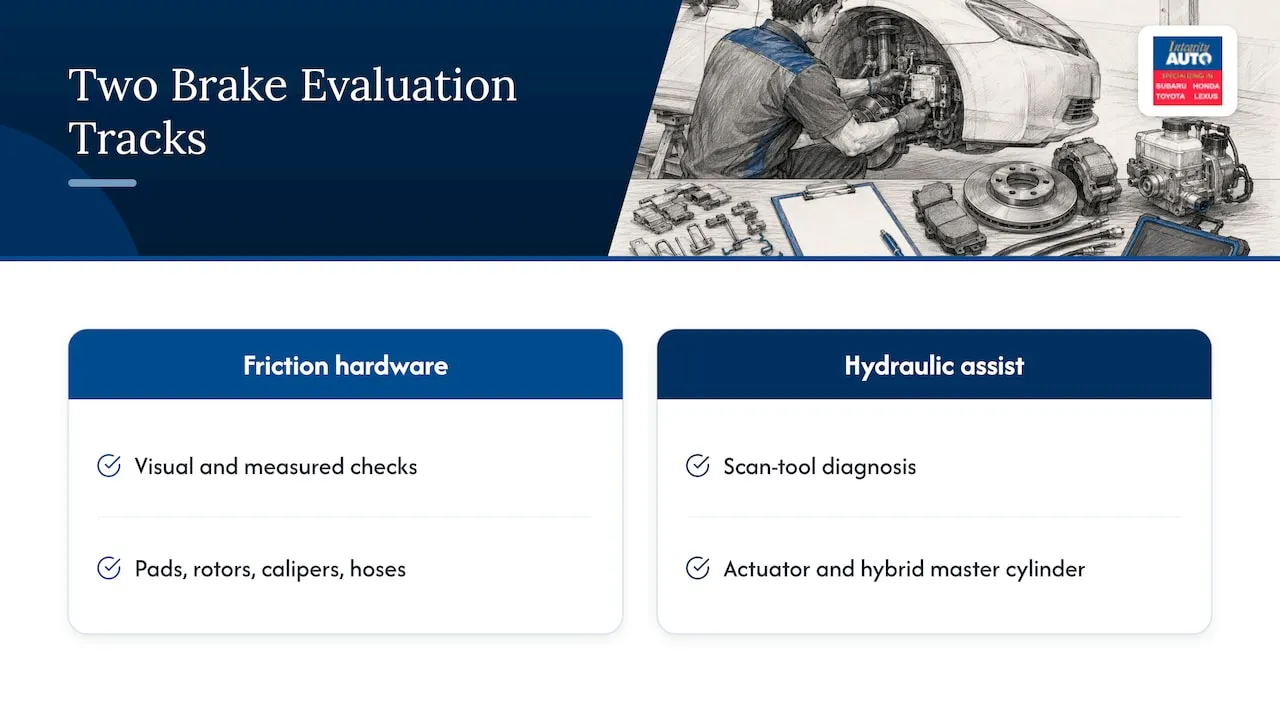
A proper evaluation covers both. On the friction side, that means pad thickness, rotor condition, caliper movement and hose condition. The shop’s guides on brake pad wear patterns, when pads need replacing and Toyota brake calipers show what that side looks like. Heavy brake dust can hide wear and leaks, so cleaning wheels first helps the inspection. A guide on removing brake dust from wheels safely explains a gentle method with a short dwell time.
Because hybrids slow the car with regenerative braking first, pads often last a long time. That can make owners skip brake checks. Hydraulic parts and fluid still age regardless of pad life.
How a shop diagnoses the actuator
Diagnosis usually follows a sequence:
- Conversation. When does the noise occur, how long has the pedal felt different, which lights are on and when?
- Code scan. Brake-control codes are read with a scan tool capable of Toyota hybrid systems. Codes point toward a circuit or component, not automatically to a part that needs replacing.
- Live data. Pressure sensor readings and pump behavior are watched during pedal application.
- Fluid and leak inspection. Fluid level, color and condition are checked, along with lines, hoses and fittings.
- Friction brake check. Pads, rotors, calipers and wheel cylinders where applicable.
- Written findings. Cause, urgency and options, ranked by safety.
This order avoids replacing an expensive assembly when the cause is a sensor, a connection or low system voltage. Integrity Auto’s page on diagnosis, diagnostic charges and estimates explains how that process is handled for Toyota vehicles.
Replacement cost and what drives it
Actuator replacement is among the larger brake repairs on a Prius. The price depends on the generation and model year, whether the repair is the whole assembly or a related part such as the accumulator or a sensor, whether parts are OEM, and labor time. The brake system also needs bleeding and a calibration or initialization procedure afterward. Published figures online vary widely, and no responsible number can be given without a diagnosis of the specific car. An estimate should list parts, labor and any related items, such as fluid, before work begins.
Brake fluid and hybrid brake maintenance
Fluid condition matters on hybrids. Brake fluid absorbs moisture over time, which can affect hydraulic components, including the actuator and ABS parts. Toyota’s maintenance schedules for some Prius models call for specific fluid and brake inspection intervals, so the correct interval for a given car comes from its own maintenance guide. The shop provides a brake hydraulic fluid flush service. On a hybrid, the procedure must suit the brake system design, which is another reason to use a technician familiar with Toyota hybrids.
A sensible routine for a Prius:
- Have brakes inspected at each scheduled service, including fluid level and condition.
- Follow the fluid interval in the owner’s maintenance guide.
- Report any change in pedal feel or pump noise at the next visit, not at the next failure.
- Inspect the parking brake mechanism too. See the page on the Toyota emergency brake and parking brake cable.
Oregon note: emissions testing and a faulty brake system
Portland-area owners with a DEQ test due should repair brake faults first. Oregon DEQ states that vehicles posing a safety hazard will not be tested. DEQ lists a $25 testing fee in Portland, payable only after a passing test, and Portland stations are closed Sunday and Monday. A Prius with a brake warning or uncertain pedal should not be driven to a test station.
Independent Prius brake service in Portland
Integrity Auto is an independent Toyota and Lexus specialist in Portland, Oregon, offering diagnostics, brake service and hybrid vehicle service as an alternative to the dealer. Technicians are described by the shop as ASE certified, and complimentary multipoint inspections are part of its approach. Owners with a Prius showing any of the signs above can start with the Independent Toyota Service and Repair page, or review the Toyota, Lexus and Scion brakes service overview. For related hybrid concerns, the guide to Prius inverter failure checks is also available.
FAQ
Is it safe to drive a Prius with the brake actuator warning on?
Not when the pedal feels different or a buzzer sounds continuously. Toyota owner information warns that braking may be impaired if the actuator fails. If the light is on but the car brakes normally, keep trips minimal and book diagnosis immediately, as ABS and stability functions may be disabled.
Is a buzzing noise from the brake pump normal?
A brief hum when the pedal is pressed or the car is started can be normal, because the pump replenishes pressure. A louder sound, a pump running constantly or much more often, or a noise paired with warning lights is a reason for inspection.
What causes a spongy Prius brake pedal?
Causes include a damaged accumulator letting nitrogen into the fluid, as described in Toyota’s 2010 Prius recall material, air in the lines, a leaking component or a failing master cylinder. Only diagnosis can separate them.
Can pads and rotors be fine while the actuator is failing?
Yes. Friction brakes and the hydraulic assist system are inspected separately. Healthy pads say nothing about accumulator pressure or pump condition.
Should the brake fluid on a hybrid be changed?
Follow the interval in the car’s own maintenance guide, and have fluid condition checked at routine inspections. Fluid absorbs moisture over time, so the service is part of protecting the hydraulic system.
Sources
- Toyota customer FAQ, 2010 Prius brake booster pump (accumulator) safety recall
- Toyota quick-reference owner information (OM47568U)
- Toyota 2024 Prius warranty and maintenance guide
- Oregon DEQ, Portland testing area information