
A rough idle at a stop usually means the engine has lost the small margin it needs to run smoothly at low speed. The usual culprits are unmetered air from a vacuum leak, weak spark, a dirty throttle body, fuel delivery problems or a faulty sensor. Most are repairable, but a flashing check-engine light or severe shaking calls for immediate attention.
TL;DR
- Idle exposes small faults that driving hides, because the engine has little operating margin at low rpm.
- The most common causes are vacuum or intake leaks, worn spark plugs or failing coils, a dirty throttle body, fuel delivery issues and bad airflow sensors.
- A flashing check-engine light, heavy shaking, power loss, smoke, overheating or near-stalling means the car should not be driven normally.
- A scan for stored codes is the first step, but a code points to a system, not automatically to a failed part.
- In the Portland area, most vehicles will not pass a DEQ inspection with the check-engine light on.
Why the problem shows up at stoplights
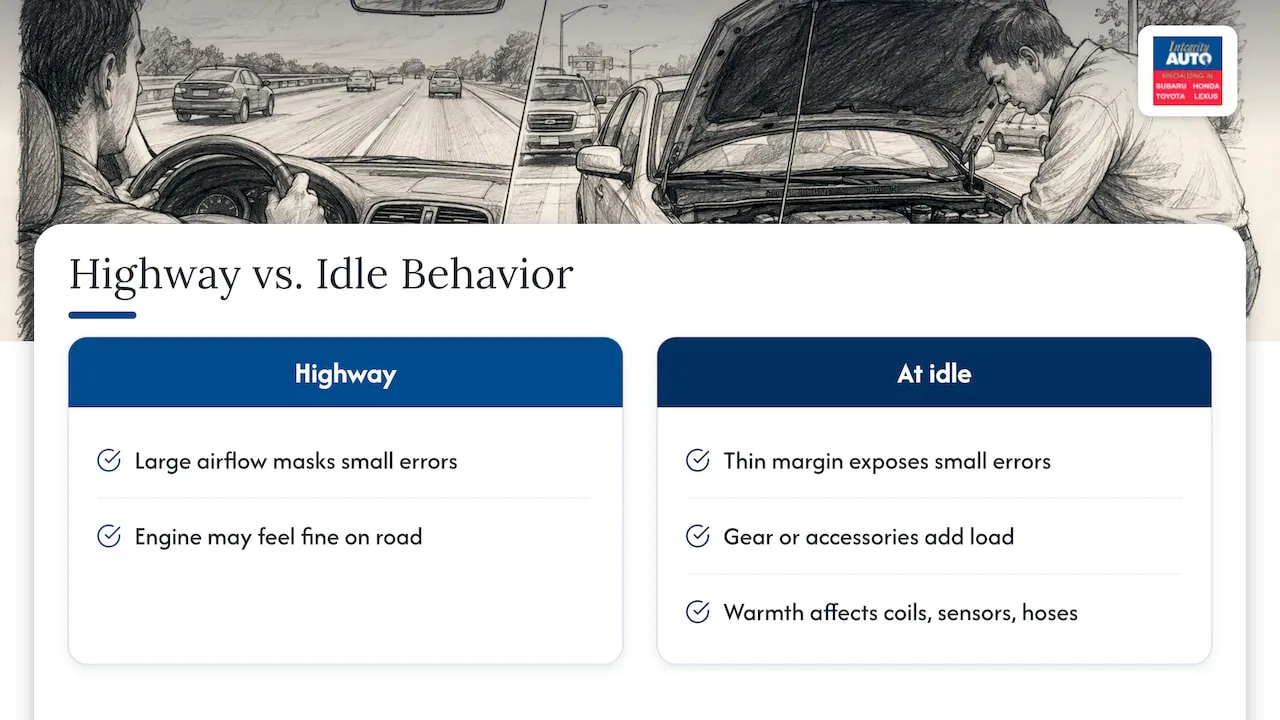
At highway speed the engine moves a large volume of air, and small errors get masked. At idle, the margin is thin. Small errors in unmetered air, purge flow, sensor calculation, spark energy, injector delivery or cylinder sealing can be hidden while driving but become obvious when the car is stopped, especially in gear or when the air conditioning and other accessories add load.
That is why a car can feel fine on the road, then shudder at a red light with the rpm dipping and the steering wheel buzzing. It is also why the symptom often appears only after the engine is warm: heat changes how coils, sensors and rubber hoses behave.
The most common causes
Diagnostic training materials group idle problems into air induction, ignition, fuel delivery, engine mechanical condition, emissions controls and electronic control. The causes below follow that grouping.
Vacuum and intake leaks
Cracked vacuum hoses, hardened gaskets, a leaking intake boot or a failing PCV system let air into the engine that the computer never measured. The mixture goes lean, the idle surges or hunts, and the engine may stall when the car comes to a stop. The symptom often eases once the car is moving and airflow stabilizes.
A hissing sound under the hood, or a fuel or exhaust smell that comes and goes, can point to a leak. For readers who want a general approach to tracing a smell back to its source before treating it, this guide to finding the cause of car odors explains the logic. Exhaust leaks near the manifold can also upset readings and are covered in this page on exhaust system leaks.
Worn spark plugs, weak coils and ignition faults
When a plug is worn or a coil is weak, one cylinder may fail to fire cleanly at low rpm. The result is a rhythmic stumble that feels like shaking. Misfire codes commonly use P0300 for a random or multiple-cylinder misfire and P0301 through P0308 for a specific cylinder, according to Clemson’s OBD-II reference.
When the code names a single cylinder, swapping the coil to another cylinder is a quick test that can avoid guessing at parts. Integrity Auto describes that approach in its article on a Honda P0301 coil swap. More background is in the page on car ignition problems.
Dirty throttle body or idle control trouble
Carbon buildup around the throttle plate restricts the small amount of air that the engine relies on at idle. The computer then struggles to hold a steady rpm, and the engine may dip low or hunt at a stop, then settle once the car moves.
Fuel delivery problems
Clogged or leaking injectors, low fuel pressure or a weak pump can starve a cylinder at low rpm. A proper evaluation can include injector and fuel-pressure testing rather than a bottle of cleaner added to the tank on a hunch.
Airflow sensor errors
Mass airflow (MAF) sensors measure airflow directly, while manifold absolute pressure (MAP) sensors measure intake-manifold pressure so the engine computer can calculate airflow. Incorrect readings can produce rough idle, hesitation, stalling, poor fuel economy or related codes. Codes in the P0101 to P0103 range relate to MAF performance.
Mechanical wear
Low compression from worn rings, valves or a head gasket can cause a persistent rough idle that no tune-up fixes. This is the least common cause, and it is confirmed with compression or leak-down testing, not assumed.
Quick reference: what the symptom pattern suggests
| What you notice | Likely area to check |
|---|---|
| Stumble with a flashing check-engine light | Active misfire: ignition or fuel, urgent |
| Rpm hunts up and down, hissing sound | Vacuum or intake leak |
| Rough only when fully warm | Coils, sensors, heat-sensitive parts |
| Rpm drops very low or stalls at the light | Throttle body, idle control, airflow sensor |
| Shaking with a rotten-egg or fuel smell | Emissions system or fuel delivery |
| Smooth on the road, rough in gear at a stop | Low-speed air or fuel error, engine or transmission mounts |
This table is a starting point only. Several causes can overlap, and a worn engine mount can make a mild idle vibration feel much worse inside the cabin.
Does a bad transmission cause a rough idle?
It can feel that way, but it is less common. A car that shakes only when shifted into Drive and stopped may have a worn engine or transmission mount, or a torque converter or clutch issue, rather than an engine fault. If the engine idles smoothly in Park and shakes in gear, tell the technician. That detail narrows the search quickly.
When to stop driving
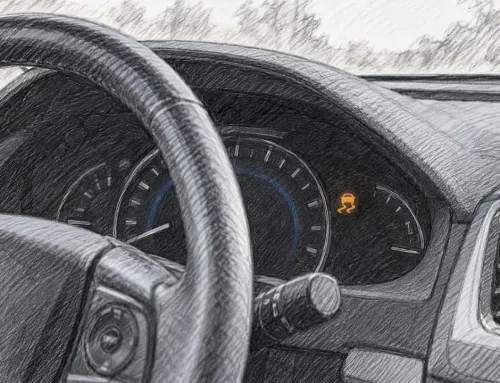
Oregon DEQ explains that a steady check-engine light means the on-board diagnostic system has detected a potential emissions problem, while a flashing light means vehicle operation is discouraged until the malfunction is repaired. A rough idle combined with any of the following should be treated as urgent:
- A flashing check-engine light
- Severe shaking or a strong fuel smell
- Noticeable loss of power
- Smoke from the engine or exhaust
- Overheating
- A stall that is about to happen or has already happened in traffic
Continued driving with an active misfire can send unburned fuel into the exhaust, which is hard on the catalytic converter. Arrange a tow or a short, gentle trip to a shop instead.
What a proper diagnosis looks like
The first professional step is to scan for stored and pending trouble codes, inspect the vehicle and evaluate live data. A code is a clue, not a verdict. Clemson notes that a scan tool can access as many as 300 diagnostic readings, depending on the vehicle and manufacturer, which is far more than the dashboard lamp shows.
From there, a thorough evaluation can include:
- A visual inspection of hoses, boots, wiring and mounts.
- Smoke testing for intake or PCV leaks.
- Review of fuel trims and sensor data.
- Ignition testing of plugs and coils.
- Injector and fuel-pressure testing.
- Compression or leak-down testing when mechanical loss is suspected.
This order matters because it avoids replacing parts at random. For more on the process, see this overview of check engine light diagnosis.
Useful notes to bring to the shop
Short, specific details save diagnostic time:
- Does it happen cold, warm or both?
- Is it worse in Drive than in Park, or with the A/C on?
- Does the rpm dip, surge or stall?
- Has the check-engine light come on, and was it steady or flashing?
- Was there recent work, such as an oil change or fuel fill-up?
A light that appears right after service is covered in check engine light after an oil change.
Portland emissions testing and a rough idle
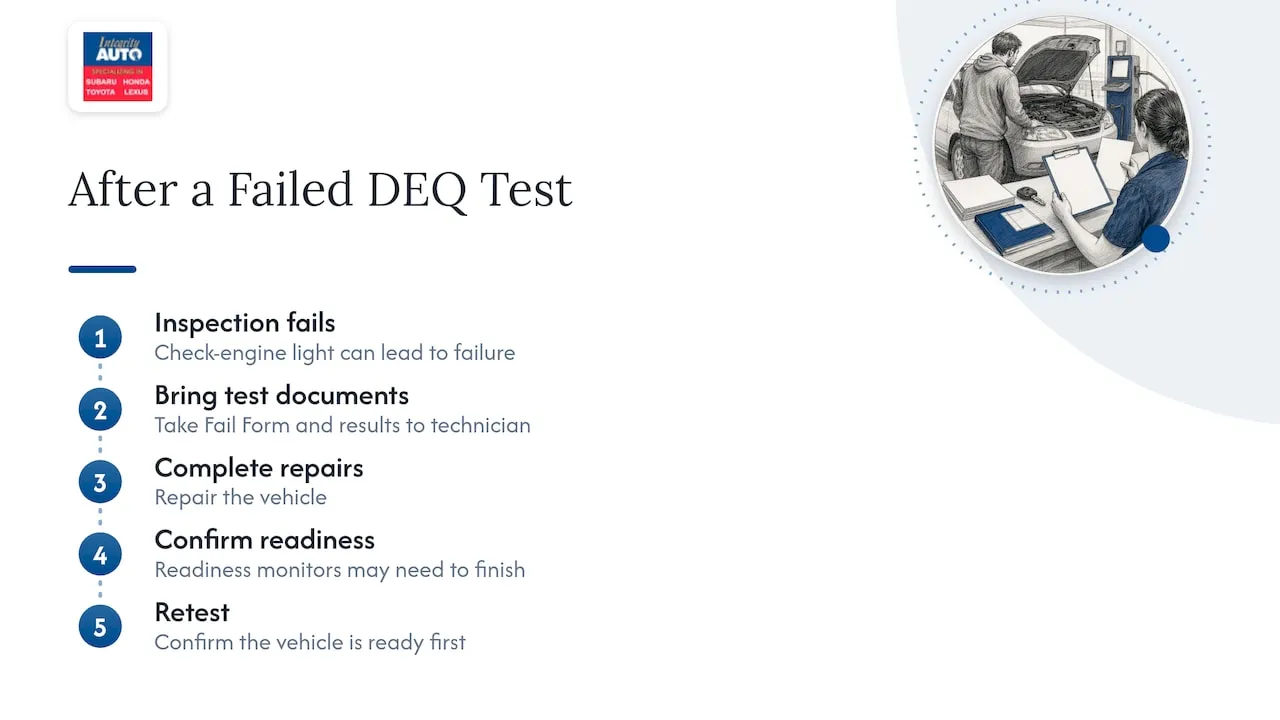
A rough idle and a lit check-engine light can lead directly to a failed DEQ test. Oregon DEQ says most vehicles will not pass inspection with the check-engine light illuminated, and that vehicles with malfunctioning emission controls can emit three to four times more air pollution than federal standards allow.
After a failed inspection, DEQ directs owners to take the Fail Form and test results to a repair technician, complete the repair and confirm the vehicle is ready before retesting. DEQ also maintains a list of recognized automotive repair shops in the Portland metro area. After repairs, readiness monitors may need to finish before a retest, as the DEQ on-board diagnostics FAQ explains. Integrity Auto covers this in Portland DEQ monitor rules and fixes and in what causes a car to fail an emissions test.
Rough idle diagnosis for Toyota, Lexus, Subaru and Honda
Integrity Auto is an independent shop in Portland, Oregon, that specializes in Toyota, Lexus, Subaru and Honda vehicles. Its services include check-engine light and DEQ diagnosis, tune-ups, emission testing and repairs, and scheduled maintenance. Owners can start with the diagnosis page or go to the page for their make: Toyota, Lexus, Honda or Subaru. Prices are not published, so an estimate comes after the diagnosis.
FAQ
Why does my engine idle rough but drive fine?
At road speed the engine moves more air and the load hides small faults. At idle, a minor vacuum leak, weak coil, dirty throttle body or inaccurate sensor has a much bigger effect on the air-fuel mix. A scan and inspection can usually separate these causes.
Why does my car shake when idling at a stoplight?
The most frequent reasons are a misfire from worn plugs or a weak coil, an intake leak, or a worn engine mount. If the shaking only happens in Drive and disappears in Park, a mount is worth checking. A flashing check-engine light with shaking means an active misfire and should be addressed right away.
Why does the rough idle only happen when the engine is warm?
Heat can change how coils, sensors and rubber parts behave. A coil that works when cool can misfire once under-hood temperatures rise, and a cracked hose can open further as it expands. Note the pattern and tell the technician.
How do I fix a rough idle?
The fix depends on the cause, so the first step is diagnosis: scan the codes, check live data and test the likely systems. Repairs range from replacing a hose, plugs or a coil to cleaning the throttle body or replacing a sensor. Replacing parts without testing often costs more and leaves the problem in place.
Sources
- Oregon DEQ: Failed Vehicle
- Oregon DEQ: On-board Diagnostics FAQ
- Oregon DEQ: Recognized Automotive Repair Shops
- Clemson University: OBD-II reference
- UTI: MAF vs. MAP Sensors