
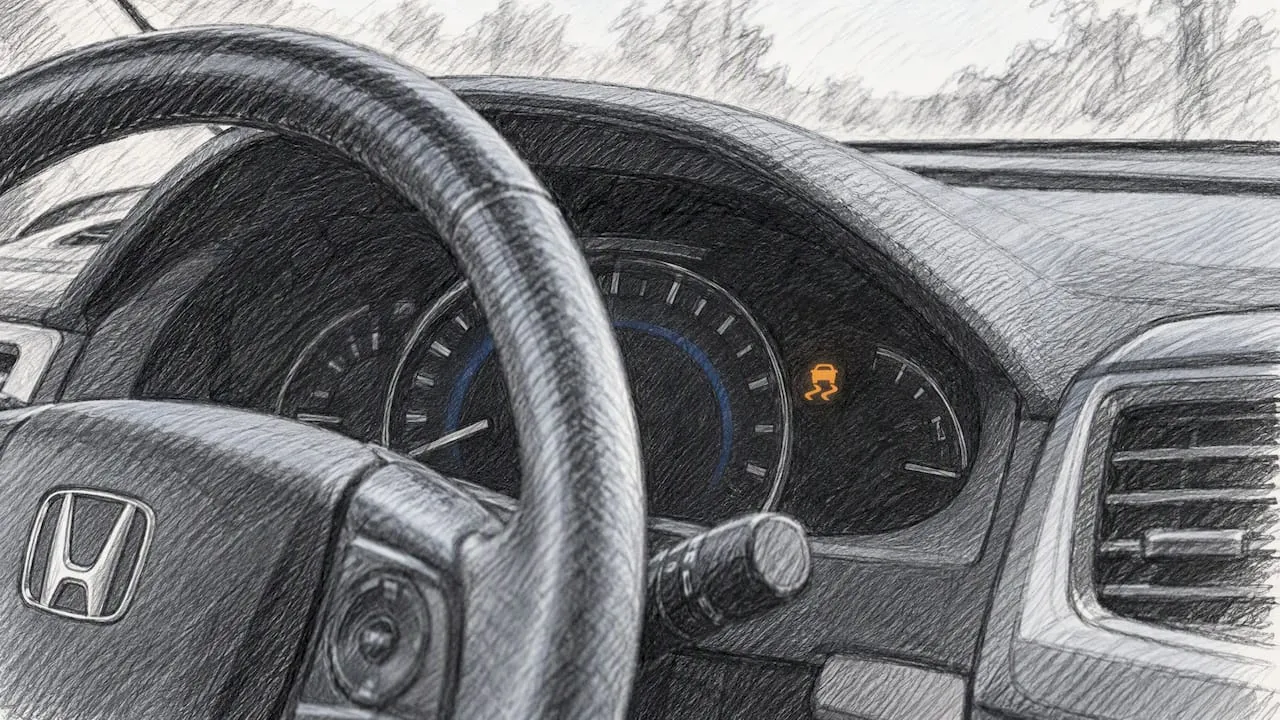
The VSA light on a Honda is the indicator for Vehicle Stability Assist, the car’s electronic stability and traction control system. If the light blinks, the system is working. If it stays on, the car has detected a fault and the system needs to be checked. If it reads “VSA OFF,” the system was switched off, usually on purpose.
TL;DR
- A blinking VSA indicator means the system is actively correcting a slide or wheelspin. This is normal on wet or icy roads.
- A steady VSA light means Honda’s manuals describe a detected problem in VSA or in related functions. Diagnosis is needed.
- After a battery disconnect, the light can stay on until the system reinitializes. A short drive may clear it. If it does not, repeated battery resets are not the answer.
- Stop driving if the light appears with a red brake warning, a soft pedal, or any loss of steering assist or braking.
What VSA does in a Honda
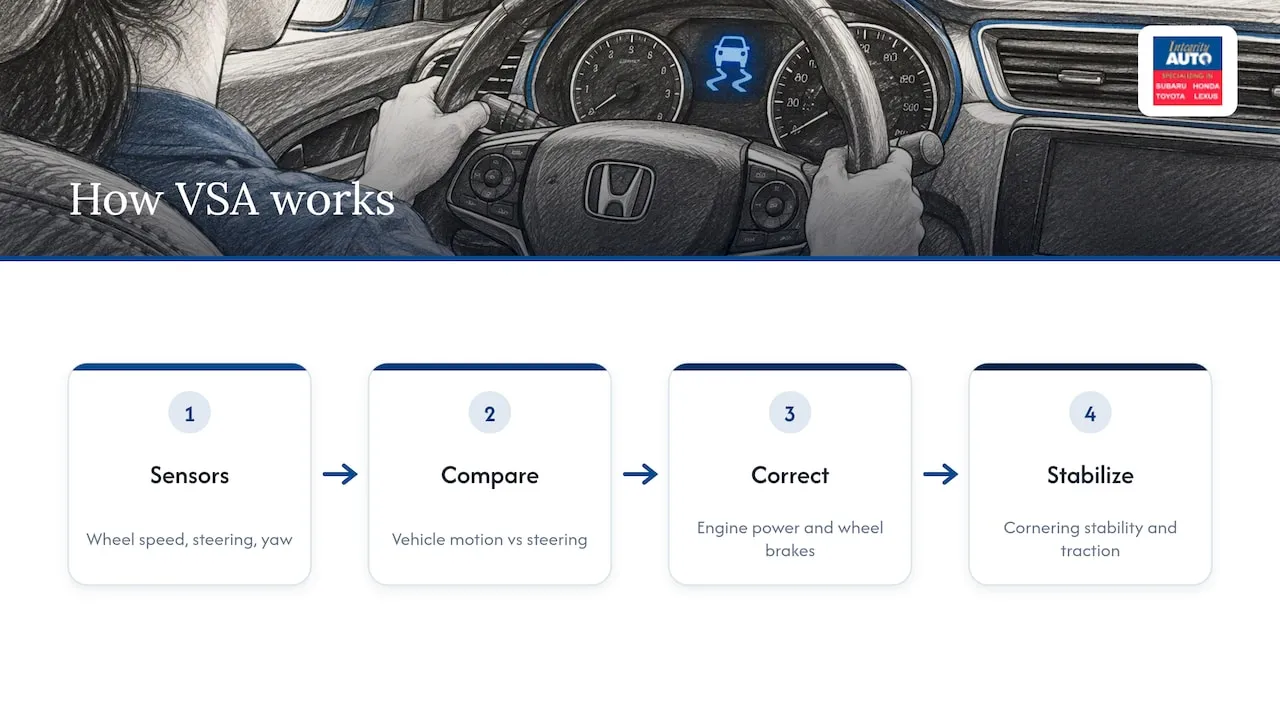
VSA stands for Vehicle Stability Assist. Honda describes it as a system that helps stabilize the vehicle in a corner when the car turns more or less than the driver intended, and that assists traction on slippery surfaces. It does this by regulating engine output and selectively applying the brakes at individual wheels.
The system compares what the car is doing with where the steering wheel is pointed. Wheel speed sensors, a steering angle sensor and a yaw sensor feed that comparison. When the two disagree, VSA trims engine power and brakes one or more wheels to pull the car back on line. Other makers call the same technology electronic stability control (ESC), and Honda’s manuals use both names.
Because VSA depends on the same wheel speed sensors and hydraulic unit as the anti-lock brakes, a fault in one often shows up in the other. That is why the VSA light so often arrives with an ABS light.
The three things the light can be telling you
The same dashboard symbol, usually a car with wavy lines or a triangle with an exclamation point, covers three different situations.
Blinking: VSA is working
Honda’s owner guidance says the indicator blinks while VSA is active. Expect it on a wet on-ramp, in a gravel turn or on an icy morning. You may also feel the engine response drop and hear a buzzing or grinding noise from the hydraulic brake unit. Honda notes that this reduced engine response and brake noise during activation is part of how the system operates. It is not a defect.
VSA OFF: the system was disabled
Most Hondas have a VSA OFF button near the driver’s knee or on the lower dash. When the system is off, traction control stops functioning, and a separate VSA OFF indicator appears. Drivers sometimes press the button by accident with a knee or a bag. Pressing it again restores the system. On the models Honda documents, VSA switches back on at every start, so a light that returns after a restart is not a button problem.
Steady: a fault was detected
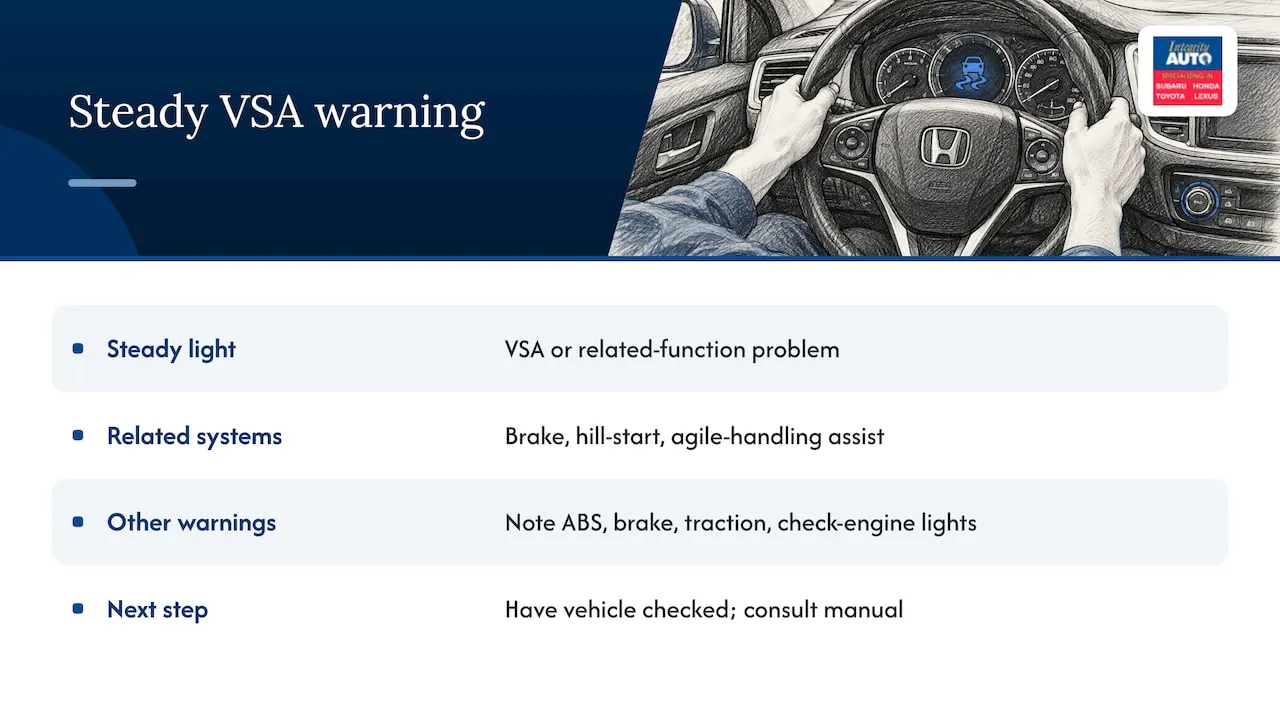
A light that stays on while driving means the car found a problem. In Honda’s indicator tables, such as the Civic Sedan 2023 indicator list, a steady VSA light points to a problem with VSA or related functions such as brake assist, hill-start assist or agile-handling assist. Honda advises having the vehicle checked. The exact combination varies by model year and trim, so note which other lights appear with it (ABS, brake, traction control, check engine) and check the owner’s manual for your car.
A steady light should not be dismissed because the car feels normal. The distinction between blinking and steady is useful: it prevents panic during normal operation, but it is not a reason to ignore a persistent warning.
Is it safe to drive with the VSA light on?
Often the car still drives normally. Honda states that normal braking and cornering ability may remain while traction-control effectiveness is reduced. The same document makes clear that VSA does not control the entire braking system and cannot prevent loss of control in every situation.
The practical meaning is that the safety net is thinner than usual. On Portland’s wet roads in fall and winter, and on the snowy drives up toward Mt. Hood, that matters. A car with a faulty stability system is more likely to slide in a sudden swerve or hard stop on a slick surface.
A sensible rule:
- Light on, car behaves normally: drive conservatively, leave extra following distance, avoid hard cornering and book a diagnostic visit soon.
- Light on with a red brake warning, a soft or sinking pedal, unusual brake application, or a loss of power steering assist: stop driving in a safe place and arrange a tow or roadside help. These are brake and steering safety problems, not just a stability-system problem.
Common causes of a steady VSA light
The most common causes are on the sensor side of the system.
- Wheel speed sensors or their wiring. Dirt, corrosion, a damaged tone ring or a cracked wire can send bad data. Because ABS uses the same sensors, an ABS light often appears too. The ABS light checks article covers what to look at before heading to a shop.
- Steering angle sensor. If the sensor loses its calibration, VSA cannot tell where the driver wants to go. This often follows an alignment, a steering repair or a battery disconnect.
- Brake system faults. A low brake fluid level, a failing brake light switch or a hydraulic modulator problem can all trip the light.
- Engine and throttle faults. VSA reduces engine output, so problems with the throttle or a stored engine code can turn the light on alongside the check engine light. When both are on, the engine code usually needs attention first. Information on check engine light diagnosis explains how that process works.
- Tires. Honda instructs owners to use the same tire size and type and the specified inflation pressures because mismatched or unevenly worn tires can affect VSA operation. Low pressure, a mixed set or a recently fitted odd-size tire belongs in the diagnostic history.
- Weak battery or charging problems. Low voltage can set several warning lights at once. The battery light guidance describes what a shop checks.
How to get the VSA light off
The fix depends on which of the three situations applies.
- Check the VSA OFF button. If the light says VSA OFF, press the button once and see whether it goes out.
- Restart the car. A one-time glitch may clear after a restart. If the light returns every time, there is a stored fault.
- After a battery disconnect or replacement, Honda’s manual says to drive above 12 mph (20 km/h) so the system can reinitialize. On some models, the steering wheel must also be turned fully left and right. If the indicator does not go out, Honda says to arrange a diagnostic inspection. Disconnecting the battery again and again does not repair anything. The related piece on ABS lights after a battery change lists what shops check in that case.
- Check tires. Confirm that all four match in size and type, and set pressures to the figure on the driver’s door jamb label.
- Get a scan. If none of this works, the light stays on because a fault is stored in the system. A scan tool that reads Honda’s ABS and VSA modules, not only the engine computer, is needed to find it. Generic code readers often miss these.
Clearing the code without fixing the cause only turns the light off until the next drive.
What the VSA light means on specific models
Readers often ask about the Accord, Pilot, CR-V and Civic. The behavior is similar across them: blinking means activation, steady means a detected fault, and the exact wording and companion lights differ by year. Honda publishes the wording in each model’s owner’s manual, such as the 2026 Pilot VSA page and the 2025 Civic Hatchback page. Older cars, such as a 2008 Pilot or a 2009 Accord, use a similar logic, but the manual for that exact year is the reference for the symbol and the companion lights.
VSA light diagnosis in Portland
Integrity Auto is an independent shop that services Honda, Toyota, Lexus and Subaru vehicles in the Portland, Oregon area. A VSA or ABS warning is handled as a diagnostic job: the shop records which lights are on, scans the relevant modules, inspects sensors, wiring, tires and brake components, and explains the findings before repairs begin. Honda owners can find the shop’s full service list, from scheduled maintenance to brakes and check engine light diagnosis, on the Honda service and repair page.
Bring a note of when the light came on, whether it blinks or stays steady, and any recent work such as tires, alignment or a battery change. That history shortens the diagnosis.
FAQ
What does the VSA light mean on a Honda Accord?
A steady VSA light on an Accord means the car detected a problem with VSA or a related function, and Honda advises having it checked. A blinking light means VSA is working. Record any ABS, brake, traction or check engine lights that appear with it, since the combination varies by year and trim.
How do you get the VSA light off?
First identify the type of light. If it reads VSA OFF, press the VSA OFF button. If the battery was recently disconnected, drive above 12 mph and, on some models, turn the steering wheel fully left and right. If it stays on, a stored fault needs diagnosis.
Can you drive with the VSA light on?
Often yes, with caution. Normal braking and cornering may remain, but traction control is reduced, so slow down and leave more space. If the light comes with a red brake warning, a soft pedal or loss of steering assist, stop driving and call for assistance.
What does VSA do in cars?
VSA monitors steering input and vehicle movement. When the car turns more or less than intended, it reduces engine output and brakes individual wheels to help stabilize the car. It also helps maintain traction on slippery surfaces.
Sources
- Honda 2023 CR-V: Vehicle Stability Assist
- Honda 2023 Ridgeline: Vehicle Stability Assist
- Honda Pilot 2026 owner’s manual: VSA system
- Honda CR-V Hybrid 2025 owner’s manual: VSA system
- Honda HR-V 2025 owner’s manual: indicators
- Honda Civic Sedan 2023 owner’s manual: indicators
- Honda Civic Hatchback 2025 owner’s manual: VSA system