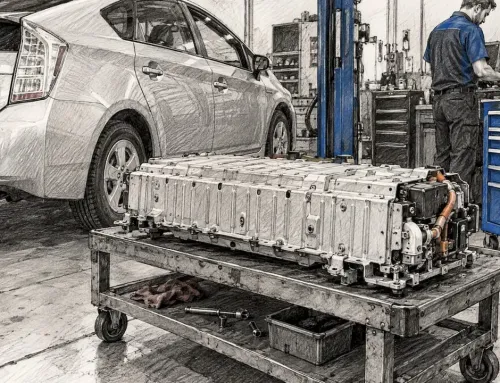

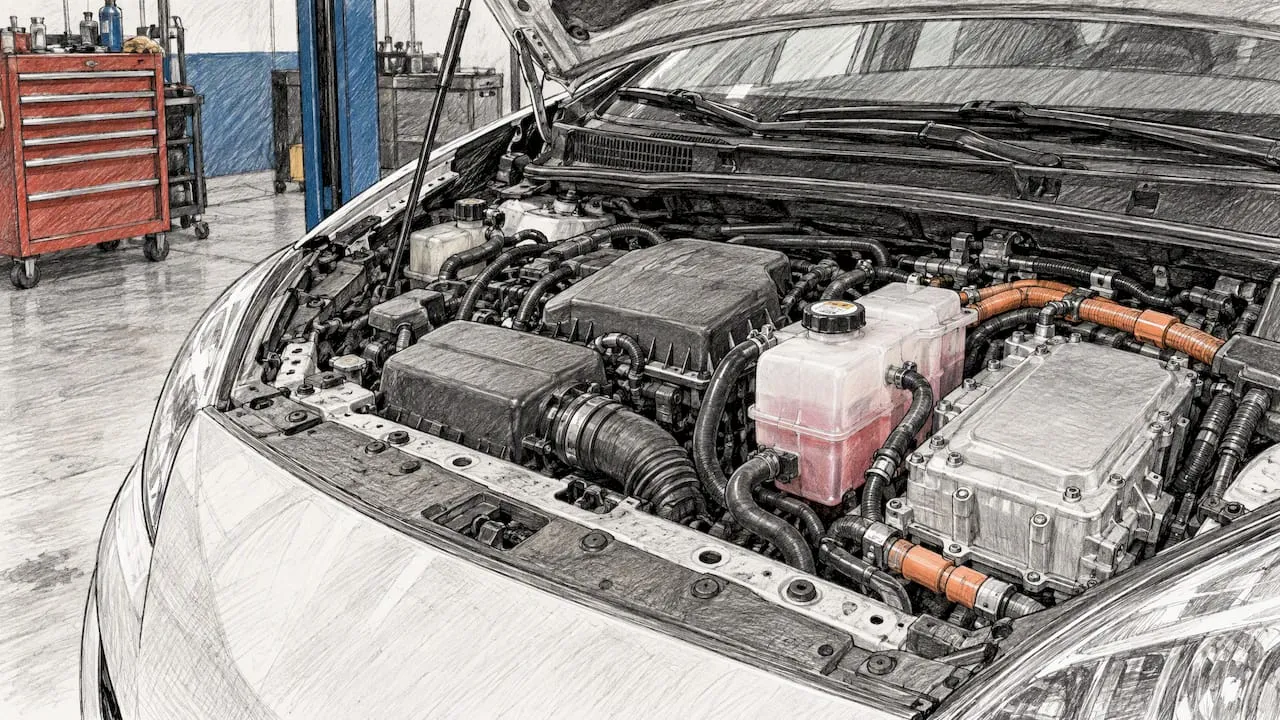
Hybrid inverter coolant is the fluid in a separate cooling loop that carries heat away from the inverter, the power electronics unit that moves energy between the high-voltage battery and the electric motor. It is not a different product category from antifreeze, but the right chemistry, the right mix and clean handling matter more here than in a conventional engine loop. The correct fluid is the one named in the owner’s manual for that exact model, and it should not be topped off with whatever is on the shelf.
TL;DR
- Many hybrids have two cooling loops: one for the gasoline engine and one for the inverter. The inverter loop has its own reservoir and its own fluid requirements.
- Honda specifies Honda Long Life Antifreeze/Coolant Type 2, premixed 50/50, for its inverter coolant, and warns against adding straight antifreeze or water.
- Toyota owners often ask about red versus pink coolant. The color alone does not prove compatibility, so the manual or a Toyota specialist should confirm the fluid.
- Additives, rust inhibitors and mixed chemistries are a common way to damage a cooling system that was engineered to be left alone.
- Spills and contamination during service can harm electronics, so the job calls for care rather than speed.
What the inverter does and why it needs its own coolant
A hybrid uses an inverter to manage electrical energy between the high-voltage battery and the electric motor. That conversion creates heat. According to the Department of Energy, current hybrid systems typically use a dedicated cooling loop for these power electronics, and researchers are working on systems that tolerate higher coolant temperatures, up to 105°C, which could eventually allow loops to be combined and costs reduced.
Until that becomes common, the practical result for owners is simple. The engine has one radiator circuit. The inverter has another, usually with a small reservoir of its own and an electric pump. A level check on one says nothing about the other.
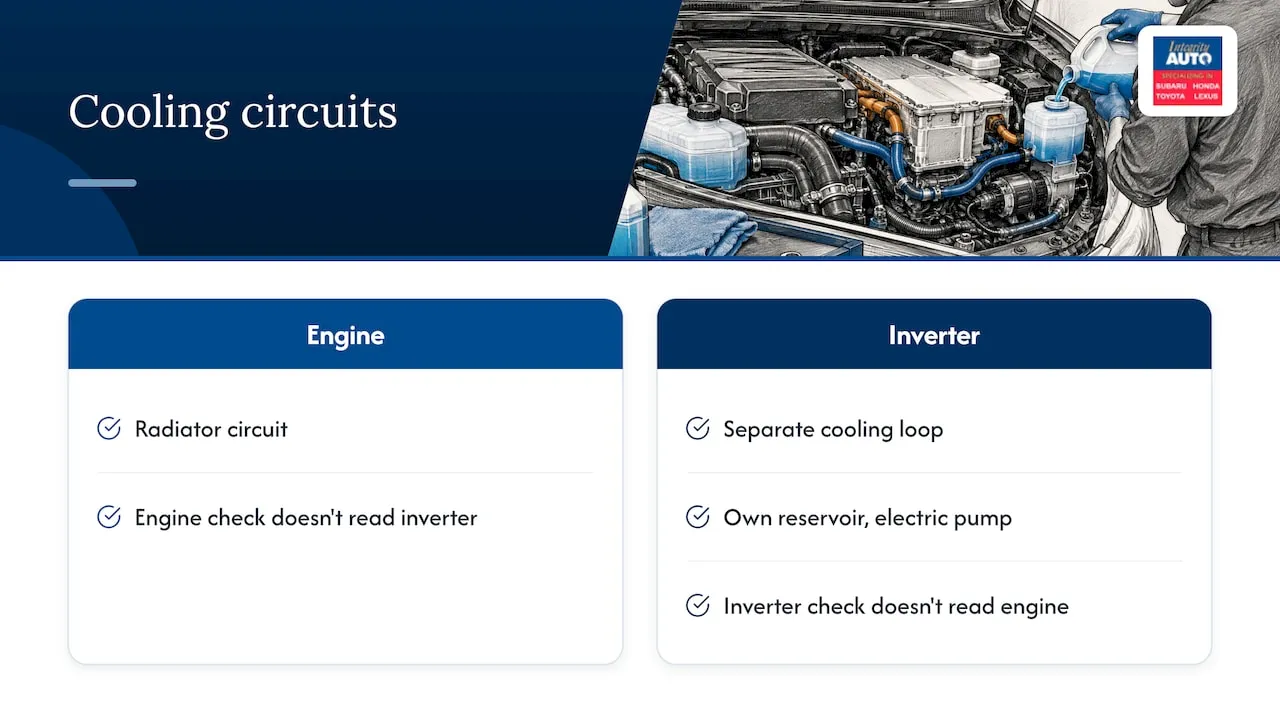
The inverter loop also runs cooler than the engine loop and sits next to electronics rather than a cast iron block. That is why the fluid is treated as a component of the electrical system, not merely as freeze protection.
Is inverter coolant just antifreeze?
In base chemistry, yes: it is an ethylene glycol coolant mixed with water. In practice, the formulation matters. The fluid is meant to protect aluminum passages from corrosion and to stay chemically stable around high-voltage hardware. Using the wrong chemistry, even a product sold as coolant, can compromise internal components.
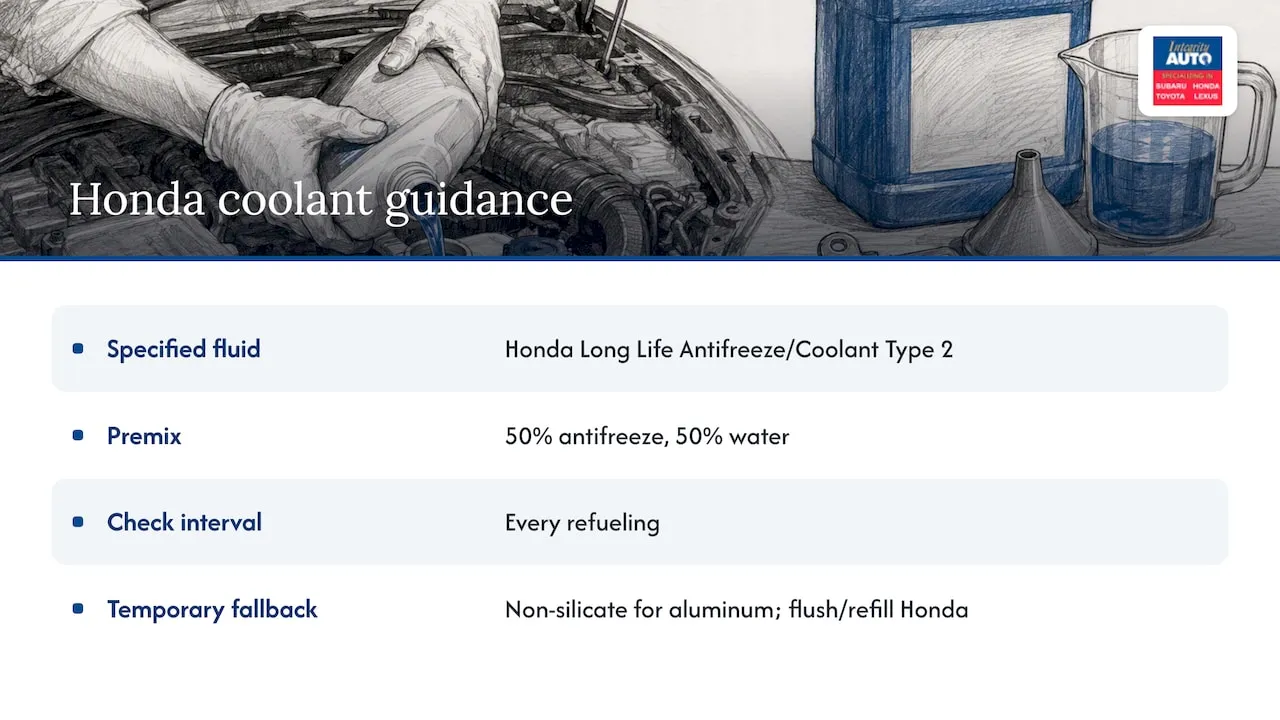
Honda’s own service information is the clearest public statement. The Honda owner guidance for the inverter coolant calls for Honda Long Life Antifreeze/Coolant Type 2, premixed with 50% antifreeze and 50% water, and says not to add straight antifreeze or water. It also recommends checking the inverter coolant level every time the vehicle is refueled. The same guidance allows a high-quality non-silicate coolant made for aluminum engines only as a temporary measure, followed by a flush and refill with Honda coolant as soon as possible.
The premixed 50/50 point deserves attention. Pouring concentrate into a reservoir, or topping off with tap water, changes the ratio and introduces minerals. Honda’s specifications for hybrid engine loops go further and list the coolant ratio as 50/50 with distilled water for the Civic Hatchback Hybrid.
Toyota red vs. pink coolant
This is the question behind many hybrid coolant searches. Toyota has sold more than one factory coolant, commonly described by color: red Long Life Coolant and pink Super Long Life Coolant. Pink Toyota coolant is described by retailers as a prediluted 50/50 product using a P-OAT formulation, which stands for phosphated organic acid technology.
Two cautions apply:
- Color is a dye, not a specification. Different manufacturers dye different chemistries pink, red, orange or green. A pink bottle from an unrelated brand is not automatically the same as Toyota’s pink fluid.
- Model year matters. The coolant a 2004 Prius left the factory with may not be the one specified for a 2020 Corolla Hybrid. The owner’s manual and the under-hood labels are the authority.
Owners also ask whether a long life and a super long life coolant can be combined. The safest answer is that mixing different formulations is a risk with no upside. If an unknown fluid is already in the system, a drain and refill with the specified product is the cleaner route than guessing.
For Toyota and Lexus vehicles in the Portland area, the Toyota, Lexus and Scion cooling system flush page explains how that service is approached.
How the inverter loop differs from the engine loop
The two loops are separate in plumbing and often in fluid handling. A few differences shape how service is done:
| Feature | Engine cooling loop | Inverter cooling loop |
|---|---|---|
| What it cools | Combustion engine, heater core | Inverter and related power electronics |
| Reservoir | Main reserve tank | Separate, usually smaller reservoir |
| Tolerance for contamination | Moderate | Low, because of nearby electronics |
| Fluid choice | Per manual | Per manual, often the same family of coolant but not always |
Honda also separates the two in its documentation. Its coolant level instructions tell owners to park on level ground and check the reserve tanks, and a level below the MIN mark is a reason to have the vehicle looked at rather than simply topped off and forgotten.
Additives, spills and why technique matters
Manufacturers including Honda and Toyota discourage aftermarket rust inhibitors and additives in these systems, because they can disturb the coolant’s designed chemical balance. Over time that can reduce cooling performance and affect inverter hardware.
Spills are a second concern. Coolant that lands on sensitive electronics in the motor compartment can cause damage, and improper mixing can accelerate corrosion in a system built around aluminum. Careful technicians keep the work area clean, use the specified fluid, and avoid overfilling. Cleanliness and precision around the motor housing are part of the job, not a courtesy.
A level that keeps dropping points to a leak, not a normal loss. Hoses, clamps, the pump and the reservoir are the usual places to look, and the Toyota cooling system leak and cooling system hoses pages describe what that diagnosis involves.
How often should inverter coolant be changed?
There is no single interval for every hybrid. Intervals differ by manufacturer, model and year, and some are expressed in both miles and months. Honda recommends a level check at every fill-up, which is about monitoring rather than replacing. For replacement timing, the maintenance schedule in the owner’s manual is the reference. Toyota publishes model-specific guides, such as the warranty and maintenance guide for the Prius, which also describes what the hybrid system warranty covers and excludes.
Severe use, such as heavy stop-and-go traffic, hot summers or towing where permitted, can justify earlier attention. A shop that knows the platform can weigh the schedule against the condition of the fluid and the age of the hoses instead of applying one number to every car.
Warning signs that the inverter loop needs attention
The inverter cooling system rarely fails silently. Symptoms that justify a prompt inspection include:
- A low or empty inverter reservoir.
- A sweet coolant smell or visible residue near the front of the engine bay.
- Warning lights for the hybrid system or the vehicle’s power electronics.
- Reduced power or a hybrid system that shuts down on hot days.
- Coolant that has turned cloudy, brown or visibly contaminated.
Inverter failures are costly, and heat is one of the contributing factors. The Prius-specific inverter failure checks cover what technicians look at before a part is condemned. A warning light by itself does not prove the inverter is bad, and a proper diagnosis separates a coolant problem from an electrical one.
What a proper inverter coolant service involves
The sequence varies by model, but a careful service generally includes:
- Identifying the specified coolant from the manual or service information for that vehicle.
- Inspecting hoses, clamps, the reservoir cap and the pump for leaks or wear.
- Draining and refilling with the specified premixed coolant, avoiding straight water or concentrate.
- Bleeding air from the loop, since trapped air reduces cooling and can set off warnings.
- Cleaning any spill from the area and rechecking the level after a short drive.
Do-it-yourself instructions circulate widely online, including a simple drain, refill and run method. Results depend on the model, and an air pocket or a contaminated reservoir can turn a cheap job into an expensive one. Because a mistake can damage electronics, many owners choose to have a specialist handle it.
Hybrid cooling service in Portland
Integrity Auto is an independent shop serving Toyota, Lexus, Subaru and Honda owners in the Portland, Oregon area, with hybrid vehicle service, diagnostics and scheduled maintenance among its offerings. Owners of hybrids can start with the independent Toyota service and repair page, and Honda hybrid owners can see the Honda services and repair page, which lists coolant services alongside other manufacturer-recommended maintenance. The shop also offers complimentary multipoint inspections, which can flag a low reservoir or a weeping hose before it becomes a repair. For general coolant work, see the antifreeze and cooling system flush page.
FAQ
Is inverter coolant the same as regular antifreeze?
It is built on the same ethylene glycol base, but the formulation is specified for the vehicle. Honda calls for its Long Life Antifreeze/Coolant Type 2 in a premixed 50/50 ratio and advises against adding straight antifreeze or water. Generic coolant should be used only as a short-term emergency measure, followed by a proper flush.
Can pink coolant go into a Toyota hybrid inverter reservoir?
Only if it is the fluid the manual specifies for that model. Pink is a dye color, and Toyota’s pink fluid is a specific P-OAT formulation. A different brand in a similar color may be a different chemistry, so the label and the manual should match.
How often should the inverter coolant level be checked?
Honda recommends checking the inverter coolant level every time the vehicle is refueled. A level that falls below the marked minimum calls for inspection, since the loop is sealed and should not lose fluid.
Does a hybrid have two radiators?
Many do, with a separate loop for the inverter. Department of Energy research notes that current hybrid systems typically use a dedicated loop for power electronics, and that consolidating loops is an active research goal.
Sources
- Honda Inverter Coolant guidance
- Honda Coolant Levels
- Honda Civic Hatchback Hybrid 2025 specifications
- Department of Energy: Thermal Control & System Integration
- Toyota 2024 Prius warranty and maintenance guide
- Toyota Genuine Super Long-Life Coolant Pre-Mixed Pink product page