

Servicing a car at an independent shop does not void the manufacturer’s warranty. Under the Magnuson-Moss Warranty Act, manufacturers and dealers cannot deny coverage simply because a consumer chose an independent repair shop for routine maintenance. “Independent service warranty” can also mean the guarantee an independent shop puts on its own work. This article covers both, with the records and questions that protect an owner in either case.
TL;DR
- Routine maintenance and repairs at an independent shop do not void a factory warranty. A claim can be denied only if the shop’s work or a part is shown to have caused the failure.
- Keep every receipt. Chronological service records are the main evidence if a claim is contested.
- An independent shop’s own warranty is separate from the factory warranty. AAA reports that good shops commonly cover parts and labor for at least 12 months or 12,000 miles, so the terms should be confirmed before work starts.
- Extended warranties are service contracts. They follow their own rules and often require pre-approval of repairs.
What federal law says about independent shops
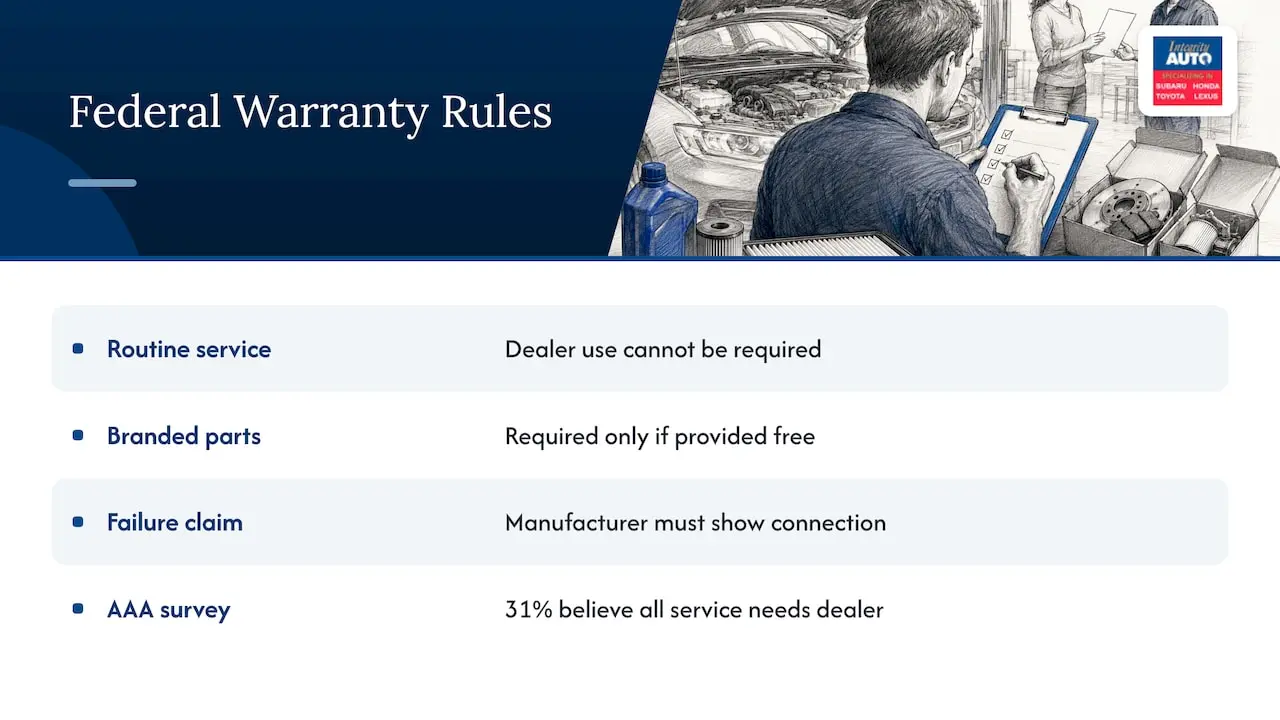
The Magnuson-Moss Warranty Act is the basis for the rule. The FTC states that a manufacturer cannot require a consumer to use its dealerships for routine service or to buy specific branded parts, unless those services or parts are provided free under the warranty. The agency has also warned major companies that conditioning warranty coverage on specified parts or services is illegal.
The law does not make a manufacturer cover everything. If an independent repair or an aftermarket part directly caused the failure, the manufacturer may deny that specific claim. The burden sits on the manufacturer to show the connection. A worn-out engine mount is not denied because the oil was changed at an independent shop.
Misunderstanding is common. An AAA survey found that 31% of people believe all service must be performed at the dealer to keep a warranty valid. AAA labels that a myth.
Two different warranties, two different jobs
Much confusion comes from mixing up the warranties a car owner may hold at the same time.
| Type | Who backs it | What it covers | Typical catch |
|---|---|---|---|
| Manufacturer warranty | The automaker, repaired by an authorized dealer | Defects in materials and workmanship for a set time or mileage | Does not cover routine maintenance such as brake wear |
| Independent shop warranty | The shop that did the work | Parts and labor on that specific repair | Terms vary by shop, so read them first |
| Extended warranty (service contract) | The contract provider | Repairs listed in the contract | Often requires pre-approval and approved facilities |
AAA notes that most factory warranties do not cover routine maintenance, so brakes, oil changes and fluids are the owner’s cost wherever they are done. That is why an independent shop’s own warranty matters: it guarantees the work the factory warranty never covered.
What an independent shop’s own warranty should include
AAA’s guidance is that a shop warranty is standard practice for guaranteeing workmanship and components, and that at least 12 months or 12,000 miles is a common benchmark, with some shops offering longer terms or lifetime coverage on selected parts. Before authorizing a repair, ask for these points in writing:
- Duration in months and miles, and which comes first.
- Whether the warranty covers both parts and labor.
- Which parts qualify. OEM parts, which are made to the automaker’s specification, are one factor. A look at original versus aftermarket parts for Toyota, Lexus, Subaru and Honda explains the trade-offs.
- Where the warranty is honored. AAA advises that a traveling owner contact the original shop before authorizing any work, or the claim can be denied.
- Any exclusions, such as damage from misuse or later work by another shop.
Records that protect a factory warranty
The FTC’s practical caveat is documentation. If a claim is disputed, receipts for oil changes, tire rotations and inspections are the proof that the vehicle was properly maintained. A simple routine is enough:
- Keep each invoice, showing date, mileage, VIN and the work performed.
- File them chronologically, on paper or as photos.
- Follow the intervals in the owner’s manual. For many Toyota, Lexus, Subaru and Honda models these are the 30,000, 60,000 and 90,000 mile services, explained in this overview of mileage services.
- Note which parts were installed, especially if they are not factory parts.
A shop that records mileage and services on every invoice makes this easy. A shop that hands over only a total does not.
Emissions components and other special cases
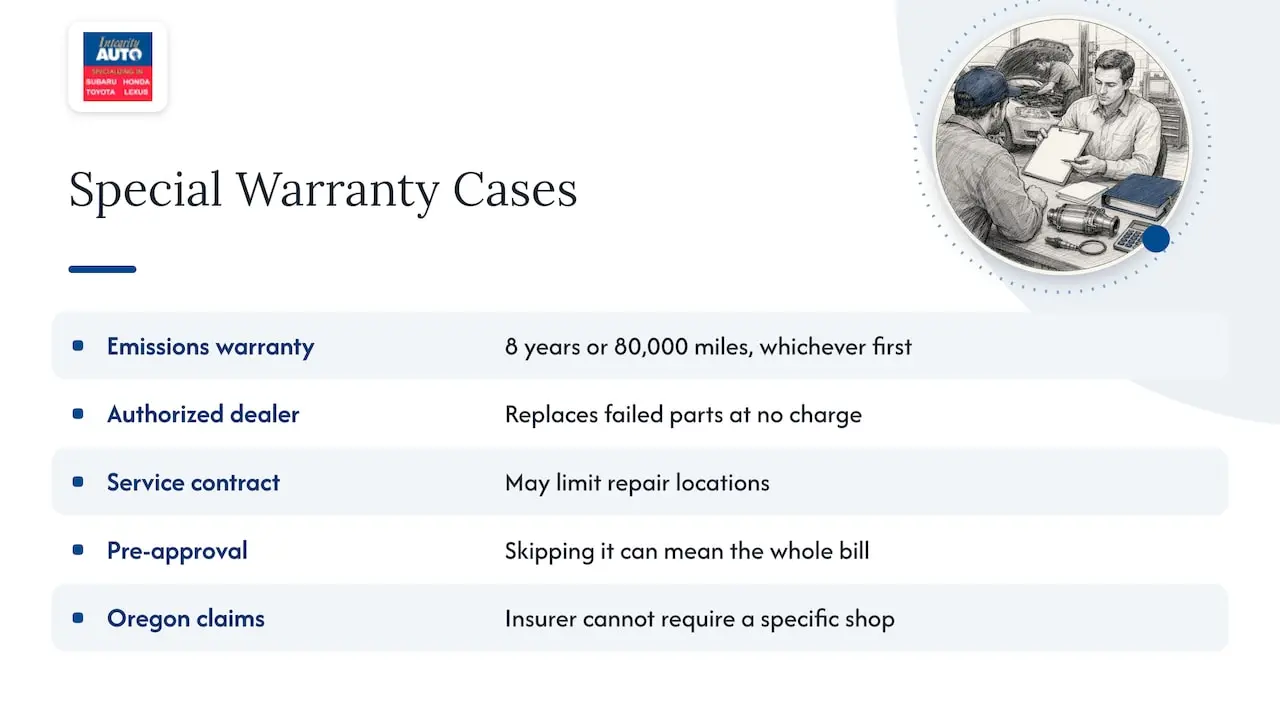
A few situations work differently. For vehicles built in 1995 or later, federal law requires an emissions warranty covering the powertrain control module and catalytic converters for 8 years or 80,000 miles, whichever comes first. During that window an authorized dealer must replace those parts at no charge if they fail. Owners with a check engine light on a newer vehicle should confirm coverage before paying for a catalytic converter replacement elsewhere.
Extended warranties need extra care. What most people call an extended warranty is technically a vehicle service contract, and the FTC notes that these contracts often limit where repairs can be done. Owners who skip a required pre-approval can be left paying the whole bill. The contract provider should be asked about pre-approval before the car enters any shop, independent or dealer.
Insurance claims are separate again. Oregon’s Division of Financial Regulation states that state law prohibits an insurer from requiring a particular repair shop after an accident.
How to judge an independent shop before trusting it
Quality varies from shop to shop. The AAA Guide to Auto Repair says that, outside certain warranty repairs, an owner is not obligated to use any particular facility. A low-risk test is a minor job such as an oil change. During that visit, check the cleanliness of the shop, the professionalism of the staff and whether modern diagnostic equipment is on hand.
Credentials also help. ASE certification shows that technicians have passed standardized testing, and the reasons it matters are covered in this guide to ASE certification for mechanics. For brand-specific work, a shop that sees the same four makes every day will know their common failure points.
Independent Toyota, Lexus, Subaru and Honda service in Portland
Integrity Auto Inc is an independent shop in Portland, Oregon, that works on Toyota, Lexus, Subaru and Honda vehicles. It describes its approach as a consultative, transparent alternative to the dealership, with ASE certified technicians, OEM parts and warranties it states are longer than dealership repairs. Owners can review service by make on the pages for Toyota, Lexus, Honda and Subaru. Scheduled maintenance, brakes, transmission work, emission testing and diagnosis with estimates are all listed. Owners with a vehicle still under factory warranty can ask the shop for itemized invoices that record mileage and services performed.
FAQ
Will an oil change at an independent shop void my warranty?
No. Federal law does not allow a manufacturer to void coverage only because routine maintenance was done outside the dealership. Keep the receipt and follow the maintenance schedule in the owner’s manual. A claim could be denied only if the work itself caused the failure.
Do I have to use OEM parts to keep my warranty?
The FTC says manufacturers cannot require specific branded parts unless they are provided free under the warranty. Aftermarket parts are not an automatic reason for denial. If a part causes damage, the related claim can be refused, so many owners choose OEM parts for key components.
Does an independent shop’s warranty replace the factory warranty?
No. The two are separate. The factory warranty covers defects, and the shop warranty guarantees the specific repair that shop performed. Warranty repairs covered by the automaker are done by an authorized dealer at no cost.
Are extended warranties protected the same way?
Not in the same terms. They are service contracts, and the contract sets the rules, including approved facilities and pre-approval. Read the contract or call the provider before any repair begins.
Sources
- FTC: FTC says companies’ warranty restrictions were illegal
- FTC: Staff warns it is illegal to condition warranty coverage on specified parts or services
- FTC: Auto warranties and auto service contracts
- AAA: Vehicle warranties offer low or no cost repairs
- AAA: What does a car warranty cover?
- AAA Guide to Auto Repair
- Oregon Division of Financial Regulation: Repair shops after an accident