
In most cases, yes. A diagnostic fee is worth paying when a warning light, an intermittent fault, a drivability problem or an emissions failure could have several causes. The fee pays a technician to test, interpret and rule out causes, so the repair that follows targets the real problem instead of a guess. It is worth less when the charge is vague, has no time limit, or covers only a code scan with no explanation.
TL;DR
- A diagnostic fee pays for testing and interpretation, not for the repair itself. Hard-to-find faults can cost more to locate than to fix.
- No nationwide price makes $200 automatically fair or excessive. What matters is what the fee includes, the time limit, and whether the shop explains it in writing.
- A trouble code is a starting point, not a verdict. Replacing the part named by a code without testing is a common way to spend money twice.
- Before authorizing anything, ask what testing is included, what the cap is, and whether the fee applies toward the repair.
- You can decline a diagnosis before work begins, but a fee already authorized generally still stands.
What a diagnostic fee actually pays for
A diagnostic fee is a charge for troubleshooting. It is not a down payment on a repair, and it is not a charge for plugging in a scanner and reading a number.
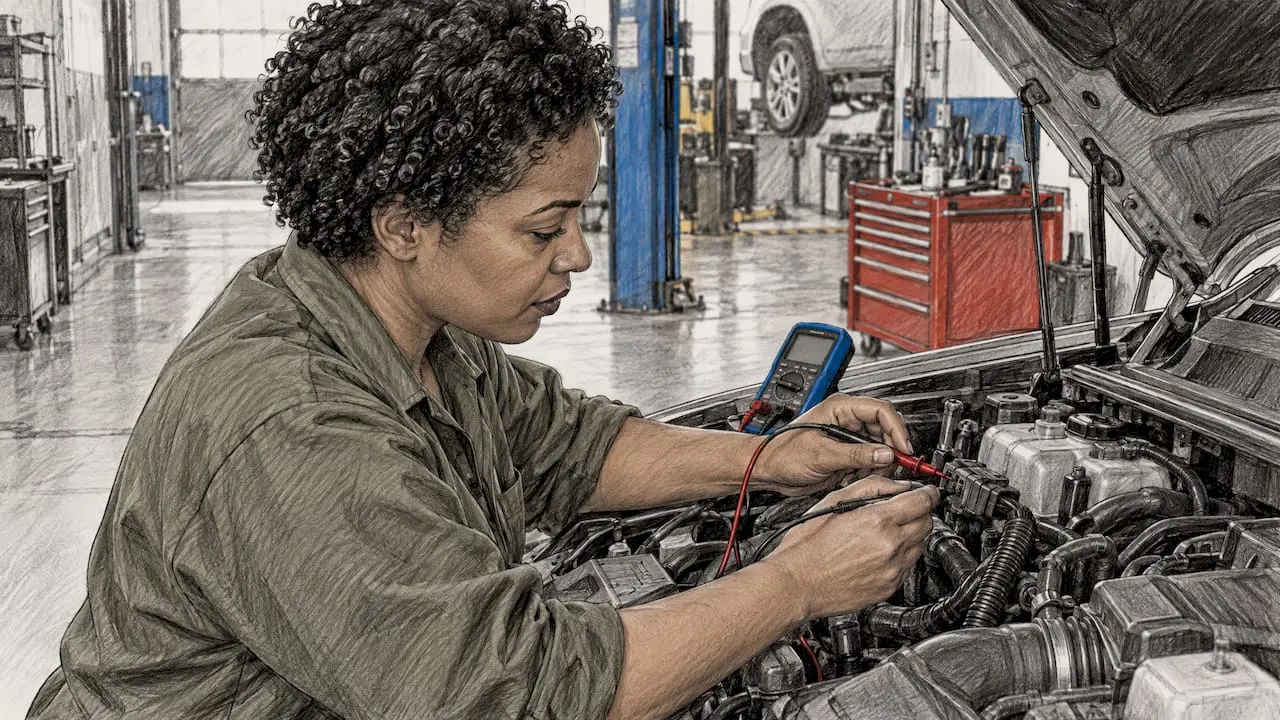
The work behind it includes verifying the complaint, retrieving stored codes, reading live data, testing circuits and components, and comparing results against what the manufacturer expects. AAA’s guidance notes that diagnostic work is hard to estimate because every troubleshooting process is different, and that shops often define an initial charge by the procedures included and a maximum amount of time, then ask for authorization before going further.
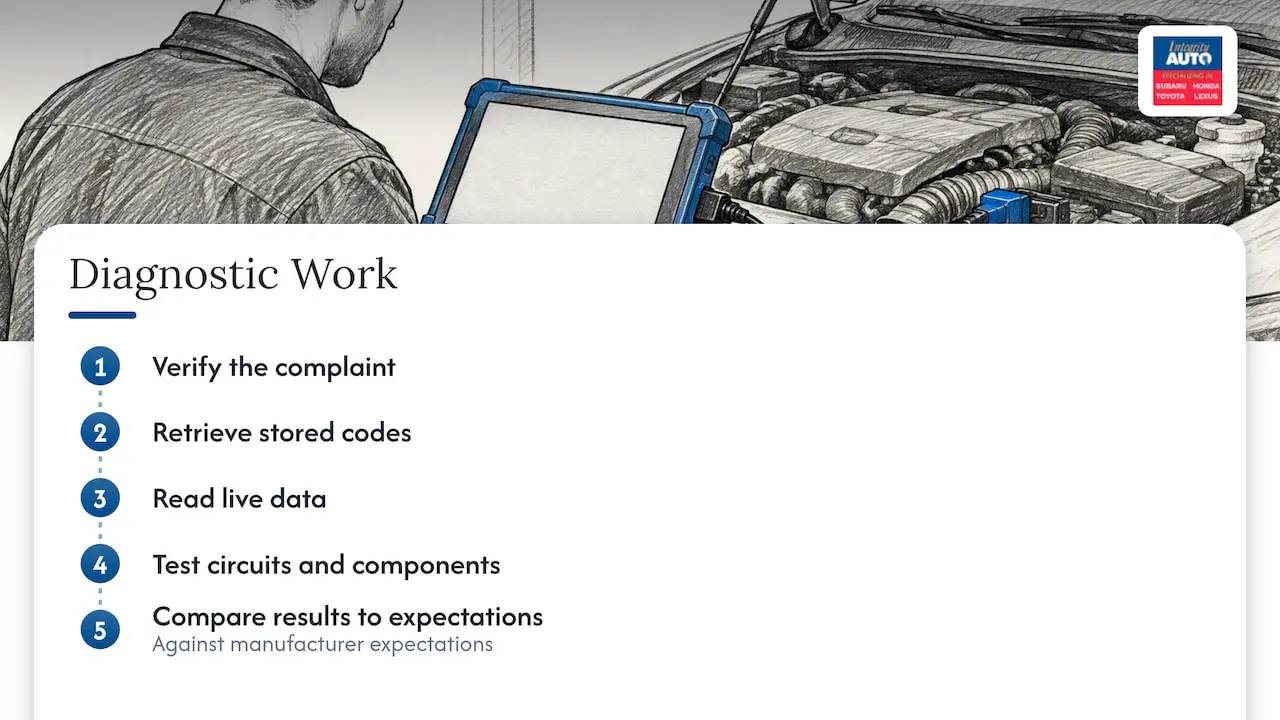
That is why a short repair does not mean a short diagnosis. Electrical faults are the clearest example. Finding a break in a wire harness can take hours of testing, while the fix itself takes minutes. The customer is paying for expertise, equipment and the time needed to eliminate competing causes.
When paying for diagnosis makes sense
Diagnosis earns its fee when the symptoms do not point to one obvious part. Typical cases:
- A check engine light or other warning light. The light says a system has detected a problem. It does not say which part has failed.
- Intermittent problems. A stall, a hesitation or a warning that comes and goes needs structured testing, and often a road test.
- Electrical issues. Parasitic battery drain, flickering lights and sensor faults can have many sources.
- Hybrid-system concerns. These involve high-voltage components and manufacturer-specific data.
- Emissions test failures. A failed test says what the system detected, not what repair will fix it.
In those situations, skipping diagnosis tends to cost more. Parts replaced on a hunch are often not refundable once installed, and the original fault stays in place.
When a diagnostic fee is not worth it
Not every charge deserves approval. Questions are warranted when:
- The shop cannot say what the fee includes.
- There is no time or dollar ceiling, and the shop expects open-ended authority to keep testing.
- The result is a code printout with no explanation of what was tested or what it means.
- The problem is obvious and does not need diagnosis, such as worn brake pads confirmed by a visual inspection.
- The estimate is verbal only.
The FTC’s auto repair guidance frames fairness as a matter of transparency, not a specific dollar figure. A reputable shop explains how it prices its work, identifies the condition being investigated, provides a written estimate and gets approval before exceeding the agreed limit.
Is a $200 diagnostic fee normal?
It can be. There is no authoritative national price that makes $200 normal or excessive. AAA’s repair guide reports typical labor rates of $50 to $150 per hour, and rates vary by region and by shop type. That is labor-rate context, not a standard diagnostic price, and the guide is from 2016, so current rates in a metro area like Portland may be higher.
A useful way to judge a quote is to translate it into time and deliverables:
| Question | A fee that is easier to justify | A fee worth challenging |
|---|---|---|
| What is included? | Named procedures: code retrieval, live data, circuit or component testing, road test | “Computer check” with no detail |
| Is there a limit? | A stated maximum time or amount, with approval needed to go beyond it | No ceiling |
| What do you receive? | A written finding, the cause, and a repair estimate | A code number and a parts suggestion |
| Does it apply to the repair? | The shop states the policy before work begins | Policy is unclear or learned only at the end |
A $200 charge for a defined, technician-led diagnosis with a written result is a different thing from $200 for an unexplained scan. The amount alone does not settle it.
Why a code is not a diagnosis
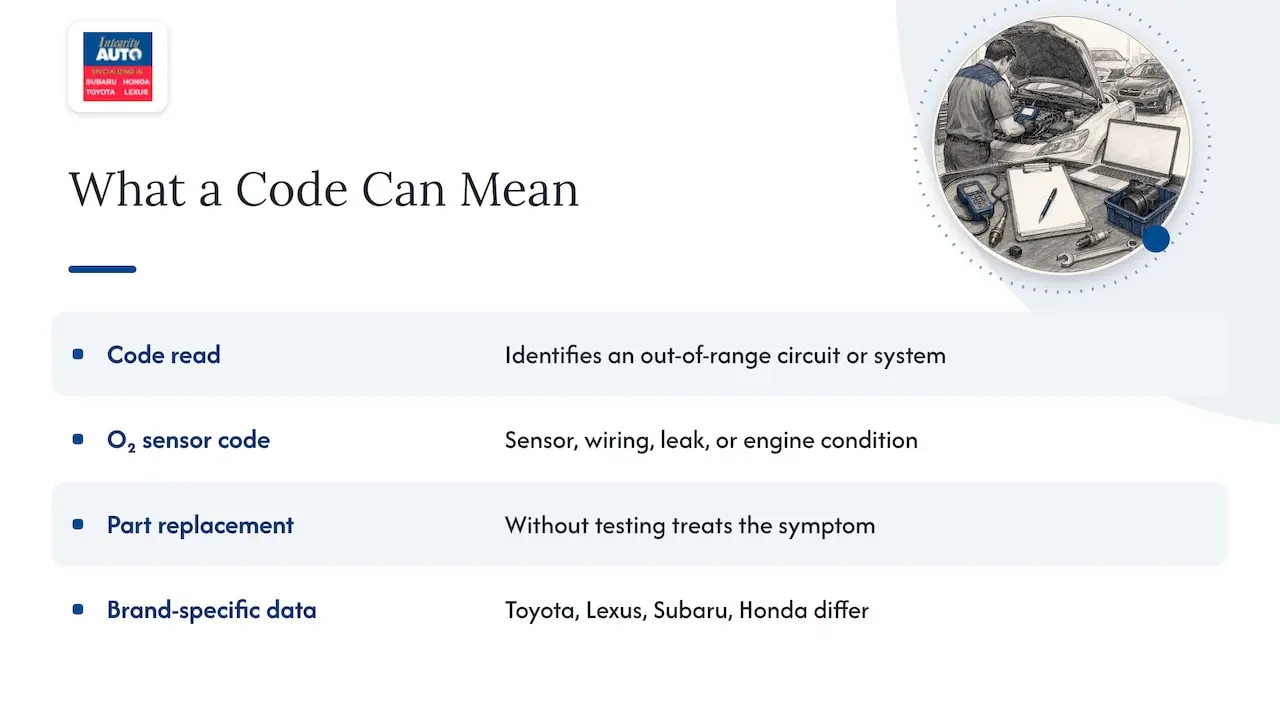
When a check engine light comes on, the vehicle stores a code through its on-board diagnostics (OBD) system. Free code reads at parts stores can be a handy first look, but a code identifies a circuit or system that tested outside its expected range. It does not prove that a part has failed.
Oregon’s Department of Environmental Quality describes OBD as a system of many components, including evaporative controls, oxygen sensors and exhaust gas recirculation, with variations between manufacturers. A code pointing at an oxygen sensor, for example, might come from the sensor, its wiring, an exhaust leak or an engine running condition that the sensor is correctly reporting. Replacing the sensor without testing treats the symptom.
This is where make-specific experience matters. Toyota, Lexus, Subaru and Honda each report data differently and have their own known patterns. A technician who works on these brands daily can read that data in context. Integrity Auto’s page on check engine light diagnosis explains how the process works for Toyota and Lexus owners, and its page on O2 sensor service shows one of the common repairs that a code can point toward.
Diagnosis after a failed Oregon emissions test
Portland-area drivers face a particular version of this question. Oregon DEQ states that a vehicle that fails its emissions test needs repairs before retesting, and that recognized repair shops can diagnose and repair the problems identified. The test station does not charge for providing the list of recognized shops, but diagnosis and repair at a private shop are billed separately.
DEQ says recognized shops have appropriate diagnostic equipment and employ at least one technician with ASE certification in engine performance, along with emissions experience. A failed test is a case where the fee tends to pay for itself, because the vehicle must be fully repaired to pass and guessing means repeated trips. More background is available in Integrity Auto’s guides to what causes a car to fail an emissions test and DEQ emissions help for Toyota, Lexus, Subaru and Honda.
Questions to ask before authorizing a diagnosis
A short conversation at the counter prevents most disputes. Ask:
- What exactly will be tested, and what will the fee cover?
- What is the maximum time or dollar amount before the shop calls for approval?
- Will the result be written, including the cause and a repair estimate?
- Does the fee apply toward the repair if the work is done here?
- Does the fee still apply if the repair is done elsewhere? The FTC recommends asking this before work begins.
- Are OEM parts used for any repair that follows?
Get the answers in writing. AAA and the FTC both advise obtaining a written estimate and not authorizing vague, open-ended work.
Can you refuse the fee, and when is a second opinion useful?
A customer can decline a diagnostic charge or additional testing before work starts. Refusal does not cancel a fee that was already authorized, and rules on estimates and authorization vary by state and by repair agreement, so the signed paperwork matters.
A second opinion is most valuable when the proposed repair is expensive, invasive or based on a quick visual guess. The FTC suggests considering a second opinion for costly or complicated repairs. If the first shop supplied a written diagnosis with test results, the second shop can often verify it faster, which keeps the second fee smaller.
How Integrity Auto handles diagnosis
Integrity Auto is an independent shop in Portland, Oregon, that specializes in Toyota, Lexus, Subaru and Honda vehicles, with ASE-certified technicians and OEM parts. Diagnosis covers check engine lights, DEQ-related problems, drivability and electrical concerns. The shop explains its approach to estimates on its diagnostic charges and estimates page, and owners can go directly to the page for their make: Toyota, Lexus, Honda or Subaru. No diagnostic price is published, so the shop is the place to ask what a specific symptom involves.
FAQ
Can I refuse to pay the diagnostic fee?
Yes, before work begins. A customer can decline the diagnosis or any additional testing. Once a fee has been authorized, though, it generally still applies, so ask what it covers and whether it is charged if repairs happen elsewhere before signing.
Is a $200 diagnostic fee normal?
It can be. No national benchmark makes that figure automatically reasonable or excessive. It is fair for a defined diagnosis with named tests, a time limit and a written result, and questionable for an unexplained scan.
Is it normal for a mechanic to charge a diagnostic fee?
Yes. Many shops define an initial diagnostic charge by the procedures included and a maximum amount of time, according to AAA’s repair guide. The charge compensates testing time and equipment, which cannot be priced like a flat-rate repair.
Should a free code scan be enough?
A free scan can show which code is stored, which is useful information. It does not confirm which part or condition caused the code. For anything beyond a simple, obvious fault, testing is what turns a code into a repair plan.
Sources
- AAA Guide to Auto Repair (2016)
- Auto Repair Basics, FTC Consumer Advice
- On-board Diagnostics FAQ, Oregon DEQ
- Recognized Automotive Repair Shops, Oregon DEQ