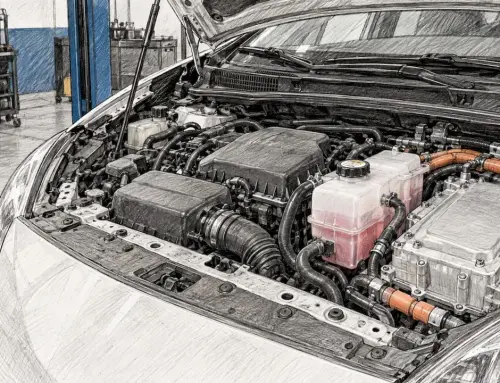

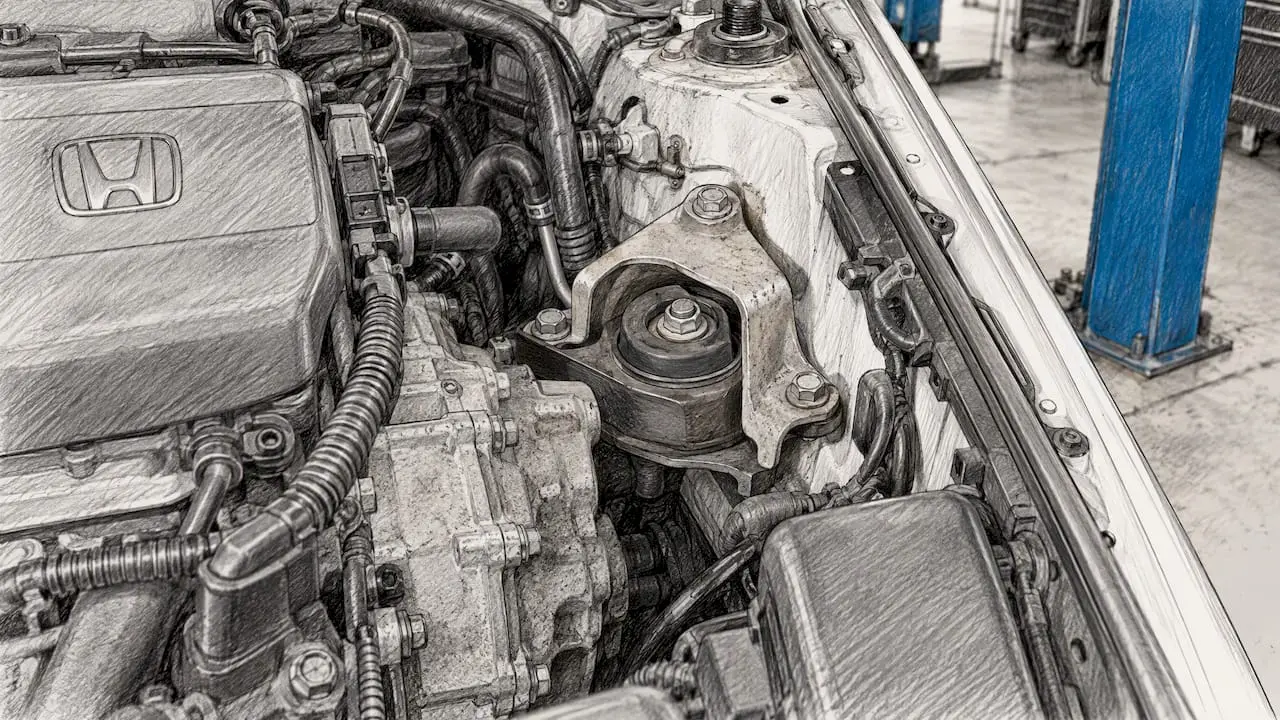
A worn Honda transmission mount usually shows up as a clunk or thud when shifting between Park, Drive and Reverse, a vibration at idle or in gear, and a drivetrain that visibly rocks under load. The mount is a rubber or fluid-filled support that holds the transmission to the body or subframe while absorbing vibration. When it cracks, collapses or separates, the drivetrain moves more than it should. This guide covers the symptoms, how they differ between automatic and manual Hondas, how a technician confirms the diagnosis and what happens if the problem is ignored.
TL;DR
- Typical signs of a failing transmission mount are clunking or banging during gear engagement, acceleration or braking, vibration at idle, and excess drivetrain movement.
- A thud when moving the shifter from Park to Drive or Reverse is one of the most common signs of a mount that no longer holds the drivetrain steady.
- Mount symptoms can resemble transmission, axle or engine problems, so the mount should be confirmed with a loaded-movement check before any parts are replaced.
- Driving on a failed mount can stress hoses, wiring, exhaust and linkages, so an early inspection is the cheaper path.
What a transmission mount does on a Honda
The engine and transmission form one heavy assembly that twists every time torque is applied. Mounts restrain that twisting and keep engine vibration out of the cabin. According to AA1Car’s motor mount guide, a failed mount amounts to a loss of restraint and vibration isolation: the powertrain moves under torque, and that movement can cause secondary contact or alignment damage.
Honda uses conventional bonded-rubber mounts on many models and hydraulic (fluid-filled) mounts on others. The wear patterns differ. Anchor’s technical sheet on mount failure says bonded rubber mounts should be replaced when the rubber separates from the metal or cracks, and hydraulic mounts when they collapse and leak fluid.
The most common symptoms
Clunking, banging or thumping
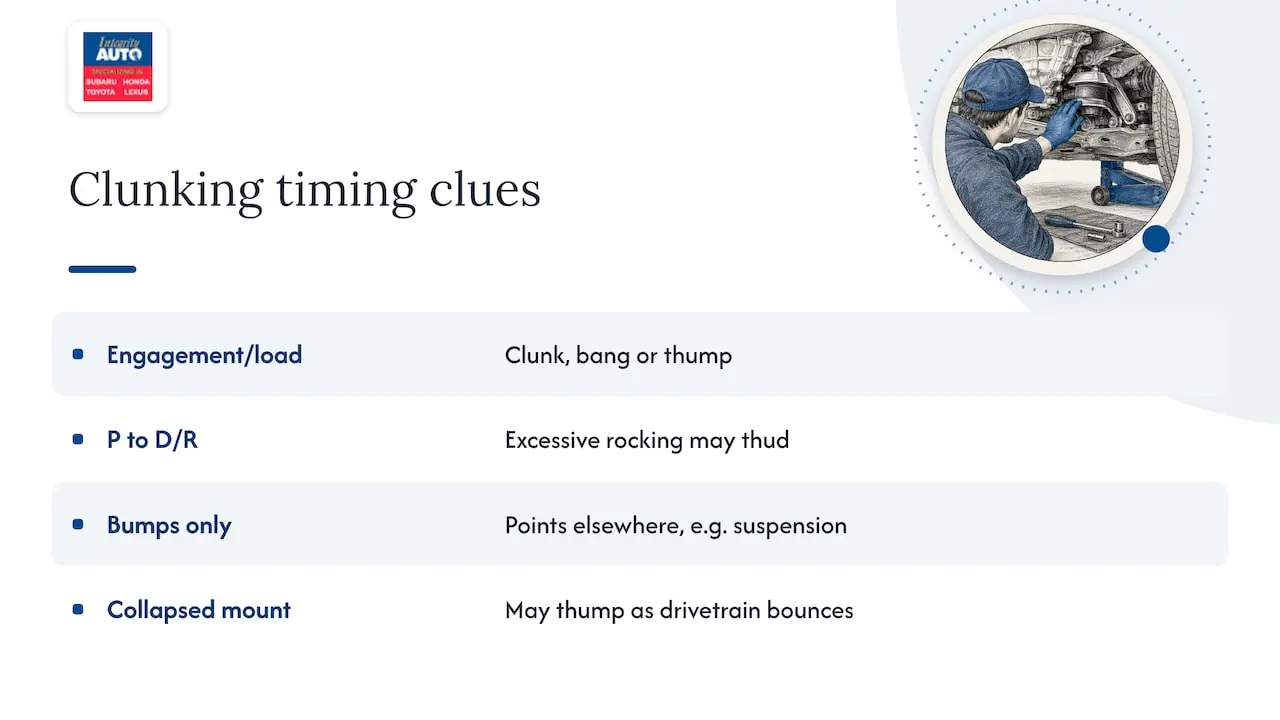
The classic complaint is a single heavy clunk. According to a diagnostic overview from VehicleRuns, a failing mount can cause clunking, banging or thumping during gear engagement, acceleration or braking. The same source notes that a drivetrain that rocks excessively can cause a thud when the shifter goes from Park to Drive or Reverse.
The timing is the clue. A mount clunk is usually tied to gear engagement, throttle input or torque reversal, meaning the moment the driver lifts off the gas or gets back on it. Noises that appear only over bumps point elsewhere, such as suspension parts, although a collapsed mount can also thump over bumps as the drivetrain bounces up and down.
Vibration at idle or in gear
A worn mount no longer absorbs engine vibration, so it passes through the floor, seat and steering column. Vibration that appears at idle in gear, then fades as RPM rises, is a typical pattern. Vibration that is present all the time, at every speed, is more likely to be engine-related than mount-related.
Excess drivetrain movement
With the hood open and a helper shifting the car into gear while holding the brake, a healthy engine bay shows only a small, controlled shift. Large lurches, tilting or an engine that visibly lifts suggest a broken mount. The engine mount guide at Integrity Auto walks through five quick tests for checking this movement and what to tell a technician.
Shift feel and linkage problems
Because the transmission shifts position relative to the body, shift cables or linkages can be pulled out of alignment. The result can be a stiff shifter or a gear that feels vague. This is why mount movement is sometimes mistaken for a transmission fault. Anchor’s sheet also lists faulty automatic-transmission shift patterns and exhaust problems among the complaints associated with failed mounts.
Automatic versus manual Hondas
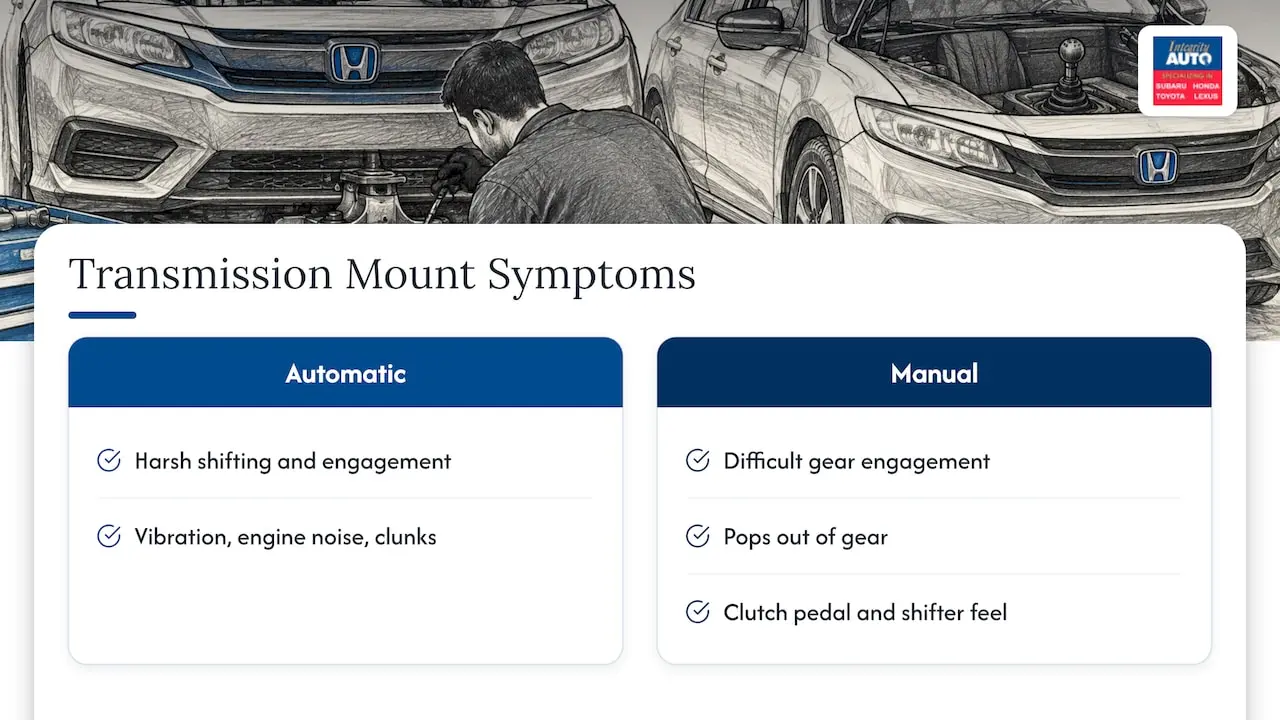
Symptoms overlap but are not identical. A Honda/Acura service bulletin on transmission mount replacement, TSB 96-024, lists harsh shifting and engagement for automatic transmissions. For manual transmissions it lists difficult gear engagement and the car popping out of gear. Both can bring vibration, excessive engine noise and clunks when cornering, accelerating or decelerating.
That bulletin dates from 1996 and covers specific older models, so it is best read as an illustration of how the symptoms divide, not as a rule for every current Honda. Manual owners tend to feel mount wear more sharply at the clutch pedal and shifter, since the driveline twists hard when the clutch is released.
Mount symptoms that look like something else
Several Honda problems feel similar, and replacing the wrong part wastes money.
| Symptom | Mount-related if… | Look elsewhere if… |
|---|---|---|
| Clunk on shifting into gear | It happens at the moment of engagement and the engine visibly rocks | The shift itself is delayed, slips or flares |
| Vibration | It is strongest at idle in gear and eases with higher RPM | It is constant at all speeds, or appears with speed |
| Clicking or knocking in turns | Not typical for a mount | CV axle wear is likely; see the lift and rotate test for Honda CV axle noise |
| Shudder at light throttle | Rare | On CVT models, fluid condition is often the first thing to check; see Honda CVT judder |
| Harsh or jerky upshifts | Only if movement is confirmed under load | Software adaptation can be the cause on some models |
The last row has a documented example. Honda Service Bulletin 20-029, dated August 24, 2020, says intermittent harsh upshifts with steady acceleration on specified 9-speed automatic models may come from abnormal TCM adaptation values and calls for a TCM update. A mount would not fix that, which shows why diagnosis comes before parts. Owners who suspect something deeper can also review warning signs of transmission failure.
How a technician confirms a bad mount
A proper check combines a visual inspection with a loaded test.
- Visual inspection. AA1Car’s guidance is to look for cracked, loose or broken brackets, loose or missing bolts, collapsed rubber and hydraulic fluid leakage. A pry bar can reveal separation or breakage that is not visible at rest.
- Load test. On an automatic, the transmission goes into Drive and the engine is lightly loaded while the brakes are held. The technician watches for excessive engine movement, which suggests a loose or broken mount.
- Forward and reverse. Revving in Park or Neutral does not apply a realistic torque load, according to Auto Service World. The car must be in gear, in both directions.
- Safety. The same source states the vehicle must be restrained by means other than the service or parking brakes. Powered brake tests are a job for a shop with a lift and experience, not a driveway experiment.
A technician also compares what the driver describes with what the test shows. Notes on when the noise occurs (shifting, braking, a particular gear) shorten the diagnosis considerably.
Can a Honda be driven with a broken transmission mount?
Short-term driving is often possible, but it is not free of risk. AA1Car notes that a failed mount lets the powertrain twist or rock under load, potentially stressing hoses, wiring, exhaust, throttle or shift linkages and CV joints. One automotive site also links a bad mount to pulling to one side and uneven tire wear through chassis misalignment, though that is a less common complaint.
Some modern mounts use interlocking plates and strongly bonded rubber so the driveline stays in place if the rubber fails, as described by Auto Service World. That reduces the chance of a sudden separation but does not remove the wear on surrounding parts. The practical conclusion: a clunk that is getting worse, a shifter that is hard to move or a visible lurch is a reason to book an inspection soon, not at the next oil change.
Replacement: what to expect
Mount replacement is generally a straightforward repair on many Hondas, with the cost and time depending on the model, which mount has failed and how accessible it is. Often the transmission mount is not the only one worn: the engine mounts carry the same load, and a technician will usually check all of them at once. Honda publishes a Service Manuals library covering 1991 to 2017 model years, and a qualified shop uses the factory procedure and torque specifications for the specific model.
Honda mount diagnosis in Portland
Integrity Auto is an independent Honda, Toyota, Lexus and Subaru specialist in Portland, Oregon. Its Honda service and repair page covers inspections, transmission and CVT services, clutches and check engine diagnosis, and the shop describes its technicians as ASE certified. Owners who hear a clunk or feel drivetrain movement can start with a diagnosis appointment so the cause is confirmed before parts are ordered.
FAQ
How do you tell if a transmission mount is bad?
Listen and feel for a clunk when shifting into Drive or Reverse, vibration at idle in gear and a drivetrain that rocks when the throttle is applied or released. A visual check for cracked rubber, separation or fluid leaks supports the diagnosis. A loaded test by a technician confirms it.
What happens if you keep driving with a broken motor mount?
Excess powertrain movement can stress hoses, wiring, exhaust parts, linkages and CV joints. Symptoms such as clunking and vibration tend to grow over time. An early inspection limits the chance of collateral damage.
Can a bad transmission mount cause hard shifting?
It can affect shift feel, because movement can misalign shift linkage. However, harsh shifts also come from fluid condition, software or internal transmission problems, so the mount should be confirmed rather than assumed.
Is replacing a motor mount a big job?
On many Hondas it is a routine repair compared with internal transmission work. Time and cost vary by model and by how many mounts are worn. A shop can give an estimate after inspecting the car.
Sources
- Bad Transmission Mount? How to Diagnose It
- How To Diagnose & Replace Bad Motor Mounts (AA1Car)
- Why Mounts Fail (Anchor technical sheet)
- Transmission Mount Replacement, TSB 96-024
- 9-Speed A/T Hard Upshift with Steady Acceleration, Service Bulletin 20-029
- Bump and Grind (Auto Service World)
- Bad Transmission Mount Symptoms To Watch Out
- Honda Service Manuals