


Run a mix of driving conditions: a cold start and warm-up, stop-and-go city driving, a steady highway cruise, then a cool-down, and repeat that pattern until the readiness flags switch to “ready.” Before scheduling your test, confirm the results with an OBD-II scan tool or ask a shop to read the readiness PIDs and permanent DTCs. If monitors stay incomplete after normal varied driving, a qualified shop can run the diagnostic checks needed to find out why.
TL;DR:
- Spend 10 to 15 minutes driving in city traffic, then hold 45 to 65 mph for 10 to 15 minutes to trigger key monitors.
- EVAP needs fuel between 15% and 85%, a cold start, and a soak with the engine off; many programs let it remain incomplete.
- Many programs assess readiness after five warm up cycles, about 200 miles, or 400 minutes of engine operation since codes were cleared.
- Check Mode $01 monitor flags and Mode $0A permanent codes; after a week of varied driving, persistent incomplete flags warrant a shop diagnosis.
What a drive cycle is and why monitor readiness matters
A drive cycle is the specific combination of driving conditions, engine temperatures, speeds, idle time, and load, that gives your vehicle’s onboard computer the chance to run its built-in self-tests on the emissions control systems. Each of these self-tests is called a monitor, and when a monitor finishes its check and finds nothing wrong, it reports a “ready” status. When it has not yet had the chance to run, it reports “not ready” or “incomplete.”
Readiness status gets reset any time the battery is disconnected, the computer is reflashed, or diagnostic trouble codes are cleared, which is exactly what happens after many repairs. That reset gives the system a clean slate, but it also means every monitor has to run again before an inspection will count it. According to Oregon’s Department of Environmental Quality, a drive cycle is a sequence of varied driving conditions, including highway driving, stop-and-go traffic, and engine cool-down periods, and there is no single mileage figure that guarantees completion since the process depends on factors like coolant temperature change and throttle behavior.
A “not ready” result does not by itself mean something is broken. It usually just means the vehicle has not yet been driven the way the computer needs in order to finish checking.
Inspection programs rely on readiness criteria for a practical reason:
- They confirm the onboard computer has actually had a fair chance to check the emissions systems before issuing a pass.
- They prevent a car with a hidden problem from passing simply because its computer was recently reset and had no time to find a fault.
- They give drivers a consistent, repeatable standard instead of a judgment call at the test station.
Step-by-step drive cycles for the common monitors
Different monitors need different conditions to run, which is why a single short trip around the block rarely sets everything. Below is a practical sequence that touches the conditions most monitors are looking for.
Cold-start warm-up. Start the engine from cold, ideally after it has sat for at least eight hours, and let it idle for no more than a couple of minutes. Then begin driving gently. The computer is watching for a steady rise in coolant temperature from a cold starting point, since several monitors, including the catalyst and oxygen sensor heater checks, only begin once that warm-up pattern is confirmed.
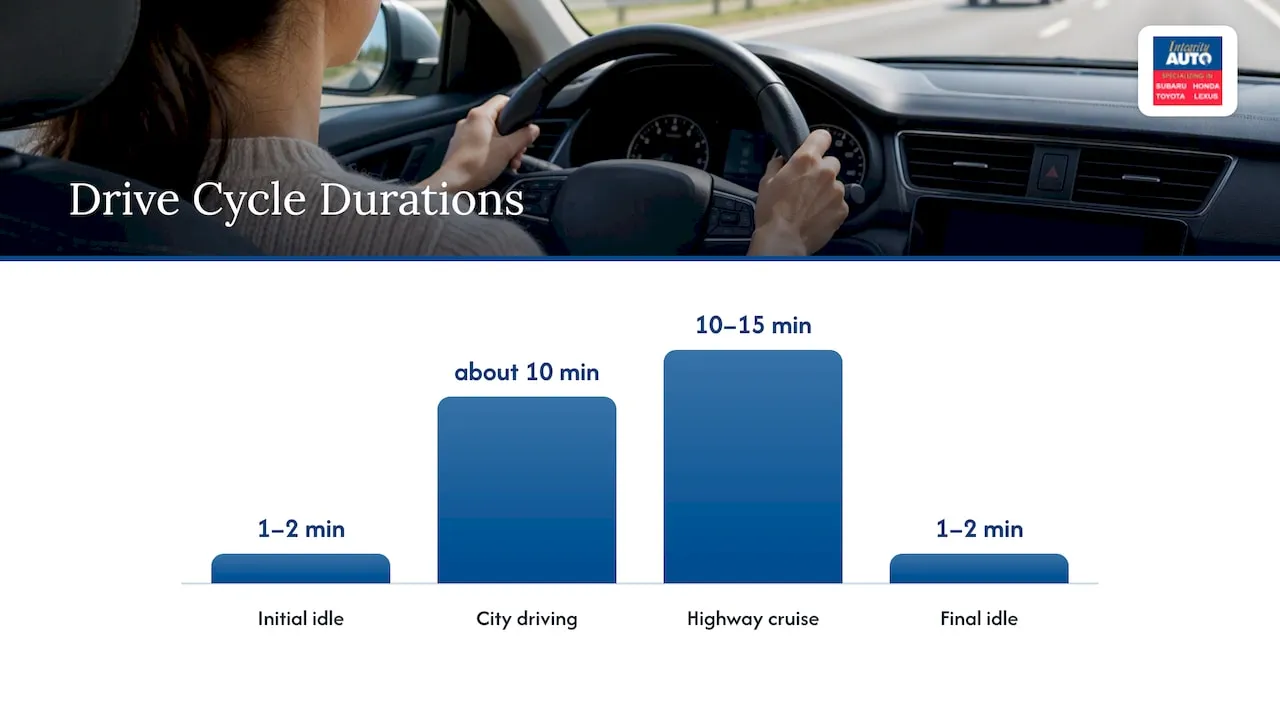
City driving block. Spend 10 to 15 minutes in stop-and-go traffic with varied acceleration and several complete stops. This segment, with its mix of idle, acceleration, and deceleration, is what tends to trigger the EGR and misfire monitors along with certain fuel system checks.
Highway cruise block. Find a stretch of road where you can hold a steady speed, typically 45 to 65 mph, for a continuous 10 to 15 minutes without heavy braking or lane changes. This steady-state segment is what the catalyst monitor and the oxygen sensor monitor are generally looking for, since they need sustained, consistent conditions to complete their comparison.
EVAP-specific sequence. The evaporative system monitor is usually the hardest to complete because it needs a fairly narrow set of conditions: a fuel level in the 15 to 85 percent range, a cold start after several hours of sitting, and in many cases a specific soak period with the key off before the next drive. Oregon DEQ’s guidance notes that many programs allow this monitor alone to remain incomplete, which reflects how difficult it can be to satisfy on ordinary errands. Running the same generic drive cycle over and over will not help if the fuel level or soak time never lines up with what the monitor needs.
A combined drive cycle you can run in one session:
- Make sure the engine has been off for at least eight hours and the fuel tank is between a quarter and three-quarters full.
- Start the engine and idle for one to two minutes without revving.
- Drive in stop-and-go conditions for about 10 minutes, including at least five full stops.
- Accelerate onto a highway or arterial road and hold a steady 45 to 65 mph for 10 to 15 minutes.
- Decelerate gradually and let the vehicle idle for one to two minutes before shutting it off.
- Let the vehicle sit off for at least one hour, then repeat the sequence.
Pro Tip: Keep a simple log of each drive, noting the date, approximate mileage, and whether you checked readiness afterward, since tracking your attempts makes it much easier to tell a shop what you’ve already tried.
Manufacturer technical service bulletins sometimes specify a model-year-specific drive cycle when the general pattern above does not get a monitor to complete. NHTSA technical service bulletins covering individual driving cycles for OBD2 readiness document these model-specific procedures, which can call for exact speeds, hold times, or gear selections that a generic drive cycle will not reproduce.
State readiness criteria, timelines, and what to expect
Inspection and testing programs do not simply ask whether every monitor shows “ready.” Most allow a small number of monitors to remain incomplete, as long as certain measurable thresholds have been met first.
What agencies typically check
CARB’s Clean Truck Check readiness criteria outline a widely used standard: a vehicle generally needs several warm-up cycles since codes were last cleared, or roughly 200 miles of driving since the clear, or 400 minutes of engine run time, before readiness is evaluated against the allowed number of incomplete monitors.
At least five warm-up cycles, about 200 miles, or 400 minutes of engine run time since codes were cleared are common thresholds programs use before evaluating monitor readiness. (CARB)
A warm-up cycle has a precise technical meaning: it is a trip in which the engine coolant temperature rises by at least 40 degrees Fahrenheit from its starting point and ultimately reaches at least 160 degrees Fahrenheit, as defined in CARB’s readiness criteria. In practice, that means short trips where the engine barely gets warm before you shut it off do not count toward the total, even if you drove several miles.
For most gasoline vehicles, normal varied driving over several days to about a week is enough to work through the thresholds and set the remaining monitors, assuming the drive cycle actually includes the conditions each monitor needs. Diesel and heavy-duty vehicles typically take longer. CARB’s Clean Truck Check background notes that heavy-duty diesel vehicles often need extended periods of normal operation and many warm-up cycles to reach full readiness, since their monitors are tied to longer duty cycles and higher engine run-time requirements.
How to verify monitor readiness before you test
Guessing whether your drive cycle worked wastes time and fuel. Checking is quick and tells you exactly where you stand.
A basic consumer OBD-II reader uses Mode $01 to display the status of each monitor, typically grouped under headings like “Misfire,” “Fuel System,” “Catalyst,” “EVAP System,” and “Oxygen Sensor.” Each one will read “complete” or “incomplete,” giving you a direct answer on whether more driving is needed. A more capable scan tool goes further by reading Mode $0A, which displays permanent diagnostic trouble codes. EPA’s readiness guidance recommends this type of check because a permanent DTC cannot be erased by clearing codes or disconnecting the battery. It only clears once the underlying fault is actually repaired and the related monitor runs clean, which makes it a far more reliable signal than readiness status alone.
When you check your vehicle’s readiness, look for a few specific things:
- The overall readiness group status, confirming how many monitors show complete versus incomplete.
- Specific monitor flags, especially EVAP, catalyst, and oxygen sensor heater, since these are the most commonly incomplete.
- MIL status, since an illuminated check engine light means the vehicle will not pass regardless of readiness.
- Permanent DTCs under Mode $0A, since their presence points to an unresolved issue rather than a monitor that simply hasn’t run yet.
If a handheld reader shows several monitors still incomplete after a week of varied driving, or if it shows a permanent DTC, that is the point to bring the vehicle to a shop rather than continuing to drive in circles. A professional scan can confirm whether the issue is simply incomplete monitors or an underlying fault that no amount of driving will resolve on its own.
Shop-level checks and when a professional should take over
A shop approaches an incomplete-monitor situation differently than a driver running laps around the neighborhood. Before any diagnostic work begins, a technician typically pulls the full readiness report along with any permanent DTCs to see exactly which monitors are affected and whether a stored fault explains it.
From there, the checks commonly include:
- Reading permanent DTCs and freeze-frame data to rule out an active fault behind the incomplete monitor.
- Testing battery voltage and charging system output, since a weak battery can interrupt a drive cycle or cause the computer to lose adaptive data mid-test.
- Verifying oxygen sensor heater circuits, since a lazy or failed heater circuit can keep that monitor from ever completing.
- Checking the fuel system and EVAP components for leaks or a faulty purge valve, which are common reasons the EVAP monitor refuses to set.
- Following the manufacturer’s specific drive-cycle procedure when the vehicle’s technical bulletins call for one, rather than relying on a generic sequence.
Some vehicles need bench diagnostics or a scan-tool-guided test rather than an on-road drive, particularly when a sensor or actuator needs to be commanded directly to confirm it responds correctly. This is common when a monitor has failed to set after repeated, properly executed drive cycles, since that pattern usually points to a component issue rather than a missed condition.
Pro Tip: If you’ve run a full week of varied driving and a monitor still won’t complete, stop repeating the cycle and have a technician pull the data instead, since further driving rarely changes the outcome once a hardware fault is the cause.
As independent specialists for Toyota, Lexus, Subaru, and Honda vehicles, we see this pattern often: a driver has already tried the right driving conditions, and the remaining step is a proper scan and targeted test rather than more miles.
How we can help get your monitors ready
We offer DEQ emissions help for Toyota, Lexus, Subaru, and Honda vehicles, which covers the full range of what a driver typically needs once a drive cycle alone has not finished the job: a readiness check, permanent DTC review, and repair of whatever is actually keeping a monitor from completing. Rather than guessing at another week of driving, a single diagnostic visit tells you exactly which monitor is affected and why.
Our diagnosis and diagnostic services are built for exactly this situation: a vehicle that has had codes cleared or a repair completed and now needs its readiness confirmed before an inspection appointment. We read the same readiness PIDs and permanent DTCs described above, using OEM-level scan tools, so you get a clear answer instead of another round of trial-and-error driving. For Subaru owners specifically, our Subaru service and repair work includes the same readiness verification alongside any underlying repair the monitor status points to.
If you’ve already run a proper drive cycle and your scan tool still shows incomplete monitors, bring it in and we will find out why before you waste a trip to the test station.
FAQ
What does an incomplete O2 sensor monitor mean?
An incomplete oxygen sensor monitor means the onboard computer has not yet finished testing that sensor’s response and heater circuit, usually because the vehicle has not had a long enough steady highway cruise since codes were last cleared. It does not necessarily mean the sensor has failed. A sustained drive at highway speed, as described in the oxygen sensor drive cycle sequence above, is usually what’s needed to let the test complete.
What drive cycle works for a 2001 Toyota 4Runner?
A 2001 Toyota 4Runner generally responds to the same general drive cycle pattern: a cold start and warm-up, 10 to 15 minutes of stop-and-go city driving, then a steady highway cruise of 10 to 15 minutes at 45 to 65 mph, followed by a cool-down period. If specific monitors remain incomplete after several attempts, a manufacturer technical service bulletin may specify an individual drive-cycle procedure for that model year.
How long should I wait to test emissions after clearing codes?
Oregon DEQ guidance recommends driving normally for about a week after clearing codes before scheduling an emissions test, since monitors need varied driving conditions to reset and complete. An emissions certificate is valid for 180 days once issued, so there is no need to rush the test the same day you clear codes.
How many miles count as one drive cycle?
There is no fixed mileage for a single drive cycle, since completion depends on operating conditions like coolant temperature rise and sustained speed rather than distance alone, according to Oregon DEQ. As a broader readiness threshold, CARB’s criteria reference roughly 200 miles of driving since codes were cleared as one of several acceptable measures, alongside warm-up cycle counts or engine run minutes.
What should I check before attempting a drive cycle?
Confirm the check engine light is off, there are no active diagnostic trouble codes, the fuel level sits between a quarter and three-quarters full, the gas cap is tight, and the battery is fully charged before starting. Skipping these basics is one of the most common reasons a drive cycle attempt fails to complete monitors even after a full session of varied driving.
Sources
- Department of Environmental Quality : On-board Diagnostics Frequently Asked Questions : Vehicle Inspection : State of Oregon
- Clean Truck Check – On-Board Diagnostic (OBD) Readiness Criteria | California Air Resources Board
- Improving I/M Performance and OBD Monitor Readiness: Memorandum (May 2011) | EPA


