
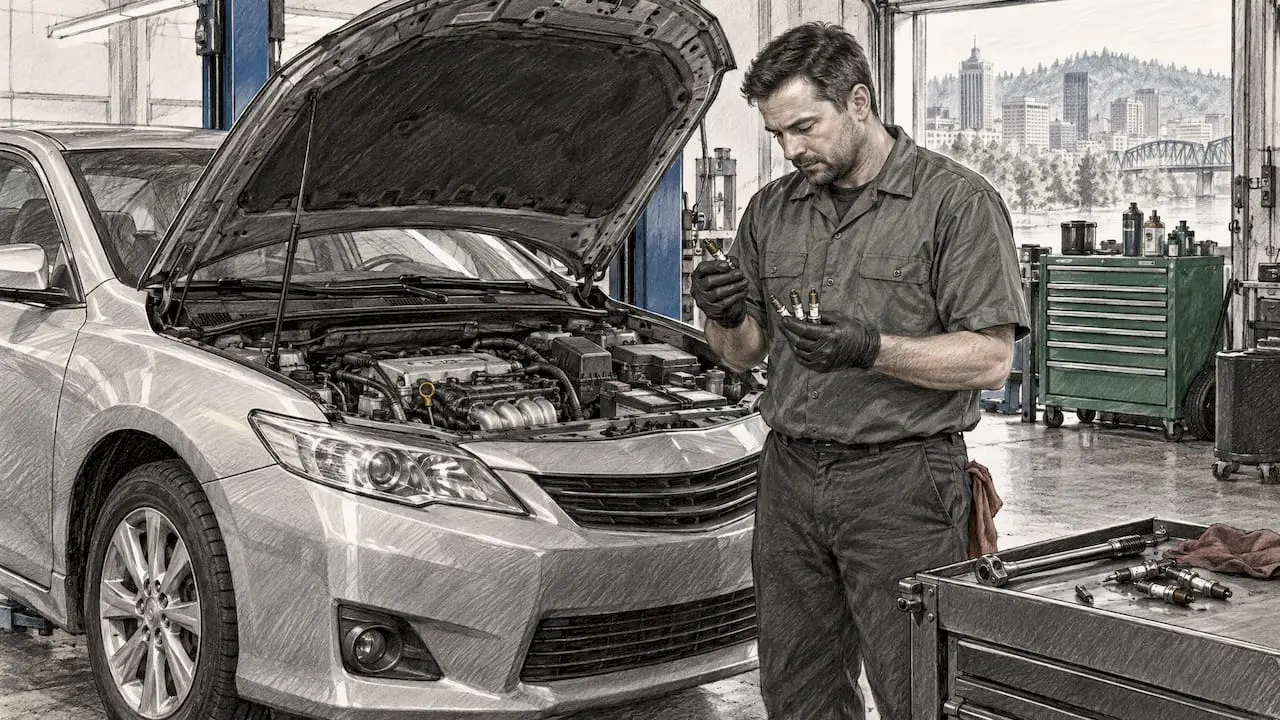
A 120,000-mile service is not one fixed package. It is the point where several long-interval items on a manufacturer’s schedule tend to come due together, usually spark plugs, coolant, transmission or CVT fluid and drive-belt or timing components, plus a full inspection of brakes, suspension and leaks. Which items apply depends on the make, model, engine and model year, so the owner’s manual or maintenance schedule for the exact vehicle decides the list. Integrity Auto, an independent Toyota, Lexus, Subaru and Honda shop in the Portland, Oregon area, works from manufacturer-recommended intervals for these brands.
TL;DR
- No universal 120,000-mile checklist exists. The vehicle’s own schedule, by model year, sets what is due.
- Common 120,000-mile items include spark plugs, coolant, transmission or CVT fluid, belts and a detailed brake, suspension and leak inspection.
- Many items fall before or after 120,000 miles, so a 75,000-mile service often has a different list from the 120,000-mile one.
- Schedules run on time as well as miles, so low-mileage cars can still be due.
- Integrity Auto services Toyota, Lexus, Subaru and Honda vehicles with ASE certified technicians and OEM parts.
Why 120,000 Miles Is a Milestone
By 120,000 miles, most of the fluids and wear items on a well-kept Japanese-brand vehicle have been serviced at least once. The remaining question is which of the long-life items are now at their first or second replacement. Spark plugs, coolant and transmission fluid are the usual candidates, and belts, hoses and suspension bushings are checked for age and wear.
This matters because the cost of skipping them is usually larger than the cost of doing them. Worn spark plugs can cause misfires and poor fuel economy. Old coolant loses its corrosion protection. Old transmission or CVT fluid is a common precursor to shifting complaints. None of this requires guessing: each item has an interval in the schedule for that vehicle.
What Is Typically Due at 120,000 Miles
The table shows the categories that commonly land near this mileage. It is a guide to what to ask about, not a replacement for the schedule for a specific vehicle.
| Item | What it involves | Where it varies |
|---|---|---|
| Spark plugs | Replacement to restore combustion efficiency | Interval differs by engine and plug type; some fall earlier or later |
| Coolant | Drain and refill, hoses and radiator checked | Often tied to years as well as miles |
| Transmission or CVT fluid | Fluid service for automatic or CVT units | Depends on transmission type and driving conditions |
| Differential and transfer fluids | Gear oil replacement on all-wheel-drive models | Common on Subaru and some Toyota, Lexus and Honda AWD models |
| Timing belt | Replacement on engines that use a belt instead of a chain | Only applies to belt-driven engines |
| Brakes | Pad and rotor measurement, brake fluid check | Wear depends on driving, not just mileage |
| Suspension | Struts, shocks, bushings and mounts inspected | Condition-based |
| Hoses, belts, leaks | Visual inspection for cracking, seepage and wear | Condition-based |
How Manufacturers Schedule It
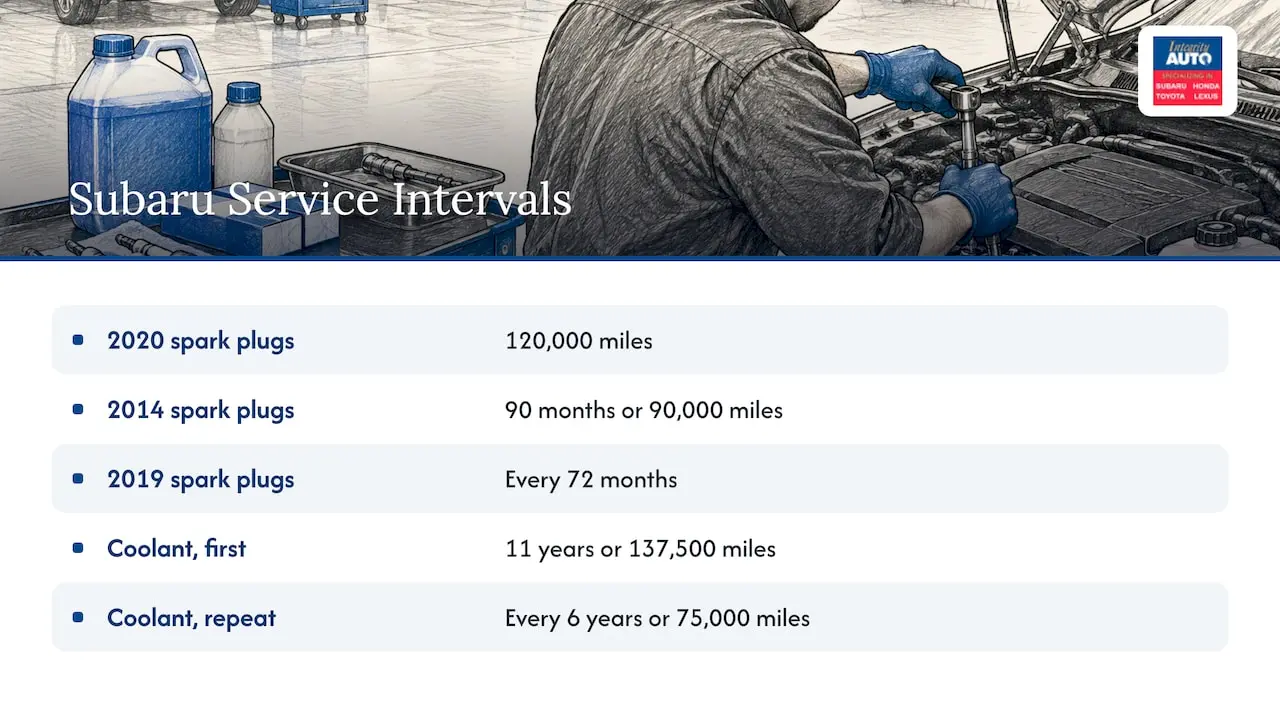
Manufacturer schedules differ more than owners expect. Subaru’s published schedule for a 2020 Subaru places spark plug replacement at 120,000 miles, with transmission and differential gear oil, CVT fluid and the air cleaner element at 60,000 miles. Coolant is first replaced at 11 years or 137,500 miles, then every 6 years or 75,000 miles.
The schedule for a 2014 Subaru lists spark plugs at 90 months or 90,000 miles instead, with the same coolant pattern. A 2019 Subaru lists plugs every 72 months. Three model years of one brand give three different spark plug answers, which is why a generic “120k service” list can be wrong for a specific car.
The same logic applies to Toyota, Lexus and Honda. Toyota and Lexus schedules vary by engine and by hybrid or conventional drivetrain, and Honda uses a Maintenance Minder system on many models that calls out service items based on how the car is driven. Schedules published for other countries use kilometers and different intervals, so U.S. owners should use U.S.-market documents for their model year.
75,000 Miles vs. 120,000 Miles
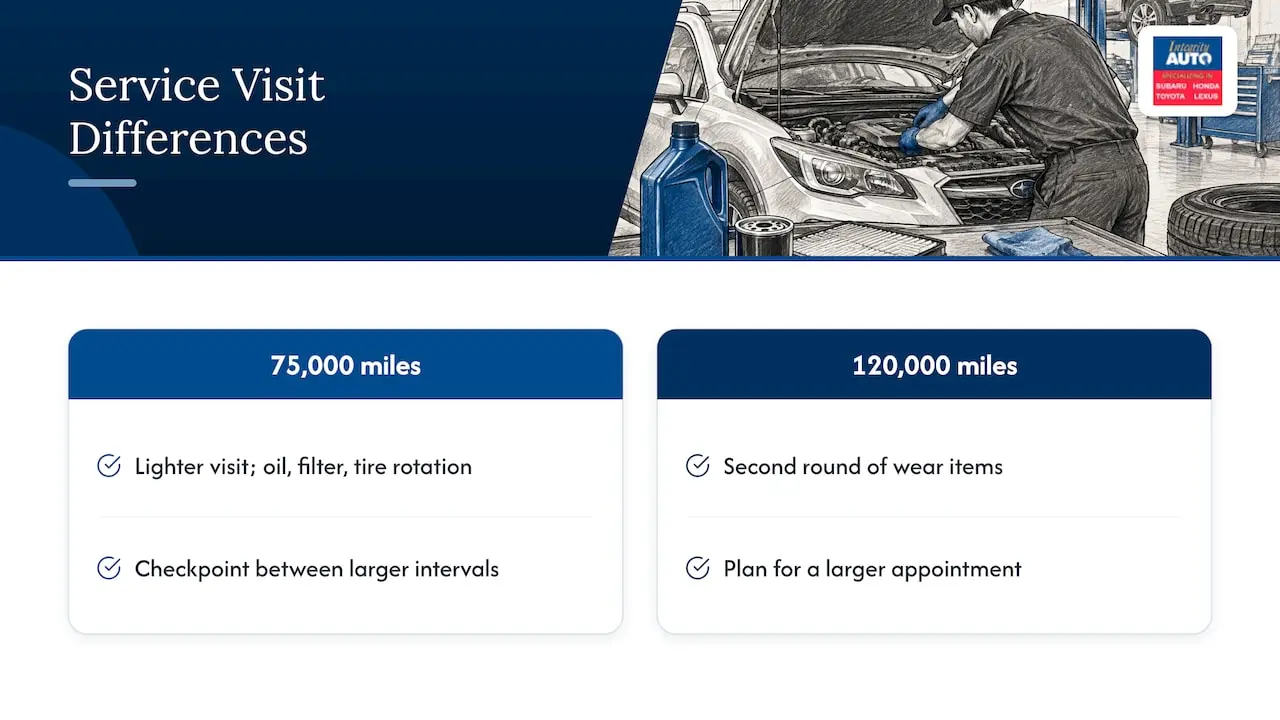
A 75,000-mile service is usually a lighter visit with a different item list. It commonly centers on oil and filter, tire rotation, a brake inspection, and checks of belts, hoses, suspension and tires, according to a 2026 maintenance checklist. Some items do land at 75,000: on the Subaru schedules above, the repeat coolant replacement falls at 75,000 miles or 6 years, whichever comes first.
The two services also differ in purpose. The 75,000-mile visit is a checkpoint between larger intervals. The 120,000-mile visit tends to be where a second round of wear items arrives, so it is worth planning for as a larger appointment. Owners who recently passed 100,000 miles can also read the Integrity Auto guide to the Toyota 100,000-mile service to see what may already have been done.
Miles or Months: Whichever Comes First
Schedules are built on two clocks. Subaru’s owner guidance says service is due at whichever comes first, the time or mileage interval, because fluids and parts degrade with age even when a car is driven little. A vehicle that reaches 120,000 miles in twelve years has very different needs from one that reaches it in six.
Severe driving conditions
Most manuals include a normal and a severe-conditions schedule. Short trips under about five miles, stop-and-go traffic, towing, heavy loads, dusty roads and temperature extremes shorten oil, filter and fluid intervals, as the 2026 checklist notes. Many Portland-area drivers fall into the severe category without realizing it: short commutes, hilly routes and winter stop-and-go driving all count. Regular washing in winter also helps protect the underbody, and this guide to winter car washing frequency explains why waiting too long between washes is a risk where roads are treated.
How to Work Out What Is Due
- Find the exact schedule. Use the owner’s manual or the maintenance booklet for the specific model year, engine and drivetrain.
- Gather records. Receipts, service stamps and shop histories show which long-interval items were already done. A plug or coolant service performed at 90,000 miles may not be due again.
- Check the time clock. Compare the vehicle’s age against the year-based intervals, not only the odometer.
- Decide on conditions. If driving matches the severe schedule, use those intervals.
- Inspect before replacing. Brake pads, rotors, struts, hoses and belts are condition-based, so measurements and visual checks decide what needs work.
When records are incomplete, the safest path is to treat the vehicle as if the unconfirmed items have not been done and have a technician inspect each system. Integrity Auto offers complimentary multipoint inspections, which gives a documented starting point for that decision. Dash reminders such as the Toyota maintenance required light are a prompt, not a full schedule, so they do not replace the checks above.
Brand Notes for Portland Owners
- Toyota and Lexus: Hybrid models add systems that need their own inspection. Integrity Auto lists hybrid vehicle service among its offerings, along with transmission, engine, brake and suspension work. See the pages for Toyota service and Lexus service.
- Subaru: All-wheel-drive models carry differential and transmission fluid intervals that deserve separate attention. The Subaru differential service guide covers intervals and signs.
- Honda: Timing belts, CVT services, coolant and tune-ups are all listed services on the Honda service page.
Oregon also requires emissions testing in the Portland area for many vehicles, and a check engine light can complicate that. Integrity Auto lists check engine light and DEQ diagnosis, plus emission testing and repairs, as services.
Having the Service Done at Integrity Auto
Integrity Auto is an independent shop specializing in Toyota, Lexus, Subaru and Honda vehicles, with ASE certified technicians, OEM parts and warranties it describes as longer than dealership repairs. Scheduled maintenance follows manufacturer-recommended intervals, and a complimentary multipoint inspection helps show which items are due and which can wait. Owners can learn more on the Integrity Auto homepage or through the brand page that matches their vehicle.
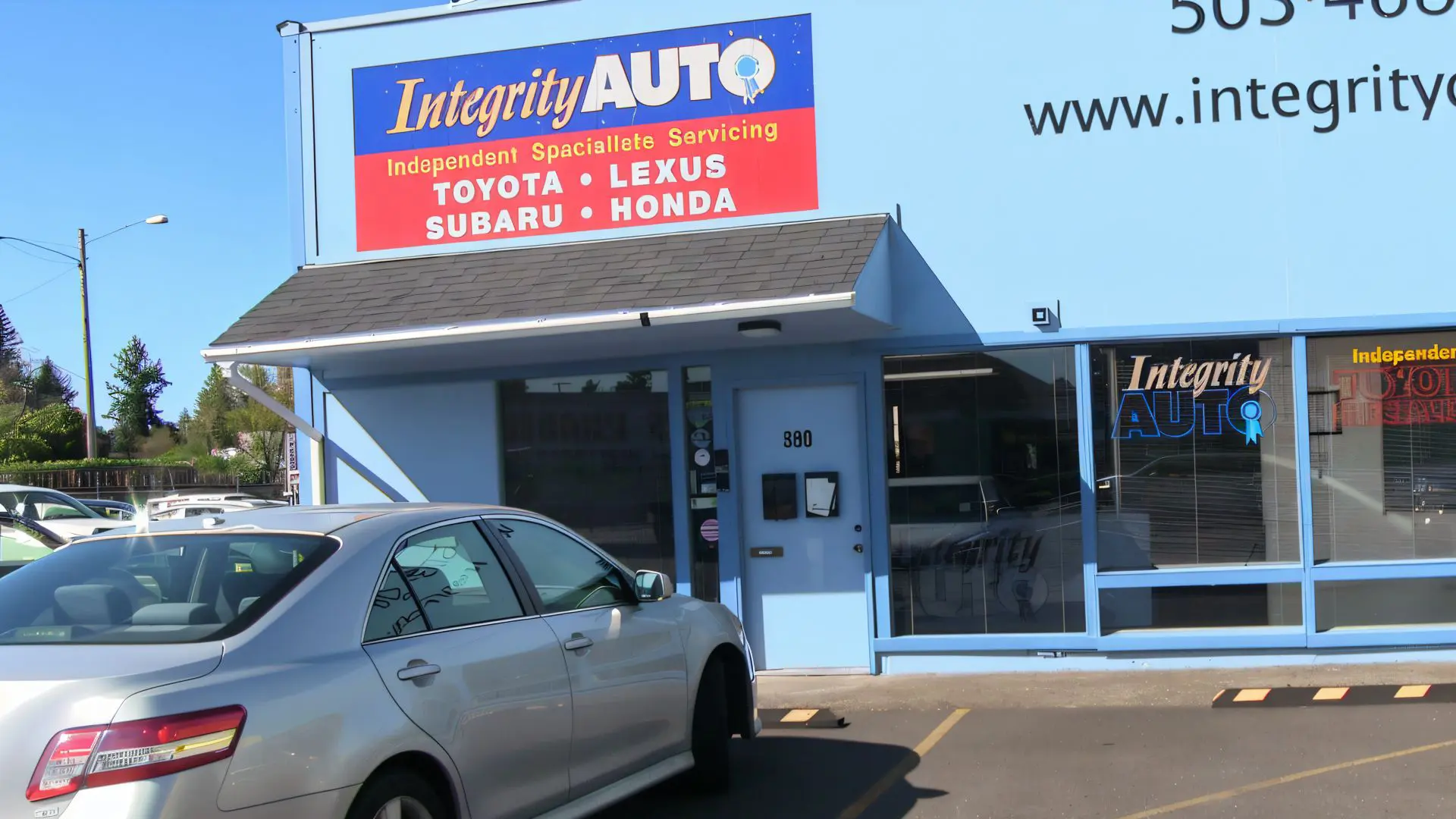
For a vehicle with a check engine light or an unusual noise ahead of the milestone, the diagnosis page explains how diagnostic charges and estimates are handled.
FAQ
Is a 120,000-mile service required?
No single service is legally required. The manufacturer’s schedule lists which items are due, and following it protects reliability and supports warranty coverage where it applies. Skipping long-interval items usually leads to larger repairs later.
What is the difference between a 75,000-mile and a 120,000-mile service?
The 75,000-mile visit is typically oil, tire rotation and a series of inspections, with a few fluid items on some models. The 120,000-mile visit is more likely to include spark plugs, transmission or CVT fluid and other long-interval replacements, depending on the schedule.
Should I do the service by miles or by age?
Both. Manufacturers list a mileage and a time interval and say to follow whichever comes first. A vehicle driven few miles per year can still be due for coolant, brake fluid and oil.
What if I do not have service records?
Assume unconfirmed items are still due and have each system inspected against the schedule for that model year. A multipoint inspection and the vehicle’s history from any past shops help narrow it down.
Sources
- What is the maintenance schedule for my 2020 Subaru?
- What is the maintenance schedule for my 2019 Subaru?
- What is the maintenance schedule for my 2014 Subaru?
- Car Care Tips: Months or Miles?
- 75,000 Mile Service: Checklist and Cost (2026)