An engine stalls when it loses air, fuel or spark while running. The cause is often an electrical or sensor fault, and it may not set a trouble code. A car that has stalled more than once needs a proper diagnosis before it goes back into traffic. For Toyota, Lexus, Subaru and Honda owners in the Portland area, Integrity Auto provides independent diagnosis for exactly this kind of intermittent problem.
TL;DR
- If the engine dies while driving, turn on the hazard lights, shift to Neutral, steer to a safe spot and then try a restart.
- The way the engine quit is a clue: a sputter points to fuel delivery, while an instant cutoff points to a sensor, wiring or ignition fault.
- Stalling at stops, after warming up or during acceleration each narrows the list of suspects.
- A car that stalls more than once should not stay in regular traffic until the cause is found.
- Intermittent stalls are diagnosed best when the symptoms are recorded and a technician can test the car while the fault is present.
What to do when the engine stalls while driving
A stall feels alarming, but the car does not become uncontrollable. Aceable’s safe-driving guidance notes that steering and brakes still work, though they take more effort. Power brake assist lasts only a press or two after the engine dies, so brake with firm, steady pressure instead of pumping the pedal.
The sequence recommended by Consumer Reports:
- Turn on the hazard lights as soon as possible.
- Shift to Neutral and coast toward the shoulder if it is safe.
- Once stopped, try restarting in Park (automatic) or Neutral (manual).
- If it restarts, let it run for a few minutes, move to a safe location off the road and arrange roadside assistance or a tow in case it stalls again.
- If it will not start, stay inside the vehicle and call 911 for help moving it to safety, then call roadside assistance.
If a check-engine light came on with the stall, one automaker’s owner’s manual says to wait at least 10 seconds before restarting so a possible limp-home condition can reset. Stalling at highway speed also makes entry and exit points more dangerous, and guidance on merging onto highways safely covers the same habits of signaling early, keeping steady speed and leaving room.
Reading the stall: how the engine quit
The moment of the stall gives a technician the first useful clue. Automotive writer Brian Turner explains in Driving.ca that in modern fuel-injected engines most stalls trace to an electrical fault, such as a sensor or circuit glitch that makes the engine computer shut off fuel and ignition. Many of these faults never set a diagnostic code. A chug or stumble before dying usually points to fuel starvation. A sharp cutoff, with the tachometer needle dropping at once, points to fuel and ignition shutting off together.
A symptom guide from Auto Module Lab maps the patterns this way:
| What the driver notices | Likely area |
|---|---|
| Instant shutoff, dash stays lit | Crankshaft or camshaft position sensor or its wiring |
| Sputter, surge or power loss first | Fuel delivery |
| All electrical systems die at once | Ignition switch, battery cable, main fuse or ground |
| Battery light and dimming lights | Alternator, belt or charging wiring |
The same source notes that stalls happening only over bumps, only when hot or only after rain are usually connection, heat or moisture faults. Notes on speed, temperature, fuel level, road surface, weather and exactly how the engine died shorten the diagnosis considerably.
Why a car stalls at a stop or when slowing down
Stalling when the car comes to a halt is one of the most common complaints. The engine has to hold a steady idle with little help from the driver, so small faults show up here first.
- Idle control and airflow. A dirty throttle body, a sticking idle air control valve or a vacuum leak can let the idle drop until the engine quits. A failing MAP or MAF sensor can also push the mixture too lean or too rich, which AutoZone describes as causing ineffective combustion and a stalling engine.
- Transmission. Driving.ca explains that if an automatic’s locking torque converter fails to unlock when the brake is pressed, it loads the engine until it cannot run without throttle input. Strong vibration usually accompanies it.
- Oil pressure signal. A Star Tribune column describes a Camry that stalled only when fully warm and idling in gear. A low oil-pressure signal from the engine’s oil pressure switch was shutting off the fuel pump.
A rough or shaky idle often comes before the stall. The Integrity Auto guide to rough idle at a stop lists the checks and the signs that mean driving should stop.
Stalling after the engine warms up
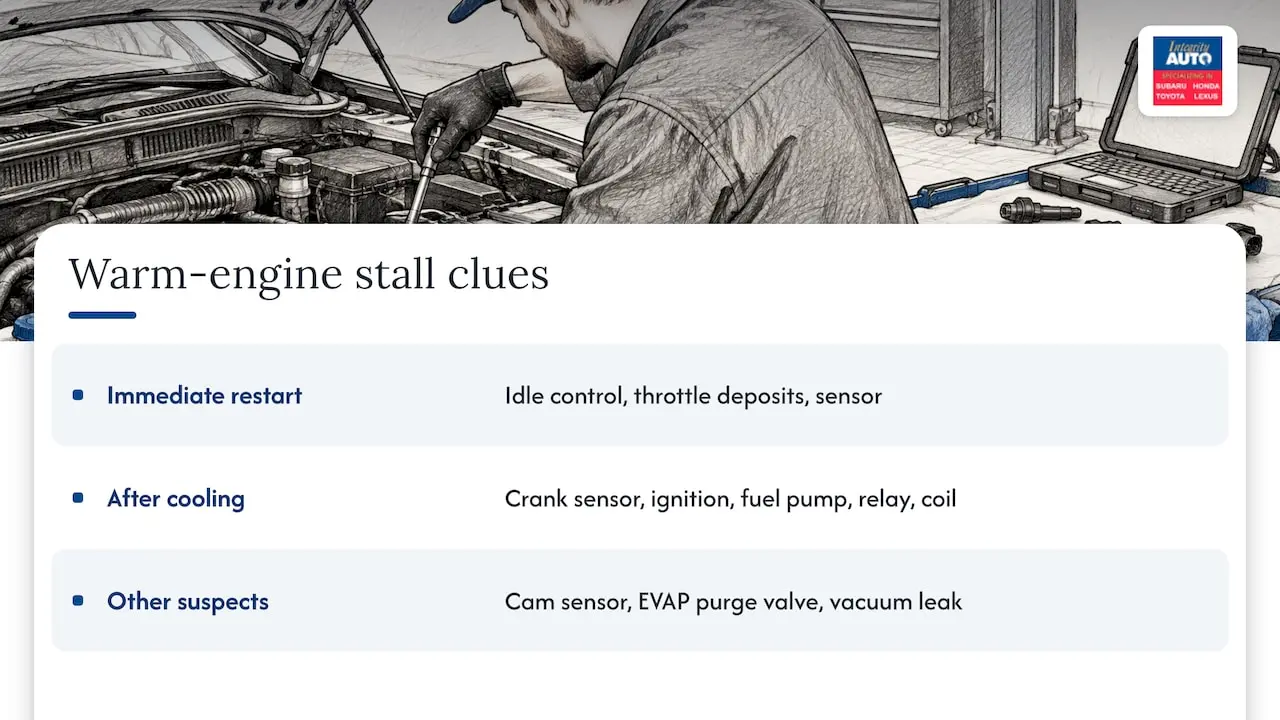
Heat changes electrical resistance, fuel temperature and vapor pressure, so a part can work cold and fail at operating temperature. My Pro Street lists a failing crankshaft or camshaft position sensor, a weak fuel pump, an ignition problem, a stuck EVAP purge valve, a dirty throttle body and a vacuum leak among the suspects. A restart that works immediately suggests idle control, throttle-body deposits or an intermittent sensor. A restart only after cooling suggests a heat-sensitive crank sensor, ignition module, fuel pump, relay or coil.
AA1Car explains the mechanism: thermal expansion can break contact at loose or corroded connectors and grounds, and a coil or injector that tests normal at room temperature may open or short when hot. That is why replacing a sensor after a single stall is a guess. The reliable approach is to capture the missing signal while the fault is happening.
Stalling during acceleration
A stall under throttle shifts the focus. Lemon Law Group Partners maps stalling during acceleration to fuel pressure, ignition, turbocharger, airflow or transmission issues. A car that hesitates or jerks before dying belongs in this group. Integrity Auto’s article on a car that jerks when accelerating covers the related causes. Trouble starting cold or a key that behaves oddly points toward the ignition system or cold-start behavior.
Is it safe to keep driving?
Occasional stalling rarely damages an engine, but repeated stalls and restarts add wear, and the safety risk is the larger concern. Consumer Reports points out that a stalled car can be stuck in moving traffic, and even a parked car on the roadside can be hit. Aceable states that a car that stalls repeatedly should be checked before it is driven again, especially on highways or in heavy traffic.
Towing is the safer choice when any of these apply:
- The engine has stalled more than once, or stalled while moving in traffic.
- The car will not stay running.
- A fuel odor, smoke, an overheating warning or a steady oil-pressure warning accompanies the stall.
- Electrical power cuts out repeatedly, or the engine’s behavior cannot be predicted.
If the car stalled once and then ran normally, a short trip on lower-speed routes with extra braking room is the cautious limit until a shop has looked at it. A weak battery or charging fault can also cause stalling and electrical cut-outs, and a battery test is a quick way to rule that group out.
How a technician finds an intermittent stall
Intermittent faults are the hardest to find, because a car that runs fine in the bay gives nothing to measure. Auto Module Lab describes a sequence that works in cost order:
- Check recalls and service bulletins, since fuel pumps, ignition switches and calibrations have all been recalled. Integrity Auto explains the difference in its recall vs. service bulletin guide.
- Scan every module and save stored, pending and history codes with freeze-frame data.
- Load-test the battery, check charging voltage at idle and voltage-drop the main grounds.
- Log fuel pressure, engine speed, crank sync and system voltage to catch the stall. The signal that dropped first points to the cause.
- Wiggle-test connectors and cables while watching live data.
- Heat-test suspect parts, and revive a failed part with freeze spray.
- Suspect the engine computer only after the rest is ruled out.
My Pro Street adds that testing must happen during the hot no-start condition, before the failed component cools and recovers. That is why notes on when the stall happens are valuable, and why the car should arrive in the condition that produces the problem.
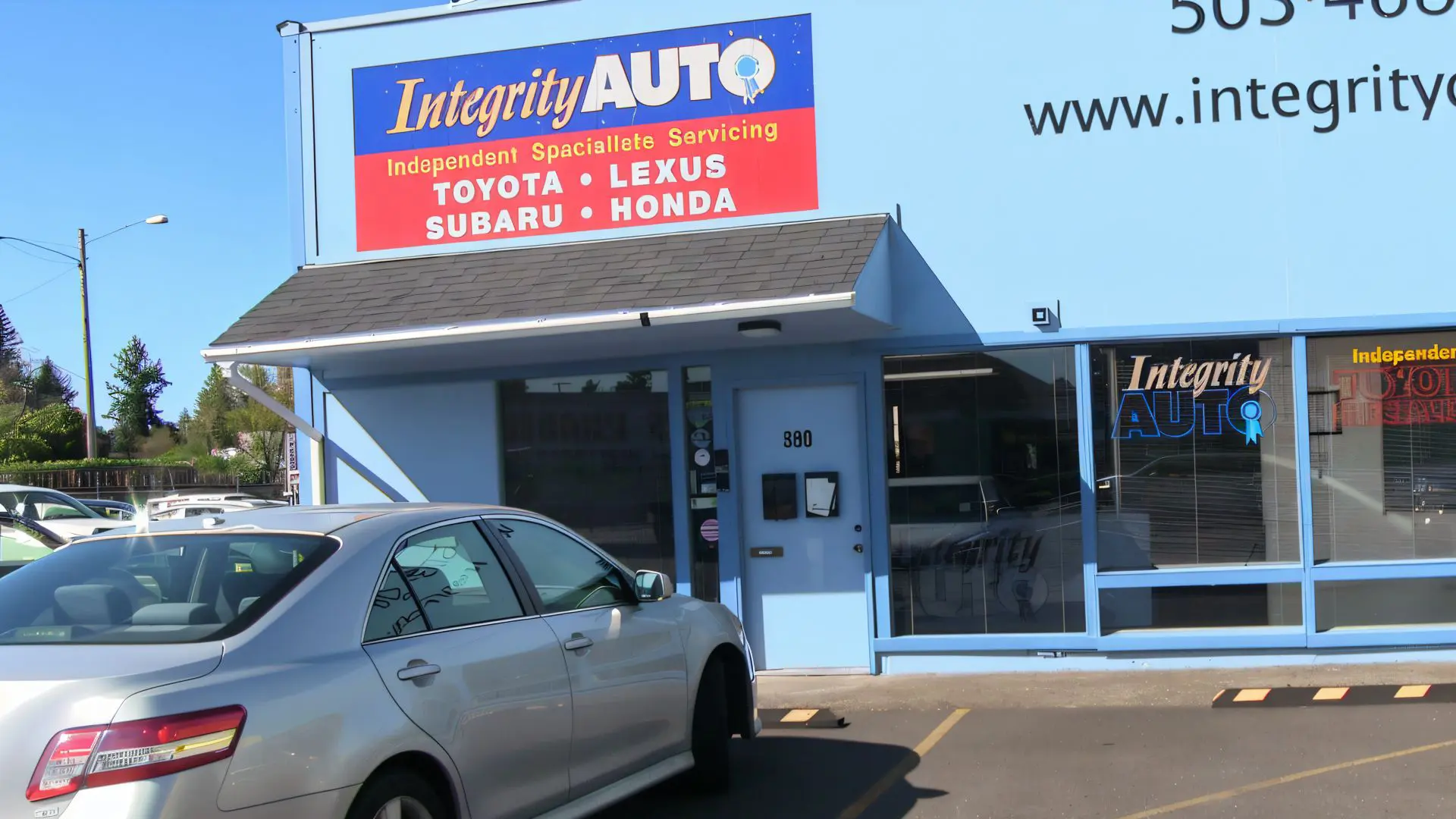
Stalling diagnosis for Toyota, Lexus, Subaru and Honda in Portland
These four makes are all that Integrity Auto services. It describes itself as an independent alternative to the dealer, with ASE certified technicians and OEM parts, and it states that its warranties are longer than dealership repairs. Its listed services cover the areas where stalling usually starts: check engine lights and DEQ diagnosis, tune-ups, transmission and CVT service, coolant service, timing belts, and complimentary multipoint inspections. It also performs emission testing and repairs, relevant in Oregon when a stalling car also has a check-engine light.
Owners can go to the page for their make:
- Toyota service and repair, including hybrid service
- Lexus service and repair
- Honda service and repair
- Subaru service and repair
The diagnosis page explains how diagnostic charges and estimates work. Bringing notes on when the stall happened, how the engine quit and whether any warning lights came on gives the technician a head start.
FAQ
Is stalling bad for your car?
An occasional stall usually does not damage the engine. Frequent stalling adds wear from repeated stops and restarts, and it creates a traffic hazard. A car that stalls repeatedly should be inspected before it is driven again.
Why does a car stall at a stop?
Common causes are a dirty throttle body, an idle control fault, a vacuum leak, a failing airflow sensor, a torque converter that does not unlock, or a low oil-pressure signal that cuts the fuel pump. The pattern, such as whether the engine is warm, narrows the list.
Why does the engine stall only when it is hot?
Heat can make a worn sensor, coil, relay, fuel pump or connection fail at operating temperature and recover after cooling. Diagnosis is most reliable when the car is tested while the fault is present.
Can a check engine light explain a stall?
It can. A lit light means the computer stored a fault, and a scan with freeze-frame data shows what was happening at the time. Many stall causes set no code at all, so a clear scan does not mean there is no problem.
Sources
- What to Do When Your Car Stalls, Consumer Reports
- Introduction, 2022 owner’s manual
- Engine Stall Causes and Prevention, Aceable
- Why cars stall?, Driving.ca
- Car Stalls While Driving: Computer, TIPM or Sensor?, Auto Module Lab
- Why is My Car Stalling While I Am Driving?, AutoZone
- Problem with idling Camry takes extra detective work, Star Tribune
- How to Diagnose Intermittent Engine Problems, AA1Car
- Car Stalls While Driving? Causes, Safety & Lemon Law