A grinding noise when braking most often means the brake pad friction material is gone and the metal backing plate is rubbing the rotor. That is a safety issue and a cost issue: the longer it continues, the more parts it damages. Toyota, Lexus, Subaru and Honda owners in the Portland, Oregon area can have the brakes inspected at Integrity Auto, where ASE certified technicians handle brake diagnosis and repair on those four makes.
TL;DR
- Deep, metallic grinding usually means the pads are worn through and metal is contacting the rotor. Automakers advise a professional inspection as soon as possible.
- A pulsating brake pedal is usually caused by rotor thickness variation or runout, often alongside worn pads.
- Brief grinding after a rainy night or a few days parked can be surface rust that clears after a few stops. Grinding that stays is not.
- Pads replaced early are far cheaper than pads, rotors and calipers replaced after metal-on-metal contact.
- Integrity Auto offers complimentary multipoint inspections and brake service for Toyota, Lexus, Subaru and Honda vehicles.
What a grinding noise means
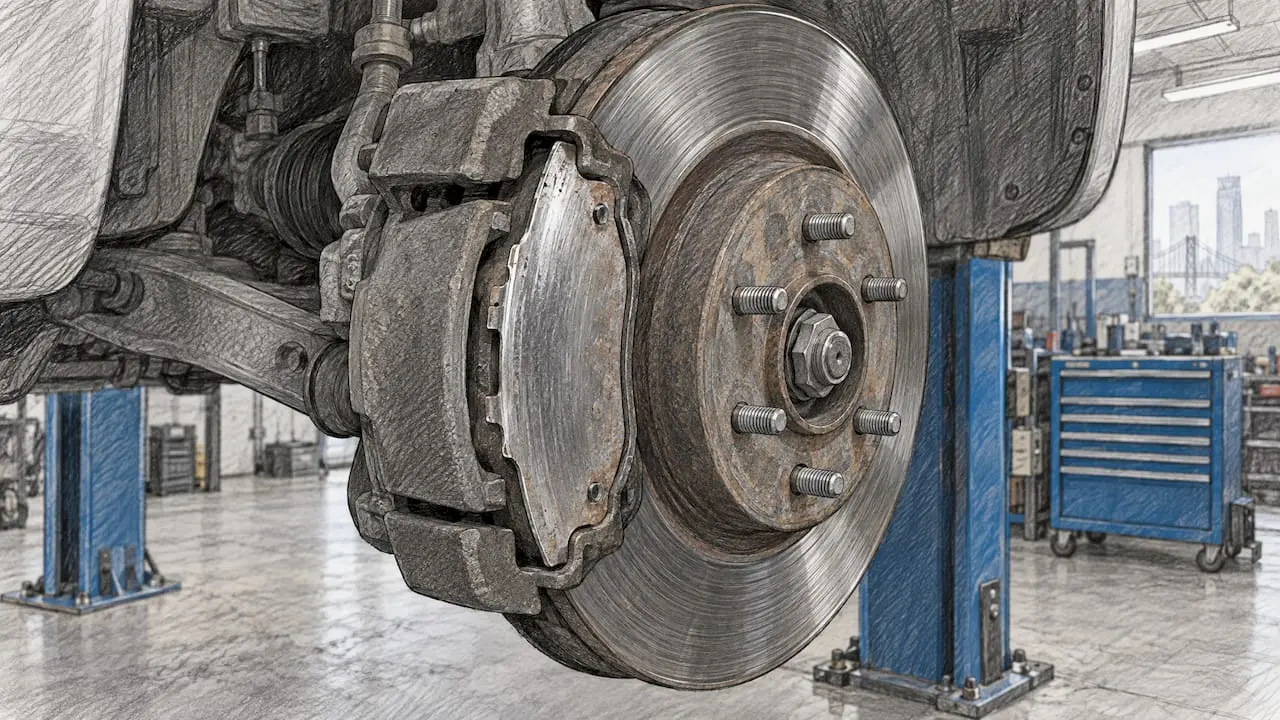
Brake pads are steel backing plates with a layer of friction material bonded to them. Pads squeeze against a rotor (the metal disc behind the wheel) to slow the car. When the friction layer wears away, or breaks loose from the plate, the steel plate meets the cast iron rotor. The result is a harsh, low grinding or growling that is present whenever the pedal is pressed.
The Family Handyman describes loud metal-to-metal grinding during stops as typically a sign that the pad material is worn or has come off its backing plate. Many pads also carry a small metal wear tab that squeals as an early warning. Once the squeal is ignored, grinding is the next stage.
Grinding is not always a worn pad, though. The common causes, from most to least frequent:
| Sound or feel | Likely cause | Urgency |
|---|---|---|
| Constant harsh grinding on every stop | Pads worn to the backing plate | Stop driving soon; inspect immediately |
| Grinding that stops once the brakes warm up | Surface rust on rotors after sitting | Low, if it clears within a few stops |
| Scraping that continues without pressing the pedal | Stone or debris caught near the rotor or shield | Inspect promptly |
| Grinding with a rhythmic pulse | Rotor thickness variation, runout, or a worn wheel bearing | Inspect promptly |
| Grinding from the rear only | Worn rear pads or shoes, or a stuck parking brake | Inspect promptly |
The Family Handyman notes that overnight rust on rotors can cause a grinding noise that disappears when the brakes heat up. That explains the short scrape heard on the first stop of a damp Portland morning. If the sound returns on every stop, or gets louder with harder braking, worn pads are the more likely explanation.
Is it safe to drive with grinding brakes?
Grinding that is consistent is a reason to have the car inspected right away. Ford lists continuous grinding, steering wheel vibration while braking, a soft pedal or a brake warning light as reasons to get the brakes checked immediately. Mazda states that a grinding sound while braking requires taking the car to a professional mechanic as soon as possible, because ignoring it may point to imminent brake failure.
Practical steps in the meantime:
- Avoid highway speeds and hard stops, and leave extra following distance.
- Do not drive long distances. Short, careful trips to a shop are the limit.
- If the pedal sinks toward the floor, feels soft, or the brake warning light is on, stop driving and arrange a tow.
The risk is not only noise. Worn-through pads reduce stopping power, and metal-on-metal contact scores the rotor surface, which turns a pad job into a pad-and-rotor job.
Pulsating brake pedal: a related symptom
Many drivers searching for grinding also feel the pedal pulse or the steering wheel shake under braking. The two can be connected, but they have different main causes.
An NHTSA-hosted technical service bulletin defines brake judder as a vibration felt in the vehicle, steering wheel or brake pedal when the brakes are applied. It attributes judder to rotor thickness variation and/or rotor runout (the rotor wobbling slightly as it spins), with the pad motion transferred through the caliper pistons and felt as a pulsation in the pedal.
Typical triggers include:
- Uneven rotor wear. Thickness differences of even a few thousandths of an inch can be felt through the pedal.
- Worn pads and rotors. Pads that wore unevenly leave an uneven surface on the rotor.
- A worn wheel bearing or hub problem. Excess play lets the rotor move relative to the caliper, producing runout and sometimes humming or grinding.
- Normal ABS activity. On a wet or slippery surface during a hard stop, a pulsing pedal can be the anti-lock system working as designed. A rhythmic pulse during ordinary stops on dry pavement is a different matter and warrants inspection.
The often-used phrase “warped rotors” is commonly applied to this, but the underlying issue is generally uneven thickness or runout, which a technician measures with a dial indicator and micrometer. Depending on the readings, rotors are either machined or replaced. The Integrity Auto guides on repairing or replacing drums and rotors and on measuring rotors against minimum thickness explain how that decision is made.
How to tell if pads are the problem
A visual check often confirms what the ears suspect. Through the wheel spokes, the pad is visible pressed against the rotor. Pad friction material that looks thin, or an outer pad noticeably thinner than the inner one, indicates wear. A brake pad gauge gives a more reliable reading, and the guide to brake pad gauges and readings explains how thickness measurements are taken.
Many shops treat pads at about 3 mm of remaining friction material as the point to replace, well before metal contact. Integrity Auto’s article on replacing pads at 2 to 3 mm lays out that threshold and the checklist a technician follows. Uneven wear between pads is itself a clue to a sticking caliper or slide pin, covered in the brake pad wear pattern guide.
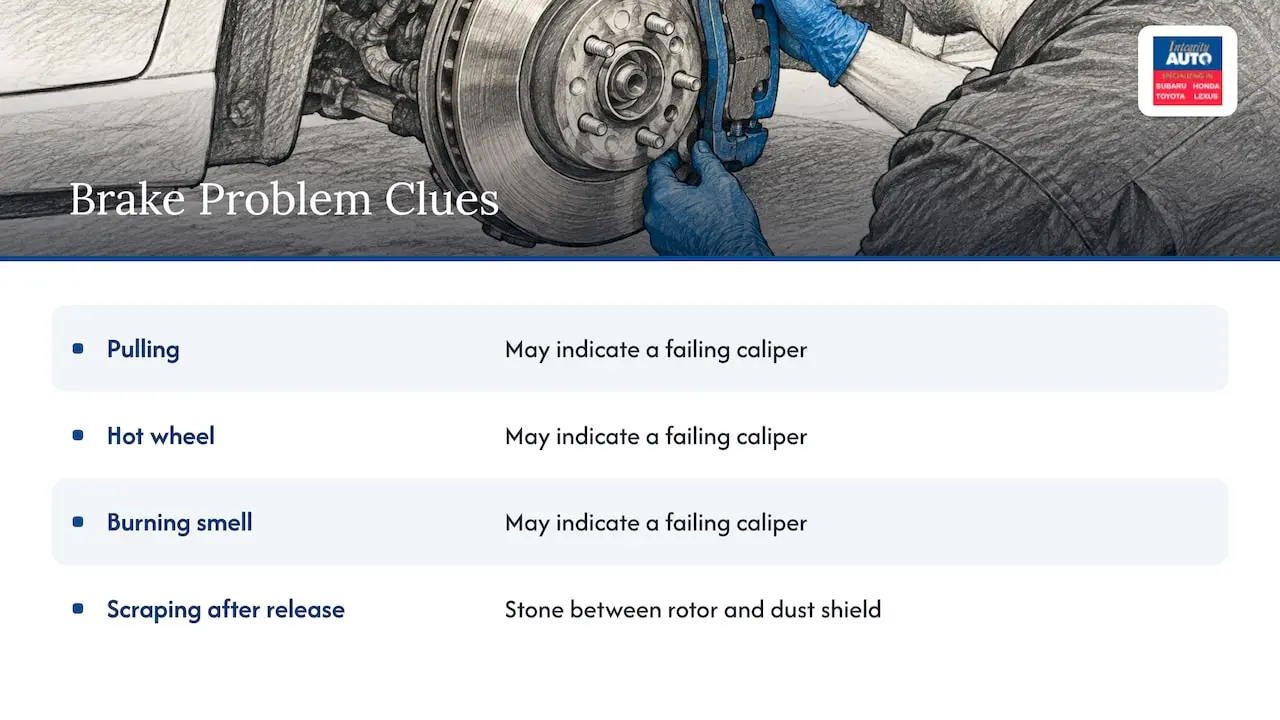
A failing caliper typically shows as the car pulling to one side during braking, one wheel running noticeably hotter than the others, or a burning smell after driving. A caliper that does not release fully can wear one pad down quickly and cause grinding on a single wheel. Debris is the least common cause: a stone lodged between the rotor and the dust shield produces a scraping that may continue with the pedal released.
What the repair involves and what it costs
The repair depends on how far the damage has gone.
- Pads caught early. The pads are replaced and the rotors are measured. If the rotors are above minimum thickness and smooth, they can sometimes be machined or reused.
- Pads worn to the backing plate. Rotors are usually scored and replaced along with the pads. Hardware, such as clips and slide pins, is cleaned or replaced and lubricated.
- Seized caliper or bad wheel bearing. The root cause is repaired in addition to the pads and rotors, otherwise the new parts wear out quickly again.
On cost, ConsumerAffairs, citing RepairPal averages in its 2026 guide, reports about $335 to $394 per axle for pads alone, $574 to $698 per axle for rotors alone, and $909 to $1,092 per axle for pads and rotors together. Those are national averages, and the figure for a specific vehicle depends on make, parts and labor rates. The point of the numbers is the gap: pads alone cost a fraction of a pads-and-rotors job, which is why prompt inspection pays off. Integrity Auto does not publish brake prices, so an estimate comes after the vehicle is inspected.
Why the make of the vehicle matters
Toyota, Lexus, Subaru and Honda vehicles each have their own brake designs, and hybrids add regenerative braking, which changes how pads wear and how rust forms on rotors that are used less. Familiarity with these makes shortens diagnosis, since a technician who sees the same platforms daily knows where pads, slide pins and wheel bearings tend to need attention. Subaru owners can find model-specific detail in the Subaru brake repair cost and service guide.
New pads and rotors can also make some noise at first. A separate article covers squeaks after new pads and rotors and when it is normal.
Brake service at Integrity Auto
Integrity Auto is an independent shop serving Toyota, Lexus, Subaru and Honda owners in the Portland, Oregon area, as an alternative to the dealer. Its services include brakes, struts and shocks, diagnosis and complimentary multipoint inspections. The shop states that its technicians are ASE certified, that it uses OEM parts, and that its repair warranties are longer than those of dealerships.
For a grinding or pulsating brake, the starting point is an inspection and diagnosis. Owners can go to the page for their make: Toyota, Lexus, Honda or Subaru. A brake check at each maintenance visit, as Ford recommends, catches thin pads before they start to grind.
FAQ
Why do my brakes grind when I stop?
The most common reason is pads worn down to the metal backing plate, which then rubs the rotor. Surface rust after the car has sat overnight can cause brief grinding that fades within a few stops. A noise that stays on every stop needs an inspection.
Can pulsating brakes make a grinding sound?
Yes. Rotor thickness variation, runout or a worn wheel bearing can cause both a pulsing pedal and a grinding or humming sound. Worn pads and uneven rotors often occur together, so the pads and rotors are usually checked at the same visit.
How long can I drive with grinding brakes?
Automakers advise inspection as soon as possible, and continuous grinding is a reason for immediate inspection. Driving on worn-through pads reduces stopping power and damages rotors, so only short, cautious trips to a repair shop are reasonable. A soft pedal or a warning light means the car should be towed.
Why does the brake pedal vibrate when stopping at low speed?
A pulse at low speed is typically linked to uneven rotor thickness or runout, or to deposits on the pad surface. Hard stops on slippery roads can also trigger ABS pulsing, which is normal. A pulse during regular dry-road stops should be inspected.
Sources
- Why Do My Brakes Keep Grinding? | The Family Handyman
- When Should I Have the Brakes Inspected? | Ford
- Why Are My Brakes Squeaking? | Mazda USA
- Brake Noise/Judder/Pedal Feel Diagnosis and Repair | NHTSA
- Cost to Replace Brake Pads and Rotors (2026 Guide) | ConsumerAffairs
- Brake Pad Gauge: Types, Readings and How to Use One