


Most Honda models equipped with a timing belt call for replacement at intervals typically around 100,000 miles or 10 years, whichever comes first, though some older models and severe-use schedules call for earlier service. The exact figure depends on the model and engine, so we recommend checking the owner’s manual or maintenance schedule for the specific vehicle before assuming a number. On an interference engine, waiting past that window risks major internal damage.
Table of Contents
- Timing Belt Replacement Interval by Model and Engine
- Why Age Matters as Much as Mileage
- Signs a Timing Belt May Need Attention, and Why Looks Can Be Deceiving
- Should the Water Pump and Tensioner Be Replaced With the Belt?
- Typical Cost and How to Compare Estimates
- How to Confirm Whether Your Honda Uses a Belt or a Chain
- What to Bring to a Timing Belt Appointment
- Book a Honda Timing Belt Inspection With Us
- FAQ
- Sources
Timing Belt Replacement Interval by Model and Engine
Honda has used timing belts across a wide range of models and engine families, and the interval is not identical from one to the next. The Honda maintenance schedule lists approximately 100,000 miles or 10 years as the standard recommendation for many belt-equipped models, with a shorter follow-up interval for a subsequent replacement on some engines. Older models and vehicles driven under severe conditions may carry a 60,000-mile ceiling instead.
Engine layout matters more than badge. V6 engines, common in minivans and midsize SUVs, tend to use timing belts longer into Honda’s lineup than four-cylinder engines, partly because chain-driven V6 designs cost more to engineer around the extra camshaft hardware. Four-cylinder Civics and Accords from many model years moved to timing chains earlier, which eliminates the belt-interval question entirely for those specific engines.
A few patterns worth knowing before assuming a number for a specific vehicle:
- Minivan and SUV V6 engines (Odyssey, Pilot, Ridgeline, Passport) have historically used timing belts on several generations, and owners should check the model-year-specific owner’s manual rather than assume the interval matches a sibling model.
- Four-cylinder Civic and Accord engines transitioned to timing chains on many model years, which removes the belt-replacement question for those specific vehicles.
- Older four-cylinder and V6 Hondas from earlier generations may still carry the shorter 60,000-mile schedule rather than the 100,000-mile figure used on newer belt-equipped engines.
- Severe-condition schedules, listed separately in most Honda maintenance documents, can shorten any of these intervals regardless of model.
The practical takeaway is that “Honda timing belt interval” is not one number. An Odyssey owner and a Ridgeline owner might both own V6-equipped vehicles, but the exact mileage and year figures still need to come from that model year’s maintenance schedule. The same caution applies to Pilot and Passport, which share engine architecture with the Ridgeline in some generations but not all.
Model-year transitions from belt to chain are worth flagging because they explain why online advice about “Honda timing belts” sometimes conflicts. A Civic or Accord built in one generation might need belt service at 100,000 miles, while the next generation of the same nameplate uses a chain and needs no scheduled belt replacement at all. Pulling the VIN and checking the specific maintenance-parts list, rather than relying on the model name alone, avoids both unnecessary service and missed service.
Why Age Matters as Much as Mileage
Honda’s guidance uses “whichever comes first” for a reason: a timing belt degrades from heat, oil exposure, and ozone in the engine bay regardless of how many miles accumulate underneath it. A low-mileage Honda that sits for long stretches or lives in a hot climate can reach the end of its belt’s service life in calendar years well before it reaches the mileage figure. That is why a 10-year-old Honda with 40,000 miles on the odometer still falls under the same replacement guidance as one with 100,000 miles, according to the Honda maintenance schedule.
Honda’s Maintenance Minder system complicates this slightly because it is sensor-driven rather than belt-aware. It tracks oil life, driving conditions, and other wear factors, but it does not directly inspect the timing belt, so owners should not treat a clean Maintenance Minder display as confirmation that the belt is fine. A few points help clarify how this interacts with the published interval:
- Maintenance Minder resets after service are required for the system to generate accurate future prompts, so a shop should confirm the code was cleared and logged after any major service.
- Severe-condition driving, including frequent short trips, stop-and-go traffic, or extended idling, can trigger earlier service recommendations even when Maintenance Minder has not flagged anything belt-related.
- Dusty, sooty, or extreme-heat environments accelerate belt degradation faster than mileage alone would suggest, which is part of why severe-condition schedules exist as a separate column in Honda’s documentation.
Owners who want a simpler way to track calendar-based intervals alongside mileage can look at general maintenance tracking guidance aimed at keeping service schedules from slipping between visits. The core point remains the same no matter the tracking method: age and mileage are two separate triggers, and either one reaching its limit calls for service.
Signs a Timing Belt May Need Attention, and Why Looks Can Be Deceiving
A handful of symptoms suggest a timing belt is approaching failure, though they are not always present before the belt actually breaks.
- Engine running rough or misfiring, especially at idle, can point to timing slipping out of sync.
- A ticking or slapping noise from the front of the engine, particularly at startup, often signals belt or tensioner wear.
- An oil leak near the timing cover can accelerate belt degradation, since oil breaks down the rubber compound faster than normal aging.
- Difficulty starting the engine, paired with no other obvious cause, sometimes indicates the belt has already slipped.
The harder truth is that modern composite timing belts often show no visible cracking or fraying before they fail, unlike older rubber belts that tended to crack visibly with age. This is part of why scheduled replacement by mileage and age, rather than a wait-for-symptoms approach, remains the standard recommendation. Belt and hose inspection guidance from Consumer Reports notes that checking for cracking, glazing, and fraying is useful general practice, but acknowledges that many composite belts simply do not display these signs even near the end of their service life.
When a technician inspects a timing belt, the job typically involves removing the timing cover to check tension, look for cracking or glazing on the belt’s underside, and examine the tensioner and idler pulleys for play or noise. Owners should ask whether the inspection included removing the cover, since a visual check from outside the engine rarely reveals much.
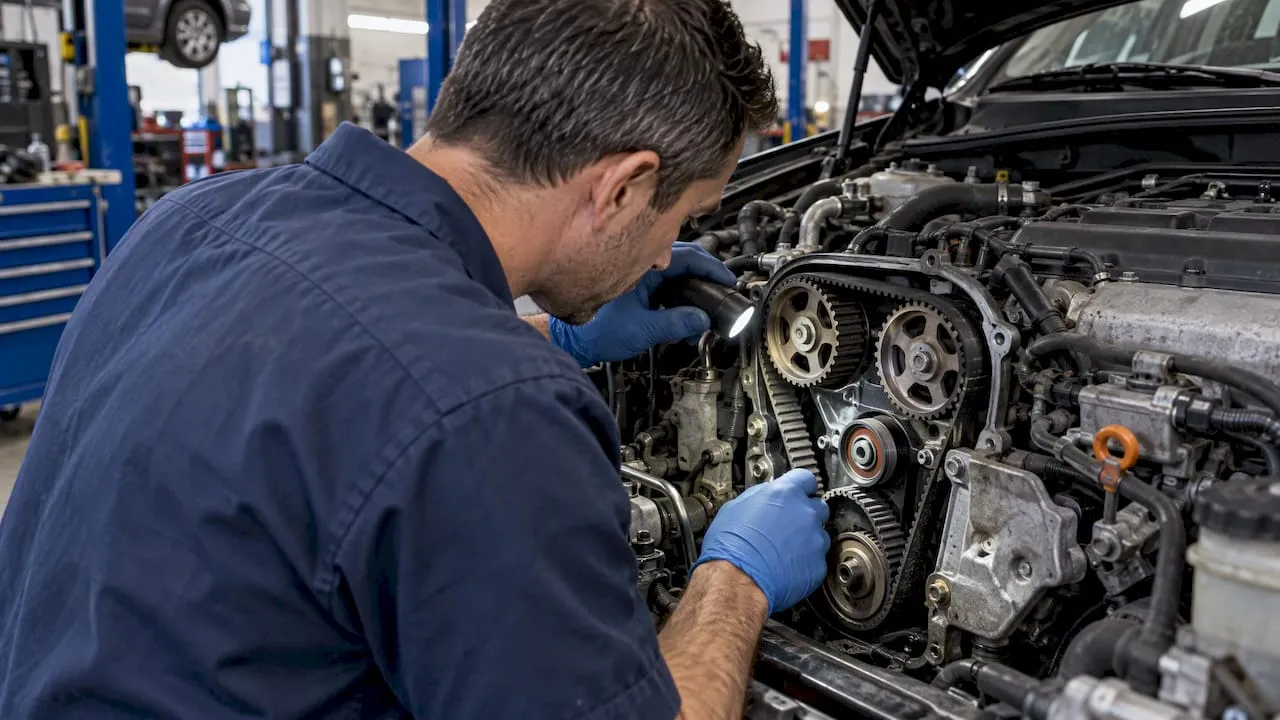
Pro Tip: Ask the shop to show you the old belt after replacement. Any cracking or glazing on the underside confirms whether the timing was close to failing or had margin left.
Should the Water Pump and Tensioner Be Replaced With the Belt?
Replacing the water pump, tensioner, and idler pulleys at the same time as the timing belt is standard practice at most shops, and the reasoning is mechanical as much as financial.
- The water pump, tensioner, and pulleys sit behind the same timing cover as the belt, so most of the labor cost of a timing-belt job comes from accessing that area, not from the belt itself.
- Replacing only the belt and leaving a failing water pump in place often means paying for the same labor again within a year or two if the pump fails afterward.
- Tensioners and idler pulleys wear on the same rough timeline as the belt, and a worn tensioner can shorten the life of a brand-new belt considerably.
A typical timing-belt job checklist includes the belt itself, the water pump, the tensioner, idler pulleys, and often new seals and a drive belt if it shares the same access point. Exceptions exist: if the water pump was replaced recently and its condition can be verified, there is no mechanical reason to replace it again. The same logic applies to a tensioner replaced outside the normal interval for an unrelated repair.
Typical Cost and How to Compare Estimates
Timing-belt replacement costs vary widely because the labor hours required depend heavily on engine accessibility rather than on the belt’s price alone. A V6 timing belt job generally requires more labor than a four-cylinder job because of the extra components and tighter engine bay access on many minivan and SUV platforms, which is one reason two Honda owners can receive very different quotes for what sounds like the same service.
A clear, itemized estimate should include:
- A parts list naming the belt, water pump, tensioner, and pulleys by part number, not just a lump “timing belt kit” line.
- Labor hours broken out separately from parts cost, so the hourly rate is visible.
- Warranty terms on both parts and labor, stated in writing rather than described verbally.
- Whether OEM or aftermarket parts are being quoted, since this affects both price and expected part life.
When comparing a dealership quote against an independent shop quote, asking for OEM part numbers and labor hours on both lets you compare apples to apples rather than guessing at why one number is higher. Our Honda 100k service cost guide walks through how dealer and independent pricing structures typically differ at major service milestones, which includes timing-belt work on many models.
How to Confirm Whether Your Honda Uses a Belt or a Chain
Not every Honda needs this service at all, so confirming belt versus chain before scheduling anything saves money and worry.
- Check the owner’s manual maintenance schedule first, since it lists the specific service items and intervals for that exact model year and engine, not just the model name.
- If the manual is unavailable, a VIN lookup through a dealer or the Honda maintenance schedule documentation can confirm the engine code, which determines belt or chain design.
- When uncertainty remains, ask a qualified technician to verify by engine code rather than relying on general statements about “most Hondas” or forum posts about a similar model.
This matters because a belt-to-chain transition sometimes happens mid-generation on the same nameplate, meaning two Accords from adjacent model years can have entirely different maintenance needs. Our page on timing-chain design and maintenance covers how chain-driven engines differ in service needs, which is useful context for owners trying to understand why their Honda’s schedule looks different from a relative’s.
What to Bring to a Timing Belt Appointment
A short checklist makes a timing-belt appointment faster and the estimate easier to evaluate:
- The VIN, so the shop can confirm the exact engine code and applicable maintenance schedule.
- The owner’s manual page or a photo of the relevant maintenance schedule entry, if available.
- A direct question about whether the water pump, tensioner, and idler pulleys will be replaced along with the belt.
- A request for OEM part numbers on the quote, along with the labor hours and warranty terms in writing.
We provide independent Honda Services & Repair for owners who want manufacturer-recommended scheduled maintenance handled without a dealership appointment. Our technicians are ASE certified and use OEM parts where appropriate, and every estimate is itemized before work begins so parts, labor, and warranty terms are clear up front. A typical timing-belt visit may include inspection of the tensioner and pulleys, confirmation of the water pump’s condition, and resetting of any related maintenance reminder systems after the service is logged.
Book a Honda Timing Belt Inspection With Us
If a Honda is approaching its mileage or age threshold, we offer a straightforward path to getting it checked and serviced without the dealership markup or the uncertainty of guessing at an interval. Our Honda Services & Repair page covers what a timing-belt appointment includes: an inspection of the belt, tensioner, and water pump, a written estimate with OEM part numbers, and the actual replacement if the vehicle is due.
To prepare for the visit, bring the VIN and, if available, the maintenance schedule page from the owner’s manual so our team can confirm the correct interval for that specific model year and engine. A few things to expect:
- A written, itemized estimate before any work begins, listing parts and labor separately.
- A recommendation on whether the water pump and tensioner should be replaced at the same time, based on the vehicle’s actual condition.
- Warranty terms on parts and labor explained clearly, not just mentioned in passing.
Estimates are intended to foster clear communication, with reasoning behind any recommendations explained before a decision is made.
FAQ
Can a timing belt last 200,000 miles?
Some timing belts survive well beyond their recommended interval without failing, but this is not something to plan around. The Honda maintenance schedule sets replacement at 100,000 to 105,000 miles or 10 years for many models precisely because belts can fail without warning past that point, and on an interference engine the consequences of waiting are severe.
How much does it cost to replace a Honda timing belt?
Cost varies by engine layout and labor hours required to access the belt, with V6 engines typically costing more than four-cylinder jobs due to tighter access and more components. We provide a written, itemized estimate before starting any timing-belt work, and pricing is available on request through our Honda Services & Repair page.
Why is Honda still using timing belts?
Honda uses timing belts on select engines, particularly some V6 designs, because belt-driven camshaft systems can be simpler and less costly to engineer around certain engine layouts than chain-driven alternatives. Many four-cylinder Honda engines transitioned to timing chains in various model years, so the choice depends on the specific engine family rather than a single company-wide standard.
Can a timing belt last 10 years?
Ten years is close to the upper limit of what most Honda maintenance schedules recommend, not a guarantee of how long a belt will perform safely. The Honda maintenance schedule lists age alongside mileage specifically because rubber and composite materials degrade over time even on a vehicle driven relatively few miles.
How do I know if my Honda has a timing belt or a timing chain?
The owner’s manual maintenance schedule for the specific model year and engine is the most reliable source, since belt-to-chain transitions sometimes occur mid-generation on the same model. A VIN lookup or a qualified technician can confirm the engine code when the manual is unavailable.
Sources
- Honda maintenance schedule / owner’s manual (official Honda technical information)
- Kelley Blue Book: Honda timing belt replacement guidance


