
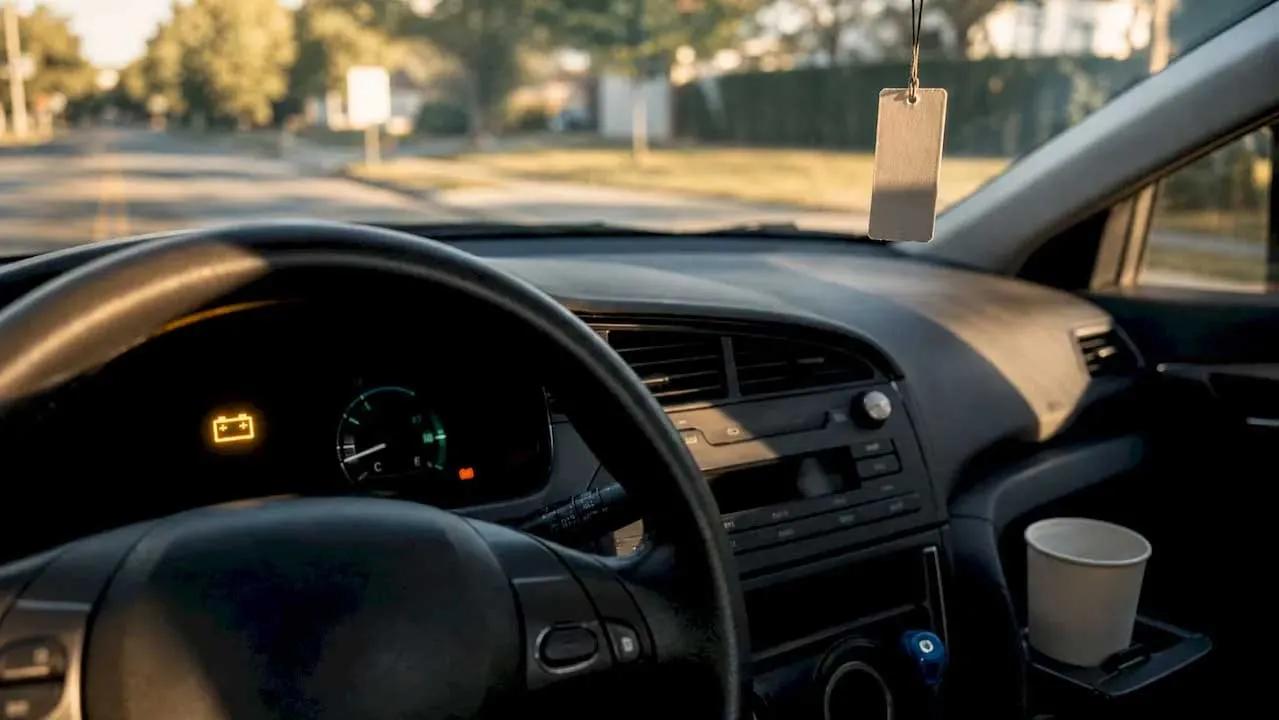
The hybrid battery warning light is an alert from your vehicle’s hybrid system control ECU indicating a detected fault in the high-voltage battery pack or its related components. Most drivers see this light and assume the worst, but about 85% of cases stem from minor issues like a single weak battery module, a blocked cooling fan, or a failing 12V auxiliary battery. That statistic matters because it means most drivers can avoid a full battery pack replacement with the right diagnosis. The Toyota Prius is the most common vehicle affected, but this warning applies to all Toyota and Lexus hybrids, as well as Honda and Subaru hybrid models.
What causes the hybrid battery warning light to come on?
The “Check Hybrid System” alert is an umbrella message, not a specific diagnosis. It triggers when monitored values such as battery voltage, temperature, or cooling efficiency fall outside the programmed safe windows in the hybrid ECU. The actual cause requires reading Diagnostic Trouble Codes, or DTCs, with a hybrid-capable scan tool.
The most common triggers fall into three categories:
- Weak battery modules. Toyota and Lexus hybrid systems monitor between 14 and 28 individual battery blocks. One failing block is enough to trigger the warning light.
- Blocked or failed cooling fan. The high-voltage battery pack relies on a dedicated cooling fan. A clogged cabin air filter or failed fan motor causes the pack to overheat, which the ECU flags immediately.
- Failing 12V auxiliary battery. A weak 12V battery can cause false hybrid system warnings. Voltage dips below 11.8V during load destabilize ECU behavior and account for roughly 20% of P3000 code complaints.
| Cause category | Common symptom | Severity |
|---|---|---|
| Weak battery module | Warning light, reduced power | Moderate |
| Blocked cooling fan | Overheating, warning light | Moderate to high |
| Failing 12V battery | False warnings, startup issues | Low to moderate |
| Inverter cooling pump failure | Warning light, limp mode | High |
| Insulation resistance fault | Warning light, no-drive condition | Critical |
The diagnostic trouble code P3000 is a parent code with many sub-codes that pinpoint specific failure locations within the hybrid battery system, including individual battery blocks, inverter components, or cooling circuits. Knowing the sub-code is what separates a $200 fix from a $4,000 mistake.
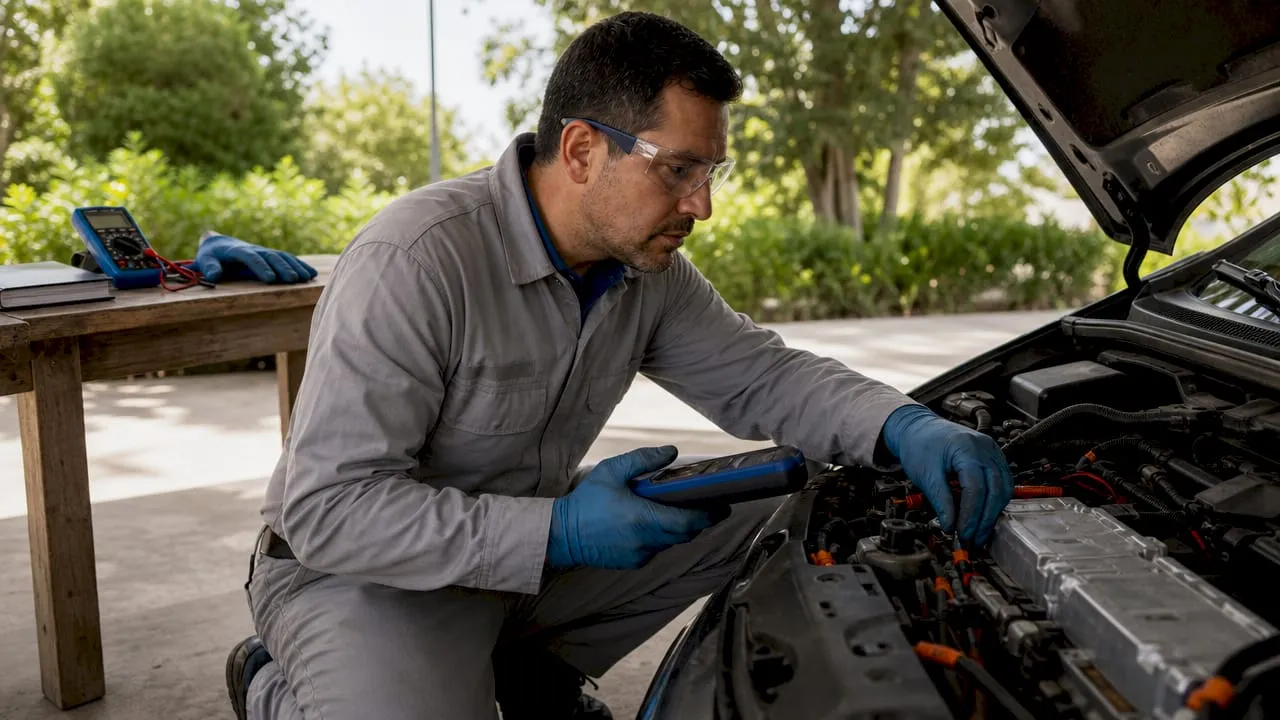
How to diagnose the hybrid battery warning light accurately
Accurate diagnosis requires a hybrid-capable scan tool, not a basic OBD-II reader. Improper diagnosis with basic readers leads many owners to replace entire battery packs unnecessarily. That is an expensive and avoidable mistake.
A proper diagnostic process follows these steps:
- Read all DTC sub-codes. Connect a hybrid-capable scan tool and retrieve every sub-code under the P3000 parent code. Generic OBD-II tools miss these sub-codes entirely.
- Test the 12V auxiliary battery under load. A battery older than four years or one that drops below 11.8V under load should be replaced before any further hybrid diagnosis. This single step clears roughly 20% of false warnings.
- Log per-block battery voltage. A healthy Nickel-Metal Hydride pack shows block voltages within 0.2V variance at rest. Lithium-ion packs show within 50 mV variance. Deviations above these thresholds identify the failing module.
- Check battery temperature sensor readings. Abnormal temperature readings confirm cooling system faults rather than cell failures.
- Verify insulation resistance. Healthy insulation reads above 500 kΩ. Values below 100 kΩ indicate moisture intrusion or harness damage, both of which are electrical hazards requiring immediate attention.
Pro Tip: Never skip the insulation resistance check before touching any hybrid battery component. Values below 100 kΩ signal a live electrical hazard. This step protects both the technician and the vehicle’s high-voltage wiring.
Understanding diagnostic trouble codes for Toyota and Lexus systems is a skill that pays for itself the first time it prevents an unnecessary battery replacement.
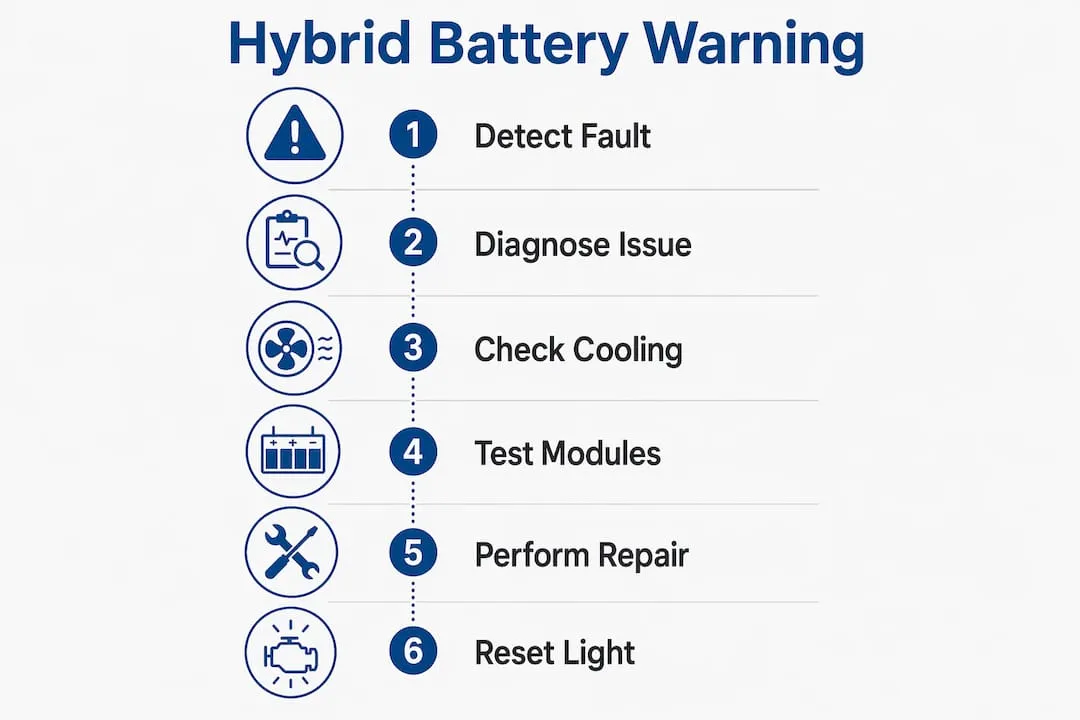
Repair and maintenance options for hybrid battery warnings
The repair path depends entirely on what the diagnosis reveals. Most warnings do not require a full battery pack replacement.
- Clean or replace the cooling fan. A blocked cabin filter or seized fan motor is a low-cost fix that resolves overheating-related warnings quickly.
- Replace the 12V auxiliary battery. This is often the first repair to attempt. It is inexpensive and eliminates a common source of false warnings.
- Replace a single faulty module. When per-block voltage logging identifies one weak cell group, replacing that module alone restores normal operation. This is far less expensive than replacing the entire pack.
- Replace the inverter coolant pump. Inverter cooling pump failures are a known issue on several Toyota and Lexus hybrid models. Heat is the leading cause of inverter and battery module damage, making this repair a high-priority fix.
- Full battery pack replacement. This becomes necessary when multiple modules fail or when the pack has degraded uniformly across all blocks. Understanding whether to recondition or replace the battery pack is a decision that requires real data, not guesswork.
Maintaining cooling systems and 12V battery health is the most effective way to prevent hybrid battery warning light triggers. Heat is the primary enemy of both battery modules and inverter components.
Pro Tip: When logging per-block voltages, watch for discrepancies greater than 0.3V at rest or 0.5V under load in NiMH packs. For lithium-ion packs, flag any block more than 50 mV outside the group average. These thresholds identify failing modules before they cause broader pack damage.
Can you drive safely when the hybrid battery warning light is on?
The answer depends on the color of the warning and the specific fault code stored. Hybrid ECU warnings fall into tiers of urgency, and treating every warning the same way is a mistake.
- Yellow warning light. A yellow or amber light typically signals a fault that requires prompt diagnosis but does not demand an immediate stop. Cooling faults and single module failures often appear as yellow warnings. Drive cautiously and schedule service within a day or two.
- Red warning light with “Hybrid System Warning: Safely Stop and Do Not Drive.” This message means stop the vehicle as soon as it is safe to do so. A red warning often accompanies a high-voltage isolation fault, such as fault code P0AA6, which signals a breach in the electrical insulation. Driving with this fault active risks electrical damage and personal safety.
- Limp mode or power loss. Some fault conditions trigger a reduced-power mode that limits vehicle speed. This is the system protecting itself. Do not attempt to override it by pushing the vehicle harder.
Ignoring a red hybrid warning is not a calculated risk. It is a decision that can turn a $500 repair into a $5,000 one.
How to reset the hybrid battery warning light
Resetting the warning light is the final step after a confirmed repair, not a shortcut around one. Resetting without repairing the root cause causes the warning to return, often within a short drive cycle.
The correct reset process works as follows:
- Confirm the repair is complete. Verify that the faulty component has been replaced or repaired and that all systems read within normal parameters.
- Check 12V battery health. A weak 12V battery can cause the ECU to re-flag faults immediately after clearing. Replace it first if it tests below specification.
- Verify cooling system function. Confirm the cooling fan operates correctly and that no temperature sensor faults remain.
- Clear codes with a hybrid-capable scan tool. Generic OBD-II tools cannot clear hybrid sub-codes reliably. Use a tool that accesses the full hybrid ECU, not just the generic powertrain module.
- Perform a drive cycle. After clearing codes, drive the vehicle through a complete warm-up cycle to confirm the warning does not return.
For Toyota and Lexus owners, Toyota maintenance light resets and hybrid system resets are related but distinct procedures. Confusing the two leads to incomplete repairs.
Integrityautoinc hybrid battery diagnostics in Portland, OR
Hybrid battery warnings deserve a precise diagnosis, not a parts-swapping approach that runs up unnecessary costs.
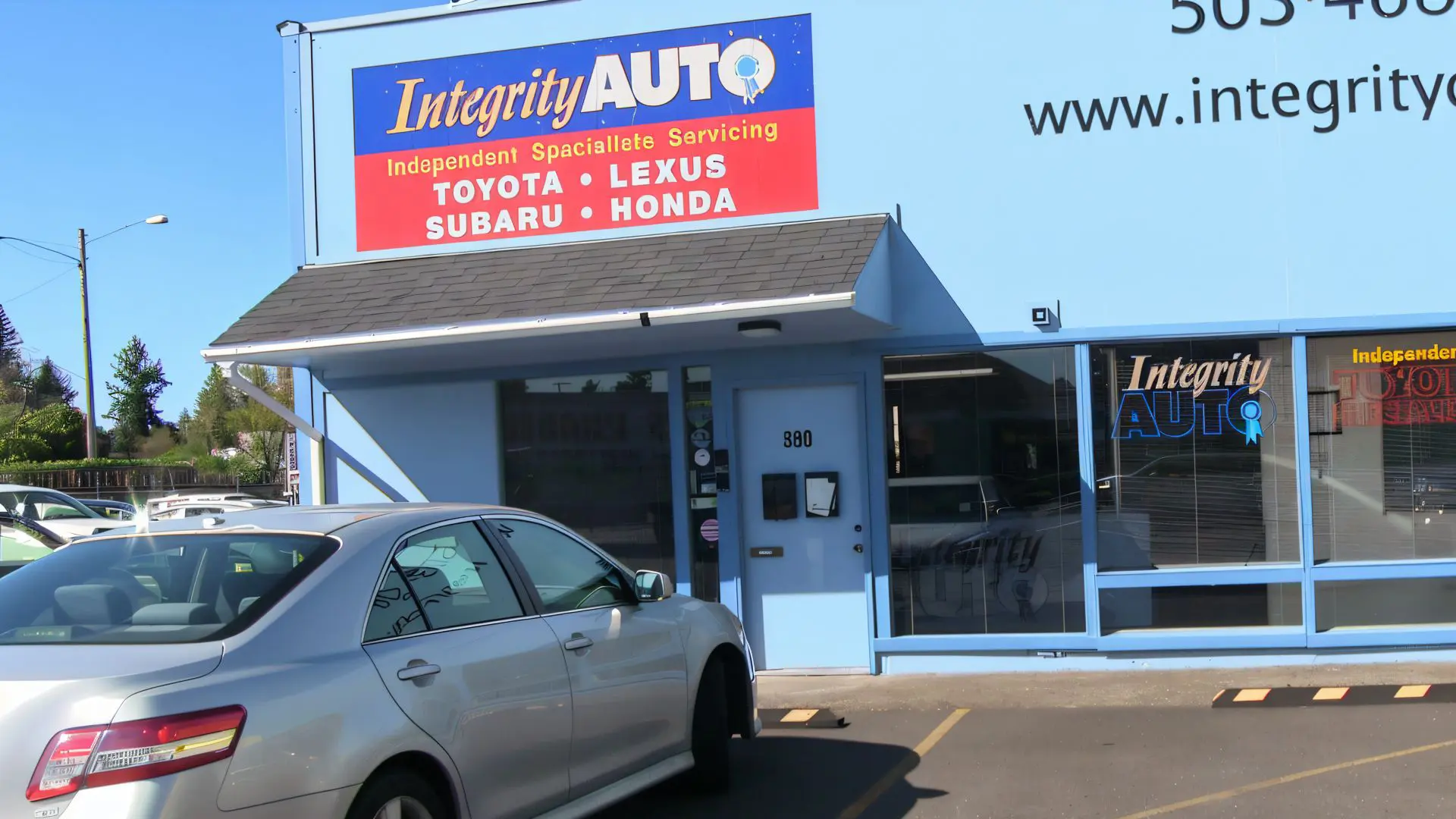
Integrityautoinc specializes in Toyota, Lexus, Subaru, and Honda hybrid systems. The shop uses hybrid-capable scan tools to retrieve full DTC sub-codes, log per-block battery voltages, and verify insulation resistance before recommending any repair. For owners who need replacement components, Toyota used parts sourced through Integrityautoinc reduce the cost of hybrid battery repairs significantly compared to dealer pricing. Integrityautoinc treats every hybrid warning as a diagnostic puzzle worth solving correctly the first time, because replacing a battery pack you did not need to replace is a cost no driver should absorb.
Key takeaways
The hybrid battery warning light signals a specific fault detected by the hybrid ECU, and accurate diagnosis with a hybrid-capable scan tool resolves most cases without a full battery pack replacement.
| Point | Details |
|---|---|
| Most warnings are minor | About 85% of hybrid warning light cases involve weak modules, cooling fans, or 12V batteries, not full pack failure. |
| Sub-codes are essential | The P3000 parent code has many sub-codes; only a hybrid-capable scan tool retrieves them accurately. |
| 12V battery matters | A 12V battery older than four years or dropping below 11.8V under load causes roughly 20% of false hybrid warnings. |
| Insulation resistance is a safety check | Values below 100 kΩ indicate an electrical hazard and require immediate professional attention. |
| Never reset without repairing | Clearing codes without fixing the root cause causes the warning to return and delays proper repair. |
FAQ
What does the hybrid battery warning light mean?
The hybrid battery warning light signals that the vehicle’s hybrid ECU has detected a fault in the high-voltage battery system or a related component. It requires diagnosis with a hybrid-capable scan tool to identify the specific cause.
Is it safe to drive with the Toyota Prius hybrid battery warning light on?
A yellow warning light allows cautious short-distance driving to a repair shop. A red warning light with the message “Hybrid System Warning: Safely Stop and Do Not Drive” requires stopping the vehicle immediately, as it often indicates a high-voltage isolation fault.
How do I reset the check hybrid system warning?
Resetting requires clearing DTC sub-codes with a hybrid-capable scan tool after confirming the underlying fault is repaired. Generic OBD-II tools cannot reliably clear hybrid system sub-codes.
What is the most common cause of the Prius hybrid battery warning light?
Single weak battery modules, blocked cooling fans, and failing 12V auxiliary batteries are the most common causes. A full battery pack failure is far less common than most drivers assume.
How much does it cost to fix a hybrid battery warning light?
Repair costs vary widely depending on the root cause. Replacing a 12V battery or cleaning a cooling fan costs far less than replacing a full battery pack. Accurate diagnosis with a hybrid-capable scan tool is the only way to know which repair is actually needed.


