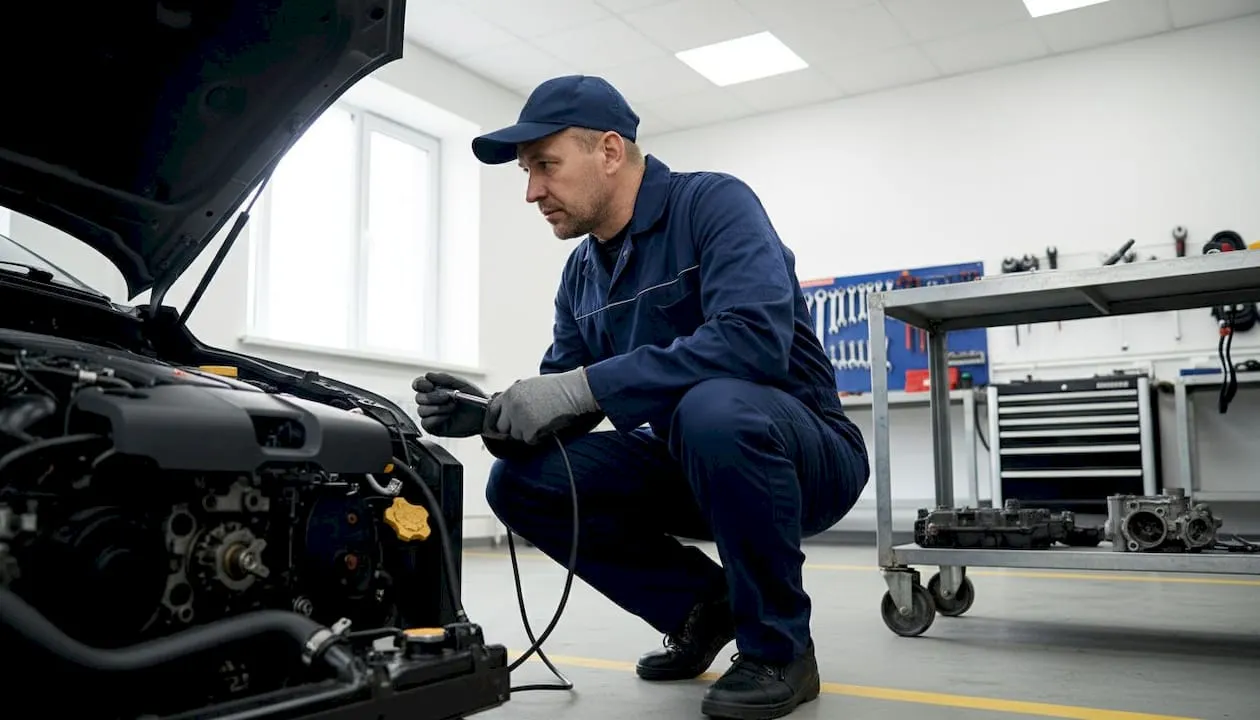
Subaru engine repair is a specialized process that addresses unique mechanical and electronic faults, including head gasket failure, ECU immobilizer synchronization, and cooling system breakdowns. These are not generic car problems. Subaru engines, particularly the horizontally opposed “boxer” design, carry specific failure patterns that require a technician who understands the platform. Repair costs in 2026 range from $1,500 for a basic head gasket job to over $8,000 for a full engine replacement. Knowing what you are dealing with before you authorize any work protects your wallet and your vehicle.
What are the most common Subaru engine problems and their symptoms?
Head gasket failure is the most well-documented Subaru engine problem, affecting a wide range of models from the late 1990s through the mid-2010s. The boxer engine’s flat cylinder layout places the head gaskets under unusual thermal stress. Coolant loss without visible external leaks, white exhaust smoke, and engine overheating are the clearest warning signs. Left unaddressed, a failing head gasket causes catastrophic internal engine damage within weeks.
ECU and immobilizer faults are the second major category Subaru owners encounter. The ECU communicates constantly with the Body Interface Unit (BIU) and the instrument cluster through Subaru’s anti-theft immobilizer system. When that communication breaks down, the engine suppresses injector pulse and refuses to start. Owners often misread this as a dead battery or a failed starter, which leads to unnecessary parts replacements.
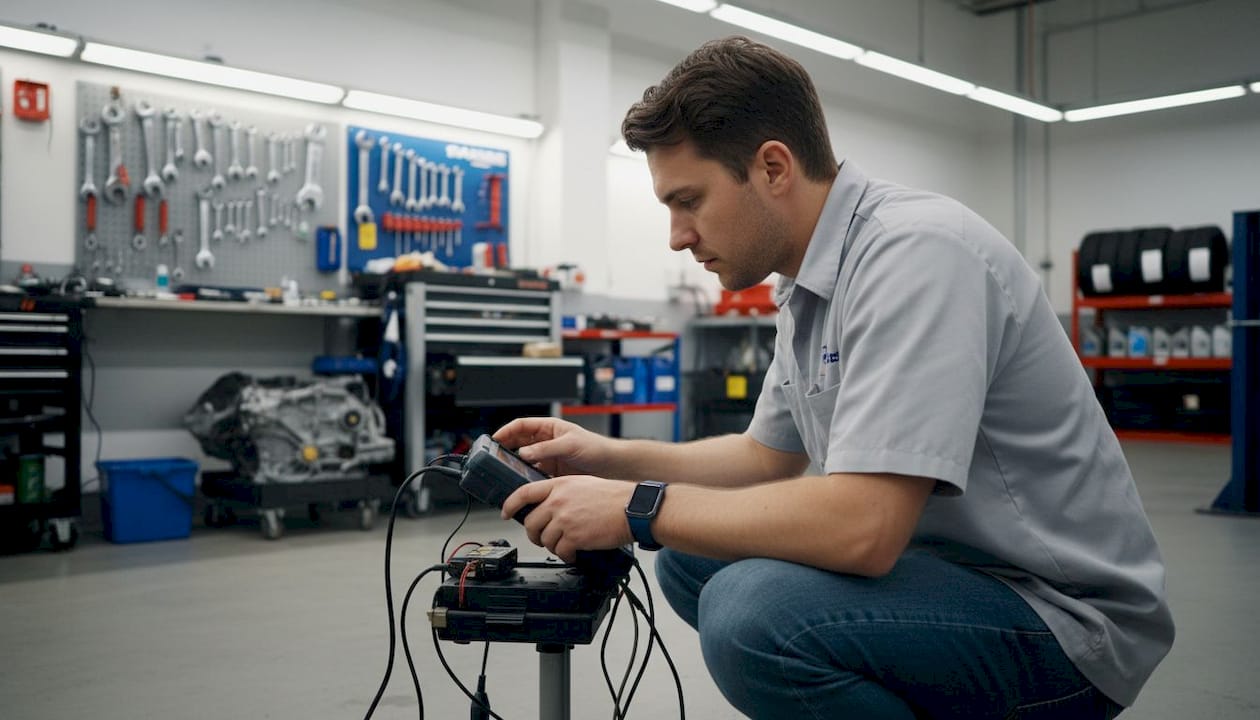
Thermo control valve failure is a more recent concern, particularly on 2020 Forester models. A failed thermo control valve disables the EyeSight driver assistance system, triggers cold engine readings, and costs between $1,500 and $1,961 to repair. Parts were on national backorder as of 2026, meaning repair timelines can stretch significantly.
Common warning signs to watch for include:
- Coolant loss with no visible external leak
- White or sweet-smelling exhaust smoke
- Engine temperature gauge climbing above normal
- Rough idle or misfires under load
- Check engine light with codes related to the ECU or immobilizer
- No-start condition with no obvious electrical fault
- EyeSight or safety system warnings appearing alongside engine codes
Pro Tip: If your Subaru shows a no-start condition alongside an IMMO fault code, do not replace the ECU before checking the BIU and cluster. Replacing one module without re-pairing all three makes the problem worse and more expensive to fix.
How does Subaru engine repair work for the head gasket and ECU?
Head gasket replacement on a Subaru boxer engine is a labor-intensive job. The engine must be partially disassembled to access the cylinder heads, and technicians typically replace the head bolts, resurface the deck, and install multi-layer steel (MLS) gaskets rather than the original composite units. MLS gaskets handle thermal cycling better and are the industry standard for Subaru head gasket repairs. Related components like the water pump, thermostat, and timing belt are almost always replaced at the same time, since the labor to access them is already done.
ECU repair on Subaru vehicles involves a different kind of complexity. Subaru’s immobilizer system ties the ECU, BIU, and instrument cluster together through a shared security seed. Replacing any one of these modules with a used unit causes a no-start condition because the new module carries a different seed. Technicians resolve this through one of two methods:
- ECU cloning: The original ECU’s data, including the VIN, immobilizer seed, and tune files, is copied directly onto the replacement unit. This is the faster and less expensive path.
- Virginizing and re-syncing: The replacement ECU is reset to a factory blank state, then programmed with the vehicle’s specific data. This method is required when the original ECU is damaged beyond data recovery.
- BIU and cluster synchronization: When the BIU or cluster is also replaced, all three modules must be re-paired in sequence. Skipping steps causes persistent IMMO fault codes and continued no-start conditions.
- All-keys-lost recovery: If all physical keys are lost, the BIU must be reprogrammed from scratch. This is the most involved scenario and requires specialized equipment.
| Repair method | Typical cost | Best used when |
|---|---|---|
| ECU cloning | 50–70% less than dealer | Original ECU is intact and readable |
| Virginize and sync | Moderate, varies by shop | Original ECU is damaged or unreadable |
| Dealer ECU replacement | $1,200–$2,500 | Warranty coverage applies |
| Mail-in BIU service | 50–70% less than dealer | All-keys-lost or BIU failure |
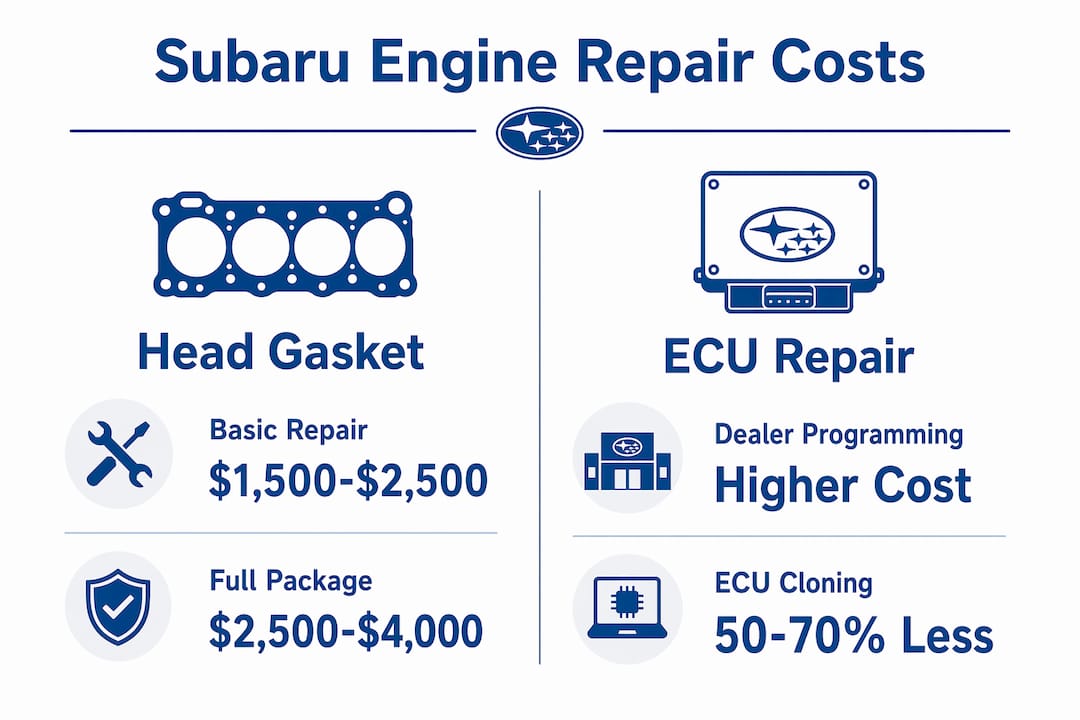
ECU cloning cuts cost by 50–70% compared to dealer programming fees. That savings is significant when the dealer quotes $1,200 to $2,500 for the same outcome.
Pro Tip: Always request a full engine diagnostic scan before authorizing ECU replacement. A weak battery under 12.4V at rest commonly triggers a P0606 fault code that looks like an ECU failure. Replacing a $120 battery often clears the code without touching the ECU.
What are the typical costs for Subaru engine repair in 2026?
Head gasket repair costs range from $1,500 to $2,500 for a basic replacement and $2,500 to $4,000 or more for a complete service package that includes the water pump, timing components, and resurfacing. Full engine replacement runs $4,000 to $8,000 or more depending on whether a remanufactured or used unit is installed. These are not small numbers, which is why catching problems early matters so much.
Major engine repairs on Subaru Forester models average around $3,100 at independent shops. Dealership pricing runs 20–40% higher for the same work. That gap represents real money, often $600 to $1,200 more for identical parts and comparable labor.
Several factors push costs up or down:
- Model year and engine type: Older models with discontinued parts cost more to source. The 2004 Subaru Forester XT, for example, uses a turbocharged EJ255 engine with fewer aftermarket options.
- Mileage and overall engine condition: High-mileage engines often need additional work discovered during teardown, such as worn piston rings or scored cylinder walls.
- Parts availability: The 2020 Forester thermo control valve was on national backorder in 2026, adding weeks to repair timelines and sometimes inflating parts pricing.
- ECU programming needs: If the repair involves module replacement, programming fees add $300 to $800 at independent shops, or $1,200 to $2,500 at a dealership.
The most effective cost-saving strategy is choosing a qualified independent specialist over a dealership. Independent shops with Subaru experience deliver the same quality of repair at a fraction of the price, and they are more likely to give you an honest assessment of what actually needs replacing.
How can Subaru owners maintain their engines to prevent major repairs?
Cooling system maintenance is the single most effective way to prevent head gasket failure. Subaru’s boxer engine runs hotter than many conventional designs, and degraded coolant accelerates gasket wear. Flushing and replacing coolant on schedule, typically every 30,000 miles or as specified in your owner’s manual, keeps the system functioning correctly. Checking coolant level monthly takes less than two minutes and catches slow leaks before they become expensive failures.
Maintaining your Subaru engine also means staying current on oil changes, valve adjustments, and timing belt replacements. Subaru’s interference engine design means a snapped timing belt causes immediate and severe internal damage. Replacing the belt at the recommended interval is not optional maintenance.
Battery and charging system health directly affects engine computer performance. A battery resting below 12.4V triggers fault codes that mimic ECU failure, including the P0606 code. Testing your battery annually and replacing it proactively every four to five years prevents unnecessary diagnostic confusion and avoids misdiagnosed repairs.
Early diagnostics save money. A Subaru engine diagnostics scan at the first sign of a warning light costs far less than the repairs that result from ignoring it. Catching a small coolant leak or an early immobilizer communication fault before it escalates is always the better financial decision.
Pro Tip: If your Subaru is approaching 100,000 miles, schedule a compression test alongside your next oil change. Low compression in one or more cylinders is an early indicator of head gasket seepage, and catching it early keeps you in the $1,500 repair range rather than the $4,000 range.
What special considerations apply to Subaru engine computer repair?
Subaru’s immobilizer system is one of the most misunderstood aspects of engine repair for Subaru vehicles. The BIU, instrument cluster, and ECU must communicate through matched security seeds. Replacing any one of these modules with a used part from another vehicle almost always results in a no-start condition and a cascade of IMMO fault codes. This is not a defect. It is the system working as designed to prevent theft.
The practical implication is that used ECU or BIU modules cannot simply be swapped in without professional programming. Technicians must either clone the original module’s data or virginize the replacement and re-sync all three components. Skipping this step wastes the cost of the part and adds labor to undo the incorrect installation.
All-keys-lost scenarios are the most expensive immobilizer situation. When every physical key is gone, the BIU must be fully reprogrammed. Dealer programming for this scenario costs $900 to $1,800. Professional mail-in BIU services perform the same work at 50–70% less, without requiring a dealership tow.
Keeping detailed records of all diagnostic codes before any module is removed is critical to repair success. Technicians use those logs to correctly re-sequence the ECU, BIU, and instrument cluster during reprogramming. Without them, the process becomes trial and error, which costs time and money.
Recording diagnostic codes before module removal is a step many owners and even some shops skip. Do not skip it.
Key takeaways
Subaru engine repair requires matching the right repair method to the specific fault, whether that is a head gasket, an ECU, or an immobilizer system, because the wrong approach always costs more than the right one.
| Point | Details |
|---|---|
| Head gasket repair costs | Basic replacement runs $1,500–$2,500; full service packages reach $4,000 or more. |
| ECU cloning saves money | Cloning cuts ECU replacement costs by 50–70% compared to dealer programming fees. |
| Immobilizer sync is mandatory | Replacing the ECU, BIU, or cluster without re-pairing all three causes a no-start condition. |
| Independent shops cost less | Major Subaru repairs average $3,100 at independent shops, versus 20–40% more at dealerships. |
| Early diagnostics prevent escalation | A battery test and compression check at 100,000 miles catches failures before they become catastrophic. |
What working with Subaru immobilizer repairs taught me
The immobilizer system is where I see owners lose the most money, not because the repair is inherently expensive, but because the diagnosis goes wrong at the start. A shop replaces the ECU without cloning it, the car still does not start, and now the owner is out $1,500 and no closer to a solution. I have seen this happen more than once.
My honest view is that most Subaru owners underestimate how tightly the engine computer, the BIU, and the instrument cluster are connected. These are not independent modules. They are a matched set, and treating them otherwise is the root cause of most failed ECU repairs. The fix is not complicated once you understand the system, but it requires a technician who has done it before and knows the sequence.
On the maintenance side, I advocate strongly for proactive cooling system service. The head gasket failures I see most often are not sudden catastrophic events. They are slow leaks that were ignored for 10,000 or 20,000 miles. A $150 coolant flush and a monthly visual check would have prevented a $3,000 repair in most of those cases.
If your Subaru is showing any warning signs, get a proper Subaru engine diagnostics scan from a specialist who knows the platform. Do not guess, and do not let a shop replace modules without a clear diagnostic path. The right diagnosis is always cheaper than the wrong repair.
Trusted Subaru engine care at Integrityautoinc
Subaru engine problems do not have to mean dealership prices or guesswork. Integrityautoinc specializes in Toyota, Lexus, Subaru, and Honda vehicles as an independent shop, which means you get dealer-level knowledge without the dealer markup.

Whether you need a head gasket replacement, ECU programming, or a full engine assessment, Integrityautoinc treats your concerns as their own and builds repairs around honesty and long-term reliability. Explore Subaru care services to see the full range of engine repair and maintenance options available, or visit the engine maintenance page to learn how proactive service keeps repair costs low. Your Subaru deserves a shop that takes its job seriously.
FAQ
What does Subaru engine repair typically cost in 2026?
Head gasket repair runs $1,500 to $4,000 depending on the scope of work, while full engine replacement costs $4,000 to $8,000 or more. Independent shops average $3,100 for major engine repairs, which is 20–40% less than dealership pricing.
Can I swap a used ECU into my Subaru without programming?
No. Used ECU and BIU modules carry immobilizer data tied to a different VIN, so a direct swap almost always causes a no-start condition. The replacement unit must be cloned or virginized and re-synced to your vehicle’s specific security seed.
What are the early signs of Subaru head gasket failure?
Coolant loss without visible external leaks, white exhaust smoke, and an overheating temperature gauge are the clearest early signs. Catching these symptoms early keeps repair costs in the $1,500 range rather than the $4,000-plus range.
What is the P0606 code on a Subaru, and does it mean the ECU is bad?
P0606 indicates an internal processor fault, but a battery resting below 12.4V commonly triggers this code. Replacing the battery often clears the fault without any ECU work required.
How does Subaru engine computer repair differ from standard ECU replacement?
Subaru’s immobilizer system requires the ECU, BIU, and instrument cluster to share matched security data. Standard ECU replacement without cloning or re-syncing all three modules causes the engine to suppress fuel injection and refuse to start.