

Hybrids cost 35–45% less annually on maintenance and repairs compared to gas vehicles, making them the more economical choice over a full ownership cycle despite higher sticker prices. Fuel savings average around 40% compared to gas vehicles, and routine service intervals stretch further because regenerative braking reduces wear on friction components. Battery replacement is one high-cost repair unique to hybrids, but it typically occurs after substantial mileage and can be managed affordably through reconditioning. Insurance premiums run about 9% higher on average for hybrids, though green car discounts from many insurers can narrow that gap.
At a glance, here is how hybrid vs gas maintenance costs compare:
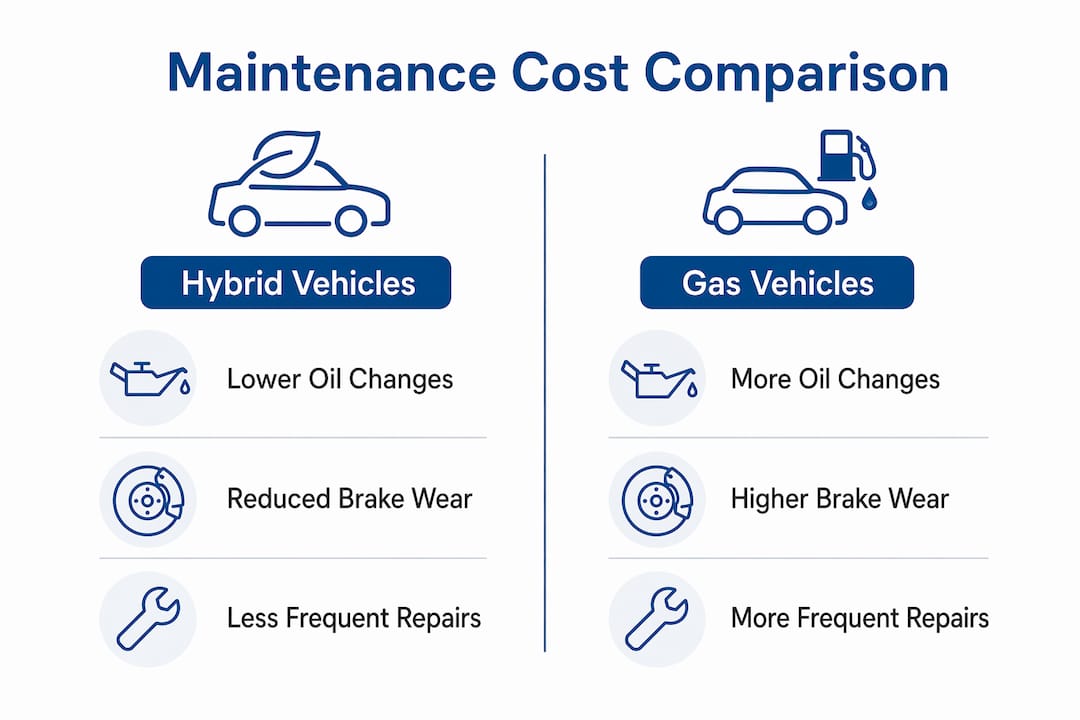
- Routine maintenance: Hybrids require less frequent oil changes and brake service, reducing annual upkeep costs.
- Repair frequency: Hybrids experience fewer repairs overall due to reduced engine strain and superior reliability ratings.
- Battery replacement: Rare before 100,000 miles; reconditioned packs cost $1,000–$2,500 versus $3,000–$8,000 or more for new dealer replacements.
- Insurance: Hybrids average about 9% higher premiums, partially offset by green vehicle discounts.
- Fuel savings: Hybrids save roughly 40% on fuel costs annually compared to comparable gas models.
- Long-term cost of ownership: Electrified powertrains, including hybrids, carry lower lifetime maintenance costs than traditional gas vehicles across 200,000 miles.
Table of Contents
- How hybrid vs gas maintenance costs differ in routine service
- What repair costs and risks look like for hybrids versus gas cars
- Are hybrids more reliable than gas vehicles?
- How insurance and fuel costs affect long-term hybrid ownership expenses
- How to manage and reduce hybrid vehicle maintenance costs
- How depreciation affects total cost of ownership for hybrids and gas cars
- How regional differences shape maintenance and repair costs
- Long-term resale value comparison for hybrids and gas vehicles
- Key Takeaways
- Hybrid and gas vehicle service at Integrityautoinc
- FAQ
How hybrid vs gas maintenance costs differ in routine service
Routine maintenance is where hybrids build their most consistent financial advantage. Several specific service categories cost less and occur less often compared to gas vehicles.
- Oil changes: Hybrid engines cycle off frequently at low speeds and during deceleration, which reduces combustion byproducts and extends oil life. Gas engines run continuously, requiring more frequent oil changes.
- Brake service: Regenerative braking slows the vehicle by converting kinetic energy into electricity, so friction brakes engage far less often. Brake pads and rotors on hybrids last two to three times longer than on gas vehicles. Owners can review hybrid brake system specifics to understand what this means for their service schedule.
- Spark plugs and filters: Hybrid engines often use extended-interval spark plugs, and reduced engine load means some filters last longer between replacements.
- Tires and fluids: These costs are broadly similar between powertrains, though electric motor assist reduces drivetrain stress on tires in some driving conditions.
- Hybrid-specific components: Electric motors themselves require minimal scheduled maintenance. The high-voltage battery cooling system does need periodic fluid checks, which adds a service item not present on gas vehicles, though the cost is modest.
For owners following factory-scheduled service intervals, the cumulative savings from reduced brake and oil service alone add up meaningfully over three to five years.
What repair costs and risks look like for hybrids versus gas cars
Repair frequency tells a different story than repair cost per incident. Hybrids tend to need repairs less often, but when a specialized component fails, the bill can be higher than a typical gas car repair.
| Repair Category | Hybrid | Gas Vehicle |
|---|---|---|
| Battery pack replacement | $1,000–$2,500 (reconditioned); $3,000–$8,000+ (new OEM) | Not applicable |
| Brake system (pads/rotors) | Less frequent; 2–3x longer service intervals | Standard frequency |
| Transmission service | CVT or eCVT systems; fewer fluid changes needed | Conventional automatic or manual; standard intervals |
| Engine repairs | Less frequent due to reduced engine load | More frequent; higher cumulative cost |
| Alternator/belt replacement | Eliminated in most hybrid designs | Regular replacement item |
Rare but costly hybrid repairs:
- High-voltage battery pack failure outside warranty coverage
- Inverter or power control unit failure, which requires specialized diagnostic equipment
- Electric motor or generator unit damage, uncommon but expensive to address
More frequent gas vehicle repairs:
- Alternator, serpentine belt, and oxygen sensor replacements
- Timing belt service (where applicable) and fuel system maintenance
- Higher cumulative brake system costs due to standard friction braking
The hybrid battery replacement cost is the figure most owners worry about, but reconditioned packs through independent shops bring that expense well within reach. Gas vehicles avoid that specific cost but accumulate repair bills across more frequent, smaller incidents over the same mileage.
Are hybrids more reliable than gas vehicles?
Consumer Reports ranks hybrids among the most dependable vehicles on the road, with hybrids reporting 26% fewer problems on average than gas-only vehicles in the Annual Auto Reliability Survey. That gap is not marginal. It reflects the real-world benefit of reduced engine stress, fewer moving parts in the braking system, and mature hybrid technology that has been refined over more than two decades.

Hybrid battery longevity contributes to this reliability profile. Modern nickel-metal hydride and lithium-ion packs are engineered to outlast most other vehicle components, and manufacturers typically back them with eight-year or 100,000-mile warranties. Regenerative braking’s role in parts durability extends beyond fuel savings: brake calipers, pads, and rotors on hybrids simply wear out more slowly, reducing the likelihood of an unplanned repair visit.
Gas vehicles are not unreliable by any measure, but their combustion systems carry more wear-prone components. Oxygen sensors, timing belts, alternators, and fuel injectors all have finite service lives and contribute to a higher cumulative repair frequency over 150,000 miles or more.
How insurance and fuel costs affect long-term hybrid ownership expenses
Insurance and fuel are two recurring costs that shape total ownership expenses as much as any maintenance bill.
Insurance premiums:
- Hybrids carry about 9% higher insurance costs on average compared to equivalent gas models.
- The higher premium reflects repair complexity and the cost of specialized parts.
- Green car discounts offered by several major insurers can offset a portion of this difference; the actual net cost depends heavily on the driver’s record, location, and chosen coverage level.
Fuel cost savings:
- Hybrids save a substantial amount on fuel annually compared to gas vehicles, with savings compounding significantly over multiple years of ownership.
- A Toyota RAV4 Hybrid, for example, delivers substantially lower annual fuel costs than its gas counterpart at $4 per gallon, with savings running into hundreds of dollars per year.
- Regional fuel prices matter. Owners in states with consistently higher gas prices, such as California or Oregon, realize fuel savings faster than those in lower-cost markets.
- Driving habits also influence outcomes. Stop-and-go urban driving maximizes regenerative braking efficiency, amplifying the fuel economy advantage. Highway-heavy drivers see a smaller but still meaningful gap.
The net effect: fuel savings typically outpace the insurance premium difference within the first two to three years of ownership for most drivers. For a practical overview of hybrid fleet cost advantages, the pattern holds across both personal and commercial use cases.
Pro Tip: Ask your insurer specifically about green vehicle or hybrid discounts before renewing. Not all carriers advertise these proactively, and the savings can partially cancel out the higher base premium.
How to manage and reduce hybrid vehicle maintenance costs
Hybrid owners have several practical tools for keeping maintenance expenses under control, and the choices made at service time can make a meaningful difference over the vehicle’s life.
- Use independent shops for battery service. Reconditioned battery packs through qualified independent repair centers cost $1,000–$2,500, compared to $3,000 or more at a dealership. The quality gap between a properly reconditioned pack and a new OEM unit is often negligible for vehicles with moderate mileage.
- Schedule regular multipoint inspections. Catching a developing issue in the cooling system or high-voltage battery early is far less expensive than addressing a failure. Preventative maintenance consistently reduces the risk of costly repairs outside warranty coverage.
- Know your warranty coverage. Federal law requires hybrid battery warranties of at least eight years or 100,000 miles on most models. Understanding exactly what is covered prevents paying out of pocket for repairs that should be warranty claims. Monitoring the hybrid battery warning light and acting promptly when it appears is part of this discipline.
- Choose shops with hybrid diagnostic capability. High-voltage systems require specialized equipment and trained technicians. A shop without the right tools can misdiagnose a hybrid-specific fault, leading to unnecessary parts replacement.
- Follow manufacturer maintenance schedules. Adhering to the recommended tune-up and oil change intervals keeps the combustion engine in the best condition possible and preserves warranty protections.
Pro Tip: Regenerative braking does more than save fuel. Because friction brakes engage far less often, brake fluid contamination also slows down, which can extend the interval between brake hydraulic fluid flushes. Ask a qualified technician to test brake fluid condition at each inspection rather than replacing it on a fixed calendar schedule.
How depreciation affects total cost of ownership for hybrids and gas cars
Depreciation is the largest single cost in vehicle ownership for most drivers, yet it rarely appears in maintenance cost comparisons. A vehicle that loses value quickly can erase years of fuel and maintenance savings.
Gas vehicles generally depreciate faster than comparable hybrids, particularly in the mid-size sedan and crossover segments where hybrid versions have established strong resale demand. Buyers in the used market increasingly seek fuel-efficient options, which supports hybrid residual values. A vehicle that retains more of its purchase price after five years effectively costs less to own, even if its sticker price was higher at the outset.
The depreciation advantage is not universal across all hybrid models. Luxury hybrids and plug-in hybrids with large battery packs can depreciate sharply if battery replacement costs become a concern for used buyers. Standard hybrid models from established manufacturers tend to hold value more predictably. Checking the 2026 vehicle selection checklist can help prospective buyers weigh depreciation alongside upfront cost when comparing powertrains.
How regional differences shape maintenance and repair costs
Where a vehicle is driven and serviced has a direct effect on what owners pay for upkeep. Labor rates vary considerably across the United States, with shops in major metropolitan areas on the coasts typically charging more per hour than those in the Midwest or rural markets. A brake job that costs $300 in Portland, Oregon may run $450 or more in San Francisco.
Parts availability also varies by region. Hybrid-specific components, particularly battery packs and inverter assemblies, are more readily available in markets with higher hybrid adoption rates. In areas where hybrids are less common, sourcing parts can take longer and occasionally cost more. Gas vehicle parts are universally available, which keeps repair timelines short and competitive pricing more consistent.
Climate plays a role as well. Hybrid batteries perform best within moderate temperature ranges. Owners in extreme cold climates, such as the northern Midwest or mountain states, may see slightly reduced battery efficiency in winter months. Extreme heat in the Southwest can accelerate battery degradation over time if the thermal management system is not properly maintained.
Long-term resale value comparison for hybrids and gas vehicles
Resale value is closely tied to depreciation but deserves separate consideration because it represents a real dollar return at the end of ownership. Hybrids from brands with strong reliability reputations, particularly Toyota and Honda, consistently command higher resale prices than their gas counterparts in the used market.
The Toyota Prius, for example, has maintained some of the strongest resale values in its segment for over a decade. Buyers shopping for a used fuel-efficient vehicle are willing to pay a premium, and that demand keeps prices elevated. Gas vehicles in the same segments tend to depreciate more steeply after the first three years, reducing the net return when the owner sells or trades in.
Battery condition is the variable that can complicate hybrid resale. A hybrid with a documented service history and a healthy battery pack commands a strong price. One with an unknown battery history or a warning light in its past may sell at a discount. Maintaining clear service records and addressing battery health proactively protects resale value as much as it protects reliability.
Key Takeaways
Hybrids deliver lower total ownership costs than gas vehicles over the long term, driven by reduced routine maintenance, fewer repairs, and substantial fuel savings that outweigh the higher purchase price.
| Point | Details |
|---|---|
| Routine maintenance savings | Hybrids cost 35–45% less annually on maintenance and repairs than gas vehicles. |
| Fuel cost advantage | Hybrids save roughly 40% on fuel annually, compounding significantly over five to ten years. |
| Battery replacement risk | Reconditioned packs cost $1,000–$2,500; new OEM replacements run $3,000–$8,000 or more, but replacement is rare before 100,000 miles. |
| Insurance premium difference | Hybrids average about 9% higher insurance costs, partially offset by green vehicle discounts. |
| Integrityautoinc service | Integrityautoinc provides specialized hybrid maintenance and battery service in Portland, Oregon, as an independent alternative to dealership pricing. |
Hybrid and gas vehicle service at Integrityautoinc
Owners who want hybrid maintenance done right without dealership pricing have a direct option in Portland, Oregon. Integrityautoinc specializes in Toyota, Lexus, Subaru, and Honda vehicles, including the hybrid models these brands are known for, and provides the diagnostic capability and technical experience that hybrid service actually requires.
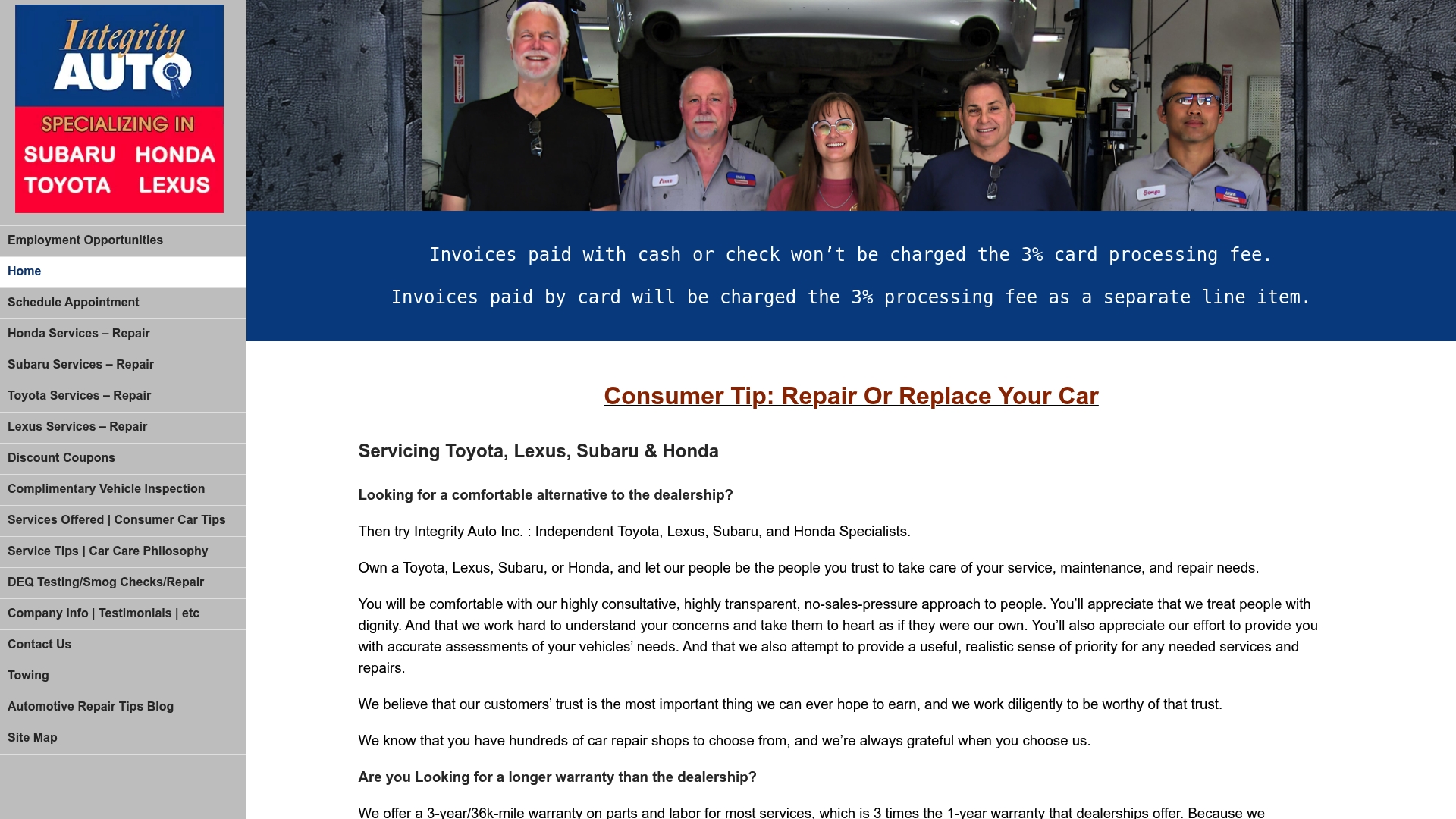
The shop handles everything from factory-scheduled maintenance and brake system service to hybrid battery diagnostics and reconditioning assessments, all at independent shop rates. For owners weighing the long-term cost of hybrid ownership, having a trusted service partner who understands high-voltage systems and hybrid-specific wear patterns is a practical advantage. Integrityautoinc also offers complimentary multipoint inspections, which catch developing issues before they become costly repairs. Owners of Toyota and Lexus hybrids can explore eco-friendly repair services or schedule service directly to get started.
FAQ
Is it cheaper to own a hybrid or gas car?
Hybrids cost less to own over the long term for most drivers. Annual maintenance and repair costs run 35–45% lower than gas vehicles, and fuel savings of roughly 40% compound significantly over five to ten years of ownership.
Are hybrids more reliable than gas vehicles?
Consumer Reports data shows hybrids report 26% fewer problems on average than gas vehicles, ranking them among the most dependable vehicles available. Reduced engine strain and regenerative braking contribute directly to this reliability advantage.
What is the downside of a hybrid car?
The primary financial risk is battery replacement, which can cost $3,000–$8,000 or more for a new OEM pack at a dealership. Reconditioned packs through independent shops reduce that cost to $1,000–$2,500, and replacement is typically not needed before 100,000 miles.
Is insurance higher on a hybrid car?
Hybrid insurance premiums average about 9% higher than equivalent gas vehicles due to repair complexity and higher vehicle values. Green car discounts from some insurers can offset part of this difference, and driver history and location also influence the final premium.
Does regenerative braking really reduce brake maintenance costs?
Yes. Regenerative braking extends brake pad and rotor life two to three times longer than on gas vehicles, reducing the frequency and cost of brake service throughout the vehicle’s life.


