

Toyota WS transmission fluid should be used, or verified as a JWS 3324-compatible equivalent, whenever an automatic transmission on a WS-spec Toyota is serviced, and drain-and-fill is the safer method for most DIY jobs and older or high-mileage vehicles. Owner practice commonly falls within a moderate mileage range between fluid changes, with some vehicles running longer and others needing service sooner under heavy use.
Table of Contents
- What Toyota WS fluid is and why the spec matters
- When to change Toyota WS fluid and how driving habits shift the timeline
- Warning signs your Toyota’s transmission fluid needs attention
- Step-by-step drain-and-fill procedure for a WS-equipped transmission
- Drain-and-fill versus high-pressure flush: which to choose
- Buying the right fluid: confirming Toyota WS compatibility
- What a Toyota WS fluid change costs and how long it takes
- A reliable shop’s checklist for a Toyota WS fluid service
- Book a Toyota WS fluid service with Integrity Auto
- FAQ
- Sources
What Toyota WS fluid is and why the spec matters
Toyota WS is a specific automatic transmission fluid engineered to the JWS 3324 technical standard, a specification Toyota created for its modern electronically controlled transmissions. The fluid is formulated as a full-synthetic product, though retail labeling varies by brand and sometimes causes confusion about whether a bottle on the shelf actually meets the JWS 3324 standard or simply claims broad compatibility.
The spec exists because WS-era transmissions depend on precise friction characteristics and viscosity behavior to shift smoothly and protect internal clutch packs. Using an older fluid type, such as Toyota Type T-IV, or an ATF built for a different viscosity range, can change how clutches engage and how the valve body responds to pressure.
The practical risks of using the wrong fluid include:
- Harsh or delayed shifting caused by friction modifiers that do not match the transmission’s design.
- Accelerated wear on clutch plates and seals not formulated for the WS additive package.
- Shudder or slipping under load, particularly during low-speed engagement.
Matching the spec is not a minor preference. It is the difference between a transmission that shifts the way Toyota engineered it and one that develops avoidable problems within a few thousand miles.
When to change Toyota WS fluid and how driving habits shift the timeline
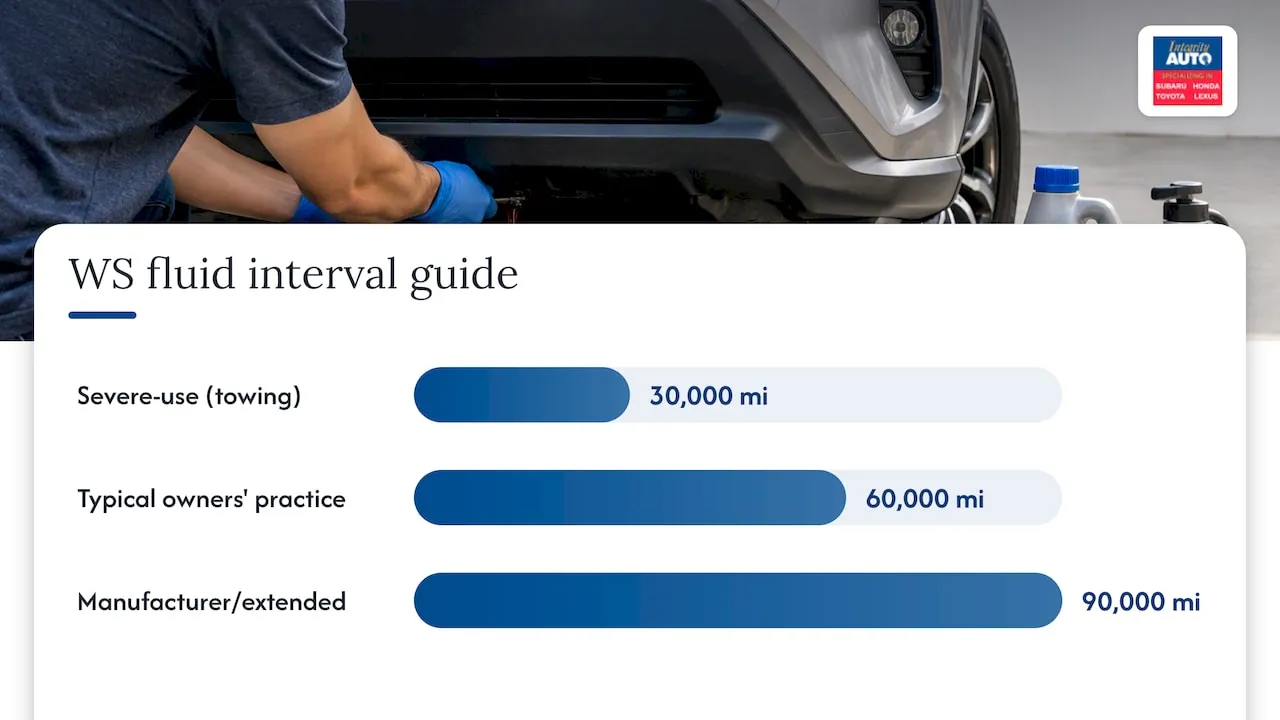
Owner practice and Kelley Blue Book’s service guidance both point to a common range: many Toyota owners change WS fluid between roughly 30,000 and 60,000 miles, while some follow manufacturer schedules that stretch to 90,000 miles. KBB also notes that some newer transmissions are marketed as needing lifetime fluid, yet many owner’s manuals still call for periodic service regardless of that label.
The right interval depends heavily on how the vehicle is driven. Conditions that call for the shorter end of the range include, similar to dealing with brake fluid degradation in severe use, frequent towing or hauling heavy loads, which raises transmission fluid temperature Brake Fluid Moisture: What Drivers and Mechanics Must Do.
- Frequent towing or hauling heavy loads, which raises transmission fluid temperature.
- Mountain or hill driving, where the transmission works harder to manage grade changes.
- Heavy stop-and-go traffic, which increases heat cycling on clutch packs.
- Consistently hot climates, where ambient heat compounds operating temperature.
A workable decision rule: follow the owner’s manual interval as the default, then move to the shorter end of the range, or even ahead of it, if your driving matches any of the severe-use conditions above. A vehicle used mostly for highway commuting in mild weather can often stay closer to the 60,000-mile mark, while a truck or SUV used for towing benefits from checking fluid condition well before then.
Warning signs your Toyota’s transmission fluid needs attention
Degraded fluid rarely fails silently. Watch for these signals:
- Shudder during acceleration, especially from a stop or at low speeds, which often points to worn friction material suspended in old fluid.
- Delayed or harsh shifts, where the transmission hesitates before engaging a gear or clunks into place.
- Dark or burnt-smelling fluid, a clear sign the fluid has broken down and lost its protective properties.
- Visible leaks under the vehicle near the transmission pan or cooler lines, which can lower fluid level enough to cause shifting problems on their own.
A simple visual check tells you a lot. Fresh Toyota WS fluid is a light red color with a faint, clean smell. Fluid that has turned brown, has a burnt odor, or shows metallic particles on the dipstick or in a drained sample signals it is overdue for a change. Shudder or harsh shifting paired with dark fluid warrants prompt inspection rather than waiting for the next scheduled interval. A slightly darkened but still clear and odor-free fluid, on the other hand, can usually be monitored until your next planned service.
Step-by-step drain-and-fill procedure for a WS-equipped transmission
Before starting, confirm the exact fluid capacity and procedure for your specific Toyota model, since pan design and fill-plug location vary across transmissions. Buy more Toyota WS fluid than you expect to need, gather a manual transmission fluid pump, a large catch pan, funnels, clean rags, and a torque wrench, and work on a level surface with the engine cool enough to handle safely but not cold.
- Warm the engine briefly to normal operating temperature so the fluid flows freely during drainage.
- Locate the drain plug and remove it to drain the fluid into the catch pan, noting the fluid’s color and smell before it empties.
- Reinstall the drain plug to the correct torque specification listed in your service information.
- Refill through the fill point with fresh Toyota WS fluid, matching the quantity removed as closely as possible.
- Start the engine and briefly cycle through the gears (park, reverse, drive, and back to park) to circulate the new fluid.
- Check the fluid level following Toyota’s specified procedure, which usually involves checking at a particular temperature with the engine running.
- Repeat the pump-out and refill cycle if the drained fluid still looks dark, since a single drain typically replaces only a portion of the total fluid volume.
- Continue cycles until the fluid draining out closely matches the color and clarity of fresh WS fluid.
- Road test the vehicle, then recheck the fluid level once more after driving to confirm it holds steady.
Each drain-and-fill cycle typically removes a few quarts at a time, which is why repeating the process produces a more thorough fluid exchange than a single drain. Record the color of the fluid before and after each cycle so you have a clear reference for how much the fluid has improved. Dispose of used transmission fluid at a certified recycling center or auto parts store that accepts used fluid, never down a drain or in household trash.
Pro Tip: Keep a small sample of the old fluid in a clear container next to a sample of fresh WS fluid so you can judge color improvement accurately in daylight rather than under shop lighting.
Drain-and-fill versus high-pressure flush: which to choose
For routine maintenance, drain-and-fill is the better default, particularly on vehicles with higher mileage or unknown service history. High-pressure flush equipment forces fluid through the entire system under pressure, and on a transmission that has accumulated sediment or wear debris, that pressure can dislodge material that then interferes with valve body operation.
- Older or high-mileage transmissions are more likely to have debris that a flush could stir loose, risking new shift problems.
- Drain-and-fill replaces fluid gradually and avoids disturbing deposits that have settled without causing symptoms.
- A professional flush or deeper service may be justified when fluid has never been changed, when symptoms suggest significant contamination, or when a shop’s inspection finds specific buildup that calls for more than a standard drain cycle.
Kelley Blue Book’s guidance notes that flushing has fallen out of favor for routine service, with many shops now preferring the more conservative drain-and-fill approach for exactly this reason.
Buying the right fluid: confirming Toyota WS compatibility
Not every bottle labeled for “multi-vehicle” use meets the JWS 3324 standard Toyota requires. Product listings and technical data sheets show that aftermarket fluids marketed as broadly compatible vary in formulation, so the label alone is not enough to confirm a match.
- Check the technical data sheet (TDS) for an explicit JWS 3324 reference rather than relying on general “fits most Toyota models” claims.
- Buy enough fluid for a full drain-and-fill cycle, plus extra if you plan to repeat the pump-out process multiple times.
- Note the OEM part number printed on genuine Toyota WS containers so you can match it when reordering.
- Compare dealer and auto-parts pricing, since genuine WS fluid is often available through both channels at different price points.
What a Toyota WS fluid change costs and how long it takes
A straightforward drain-and-fill typically takes about an hour of labor when performed as a standalone service. Full-service costs commonly land in the low hundreds of dollars, with one cost estimate showing a range of $323 to $381 for a comparable service, depending on fluid quantity and labor rates.
- Pan gasket or filter replacement, when applicable to the transmission design, adds parts and labor time.
- Diagnostic work for symptoms like shudder or harsh shifting adds cost beyond a routine fluid change.
- Dealer labor rates often run higher than independent shop rates for the same service.
Professional service is worth the added cost when symptoms are already present, when the vehicle’s fluid history is unknown, or when you want documented confirmation that the correct spec fluid was used and torque specs were met.
A reliable shop’s checklist for a Toyota WS fluid service
A dependable shop confirms the exact procedure for your transmission model before starting, uses verified Toyota WS or JWS 3324-compatible fluid, torques the pan and drain plug to specification, and road tests the vehicle afterward to confirm smooth shifting. Service records should note the fluid brand and part number used along with the fluid’s condition before the change.
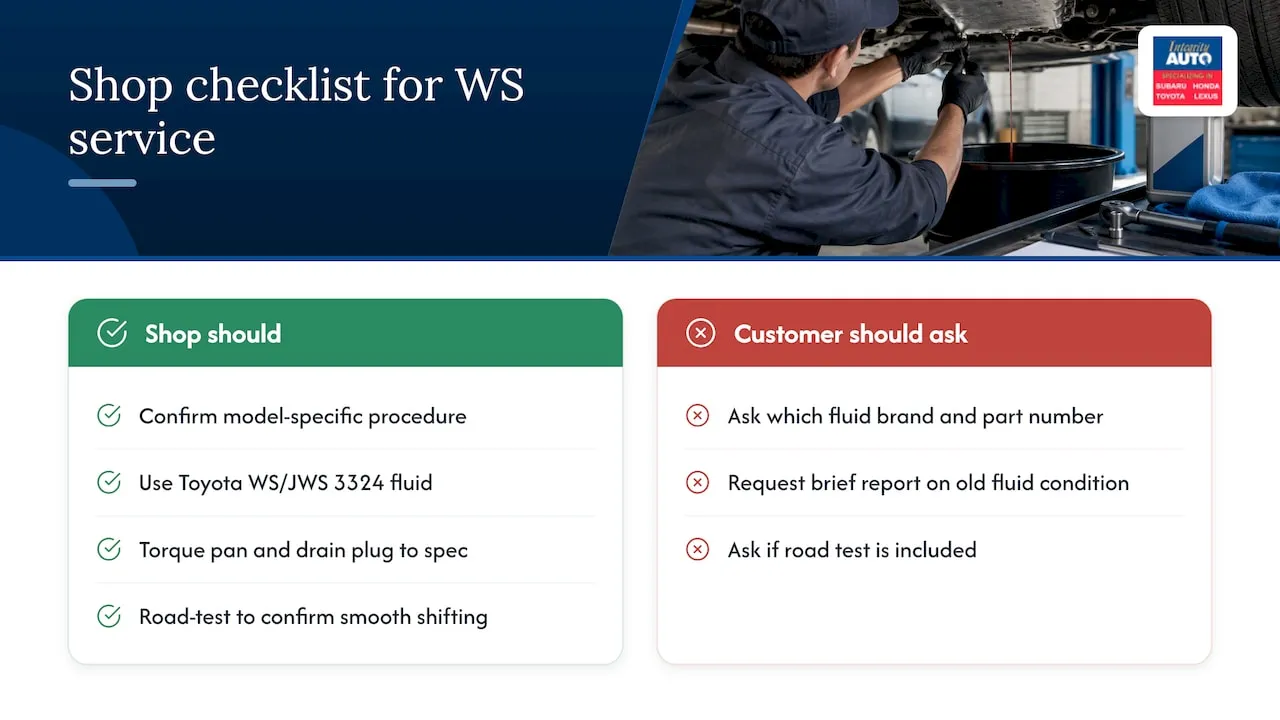
When booking a transmission service, it is reasonable to ask which fluid brand and part number will be used, request a brief condition report on the old fluid, and ask whether a road test is included after the work is complete.
Book a Toyota WS fluid service with Integrity Auto
For Toyota owners who would rather leave the pump-out cycles and torque specs to a shop, Independent Toyota Service and Repair covers transmission fluid changes alongside full diagnostics and manufacturer-recommended maintenance.
- We confirm the correct WS or JWS 3324-compatible fluid for your specific model before starting.
- Our technicians document fluid condition and torque specs as part of every transmission service.
- We provide a transparent estimate before any work begins, so there are no surprises on the invoice.
Reach out through our Toyota service page to get a quote or schedule an appointment.
FAQ
How much does Toyota WS fluid cost?
Pricing varies by retailer and whether you buy genuine Toyota WS or a verified compatible alternative, and a full-service drain-and-fill including labor commonly falls in the low hundreds of dollars, with one cost estimate showing a $323 to $381 range. Buying fluid by the quart for a DIY job typically costs less than a full shop service but requires purchasing enough for multiple drain cycles.
What can I use instead of Toyota’s ATF WS fluid?
Some aftermarket fluids marketed as multi-vehicle compatible claim to meet the JWS 3324 standard, but formulations vary by brand, so the technical data sheet should confirm compatibility before use. Using a fluid that does not match the spec, including older Toyota Type T-IV, risks shift quality problems and added wear.
Is Toyota WS fluid full synthetic?
Yes, Toyota WS fluid is formulated as a full-synthetic product built to the JWS 3324 specification. Retail labeling can vary between brands, so checking for an explicit JWS 3324 reference on the product confirms it meets the correct standard.
Is 120,000 miles too late to change transmission fluid?
It is later than most owner-practice intervals, which commonly range between 30,000 and 60,000 miles with some vehicles extending to 90,000 miles, but a change can still help if the fluid has never been serviced. A drain-and-fill is generally preferred over a high-pressure flush at higher mileage, since flushing can dislodge debris that has settled without causing symptoms.
Sources
- 2025 Toyota Crown Transmission Fluid Change Prices & Cost Estimates | Kelley Blue Book
- Toyota WS fluid — product listings and compatibility notes (retailer page)


