

Many Subarus run within an acceptable oil consumption range, but topping off more than about one quart per 1,000 miles, or watching the level drop quickly between changes, points to a problem that needs diagnosis. The first actions are simple: check the oil with the engine off on level ground, write down the mileage and amount added, and confirm the oil grade matches the owner’s manual. Blue-tinted exhaust smoke, a burning smell, or a sudden drop in level means a shop visit sooner rather than later.
Table of Contents
- How to measure and track oil consumption accurately
- What causes oil consumption across Subaru engines
- Diagnostic tests a shop will run to confirm the cause
- When warranty, TSB, or recall coverage applies
- Repair options, costs, and the risk of waiting
- Integrity Auto: Subaru oil consumption diagnosis and repair
- FAQ
- Sources
How to measure and track oil consumption accurately
A reliable consumption log is the single most useful thing an owner can hand to a dealer or independent shop. Subaru’s own guidance treats fluid checks as an owner responsibility rather than a shop-only task, and the Warranty & Maintenance Booklet instructs owners to check fluid levels frequently, such as each time fuel is added, because scheduled intervals are minimums rather than guarantees.
Follow this sequence to build a record that actually holds up:
- Start with a fresh oil change and note the exact odometer reading as your baseline.
- Check the dipstick cold, before the first start of the day, on level pavement, and again after the engine has cooled for several minutes if checked after driving.
- Record every top-off: date, mileage, and the amount added, in quarts or liters.
- Use only the oil grade and viscosity specified for your engine, since mixing grades can distort consumption readings and mask a real leak.
- Repeat the cold check at consistent intervals, roughly every 500 to 1,000 miles, until a pattern emerges.
A few habits make the log more trustworthy:
- Check the dipstick the same way every time; pulling it while the engine is still warm reads differently than a cold check.
- Note weather and driving conditions, since cold starts and short trips can temporarily affect readings.
- Keep receipts for oil purchased and added, since these support a warranty claim later.
- Photograph the dipstick reading if the level is borderline, so there is no dispute about where the mark sat.
Consumption of about one quart per thousand miles sits near the upper edge of what many owners consider tolerable, though any engine losing oil that fast deserves a second look rather than routine acceptance. A log that shows a consistent, repeatable rate across several fill-ups is far more persuasive to a dealer than a single low reading, and it is the kind of documentation Subaru’s own booklet points toward when it asks owners to track level checks between services.
What causes oil consumption across Subaru engines
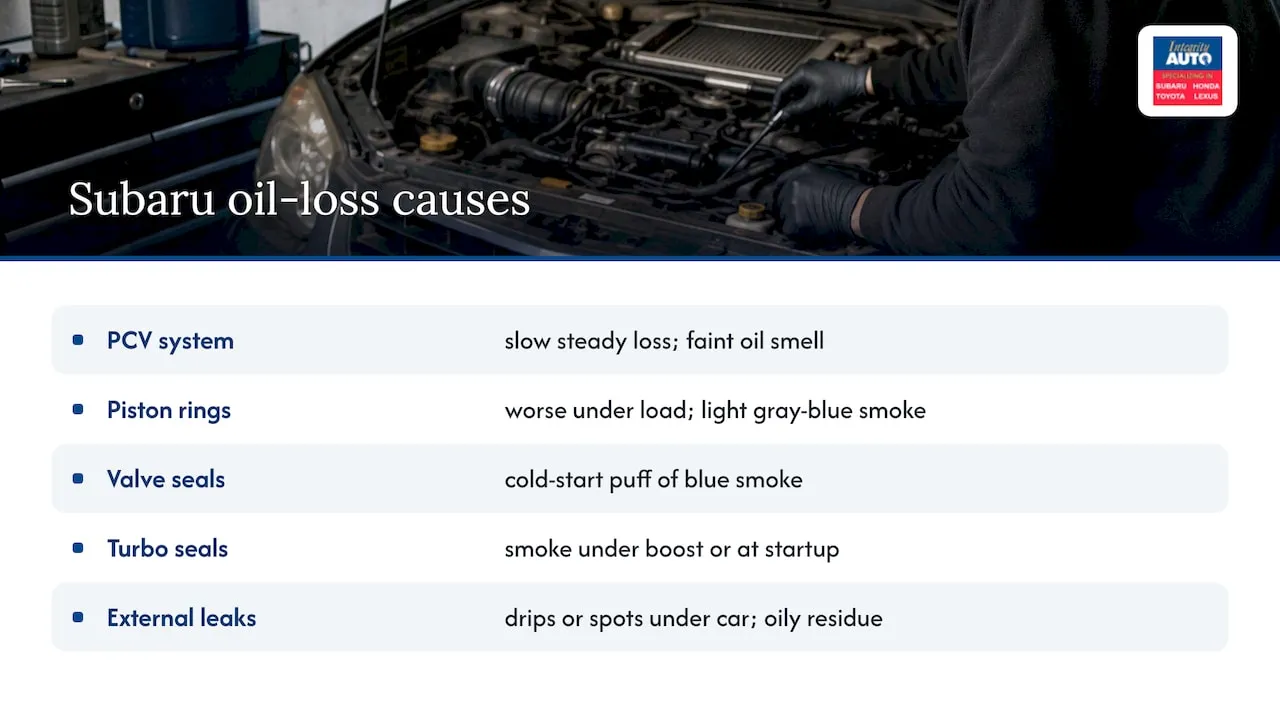
Oil consumption on a Subaru traces back to one of four general sources: the PCV system, worn piston rings, degraded valve seals, or an external leak that only looks like burning. Each leaves a different signature, and knowing which one you are looking at narrows the diagnostic path before a shop ever opens the hood.
The PCV (positive crankcase ventilation) system manages crankcase pressure, and when its valve or hoses fail, oil vapor gets pulled into the intake rather than recirculated properly. This produces a slow, steady consumption pattern along with a faint oil smell at idle and sometimes a rough idle itself. Forum discussions among Subaru owners frequently point to the PCV valve as a first suspect, partly because it is inexpensive to replace and partly because its symptoms overlap with more serious ring wear.
Piston rings, and specifically the oil control ring, seal the cylinder and scrape excess oil back into the pan. When rings wear or glaze over, oil slips past into the combustion chamber and burns alongside the fuel. This tends to show up as consumption that gets worse under load, such as climbing hills or towing, and often comes with light gray-blue smoke that is most visible after the engine has been idling and then revved.
Valve seals and guides control oil at the top of the engine, where they keep oil in the cylinder head from seeping down the valve stem. Worn seals create a telltale puff of blue smoke on cold start that clears up within a minute or two as the engine warms, a pattern distinct from the steadier smoke of ring wear.
Turbocharged Subaru engines add another possible source: the turbo’s oil seals. When these degrade, oil can migrate into the intake or exhaust side of the turbo, producing smoke under boost or at startup depending on which seal failed.
External leaks are easy to confuse with burning oil because both lower the dipstick reading. The distinguishing clue is physical evidence: spots under the car, oily residue on the underside of the engine, or a burning smell without visible smoke. A valve cover gasket, oil pan gasket, or rear main seal leak drips rather than burns, so no exhaust smoke accompanies it.
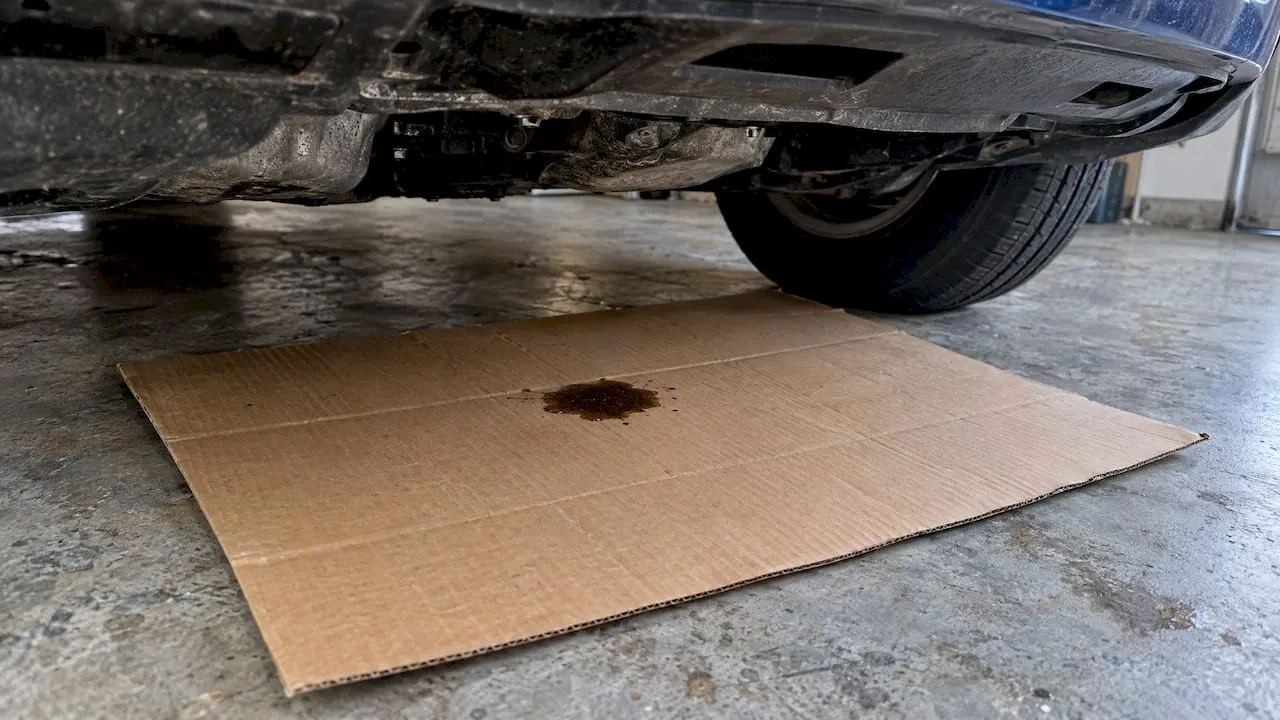
Pro Tip: Park on a clean sheet of cardboard overnight. A fresh spot by morning points to an external leak rather than internal burning, and it costs nothing to check.
Engine family matters here too. The older EJ-series engines, found in many Subaru models through the mid-2010s, have a well-documented owner history of piston ring wear contributing to consumption complaints, particularly in higher-mileage examples. The newer FB and FA engine families, including the FB25 and FA24, were redesigned partly to address oil consumption concerns, though PCV and valve seal issues still appear across the lineup regardless of engine generation. A clear symptom pattern, cold-start smoke versus load-related smoke versus a slow drip, does more to identify the cause than the engine family alone.
Diagnostic tests a shop will run to confirm the cause
Once a consumption log shows a repeatable pattern, a shop moves from guesswork to structured testing. Understanding what each test measures helps make sense of the findings and the repair recommendation that follows.
- Visual leak inspection. A technician examines the engine, oil pan, valve covers, and rear main seal area for wet spots, and may use a UV dye added to the oil that fluoresces under a black light to pinpoint a slow leak that is otherwise hard to spot. Properly following safe steps to clean the engine bay can help owners spot such leaks early and maintain a well-inspected engine compartment.
- PCV system inspection. This includes checking the PCV valve for proper operation and inspecting hoses for cracks or disconnection, sometimes paired with a smoke test that introduces visible vapor into the intake system to reveal where air, and oil vapor, escapes.
- Compression testing. Each cylinder is tested for the pressure it holds during compression; a cylinder reading noticeably lower than its neighbors suggests a sealing problem, which can point toward worn rings or valve issues.
- Leak-down testing. Compressed air is introduced into a cylinder at top dead center, and the rate at which it escapes, along with where it escapes from, helps distinguish ring wear from valve problems by isolating which path the air takes.
- Oil consumption test procedure. When the cause isn’t obvious from the steps above, a shop may run a controlled consumption test over a set mileage interval, tracking exact oil added against distance driven, mirroring the owner log but under controlled, witnessed conditions.
When compression and leak-down results point clearly to internal wear rather than a seal or gasket, further teardown, such as removing the cylinder head or oil pan, becomes the only way to confirm the extent of ring or bore wear before quoting a repair. A shop that skips straight to a major repair recommendation without these tests is skipping the evidence that actually supports the diagnosis. Our Subaru Engine Repair guide covers what typically follows once a cause is confirmed.
When warranty, TSB, or recall coverage applies
Warranty coverage for oil consumption issues depends heavily on documentation, not just the symptom itself. The Subaru Warranty & Maintenance text explains that owners are responsible for retaining proof of maintenance, and that warranty coverage depends on maintenance compliance; it specifically recommends validating service records with an Authorized Subaru Retailer when possible.
A few points matter most when pursuing a claim:
- Warranty may cover parts that fail from a manufacturing defect, but it excludes failures linked to lack of maintenance, so a gap in oil-change history can complicate a claim.
- Present the dated consumption log, with mileage and amounts added, directly to the dealer’s service department rather than describing the problem verbally.
- Ask whether a technical service bulletin applies to your specific engine and model year, since TSBs address known issues without requiring a formal recall.
- Understand that a warranty investigation can take multiple visits, since the dealer typically needs to witness or replicate the consumption pattern before authorizing repair.
Owners outside the factory warranty period still benefit from the same documentation habit. A clear log demonstrates good faith maintenance and gives any shop, dealer or independent, a stronger starting point than an undocumented complaint. Our vehicle inspection page outlines the kind of multi-point check that catches related issues early, even outside a formal consumption investigation.
Repair options, costs, and the risk of waiting
The right repair path depends on what the diagnostic tests actually show, not on guesswork or the cheapest first guess. Matching the fix to the confirmed cause avoids paying for work that won’t solve the problem.
- A failing PCV valve is a low-cost part and one of the simpler fixes, appropriate when PCV inspection and smoke testing confirm it as the source.
- A valve cover or oil pan gasket replacement addresses an external leak once a UV dye test or visual inspection confirms the leak point.
- Valve seal replacement requires removing the cylinder head, which raises labor cost compared to gasket work but is far less invasive than a full ring job.
- Worn piston rings typically require an engine teardown or, in more severe cases, a rebuilt or replacement engine, since rings sit behind the cylinder head and oil pan.
- Turbocharger seal failure usually means turbo replacement or rebuild, since the seals are not practically serviceable in isolation.
Cost ranges vary widely by engine family, mileage, and how far the wear has progressed, which is exactly why compression and leak-down results matter before a shop quotes a number. A ring job on a high-mileage EJ engine costs meaningfully more than a PCV valve, and a shop that recommends major work should be able to point to the specific test result driving that recommendation.
Pro Tip: Running an engine persistently low on oil accelerates wear on the same rings and seals already causing the consumption, so even a short delay between diagnosis and repair can turn a moderate fix into a bigger one.
Delaying repair rarely saves money. Low oil levels increase friction and heat in exactly the components already under stress, which means a slow leak or marginal ring wear left unaddressed for months can progress into a more expensive failure. Mileage also plays a role in the decision: an owner weighing a major repair on a vehicle nearing the end of its useful life faces a different calculation than one with a newer, lower-mileage engine showing early PCV symptoms.
Integrity Auto: Subaru oil consumption diagnosis and repair
We diagnose Subaru oil consumption issues using the same structured sequence outlined above: visual leak inspection, PCV system checks, and compression or leak-down testing when internal wear is suspected. We treat your consumption log as real evidence, not an inconvenience, and build our diagnostic notes around it so the findings hold up if a warranty or TSB conversation follows with your dealer.
Our Subaru work covers the full range a consumption problem might require, including diagnostic testing, oil services using the correct specified grade, and engine repair ranging from gasket and seal replacement to more involved internal work, depending on what the tests show.
Every diagnostic visit comes with documentation of what we found and tested, which you can bring to a dealer if warranty coverage is worth pursuing. If your Subaru is burning or losing oil faster than it should, visit our Subaru Service and Repair page to schedule a diagnostic appointment.
FAQ
Does Subaru still have an oil consumption problem?
Oil consumption concerns are most associated with older EJ-series engines, while newer FB and FA engine families were redesigned partly to address the issue. Individual vehicles can still develop consumption problems from PCV failure, worn rings, or leaking seals regardless of engine generation, so a diagnosis is the only way to confirm the cause in a specific car.
What is normal oil consumption on a Subaru?
Consumption at or below about one quart per thousand miles is often considered within a tolerable range, though any steady, repeatable loss at that rate still deserves monitoring. The Subaru Warranty & Maintenance Booklet frames level checks as an ongoing owner responsibility rather than a one-time measurement, which is why a dated log matters more than a single reading.
What would cause a Subaru to burn oil?
The most common internal causes are a failing PCV valve, worn piston or oil control rings, and degraded valve seals, each producing a distinct smoke or smell pattern. Turbocharged models add turbo oil seal wear as another possible source, while external leaks from gaskets or the rear main seal can mimic burning without actually consuming oil internally.
Is it normal to burn 1 quart of oil every 1000 miles?
Burning around one quart every thousand miles sits near the upper edge of what many owners and shops consider acceptable rather than a guaranteed-safe threshold. Because Subaru’s own maintenance guidance treats intervals as minimums and recommends frequent checks, a rate that high still warrants a documented log and a diagnostic visit if it continues across several fill-ups.


