


Conventional automatic transmissions generally offer greater long-term durability for most drivers because their planetary gear design tolerates heat, heavy loads, and deferred maintenance better than a CVT’s belt-and-pulley system. Some CVT applications, particularly in certain hybrid models, have strong reliability records when properly maintained. If you own a CVT or are shopping for one, the maintenance section below explains exactly what protects it, and a transmission diagnostic can confirm whether yours is in good shape.
TL;DR:
- CVTs are more prone to heat build-up due to their belt-and-pulley design, making proper fluid maintenance critical for longevity.
- Regular use of manufacturer-specified fluid and adherence to severe-duty service intervals significantly reduces the risk of premature CVT failure.
- Conventional automatics generally last longer because their planetary gear design tolerates heavier use and deferred maintenance better than CVTs.
- CVT reliability varies greatly by model year and manufacturer, with some hybrid applications performing well if properly maintained.
- Costs for CVT repairs tend to be higher, often requiring full unit replacements, whereas automatic transmissions are more repairable through targeted component fixes.
How CVTs Work and What You’ll Feel Behind the Wheel
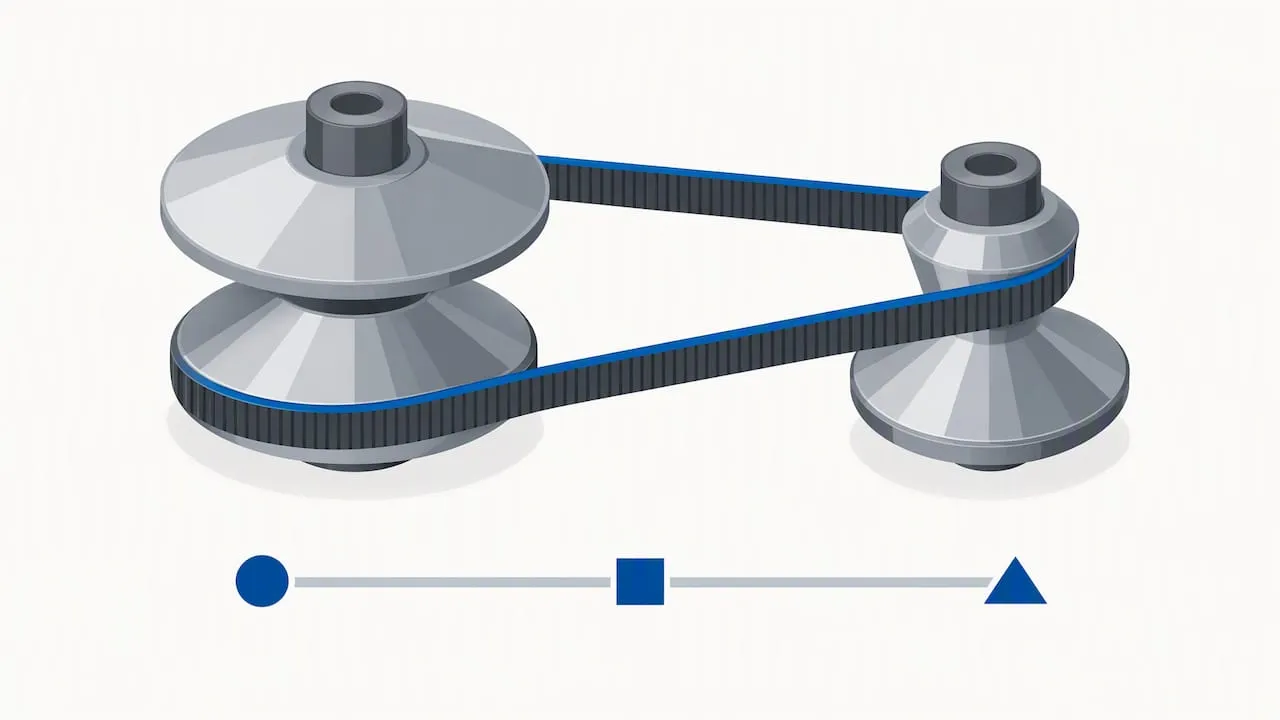
A continuously variable transmission uses a steel belt or chain riding between two variable-diameter pulleys instead of fixed gears. As the pulleys widen or narrow, the transmission creates an infinite range of ratios rather than shifting between set steps. That design is why a CVT can hold the engine at a steady, sometimes elevated, RPM while the car’s speed climbs gradually. Many manufacturers now program CVTs to simulate stepped gear changes so the sensation feels closer to a traditional automatic.
CVTs show up most often in:
- Compact and midsize economy cars built for daily commuting.
- Many hybrid models, including several from Honda and Toyota.
- Some crossovers and small SUVs where fuel economy matters more than towing capacity.
Because the belt and pulleys run under constant tension, CVTs depend on specialized fluid formulated for that friction environment, and they run hotter under sustained load. Following the owner’s manual service schedule matters more here than with most other transmission types.
How Torque-Converter Automatics Work and Why They Tend to Last
A conventional automatic transmission uses planetary gearsets, a torque converter, and hydraulic pressure to shift between discrete gear ratios. The torque converter transfers engine power through fluid coupling rather than a direct mechanical link, which cushions the drivetrain during acceleration and towing. That cushioning, combined with hardened gear teeth instead of a belt under tension, is a major reason automatics often tolerate higher torque loads and heavier use.
Common strengths and vulnerabilities include:
- Planetary gears distribute load across multiple teeth, reducing wear concentration.
- Many modern automatics now use eight, nine, or ten gears with sealed, longer-life fluid.
- Typical failure points are the valve body, shift solenoids, and torque converter clutch wear.
Sealed designs reduce routine maintenance visits but do not eliminate the risk of an expensive repair later if fluid breaks down unnoticed.
Real-World Longevity and Reliability Evidence
Reliability data paints a more nuanced picture than a blanket “automatics win” verdict. Consumer Reports’ reliability survey found that newer transmission technology, CVTs included, caused above-average trouble for some brands, while certain Honda and Toyota hybrid CVT applications performed well. That split matters: the label “CVT” does not predict reliability on its own. Design quality, thermal management, and how consistently an owner follows the maintenance schedule explain far more of the variance than the transmission type alone.
CVTs can deliver a notable fuel economy improvement over traditional automatics, according to AAA Automotive, thanks to their infinite-ratio pulley design. That efficiency gain is a separate question from durability. A CVT that saves fuel for five years and then needs a costly rebuild is not necessarily a better long-term value than a less efficient automatic that runs reliably past 150,000 miles. MotorTrend’s comparison of CVTs and automatics echoes this: fewer CVTs are on the road overall, and early applications saw higher-than-average problems, so researching the specific model year matters more than the transmission category.
Maintenance That Actually Protects Your Transmission
Most transmission failures trace back to fluid, not the transmission’s basic design. Getting the maintenance right is the single most effective way to extend life on either type.
- Check your owner’s manual or VIN-specific service schedule rather than relying on generic online advice.
- Use CVT-specific fluid for a CVT and the manufacturer-specified ATF for a conventional automatic; the wrong fluid can cause rapid failure, according to AAA’s fluid service guidance.
- Shorten service intervals if you tow, drive mostly stop-and-go traffic, or operate in consistently hot climates, all of which count as severe duty.
- Keep written service records, since gaps in fluid history make warranty claims and resale harder to support.
- Ask whether your shop performs a full fluid exchange rather than a partial drain-and-fill when contamination is suspected; a partial change can leave old, degraded fluid mixed with new.
Cars notes that many owners mistakenly treat CVT fluid as a lifetime item, when belt-and-pulley systems are high-stress and often need the severe-duty schedule to avoid slippage and heat damage.
Pro Tip: Confirm your transmission fluid specification by VIN before any service, since using an automatic transmission fluid in a CVT, or vice versa, can cause damage that shows up only after the car is back on the road.
Warning Signs You Shouldn’t Ignore
Some sensations are normal. Others are early signals of a developing problem.
- A gradual RPM rise with smooth acceleration is typical CVT behavior, not a defect.
- Slipping, shuddering, or a delay before the car engages gear is not normal in either transmission type.
- Whining, grinding, or burning smells often point to overheating or fluid breakdown.
- Warning lights paired with rough shifting usually mean a fault code has already been logged.
- Excessive revving with little corresponding speed increase suggests belt slippage in a CVT.
If you notice any of these, stop towing or hauling heavy loads immediately and avoid hard acceleration until a technician runs a diagnostic scan. AAA Club Alliance’s advice is direct on this point: transmission problems rarely resolve on their own, and waiting typically turns a manageable repair into a full rebuild. Our guide to transmission failure warning signs covers these symptoms in more detail.
What Repairs Typically Cost on Each Transmission Type
Routine fluid service, filter replacement, and diagnostic fees are the baseline cost for both transmission types. Beyond that, costs diverge. CVT repairs tend to run higher because belt-and-pulley components and the mechatronic control units are specialized, with fewer rebuild shops equipped to handle them, which pushes many owners toward full unit replacement instead of repair. Conventional automatics more often allow targeted fixes, such as a valve body or solenoid replacement, before a full rebuild becomes necessary.
- Sealed “lifetime” fluid automatics reduce visible maintenance but can still face expensive repairs if fluid degrades unnoticed.
- A used-car purchase with no documented fluid history carries real repair risk regardless of transmission type.
- Compare the repair estimate against the vehicle’s value; a transmission replacement nearing the car’s worth is often the point to consider moving on. Our guide on fixing transmission problems without full replacement walks through when repair still makes sense.
Which Transmission Fits Your Driving Needs
Matching the transmission to how you actually drive matters more than chasing a reliability label.
- If you regularly tow or haul heavy loads, a conventional automatic generally handles that stress better.
- If your driving is mostly steady commuting and you’re committed to following the maintenance schedule, a well-reviewed CVT can deliver strong fuel economy without excess risk.
- Before buying used, research reliability data for that specific model year, not the transmission type in general.
- Request the full service history, including fluid change dates and type, from any seller.
- During a test drive, pay attention to hesitation, shudder, or unusual RPM behavior under both light and firm acceleration.
Avoid a used vehicle with unknown fluid history, any hesitation during gear engagement, or a pattern of repeat transmission repairs noted in past service records.
What a Diagnostic Inspection Reveals About Transmission Health
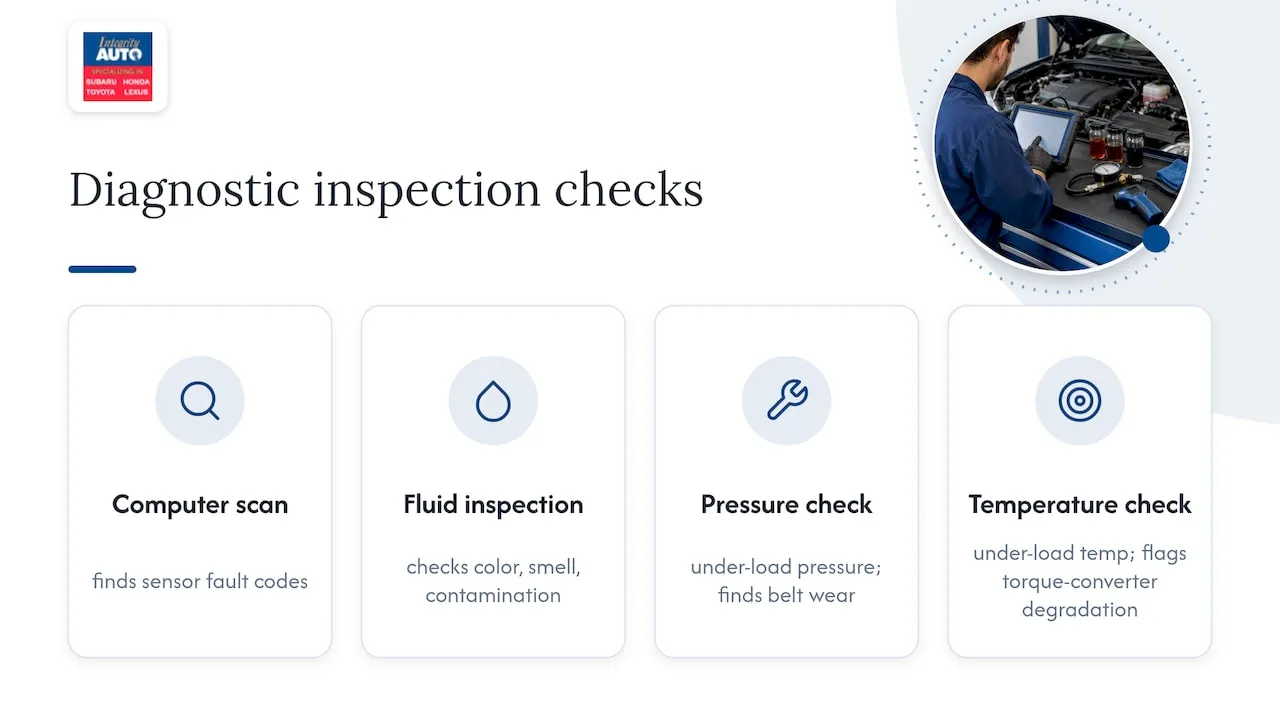
A thorough transmission diagnostic combines a computer scan for stored fault codes with a physical fluid inspection, checking color, smell, and contamination, along with pressure and temperature checks under load. Each step isolates a different possible cause, from a failing sensor to belt wear to a degrading torque converter. We perform CVT service, automatic transmission flush, and transmission case service using OEM-spec fluids, and our technicians document fluid type and service dates for warranty support. You can review our diagnostic service details to see what an inspection covers.
Keep Your Toyota, Lexus, Subaru, or Honda Transmission Running Longer
CVT service, automatic transmission flush, and transmission diagnostics are performed based on manufacturer-specific fluid requirements rather than generic shop procedures. A correctly scheduled fluid exchange now is far less expensive than a belt or rebuild later.
- Independent Toyota Service and Repair covers transmission maintenance and diagnostics for Toyota owners.
- Our Honda services page includes CVT service for Honda hybrid and non-hybrid models.
- A complimentary multipoint inspection is included when you schedule a visit, giving you a clear picture of transmission condition alongside the rest of the vehicle.
Schedule a diagnostic to find out exactly where your transmission stands before a small issue becomes an expensive one.
FAQ
Which lasts longer, a CVT or automatic transmission?
Conventional automatics generally last longer across the vehicle fleet because planetary gear designs tolerate heavier use and deferred maintenance better than belt-driven CVTs. Certain CVT applications in hybrid models have strong records, so the specific vehicle and maintenance history matter as much as the transmission type.
Why avoid CVT transmission?
Some buyers avoid CVTs because early applications in several models showed higher-than-average problems, and repairs often cost more due to specialized parts and limited rebuild options. A well-maintained CVT in a model with a solid track record does not carry the same risk as an early, poorly supported design.
Is it better to have CVT or automatic transmission?
It depends on how you drive: a conventional automatic suits towing, heavy loads, and high-mileage durability, while a CVT suits steady commuting where fuel economy matters and you’re committed to following the severe-duty maintenance schedule. Neither option is universally better across every use case.
Can a CVT transmission last 300,000 miles?
A CVT can reach high mileage when the specific model has a strong reliability record and the owner follows CVT-specific fluid and service intervals closely. Reaching that mileage is far less likely if the wrong fluid is used or fluid changes are skipped, since belt-and-pulley systems are more sensitive to heat and contamination than planetary gear designs.
Sources
- Not All Automatic Transmissions Are Created Equal | AAA Automotive
- Consumer Reports 2015 annual auto reliability survey press release
- How to catch transmission problems before they get expensive | AAA Club Alliance
- Cars
- CVT vs. Automatic Transmission: Your Burning Questions Answered | MotorTrend


