
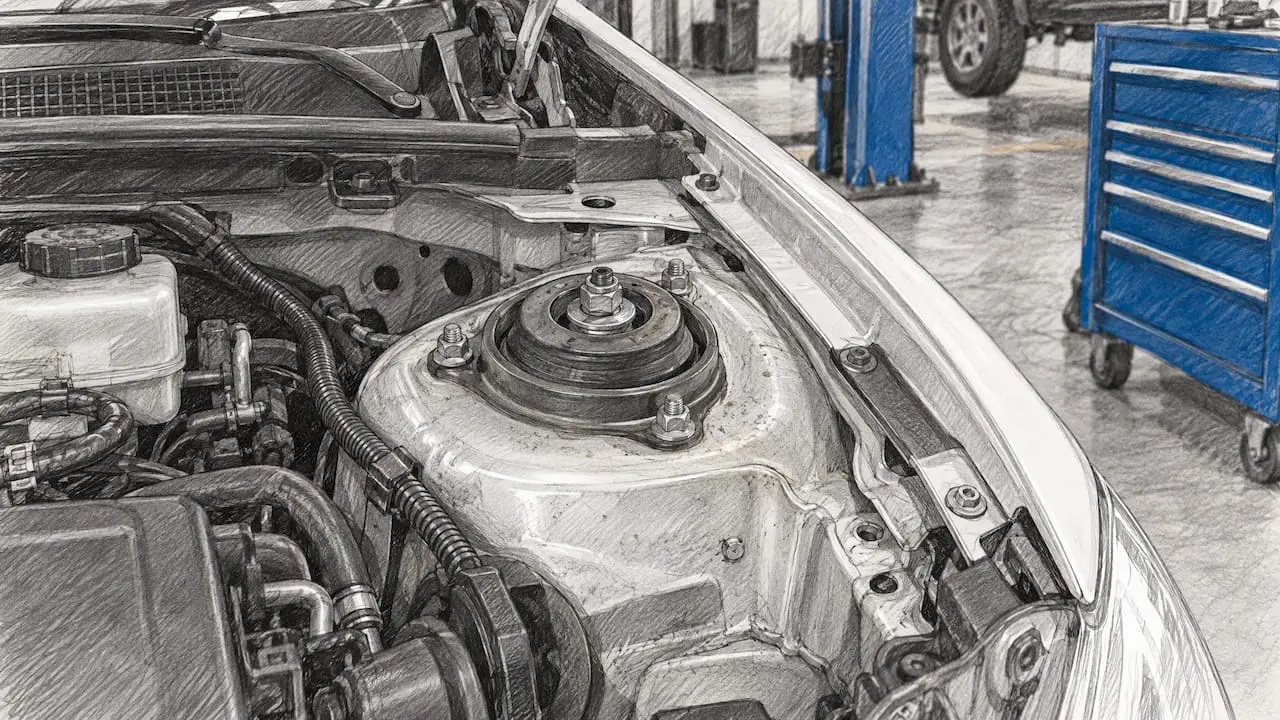
Strut mount noise usually shows up as a clunk or thud over bumps, or as a creak, groan or pop when the steering wheel turns. The timing of the sound is the best clue. Noise over bumps points to the upper mounting plate and its rubber, while noise during steering points to the strut bearing. A mild noise is not an emergency, but it rarely fixes itself, and a mount that is separating or a wheel that binds while turning should be inspected soon.
TL;DR
- Noise over bumps and potholes generally points to the upper strut mount. Noise while turning generally points to the upper bearing, according to Monroe’s diagnostic guidance.
- Sway bar links, ball joints, tie-rod ends and a worn steering rack can imitate a bad mount, so the source should be confirmed before parts are replaced.
- A mild noise can be driven on for a short time with caution. Visible rubber separation or binding steering moves the repair to the top of the list.
- Strut mounts and bearings are normally inspected whenever struts are replaced, since the labor overlaps.
- Independent Toyota, Lexus, Subaru and Honda specialists in Portland, Oregon can pinpoint the source with a road test and a lift inspection.
What a strut mount does
In a strut-type suspension, the strut is the damper and a structural part of the suspension in one. Its top end bolts to the body through the strut mount, which is a metal plate with a rubber or polyurethane section. On many vehicles a bearing sits in or under the mount so the strut can rotate with the front wheels when the driver steers.
The mount has two jobs. The rubber insulates the cabin from road noise and vibration, and the bearing allows smooth steering. A lesson in an ASE-aligned training library describes the same split: a failing bearing may creak or groan on turns, while a worn mount may clunk over bumps.
Because the mount sits at the top of the strut tower, near the hood hinge and firewall, noises from it often seem to come from the engine bay or the dashboard. That is one reason the problem gets misdiagnosed.
What a bad strut mount sounds like
Descriptions vary by driver, but the sounds fall into a few patterns.
| When the noise happens | What it often sounds like | Likely source |
|---|---|---|
| Over bumps, potholes, speed bumps | Clunk, knock or thud from the front corner | Worn or cracked upper mount, loose mounting hardware |
| While turning, especially at parking speeds | Creak, groan, squeak or pop | Dry or worn strut bearing |
| Turning the wheel while parked | Notchy, gritty or binding feel, with noise | Strut bearing |
| Over rough pavement at speed | Rattle or hollow rumble | Mount, but also links, bushings or the strut itself |
Monroe’s guidance ties the noise to timing: noise over bumps calls for an inspection of the upper mounting plate, and noise while turning calls for an inspection of the upper bearing assembly, with replacement of the implicated part if needed.
Other signs can go along with the noise. Vehicle Service Pros notes that the bearing should allow smooth steering, and that one that is damaged, binding or gritty feeling should be replaced. Steering that feels heavier or rougher than before, a front end that seems to wander, and uneven tire wear can all appear when mounts are worn, though tire wear has many other causes too.
Some designs are known for specific sounds. A Ford service bulletin, for example, describes a low-speed click or pop while turning on some 2020 to 2025 Explorers, traced to movement of the upper strut mount washer under steering loads. That is one model, but it shows that mount noise can be a design-specific quirk and not only a sign of age.
Why strut mounts wear out
Rubber ages. Every bump flexes the mount, and heat, cold and road chemicals take their toll. Environmental factors such as ice, water, salt spray, humidity and temperature swings can damage top strut mounts. In the Portland area, constant wet weather and winter road treatment make moisture exposure a regular factor.
Mileage matters, but so do potholes, curb strikes and worn struts. A strut that no longer controls wheel movement lets the mount absorb harder hits than it was designed for. That is why a noisy mount often turns up alongside worn struts, and why the two are commonly inspected together.
How to narrow down the source
Several parts can make a similar sound, so a methodical approach beats guessing. Vehicle Service Pros recommends first reproducing the noise and recording when it occurs: over bumps, while turning, under a certain load. Noise travels through the suspension and can seem to come from the wrong component.
The following checks help an owner collect useful information before visiting a shop.
Note the pattern
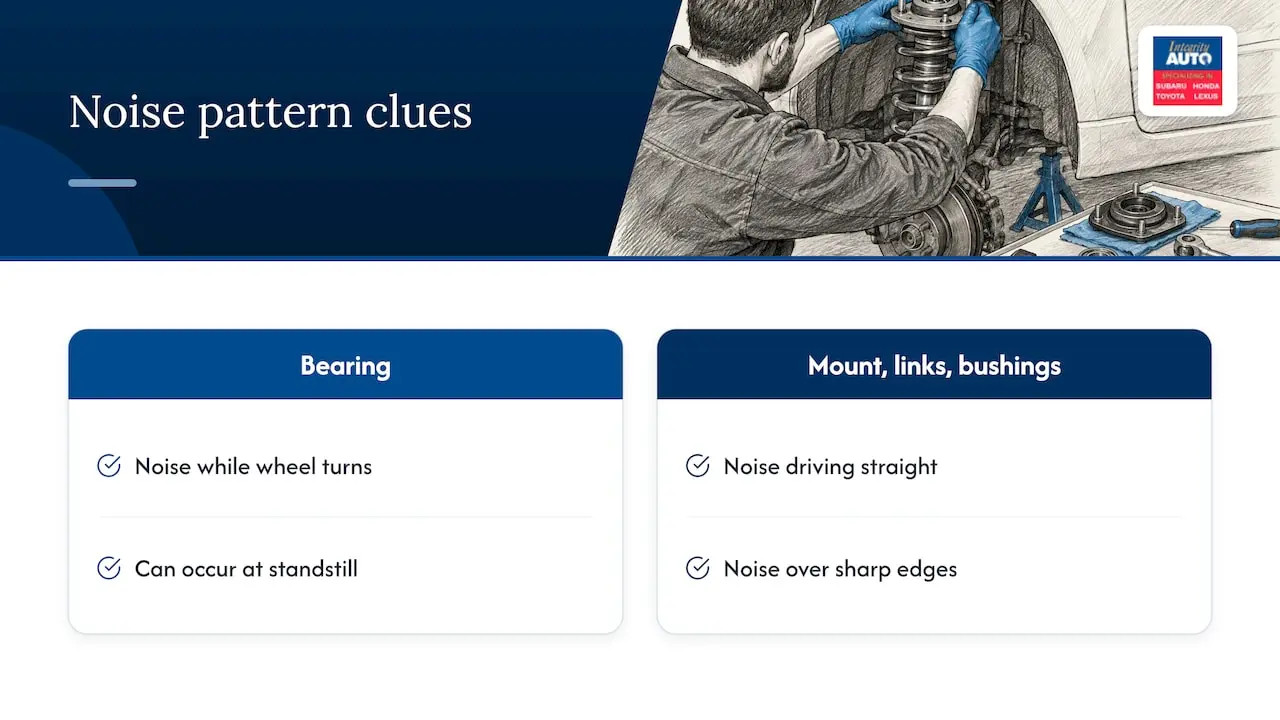
Write down whether the sound happens on one side or both, at low or high speed, cold or warm, turning left or right, and over sharp bumps or long rolling dips. A noise that appears only while the wheel is turning, even at a standstill, leans toward the bearing. A noise that appears while driving straight over a sharp edge leans toward the mount, links or bushings.
Try the parked tests
With the vehicle parked on level ground and the engine off, press down firmly on the front fender over the noisy wheel several times. A creak or groan from the top of the strut deserves a closer look. A bounce test followed by turning the steering wheel while parked can reveal binding or notchiness. Have a helper listen near the strut tower, which helps separate mount noise from lower suspension noise such as sway bar links or ball joints.
These are listening tests only. Nothing under the vehicle should be touched or loosened without the right equipment and support. For a deeper walkthrough of clunks, the four quick checks for a suspension clunk over bumps cover what owners can safely observe.
Look for visible damage
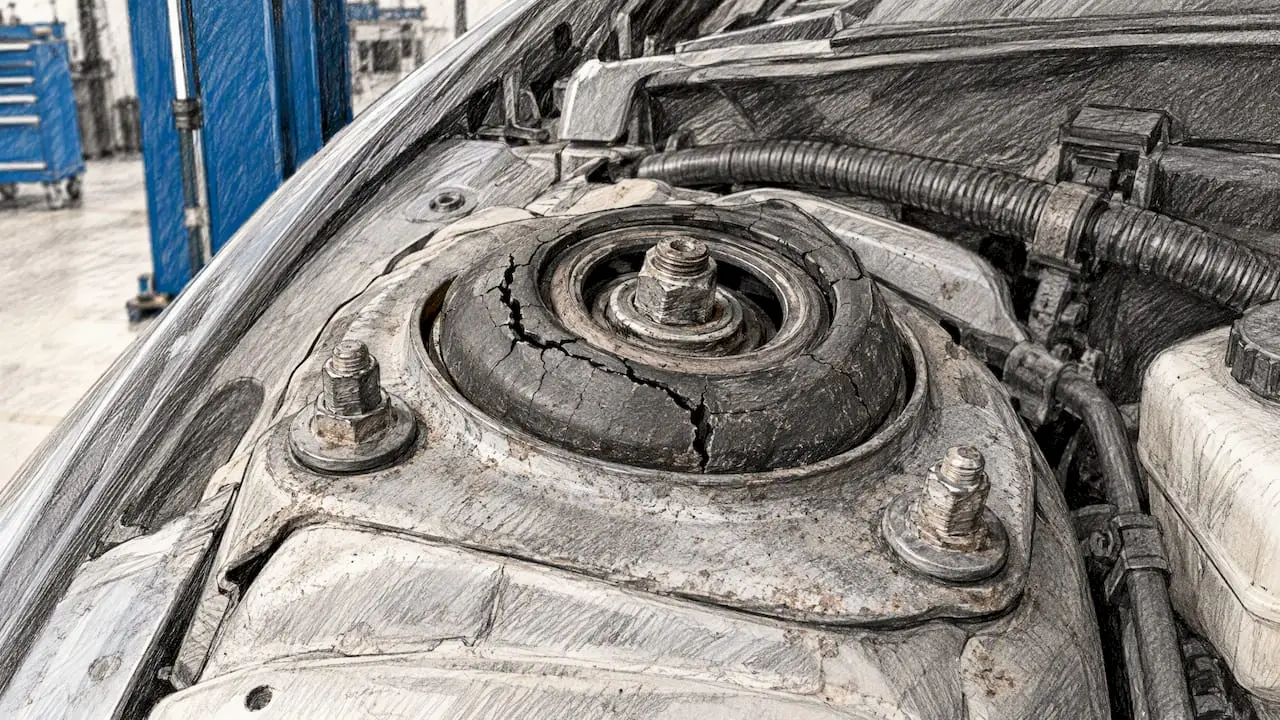
A technician checking the mount looks for cracked, split or separated rubber, corrosion or deformation of the mount plate and bearing housing, and the condition of the studs. Vehicle Service Pros adds that the upper mount should be checked for cracked or deteriorated rubber, excessive movement, rust or damaged studs, even when a jounce test has already pointed to the area.
Use a lift and listening tools
For intermittent noises, a technician can attach electronic listening transmitters, often called chassis ears, to the strut mount and nearby parts. The loudest signal helps identify the source. A road test with the technician in the car is often the quickest way to turn a vague description into a confirmed cause.
Look-alikes that get blamed on the mount
Strut mount symptoms are easy to confuse with other problems. A knock over bumps may be blamed on a worn link, and notchy steering on the steering rack, and the reverse also happens. Common look-alikes include:
- Sway bar links and bushings: a rattle or clunk over uneven pavement.
- Ball joints: a clunk or creak that changes with load and steering. See the notes on Toyota and Lexus ball joints.
- Tie-rod ends: looseness and clunking in the steering. See Toyota tie-rod ends.
- Power steering rack: notchiness and noise on turns, covered on the Toyota, Lexus power steering rack page.
- Wheel bearings and CV axles: hum, click or growl that changes with speed or turns.
- The strut itself: internal wear that causes knocking or a bouncy ride.
Replacing a mount that was not the source is an expensive way to learn the noise is still there. Confirming the cause first saves money.
Can you drive with a noisy strut mount?
Usually for a short time, with care. According to one diagnostic guide, a mild problem is typically not an immediate catastrophic failure, but driving on it is not ideal. Steering can become less smooth, the noise can worsen, and related suspension parts can wear faster. The same guide advises repairing it soon if the mount is visibly separating or the steering binds, and notes that severe cases can cause poor alignment behavior or unpredictable handling.
In practical terms:
- A light clunk on rough roads, with normal steering: schedule an inspection in the coming weeks.
- A new groan or binding feel when turning: schedule it sooner, and avoid fast or emergency maneuvers until it is checked.
- Rubber visibly separated, the strut leaning, or steering that feels loose or heavy: stop driving normally and have the vehicle looked at right away.
How to quiet a noisy strut mount
Some articles suggest spraying lubricant on the mount to see whether the noise stops. That can help locate a dry bushing or bearing, but it is a test, not a repair. Monroe’s advice is to check that mountings are secure and replace hardware that no longer holds its original torque or is excessively worn. If the noise comes from the plate, the plate is inspected and replaced if necessary. If it comes from the bearing, the bearing assembly is inspected and replaced if necessary.
In most cases a worn mount or bearing is replaced, not repaired. Because the strut has to be removed to reach the mount, it makes sense to inspect the mounts, bearings, bump stops and boots whenever struts are replaced. After the work, an alignment check is normally part of the job, since the front suspension has been disturbed.
What strut mount repair costs
There is no single price. The bill depends on the vehicle, the design of the mount, whether the bearing is a separate part, whether the struts are being replaced at the same time, and which parts are selected. A written estimate after an inspection is the reliable way to get a number, and it should list parts and labor separately for each side. Ask whether the quote covers both sides, since mounts on the same axle tend to wear at similar rates, and whether an alignment is included.
Strut mount service for Toyota, Lexus, Subaru and Honda
These brands use strut-type front suspensions on many popular models, so mount and bearing wear is a familiar item at higher mileage. Integrity Auto is an independent shop in Portland, Oregon that specializes in Toyota, Lexus, Subaru and Honda vehicles, and its stated approach is a consultative one: the concern is described, the vehicle is inspected, and the findings are explained before work is approved.
Owners can book a suspension noise inspection through the pages for Toyota, Lexus, Honda or Subaru service, which list the brand-specific work offered, including struts and shocks. For noises that are hard to place, the diagnosis page explains how diagnostic charges and estimates work. When describing the problem, mention when the noise occurs, which side it seems to come from and how long it has been present. That detail shortens diagnosis.
FAQ
How do I tell if a strut mount is bad?
Listen for when the noise happens. A clunk over bumps suggests the mount, and a creak, groan or notchy feel while steering suggests the bearing. Visible cracked or separated rubber, rust, or excess movement at the top of the strut confirms it. Because other parts sound similar, a technician’s inspection is the dependable test.
Can a bad strut mount be fixed without replacing it?
Tightening loose hardware can stop a clunk if the mount itself is sound. Worn rubber and gritty bearings are not repaired, they are replaced. Lubricant sprayed on the mount may quiet it briefly, but that only helps locate the noise.
Is strut mount noise dangerous?
A mild noise is usually not an immediate failure, but it should not be ignored. Steering effort, ride quality and handling can all suffer as the mount deteriorates. Binding steering or visibly separating rubber calls for prompt repair.
Should mounts be replaced when the struts are replaced?
Often they are inspected at the same time, because the strut must come off to reach the mount and the labor overlaps. Mounts that are cracked, loose or noisy are replaced then, which avoids paying for the same disassembly twice.
Sources
- Noise With New Shocks & Struts, Monroe
- Ride control tech talk, Vehicle Service Pros
- Tool Briefing: How to diagnose different suspension noise issues, Vehicle Service Pros
- Bad Strut Mounts? How to Diagnose Them Correctly
- Inspect front strut bearing and mount, ASE G1 lesson
- Shock Absorber Top Mounts and Strut Bearings: Symptoms and Selection
- Best practice advice on strut mount replacement, Delphi
- Click/Pop Noise While Turning The Steering Wheel, NHTSA service bulletin