

A Honda valve adjustment is a check of the small gap between each valve and its rocker arm or adjusting screw, followed by a reset to factory specification when a gap is out of range. Honda does not schedule it at a fixed mileage on most U.S. models. The Maintenance Minder lists the inspection as a sub-item and calls for adjustment when the valves are noisy. This article covers what the service is, when it makes sense, which symptoms point to it and how the job is done.
TL;DR
- Valve clearance is the small gap in the valve train. Heat and wear change it over time, so it has to be measured, not guessed.
- Honda’s Maintenance Minder lists a valve-clearance inspection as a sub-item and says to adjust the valves if they are noisy.
- Ticking, a rough idle or lost power can point to the valves, but other parts cause the same signs. Diagnosis comes first.
- The job requires a cold engine (coolant below 100°F / 38°C), a feeler gauge and the exact specification for the engine.
- Labor is the main cost, because the valve cover must come off to measure.
What valve clearance is and why it matters
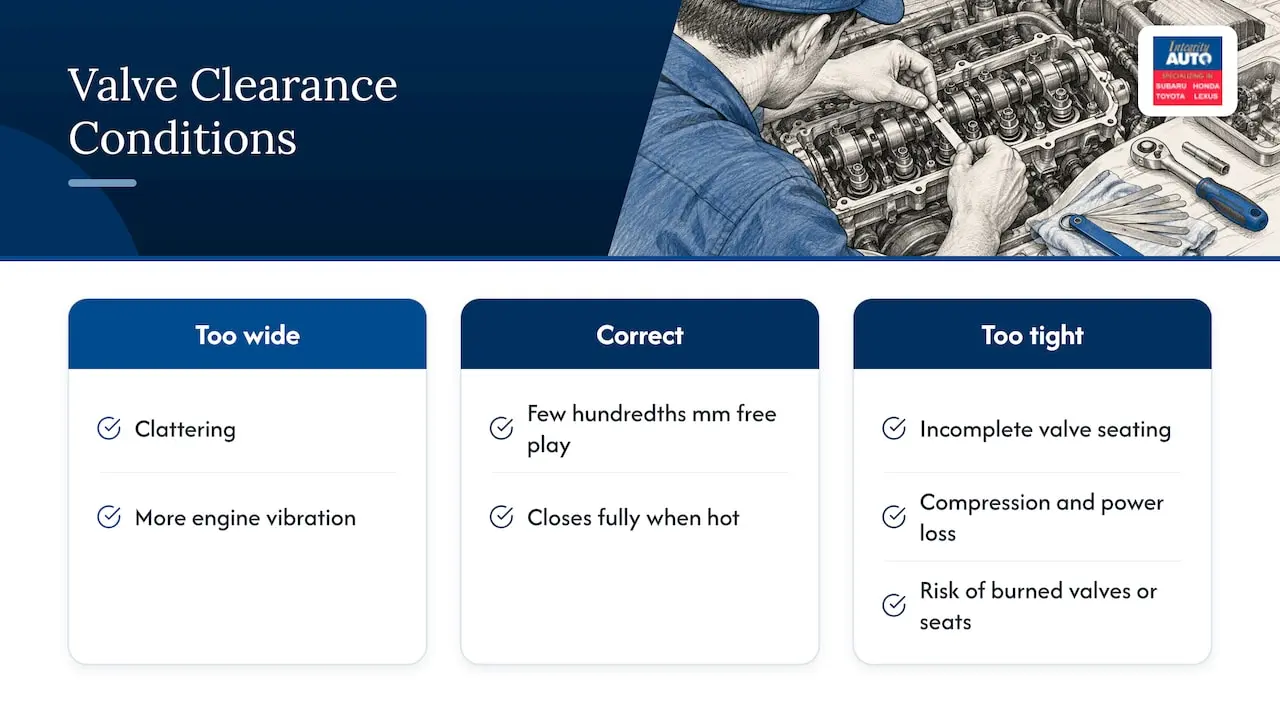
Each engine valve needs a few hundredths of a millimeter of free play so it can close fully when the engine is hot. As the valve train wears, that gap drifts. A gap that grows too large produces clattering and more engine vibration. A gap that shrinks too far can keep a valve from seating completely, which causes compression and power loss and can eventually burn valves or seats.
Many modern engines use hydraulic lifters that adjust themselves. Several Honda engines, including the K-series and J-series, use a screw and locknut at each rocker arm instead, so the gap is set by hand.
When Honda calls for a valve check
Honey-sweet round numbers are common online, but Honda’s own documents are more conditional. The 2018 Accord Hybrid Maintenance Minder lists valve-clearance inspection as sub-item 4 and says to adjust the valves during services A, B, 1, 2 or 3 if they are noisy. The 2017 Pilot Maintenance Minder uses the same logic under sub-item 6.
In practice, that means:
- The inspection is tied to the Maintenance Minder codes on the dash, not to a single mileage.
- Adjustment follows a noisy result or a symptom, not the calendar.
- The exact wording differs by model and year, so the owner’s manual or Maintenance Minder booklet for the specific vehicle is the reference.
Some owners and shops choose to check clearances proactively as mileage climbs into six figures, often alongside other major services. Timing components are a separate topic, covered in the Honda timing belt interval guide, and a valve check is often discussed at the same visit as the 100,000-mile service.
Symptoms that can point to the valves
Cars.com lists clattering or extra vibration, poor performance or rough idle, and loss of power as possible indicators. Two cautions apply:
- Tapping can also come from a loose rocker arm or another component, and power loss can come from a weak or broken valve spring.
- On some engines the valves stay quiet even when clearance is excessive, so silence does not prove the gap is correct.
Honda’s own service information supports the same approach. A Civic troubleshooting index for 2016 to 2021 models lists incorrect valve adjustment as one item to check when idle speed fluctuates, and incorrect valve timing or clearance when warm idle is below specification. It is one entry on a list, not a conclusion. A check engine light, a misfire or an emissions failure should be diagnosed before any valve work is approved. The Diagnosis page explains how diagnostic charges and estimates work at Integrity Auto.
Valve clearance specifications by engine
Specifications vary by engine, year and even by intake versus exhaust. The figures below come from Honda service-manual procedures for the models named and are not interchangeable.
| Vehicle / engine | Intake | Exhaust | Locknut torque |
|---|---|---|---|
| 2012 to 2016 CR-V | 0.21 to 0.25 mm | 0.25 to 0.29 mm | 14 N·m (10 lbf·ft) |
| 2016 to 2021 Civic K20C2 | 0.21 to 0.25 mm | 0.25 to 0.29 mm | per procedure |
| 2008 Civic Si R18A1 | 0.18 to 0.22 mm | 0.23 to 0.27 mm | 14 N·m (10 lbf·ft) |
| HR-V | 0.18 to 0.22 mm | 0.23 to 0.27 mm | per procedure |
Note that a second CR-V reference lists a different exhaust range of 0.28 to 0.32 mm, which shows why the specification must be matched to the exact engine code and model year. A shop with access to manufacturer service information avoids that mistake.
How the adjustment is done
The Honda procedures cited above share the same outline:
- Let the engine cool. Adjustment is done only with coolant temperature below 100°F (38°C). A warm engine gives false readings.
- Remove the valve cover and set cylinder No. 1 to top dead center using the timing marks.
- Measure each gap with a feeler gauge between the adjusting screw and the valve stem, or the rocker arm, as the procedure specifies.
- Adjust where needed. Loosen the locknut, turn the adjusting screw until the gauge drags slightly, then tighten the locknut to specification.
- Recheck the gap, because tightening the locknut can move the screw.
- Rotate the crankshaft to the next position (the Accord procedure uses 180-degree turns between cylinders) and repeat for the remaining valves.
- Refit the cover with a new gasket and, where the procedure requires it, reset the Maintenance Minder.
The job is simple in concept and unforgiving in detail. A gauge that is slightly too tight or too loose, or a locknut that shifts the screw, leaves the clearance wrong.
What the service costs
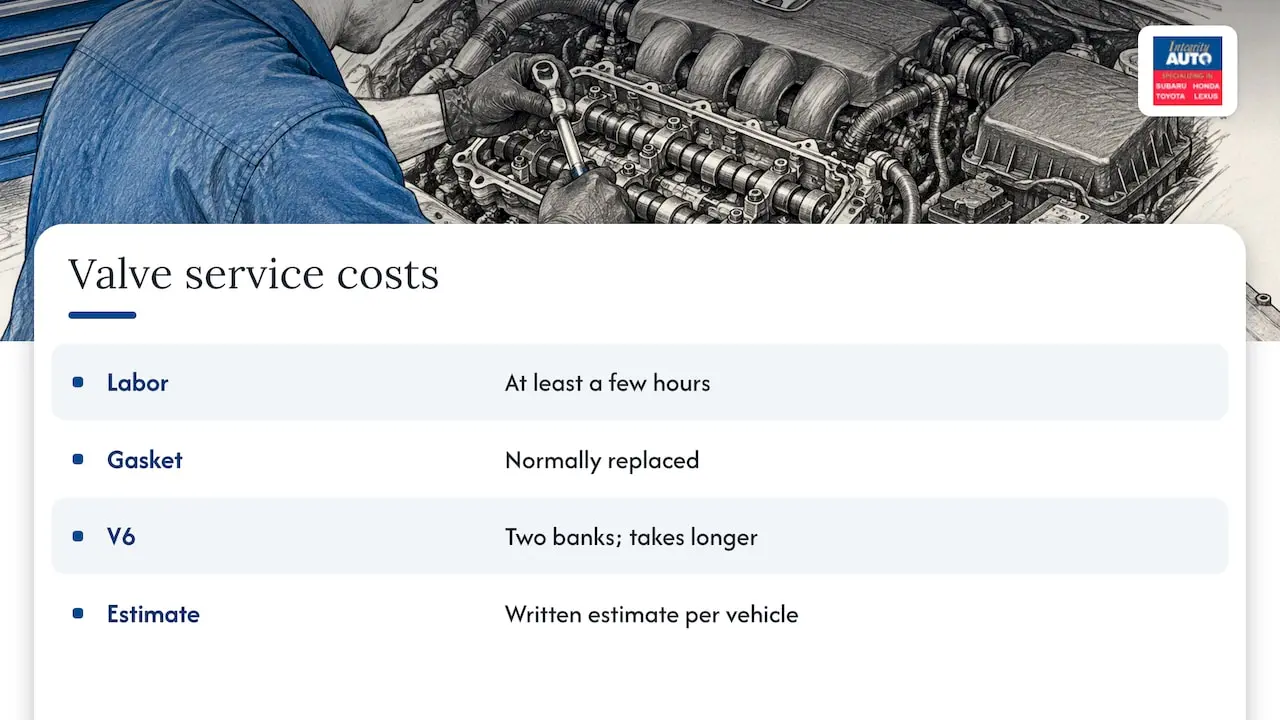
Labor drives the price. Checking clearance means removing the valve cover, and shops charge for at least a few hours of labor plus the inspection itself. A valve cover gasket is normally replaced at the same time. Cost varies with engine layout: a V6 with two cylinder banks takes longer than a four-cylinder. Integrity Auto does not publish a flat price for this service, so a written estimate for the specific vehicle is the reliable number.
Having it done in Portland
Integrity Auto is an independent shop serving Honda, Toyota, Lexus and Subaru owners in the Portland, Oregon area. Honda work includes manufacturer-recommended scheduled maintenance, tune-ups, inspections, timing belts and check engine light and DEQ diagnosis. Technicians are ASE certified and the shop states it uses OEM parts.

Owners who hear valve noise or are approaching a major service interval can book through the Honda service and repair page. Toyota and Lexus owners with the same question can read about valve adjustment for those models.
FAQ
Does every Honda need a valve adjustment?
No. Honda’s Maintenance Minder lists valve-clearance inspection as a sub-item and ties adjustment to noisy valves. Engines with self-adjusting hydraulic lifters have no routine adjustment at all. The owner’s manual for the specific model gives the rule.
Can a valve adjustment fix a rough idle?
Sometimes. Incorrect clearance is one of several items Honda’s troubleshooting information lists for idle problems. Spark plugs, ignition parts, vacuum leaks and sensors are also checked, so diagnosis should precede any valve work.
Can the valves be adjusted on a warm engine?
No. The Honda procedures cited here require coolant temperature below 100°F (38°C). Measuring a hot engine produces readings that do not match the specification.
What happens if valve clearance is ignored?
A gap that is too large mostly causes noise and vibration. A gap that is too tight is the more serious case, since it can prevent full valve closure and lead to compression loss and burned valves or seats.
Sources
- Car Talk: Valve Clearance Adjustments
- Honda 2018 Accord Hybrid Maintenance Minder
- Honda 2017 Pilot Maintenance Minder
- Cars.com: Does My Engine Need a Valve Clearance Adjustment?
- Civic fuel and emissions symptom troubleshooting index
- 2012 to 2016 CR-V valve clearance adjustment
- CR-V valve clearance adjustment, cylinder head
- 2008 Civic Si valve clearance adjustment
- Civic K20C2 valve clearance adjustment
- HR-V valve clearance adjustment
- Accord valve clearance adjustment