
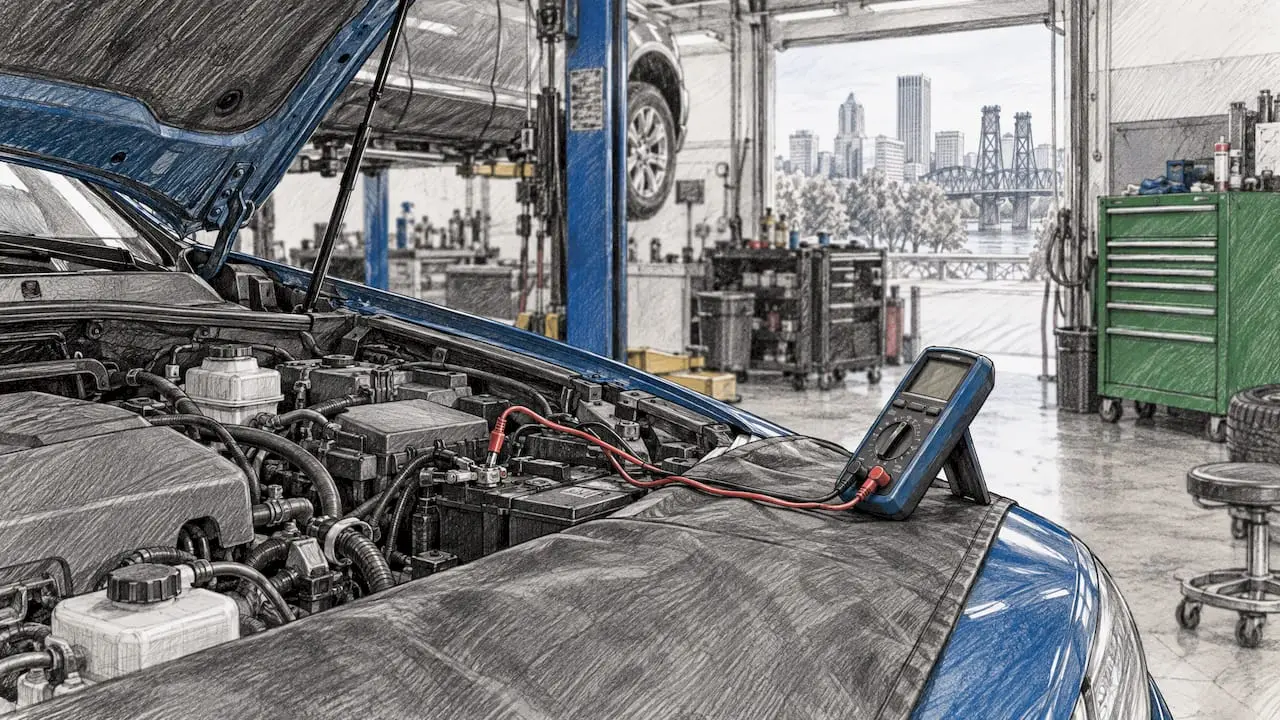
Automotive electrical diagnostics is a step-by-step process that follows a symptom to a system, then to a circuit, then to the one failed component. The key measurement is voltage drop, taken while the circuit is working. For Toyota, Lexus, Subaru and Honda owners in the Portland, Oregon area, Integrity Auto performs diagnosis as an independent shop with ASE certified technicians, so the cause gets found before parts are replaced.
TL;DR
- Electrical diagnosis means testing circuits under load, not just reading a trouble code. Voltage drop on the power side and the ground side is the core test.
- Dimming lights, hard starting, a battery warning light, a burning smell, blown fuses and erratic gauges are the usual signs of a fault.
- Modern circuits tolerate very little resistance, so small faults such as a corroded connector can cause intermittent problems.
- Standalone diagnostic fees commonly run about $100 to $180 at independent shops, based on roughly an hour of technician time.
- Integrity Auto handles electrical diagnosis, check engine light and DEQ diagnosis, and battery testing for Toyota, Lexus, Subaru and Honda vehicles in Portland.
What electrical diagnostics actually involves
A car’s electrical system is a set of circuits: a power source, wiring, connectors, a switch or module, the device doing the work and a return path to the battery. A fault anywhere in that chain looks like a failed component, which is why replacing the obvious part so often fails to fix the problem.
Professional diagnosis works in order. According to Vehicle Service Pros, the path runs from symptom to system to circuit to component, with each question answered before moving on. Within the circuit, the technician uses voltage-drop testing: measuring how much voltage is lost across part of the circuit while current is flowing. The power side is measured from battery positive to the power pin at the device while it operates. The ground side is measured from the device’s ground pin to battery negative, also while it operates.
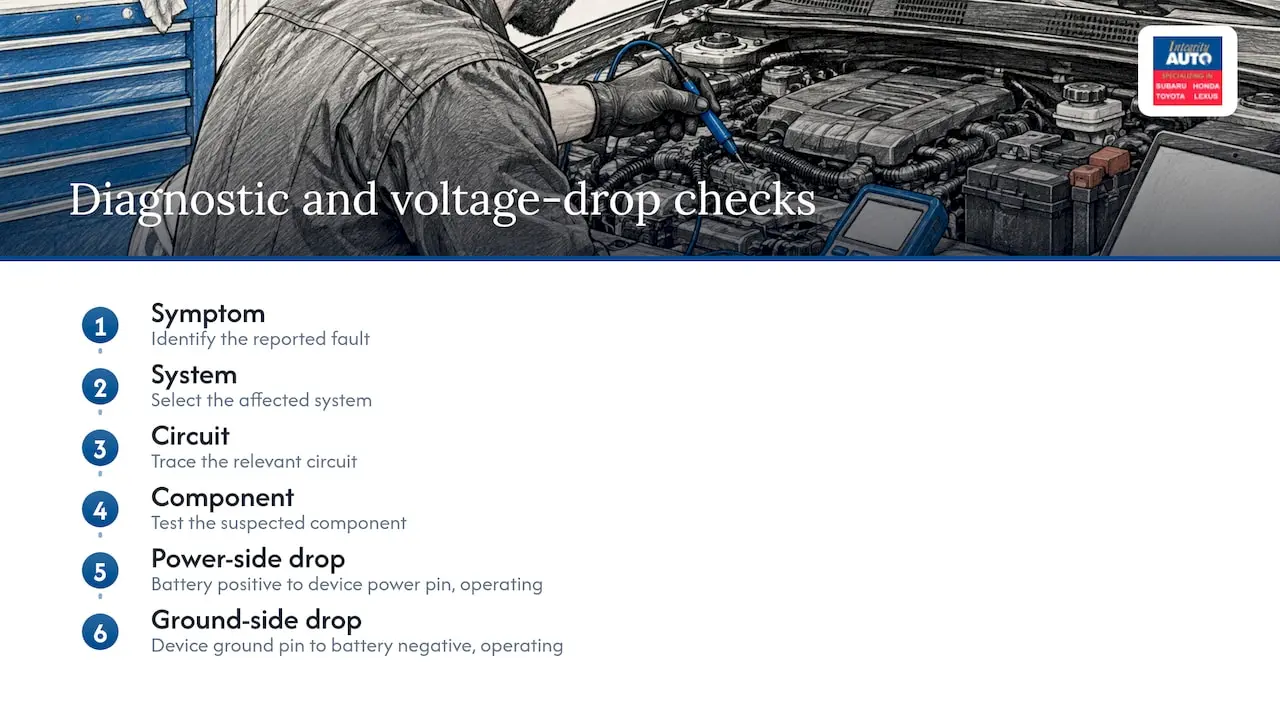
Circuit diagnosis rests on three quantities: voltage, current flow and resistance. Tomorrow’s Technician adds a fourth, logic: service information tells the technician what to test and which specifications apply.
Symptoms that point to an electrical fault
Electrical problems rarely announce themselves with one clear signal. The common patterns include:
- A slow crank, a no-start or a repeatedly dead battery
- Headlights, dash lights or interior lights that flicker or dim
- Power windows, the radio or other accessories that stop or work intermittently
- Fuses that blow more than once
- A burning smell, especially of plastic or rubber
- Gauges that behave erratically
- Stalling or rough running
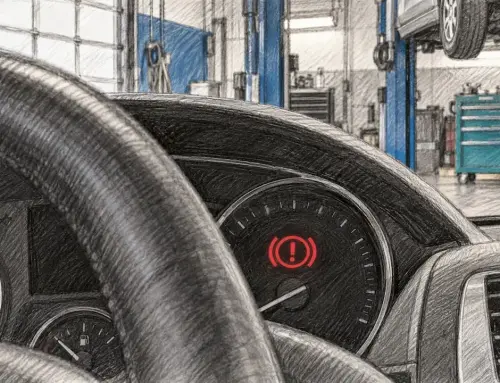
- A battery warning light or a check engine light that stays on
A battery light while driving deserves prompt attention, and the steps a shop takes are covered in what shops check when the battery light comes on. Starting trouble has its own set of causes, outlined in car ignition problems and their fixes.
Intermittent symptoms are the hardest to chase. A fault that appears only when the engine is hot, when it rains or when a particular accessory is on needs testing under those same conditions.
How technicians test and trace a fault
A thorough diagnosis follows a repeatable sequence.
- Verify the complaint. The technician confirms the symptom and learns when it happens: cold start, after rain, under load, at idle.
- Scan for stored codes. The onboard diagnostic system reports which circuit or system set a code. The code is a starting point that narrows the search. It does not name the failed part.
- Check the battery and charging system. Low or unstable voltage causes problems in unrelated systems. A healthy battery with the engine off typically reads about 12.6 volts, according to Motor, which puts a nominal 12.66 volts at 80°F as healthy and 12.45 volts or lower at roughly a 75% state of charge or less.
- Consult service information. Specifications and wiring diagrams show what each circuit should do.
- Run voltage-drop tests under load. The meter is placed across the power side and the ground side while the device operates.
- Isolate the failure. Testing is narrowed to the connector, wire, switch, ground point or module responsible.
- Repair, then retest. The same test is repeated to confirm the circuit now performs to specification.
Why voltage drop beats a simple voltage reading
A meter can show full battery voltage at a device that still starves under load. Voltage drop reveals resistance that restricts current, such as a loose or corroded connector, a damaged wire or a worn switch. Tomorrow’s Technician states that, generally, a drop of more than 0.10 volts is unacceptable in automotive circuits, and that a high-impedance meter is needed so the meter itself does not disturb the circuit.
That precision matters more on newer vehicles. Resistance that would barely affect a lighting circuit years ago can exceed the allowable specification for a modern circuit, producing intermittent faults that are difficult to reproduce.
Tools involved
The tools usually include a scan tool, a digital multimeter, wiring diagrams and, for fast events, an oscilloscope. The U.S. Bureau of Labor Statistics notes that diagnostic technicians draw on knowledge of engine management, fuel, electrical, ignition and emissions systems, often using the onboard diagnostic system alongside scan tools and multimeters.
Meter technique matters too. Fluke advises consulting the service manual for target values, back-probing connectors to avoid damaging wire insulation, and disconnecting power before resistance or continuity tests. These habits protect the wiring while the fault is being found.
Who diagnoses electrical problems
Electrical work is a specialty within general repair. The ASE A6 Electrical/Electronic Systems test certifies technicians in this area, and the ASE study guide divides it into general electrical diagnosis, battery and starting, charging, lighting, and body electrical systems. Body electrical carries the largest weight at 34%, followed by general diagnosis at 26%.
Integrity Auto’s technicians are ASE certified, and the shop works exclusively on Toyota, Lexus, Subaru and Honda vehicles. Concentrating on four makes means the same wiring layouts, common fault patterns and service procedures come up repeatedly.
What electrical diagnostics costs
Diagnostic pricing is based on technician time. One 2026 estimate puts a standalone car diagnostic at $100 to $180 at most independent shops, roughly an hour at a national average labor rate of about $110 an hour. Dealerships typically run higher.
The price depends on several factors:
- How easy the fault is to reproduce. A constant fault is found faster than one that appears once a week.
- Access. Wiring behind dashboards or under carpeting takes longer to reach.
- Vehicle complexity. Hybrid systems and modules on shared data networks add testing steps.
- Whether the fault is a single point or several. A corroded ground can cause symptoms in multiple systems.
Integrity Auto publishes no flat price for diagnosis. The shop explains how charges and estimates work on its diagnostic charges and estimates page, and the reasoning behind the fee is laid out in why a diagnostic fee is worth it.
Why the diagnosis matters before any repair
A trouble code identifies the circuit that reported a problem. The real cause might be the sensor, the connector, the wiring, a ground or the module. Replacing the part named in a code without testing the circuit is the most common way to spend money and keep the symptom.
Testing the circuit first has practical results:
- The repair targets the actual failure, so the problem does not return.
- Related damage, such as a connector that has overheated, is found in the same visit.
- The estimate rests on measured results instead of guesses.
Check engine lights follow the same logic. The article on check engine light diagnosis explains how codes lead into testing, and the page on what causes a car to fail an emissions test shows how electrical and sensor faults can affect Oregon DEQ results.
Electrical diagnosis at Integrity Auto
Integrity Auto is an independent Portland shop for Toyota, Lexus, Subaru and Honda vehicles. Its services include diagnosis, check engine light and DEQ diagnosis, emission testing and repairs, and complimentary multipoint inspections. The shop states that it uses OEM parts and backs repairs with warranties longer than dealership repairs.
Battery and starting complaints are a frequent first step in electrical work, and the shop offers battery testing and replacement. Owners can start from the page for their make: Toyota, Lexus, Honda or Subaru. Appointments and questions go through the Integrity Auto website.
Noting the details helps the technician: when the symptom appears, which accessories were on, the weather, and any recent battery or electrical work. A symptom that appeared after a battery change, for example, has its own checklist, described in six checks shops use for an ABS light after a battery change.
FAQ
What are signs of an electrical problem in a car?
Common signs are a slow or failed start, flickering or dimming lights, accessories that quit, repeated blown fuses, a burning smell, erratic gauges and a battery or check engine light that stays on. Any burning smell warrants prompt attention from a qualified technician.
How much does an electrical diagnostic cost?
A standalone diagnostic commonly runs about $100 to $180 at independent shops, roughly an hour of technician time, according to a 2026 estimate. Difficult intermittent faults can take longer. Integrity Auto explains its approach to charges on its diagnostic page.
What kind of technician fixes electrical problems?
A diagnostic technician, ideally one with ASE electrical/electronic certification (the A6 test), handles these faults. They combine scan tool data, multimeter testing and wiring diagrams to find the failed circuit or component.
Does a trouble code show which part has failed?
A code shows which circuit or system reported a fault. Pinpointing the failed part takes additional testing, such as voltage-drop measurements on the power and ground sides, which is the work a diagnostic visit covers.
Sources
- Electrical system testing techniques, Vehicle Service Pros
- Electrical Circuit Diagnostics, Tomorrow’s Technician
- Quick Tricks for Troubleshooting Electrical Problems, Motor
- Automotive Service Technicians and Mechanics, U.S. Bureau of Labor Statistics
- ASE Automobile Study Guide
- 11 Automotive Troubleshooting Tests You Can Perform with a Multimeter, Fluke
- Car diagnostic cost 2026, RepairMath