


Most transmission problems can be fixed without replacing the unit. A fluid change, solenoid replacement, valve body repair, or torque converter service often resolves transmission symptoms if addressed before internal clutch packs wear through completely. The key is accurate diagnosis first, then targeted repair.
- Check transmission fluid level and condition before anything else. Low or degraded fluid is the most common cause of slipping and delayed engagement.
- Use an OBD-II scanner to read fault codes. Codes like P0700, P0732, or P0750 point to specific solenoids or sensors, not necessarily a full mechanical failure.
- Inspect for external leaks along cooler lines, the pan gasket, and seals. A slow leak can drop fluid just enough to cause intermittent slipping without triggering a warning light.
- Replace faulty solenoids or sensors when codes confirm the fault. Solenoid replacement typically costs $200–$500 and resolves gear-specific slipping.
- Perform a drain-and-fill fluid service if fluid is dark or burnt. This method is generally safer than a full flush on vehicles with unknown or high mileage.
- Consult a transmission specialist for valve body repairs, torque converter servicing, or TCM resets when basic checks do not resolve the problem.
Pro Tip: Always verify the exact fluid specification in your owner’s manual before adding or changing transmission fluid. Toyota WS, Honda DW-1, GM Dexron HP, and Ford Mercon LV are not interchangeable. Using the wrong fluid causes shift problems and can cause immediate failure in CVTs.
How to fix transmission problems without replacing it: start with diagnosis
Transmission problems almost always start small. Slipping gears, rough shifts, a burning smell, or a delayed engagement from Park to Drive are the early warnings. Catching what those symptoms mean early is what separates a $200 repair from a $3,500 rebuild.
Common symptoms and their likely causes:
- Slipping gears or RPM flare during shifts: Low or degraded fluid reducing hydraulic pressure, worn clutch packs, or a failed shift solenoid.
- Delayed engagement when shifting from Park to Drive: Degraded fluid with poor cold viscosity, or a sticky solenoid. If it only occurs when cold and clears after five minutes, a fluid change often resolves it.
- Burning smell: Severely degraded fluid or overheating from towing and heavy use.
- Grinding or whining noises: Low fluid, worn bearings, or torque converter damage.
- Check engine light with transmission codes: Electronic faults such as solenoid failure, speed sensor errors, or TCM issues. Codes P0730–P0736 indicate incorrect gear ratio; P0740–P0744 point to torque converter clutch faults.
- Transmission warning light or limp mode: The TCM has detected a fault and locked the transmission into a single gear to protect internal components.
Diagnostic steps to perform before any repair:
- Pull the dipstick and check fluid level and color. Red or pink fluid is healthy. Dark brown or black fluid with a burnt smell needs immediate replacement. Milky or foamy fluid signals water contamination and requires professional diagnosis right away.
- Scan for OBD-II fault codes. A P0732 code, for example, pinpoints the exact clutch pack or solenoid involved, eliminating guesswork. Reading codes before authorizing any repair is the most valuable diagnostic step available.
- Inspect cooler lines, the pan gasket, and seals for wet spots or drips.
- Road test the vehicle under the conditions that trigger the symptom, noting whether it occurs cold, warm, or under load.
For sealed transmissions without a dipstick, the fluid level is checked via a fill plug on the transmission pan with the engine running and fluid at operating temperature. If fluid drips steadily when the plug is removed, the level is correct. A professional line pressure test is the next step when fluid and codes check out but symptoms persist.
Practical repair methods that avoid full replacement
Many transmission faults are correctable with targeted repairs that do not require pulling and rebuilding the entire unit. Understanding which repairs are feasible without major disassembly is central to a cost-effective transmission fix.
- Fluid drain-and-fill: Replaces 40–50% of old fluid and is the recommended approach for high-mileage vehicles or those with unknown service history. Repeated drain-and-fill services over 5,000-mile intervals are safer than a single high-pressure flush, which can dislodge debris into valve body passages.
- Solenoid replacement: Solenoids are electro-hydraulic valves that control fluid pressure to specific clutch packs. Contaminated fluid accelerates solenoid wear. Replacing a failed solenoid is a moderate-difficulty repair, often doable without removing the transmission on many popular models.
- Valve body repair or replacement: The valve body directs hydraulic fluid through the transmission. Erratic shifting, flared shifts, or stuck gears often trace back to stuck spool valves or a worn valve body. Many valve bodies can be serviced in-vehicle on common platforms.
- Sensor and TCM repairs: A failed speed sensor, range sensor, or temperature sensor can mimic internal mechanical failure. Replacing a faulty sensor is usually a more affordable option than a full transmission rebuild. After any solenoid or sensor repair, a TCM adaptive learning reset is often necessary. The TCM learns shift patterns over time, and stale adaptive data after a repair can cause the same hard shifting that prompted the repair in the first place.
- Torque converter service: Torque converter shudder at cruise speed is frequently resolved by a fluid change with the correct specification. If fluid replacement does not resolve the shudder, torque converter replacement is typically required.
Safety and tool notes: Wear nitrile gloves and eye protection when draining fluid. Use a proper drain pan rated for transmission fluid volume. Always consult the vehicle’s service manual for torque specifications when reinstalling the pan. Internal valve body and solenoid work requires a clean workspace and organized parts storage. For anything beyond a fluid service or external solenoid swap, a transmission specialist with the correct tooling produces far better outcomes than a general mechanic.
Cost considerations: repair vs full transmission replacement
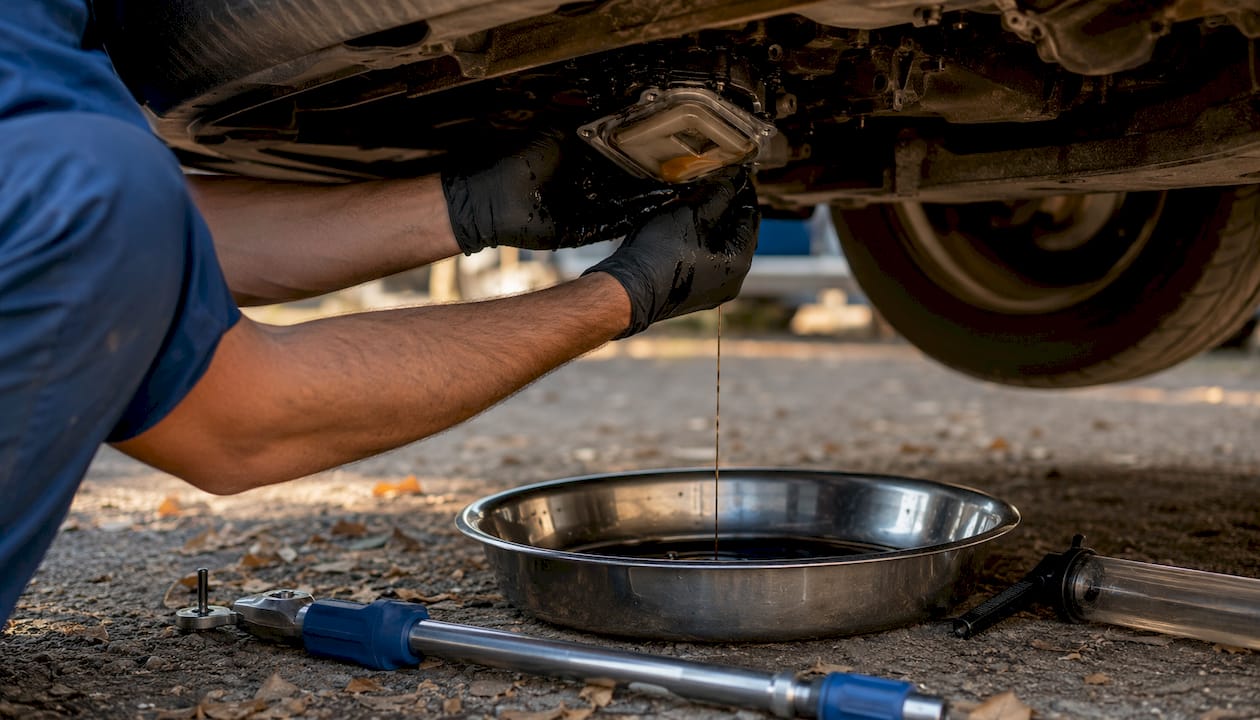
Transmission fluid service costs $150–$200 and prevents $2,500–$5,000 failures caused by degraded fluid. That gap illustrates why early intervention is the most financially sound approach to transmission care.
| Service | Typical Cost | What It Addresses |
|---|---|---|
| Fluid drain-and-fill | $150–$200 | Degraded fluid, torque converter shudder, early slipping |
| Fluid flush (full exchange) | $150–$200 | Severely contaminated fluid |
| Solenoid replacement | $200–$500 | Gear-specific slipping, stuck shifts |
| Sensor replacement | $150–$200 | Check engine light, incorrect shifting |
| Valve body repair or replacement | — | Hydraulic circuit faults, multiple solenoid issues |
| Torque converter replacement | — | TCC failure unresolved by fluid change |
| Transmission rebuild | $1,500–$3,500 | Worn clutch packs, moderate internal damage |
| Full replacement (remanufactured) | $2,500–$5,000 | Severe damage, extensive internal failure |
| Full replacement (new OEM) | — | Under warranty or high-value vehicles |
The pattern is clear. A $150 fluid service at the earliest symptom stage prevents a $1,500–$3,500 rebuild at the late stage. Early diagnosis via fluid check and OBD-II codes can prevent repair costs from escalating 10–20x. Vehicle owners should also clarify repair quotes carefully. A rebuilt transmission is typically less expensive than a factory remanufactured unit, but warranty coverage and quality vary considerably depending on the rebuilder’s skill and parts choices.
When to repair versus replace your transmission
Not every transmission problem warrants a repair. Several factors determine whether fixing the existing unit makes financial and practical sense.
- Vehicle value: If a rebuild quote exceeds roughly half the vehicle’s private-party value, replacement or selling the car outright deserves serious consideration. A quality rebuild makes the most sense for vehicles valued between $6,000 and $15,000.
- Extent of damage: Targeted repairs work when problems are confined to solenoids, sensors, fluid, or the valve body. Widespread internal damage to clutch packs, planetary gear sets, or the transmission case typically points toward a rebuild or replacement.
- Repair cost relative to replacement: When a rebuild quote is within roughly 30% of a quality remanufactured unit that carries a multi-year warranty, the remanufactured option often provides better long-term value.
- Transmission type: Traditional automatics are the most straightforward and least expensive to rebuild. CVTs, found in many Subaru, Honda, and Nissan models, are more expensive and harder to rebuild correctly. Dual-clutch transmissions are the most complex and costly.
- Intended vehicle lifespan: A quality rebuild from a reputable specialist lasts 100,000+ miles. If the vehicle is otherwise solid and the owner plans to keep it five or more years, a rebuild or remanufactured unit is usually the right call.
- Risk of delaying repairs: Driving with known transmission symptoms accelerates damage. A mid-stage slipping situation repairable for a few hundred dollars can become a full rebuild when clutch packs are allowed to wear through completely.
Signs that lean toward replacement rather than repair include no movement in Drive or Reverse with correct fluid level, severe grinding or metal debris in the pan, and multiple simultaneous internal failures confirmed by a professional inspection.
Preventive maintenance to avoid transmission problems
The most cost-effective transmission repair is the one that never becomes necessary. Regular maintenance keeps the hydraulic system functioning correctly and catches problems before they escalate.
- Change transmission fluid regularly following manufacturer recommendations, typically within recommended mileage intervals, using a drain-and-fill method. Do not rely on manufacturer “lifetime fluid” claims. Fluid degrades with heat and use, and thermal damage is the primary factor shortening transmission life.
- Inspect cooler lines annually for leaks, corrosion, and clogs. Rubber-to-metal connection points are the most common leak locations.
- Install an auxiliary transmission cooler if the vehicle is used for towing, hauling, or driving in hot climates. Towing and heavy use increase transmission temperature and accelerate wear significantly.
- Scan for OBD-II soft codes quarterly. Catching a P0700 or solenoid code early prevents cascade failures that turn a $300 fix into a $3,500 rebuild.
- Avoid aggressive acceleration from cold starts. Allowing 30–60 seconds of warm-up before hard acceleration reduces stress on cold, thicker fluid.
- Check for signs of transmission failure at the first hint of slipping, rough shifts, or unusual noises. Addressing symptoms at the earliest stage costs a fraction of late-stage repair.
For Toyota, Lexus, Subaru, and Honda owners, following the manufacturer’s specific fluid specification and service interval is particularly important. These vehicles use proprietary fluid formulations that are not compatible with universal alternatives.
Expert insights on transmission repair costs and choices
Industry experts consistently identify diagnostic accuracy as the critical factor separating a $150 fluid flush from an $8,000 new transmission. ASE Master Technicians emphasize clarifying rebuild versus remanufactured quotes before authorizing any major work. A rebuilt transmission is reassembled from the original case with replaced worn parts, while a remanufactured unit is restored to OEM specifications at a factory facility with updated components that address known failure points. The cost difference is real, and so is the warranty difference.
A common and costly mistake is authorizing a rebuild without a thorough prior diagnosis. A shop that recommends a rebuild without running a computer scan, checking fluid condition, performing a road test, and explaining the specific failure mode is cutting corners. Vehicle owners are entitled to a written diagnosis and a written estimate before any disassembly begins.
Key insight: Focused diagnostics determine whether a $150 fluid service or a $8,000 transmission is needed. Skipping this step is where most owners overpay.
Transmission rebuild quality depends heavily on rebuilder expertise, thorough part replacement, and the use of OEM-quality seals. A quality rebuild performed by a certified specialist can provide long-lasting transmission performance. A poor rebuild can fail again within 20,000–30,000 miles. The importance of ASE certification for the technician performing the work translates directly into rebuild longevity and fewer repeat failures.
Step-by-step troubleshooting guide for specific problems
A structured approach prevents unnecessary parts replacement and keeps repair costs in check.
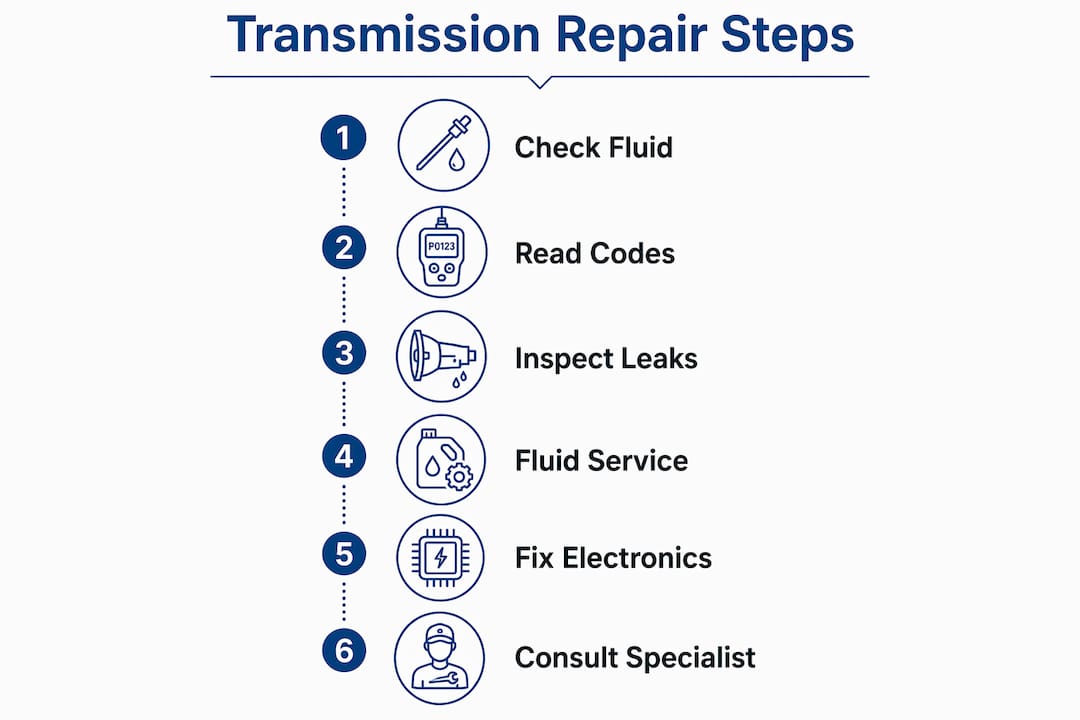
Step 1: Check fluid level and condition. Pull the dipstick with the engine warm and the vehicle on level ground. Note color and smell. Dark brown or black fluid with a burnt odor requires an immediate drain-and-fill. If fluid is low, top up with the correct specification and retest before proceeding.

Step 2: Read fault codes. Connect an OBD-II scanner and record all stored and pending codes. Transmission codes in the P07xx range identify specific solenoids, sensors, or circuit faults. Do not authorize any mechanical repair without this step.
Step 3: Inspect for external leaks. Check the pan gasket, cooler lines, and axle seals for wet spots or drips. A slow leak can cause intermittent slipping without triggering a warning light.
Step 4: Perform a fluid service if needed. Drain the pan, replace the filter and pan gasket, and refill with the exact fluid type listed in the owner’s manual. On vehicles with unknown service history, a drain-and-fill is safer than a full flush. Road test after the service. If symptoms clear, the fluid was the cause.
Step 5: Address electronic faults. If codes point to a solenoid or sensor, replace the specific component. After replacement, perform a TCM adaptive learning reset using a scan tool. Simply clearing codes without the reset can leave stale shift data that reproduces the original symptom.
Step 6: Escalate to a specialist. If symptoms persist after fluid service and electronic repairs, a professional line pressure test is the next diagnostic step. This test measures actual hydraulic pressure inside the transmission and identifies whether the fault is a pump, valve body, or internal seal failure. For transmission repair in Portland, working with a specialist who has experience with your specific vehicle make produces the most accurate diagnosis.
How to find and work with transmission repair professionals
Choosing the right shop matters as much as choosing the right repair. A skilled specialist performing a rebuild will outperform a mediocre shop installing a remanufactured unit, because installation quality directly affects longevity.
Prioritize transmission-only shops or independent specialists with documented experience on the specific vehicle make. A shop that exclusively handles transmissions has the tooling, diagnostic equipment, and pattern knowledge from seeing the same failure modes repeatedly. General repair shops that “also do transmissions” rarely have the same depth of experience.
Before authorizing any work, request a written diagnosis that names the specific failure mode and a written estimate that separates parts, labor, and warranty terms. A reputable shop offers at least a 2-year, 24,000-mile warranty on parts and labor for rebuild work. Ask specifically how many of the exact transmission model the shop has rebuilt. Experience with a particular unit translates directly into fewer comebacks.
Get at least two estimates, ideally from a brand specialist and an independent transmission shop. Compare parts choices, labor hours, and warranty terms line by line. A shop with a strong review history at a slightly higher price is a better bet than an unknown shop offering the lowest quote. For automatic transmission flush services and routine maintenance, an independent specialist familiar with Toyota, Lexus, Subaru, and Honda vehicles provides a cost-effective alternative to dealer pricing without sacrificing quality.
Integrityautoinc serves Toyota, Lexus, Subaru, and Honda owners in the Portland, Oregon area with transmission diagnostics, fluid services, and targeted repairs. Vehicle owners looking for used Toyota transmission parts or professional transmission service can contact Integrityautoinc for an honest assessment before committing to any major repair.
Key Takeaways
Fixing transmission problems without full replacement is achievable through accurate diagnosis, correct fluid maintenance, and targeted component repairs performed before internal clutch damage becomes irreversible.
| Point | Details |
|---|---|
| Fluid is the first check | Low or degraded fluid causes most slipping symptoms; a $150–$200 service prevents $2,500–$5,000 failures. |
| OBD-II codes guide repairs | Codes like P0732 or P0750 identify the exact solenoid or sensor, preventing unnecessary disassembly. |
| Drain-and-fill over flush | On high-mileage vehicles, drain-and-fill replacing 40–50% of fluid is safer than a high-pressure flush. |
| Rebuild vs remanufactured | A quality rebuild lasts 100,000+ miles; clarify warranty and parts quality before authorizing either option. |
| Act at first symptoms | Each stage of delay can increase repair costs 10–20x; early intervention is always the cheapest path. |
FAQ
Can a bad transmission be fixed without replacing it?
Yes, in many cases. Fluid changes, solenoid replacements, valve body repairs, and sensor fixes resolve the majority of transmission problems when caught before internal clutch packs wear through completely.
What is the number one killer of transmissions?
Thermal damage from excessive heat is the primary factor shortening transmission life, most often caused by degraded fluid that can no longer manage heat effectively.
What is the average cost to fix a transmission?
Costs range from $150–$200 for a fluid service to $1,500–$3,500 for a full rebuild and $2,500–$5,000 for a remanufactured replacement. The specific cost depends entirely on what is wrong and how early it is addressed.
What are the first signs of transmission failure?
The earliest signs include a subtle RPM flare during gear changes, a brief delay when shifting from Park to Drive, and slightly rough or hesitant shifts, particularly when the transmission is cold.

