
A flashing VSC light means Vehicle Stability Control is actively correcting a loss of traction, and the system is working as designed. A steady, unblinking VSC light usually means the system is disabled or has detected a fault that needs attention.
- Check whether a Check Engine Light is also on
- If so, reseat and tighten the gas cap first
- Note any change in steering feel, braking, or acceleration
- If the light stays steady, plan on a scan with an OBD-II scanner that reads ABS wheel speed sensors and related modules
Pro Tip: A shop like Integrity Auto can pull the exact fault codes in minutes, which saves guesswork compared to swapping parts based on a hunch.
Key Takeaways
A flashing VSC light signals normal stability correction, while a steady VSC light almost always means a sensor, wiring, or EVAP fault needs professional diagnosis to clear permanently.
| Point | Details |
|---|---|
| Flashing means normal | The system is actively correcting traction and should turn off within seconds. |
| Steady means investigate | A steady light usually points to a disabled system or an unresolved fault code. |
| Check the gas cap first | A loose gas cap can trigger an EVAP code that cascades into a VSC warning. |
| Watch for companion lights | VSC paired with ABS or Check Engine narrows down the likely cause fast. |
| Integrity Auto handles diagnostics | Integrity Auto reads exact fault codes and inspects sensors before recommending repairs. |
Table of Contents
- How the VSC System Works With Other Safety Systems
- Flashing Vs. Steady VSC Light: What’s the Difference?
- What Causes the Lexus VSC Light to Turn On?
- Owner Checks You Can Try Before Booking a Diagnostic
- Is It Safe to Drive With the VSC Light On?
- What Happens During a Shop Diagnostic and What It Costs
- Preventing Future VSC Faults With Routine Maintenance
- How a Lexus Specialist Approaches VSC Diagnostics
- Do VSC Light Behaviors Differ Across Lexus Models and Years?
- How the VSC Light Relates to Other Dashboard Warnings
- Getting Your Lexus VSC Light Checked in Portland
- Sources
- FAQ
How the VSC System Works With Other Safety Systems
Vehicle Stability Control pulls data from wheel speed sensors, a yaw/acceleration sensor, and a steering angle sensor to figure out whether the car is moving the direction the driver intends. When it detects a mismatch, it can brake individual wheels or cut engine power to pull the vehicle back in line.
That data does not stay isolated. VSC shares a communication network with the ABS module and the engine control module, which is part of a networked safety architecture where a fault in one system can surface as a VSC warning.
- Sensor inputs: wheel speed, yaw/acceleration, steering angle
- Processing: VSC module compares expected path to actual path
- Output: brake actuator commands to individual wheels, or a request to reduce engine torque
A fault anywhere in that chain, from a corroded sensor connector to a communication glitch, can trip the VSC light even when the stability system itself is fine.
Flashing Vs. Steady VSC Light: What’s the Difference?
A flashing light is the system doing its job. A steady light means something in the chain has failed a self-check.
| Behavior | What it means | Typical example |
|---|---|---|
| Flashing | Active stability correction, temporary | Light taps the brakes briefly on an icy on-ramp |
| Steady | System disabled or fault detected | Light stays on after a battery disconnect or a failed wheel sensor |
A brief flash on a wet or icy road is confirmation the system caught a slide and corrected it, not a warning sign. Once the intervention ends, the light should turn off on its own within a few seconds.
Pro Tip: If the light flickers once during hard cornering or braking and then goes out, keep driving normally. If it stays lit mile after mile, treat that as a signal to get it checked rather than wait it out.
What Causes the Lexus VSC Light to Turn On?
Most VSC warnings trace back to a handful of repeat offenders, and they are usually diagnosable without guesswork.
- Wheel speed sensor faults. Dirt, corrosion, or a damaged tone ring can corrupt the signal the sensor sends, and the module disables VSC as a safety response rather than act on bad data.
- Steering angle or yaw sensor issues. These need a valid zero-point reading; a bad sensor or missed calibration throws the system off.
- ABS module faults. Since VSC leans on ABS hardware to apply braking force, a fault there cascades into a VSC warning.
- EVAP-related engine codes. A loose gas cap can trigger an EVAP code such as P0455, and that engine fault can pull VSC status down with it.
- Weak battery or corroded terminals. Low voltage can prevent modules from completing startup checks.
- Wiring and connector issues. Chafed wiring or a loose connector anywhere in the chain can interrupt sensor communication.
When the Check Engine Light comes on at the same time as VSC, the odds shift toward an EVAP or engine-management cause rather than a stability hardware fault. Technicians typically see C-codes for ABS and traction-related faults and P-codes for engine and EVAP issues, with P0455 being a common illustrative example of a large EVAP leak triggering a cascade.
Pro Tip: Wheel-sensor corrosion and recent alignment work are two of the most common triggers technicians see, since both can quietly throw off the readings VSC depends on without any obvious symptom.
Owner Checks You Can Try Before Booking a Diagnostic
Try these in order. Most take five minutes or less.
- Note whether the light is flashing or steady, and whether a Check Engine Light is also on.
- If the Check Engine Light is on, pull over safely and check that the gas cap is fully seated and clicked tight.
- Check battery terminals for corrosion and loose connections; a weak battery can produce false module warnings.
- Verify all four tires are inflated to spec and matched in size, since mismatched tires confuse wheel speed readings.
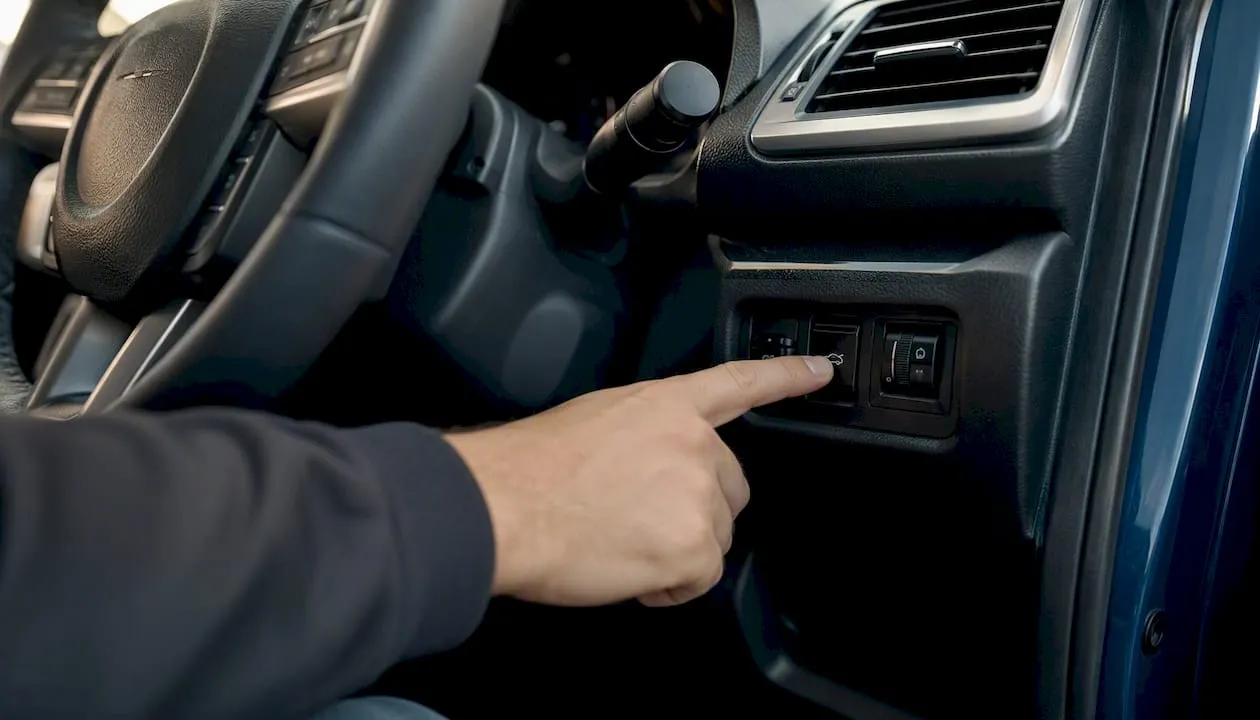
- Press the VSC OFF button, then cycle the ignition off and on to see if the light resets.
An ABS-capable OBD-II scanner can clear stored codes, but clearing a code does not fix the underlying fault. It only tells you whether the light returns.
Do not attempt wheel bearing or sensor replacement without a lift and proper tools, and never turn VSC off intentionally while driving in rain, snow, or on loose surfaces. If braking feel or steering response changes at any point, stop the checks and get professional help.
Is It Safe to Drive With the VSC Light On?
Safety depends on what else is happening on the dashboard, not just the VSC light alone.
- Green: Light flashes briefly during a traction event and clears. No other warnings. Normal driving is fine.
- Yellow: VSC light stays steady but the car drives normally otherwise. Drive cautiously, avoid rain or snow if possible, and schedule diagnostics soon.
- Red: Steady VSC light plus an ABS or engine warning, or any noticeable change in braking or steering control. Stop driving and arrange a tow.
| Signal Level | Example | Recommended Action |
|---|---|---|
| Green | Quick flash on a wet curve, then off | Continue driving |
| Yellow | Light stays on after a battery reconnect | Drive gently, book diagnostics |
| Red | VSC and ABS lights on with soft brake pedal | Stop, arrange a tow |
What Happens During a Shop Diagnostic and What It Costs
A proper VSC diagnostic follows a set sequence, and skipping steps is how repeat comebacks happen.
- Connect a Techstream or ABS-capable scanner and record every stored trouble code, not just the first one.
- Inspect wheel speed sensors and tone rings for corrosion, damage, or debris.
- Test steering-angle sensor calibration and perform a zero-point reset if the vehicle was recently aligned or had the battery disconnected.
- Check battery voltage, charging output, and wiring harness condition at each connector.
- Clear codes and road-test to confirm the fix holds under real driving conditions.
These ranges vary by labor rate and parts availability, and a shop should always confirm a firm number after reading the codes. You can review how diagnostic fees and estimates typically work before booking.
Pro Tip: Ask to see the actual trouble codes on the scanner screen, and ask which specific system triggered the VSC warning. A shop that can answer both questions clearly is doing the diagnostic right.
Preventing Future VSC Faults With Routine Maintenance
Most VSC warnings are preventable with maintenance most owners already have scheduled anyway.
- Clean battery terminals and check voltage during routine service.
- Inspect wheel sensors and hubs whenever brakes are serviced.
- Confirm steering-angle sensor initialization after any alignment.
- Keep all four tires matched in size and properly inflated.
- Ask that VSC and ABS checks be included at scheduled maintenance intervals rather than only when a light appears.
How a Lexus Specialist Approaches VSC Diagnostics
An independent Lexus specialist follows a structured process rather than replacing parts by trial and error.
- Connect a scanner capable of reading ABS and VSC-specific modules, not just generic engine codes.
- Perform a visual inspection of wiring and connectors at each wheel sensor.
- Bench test sensors that show intermittent readings before condemning them.
- Run steering-angle zero-point calibration when alignment or battery work is involved.
- Complete a verification drive to confirm the light stays off under normal conditions.
Platform familiarity matters here. A shop that works on Toyota and Lexus vehicles daily knows the factory-specified steering-angle calibration procedure and has access to OEM parts when a repair calls for one.
A steady VSC warning rarely fixes itself. Resolving the root fault, whether that’s a sensor, a connector, or an EVAP code, is what actually clears the light for good rather than just for a drive cycle or two.
Do VSC Light Behaviors Differ Across Lexus Models and Years?
The core logic behind VSC stays consistent across the Lexus lineup, but the details of how it presents can shift by model and generation. Older Lexus models, including early ES and IS generations, tend to rely on simpler sensor networks and may show the VSC light for issues that newer models catch and self-correct without ever alerting the driver.
Newer Lexus models with more advanced driver-assist packages often link VSC status to additional systems, including lane-keeping and adaptive cruise modules. That means a sensor fault on a newer RX or ES can potentially trigger a wider combination of warning lights than the same fault would on an older model, since more systems are pulling from the same sensor data.
Hybrid Lexus models add another layer. The hybrid control system communicates with VSC over the same vehicle network, so a fault in hybrid battery management or regenerative braking can occasionally present as a VSC warning even when the stability hardware itself is fine.
One behavior that shows up across nearly every model year involves low-speed driving. VSC generally will not engage below roughly 9 mph, and the steering-angle sensor needs a short stretch of straight-line driving at speed to complete its zero-point check after startup. Owners who only drive short, slow trips sometimes notice the VSC light stays on longer than expected, not because of a fault, but because the system never got the chance to complete its self-check. A short drive on a road with some speed usually resolves this on its own.
How the VSC Light Relates to Other Dashboard Warnings
The VSC light rarely operates in isolation, and reading it alongside other dashboard warnings speeds up diagnosis considerably.

When the VSC light and Check Engine Light appear together, the cause is often an engine-management issue, particularly an EVAP leak from a loose gas cap, that has cascaded into a VSC warning because the two systems share network data. Resolving the EVAP code frequently clears the VSC light on its own without any separate repair.
A VSC light paired with an ABS warning points more directly at the braking hardware itself, such as a wheel speed sensor or a fault within the ABS module. This combination deserves more caution while driving, since it suggests the braking system’s ability to modulate individual wheels may be compromised.
If the VSC light appears with a battery or charging warning, voltage issues are the likely root cause. Low voltage can prevent control modules from completing their startup diagnostics correctly, which triggers a VSC fault even though nothing in the stability hardware itself has failed.
A VSC light with no companion warning at all, appearing steady, often points toward the steering-angle sensor or a wheel speed sensor issue that hasn’t yet escalated into a broader system fault. This is a case where a dedicated Check Engine Light diagnostic can rule out engine causes and narrow the search to the stability system itself. Reading the full combination of lights, rather than reacting to VSC alone, is what separates a fast, accurate diagnosis from a guess.
Getting Your Lexus VSC Light Checked in Portland
A steady VSC light deserves a real diagnostic, not a parts-swapping guess. Integrity Auto reads the exact trouble codes your Lexus is storing, inspects wheel sensors and connectors by hand, and confirms steering-angle calibration before ever recommending a repair, so you are not paying for parts that were never the problem.
A typical VSC diagnostic includes a full code read across the ABS and VSC modules, a wiring and connector inspection, sensor testing, and a verification road test once repairs are complete. Turnaround on most VSC diagnostics runs same-day to next-day, depending on parts availability if a sensor needs replacement.
Service scope includes:
- OBD-II and Techstream-level ABS/VSC diagnostics
- Battery and charging system checks
- Wheel speed and steering-angle sensor replacement or calibration
- Post-repair road testing and code-clear confirmation
If persistent limp-mode behavior accompanies your VSC light, understanding how limp mode functions can help explain why the vehicle feels sluggish until the fault is resolved. For Portland-area Lexus owners, the Independent Lexus Service Center page outlines what a diagnostic visit covers, and you can also review Best Lexus Service for a broader look at Lexus-specific repair capabilities before scheduling.
Sources
- What The VSC Warning Light Means For Toyota And Lexus Owners
- Lexus ES – VSC does not Operate or VSC does not Operate Correctly – Electronically Controlled Brake System (for Gasoline Model)
- How to Fix Check Vsc on a Lexus Is250
FAQ
Is It Safe to Drive With the VSC Light On in a Lexus?
It depends on what else is happening. A steady VSC light alone with no drivability changes allows cautious driving to a diagnostic appointment, but VSC paired with an ABS or braking issue means you should stop and arrange a tow.
What Causes the VSC Light to Come On in a Lexus?
The most common causes are wheel speed sensor faults, steering-angle or yaw sensor issues, a loose gas cap triggering an EVAP code, weak battery voltage, or a fault within the ABS module.
How Much Does It Cost to Fix a VSC Light on a Lexus?
Costs vary by cause: sensor cleaning or a gas cap fix runs low, while wheel speed sensor replacement or ABS module repair costs more due to parts and labor time. A shop like Integrity Auto can provide a firm estimate after reading the actual codes.
How Do You Reset the VSC Light on a Lexus?
Press the VSC OFF button or clear stored codes with an ABS-capable OBD-II scanner, then cycle the ignition. If the light returns, the underlying fault has not been resolved and needs diagnosis.
Why Is My Lexus VSC Light Blinking Instead of Staying On?
A blinking VSC light means the system is actively correcting a traction event, such as a slippery patch of road, and this is normal, temporary behavior that should stop once the correction is complete.