

P0171 means the engine control module has detected a lean fuel condition on Bank 1, the cylinder bank containing the number one cylinder. The most likely causes are unmetered air entering through vacuum leaks or cracked intake components, a dirty mass airflow sensor, or a fuel delivery shortfall. A Toyota can typically still be driven short distances with this code active, but the vehicle should be scanned and inspected soon. A flashing check engine light means stop driving and get it looked at immediately.
TL;DR:
- Most P0171 cases on Toyota engines are caused by vacuum leaks or unmetered air entering the intake system, not necessarily failing sensors.
- Diagnosing the code requires analyzing fuel trim data and airflow readings, not just replacing parts like the MAF sensor or oxygen sensors.
- Symptoms can include rough idle, acceleration hesitation, and reduced fuel economy, while a flashing check engine light indicates active misfires needing immediate attention.
- Repair costs vary from simple hose or intake boot fixes to more expensive fuel pump or injector replacements, with diagnostics guiding cost-effective solutions.
- Driving with a steady P0171 is usually safe for short trips, but prolonged neglect risks damaging the catalytic converter and worsening fuel economy.
Table of Contents
- What Does P0171 Mean on a Toyota Engine?
- What Symptoms Show Up With P0171 on Toyota Vehicles?
- Most Likely Causes of a P0171 Code, Ranked
- How Do You Troubleshoot a P0171 Code Step by Step?
- How Much Does It Cost to Fix P0171 on a Toyota?
- Is It Safe to Drive a Toyota With a P0171 Code?
- How Do You Confirm the P0171 Repair Actually Worked?
- Bring Your Toyota to Integrity Auto Inc for P0171 Diagnosis and Repair
- Sources
- FAQ
What Does P0171 Mean on a Toyota Engine?
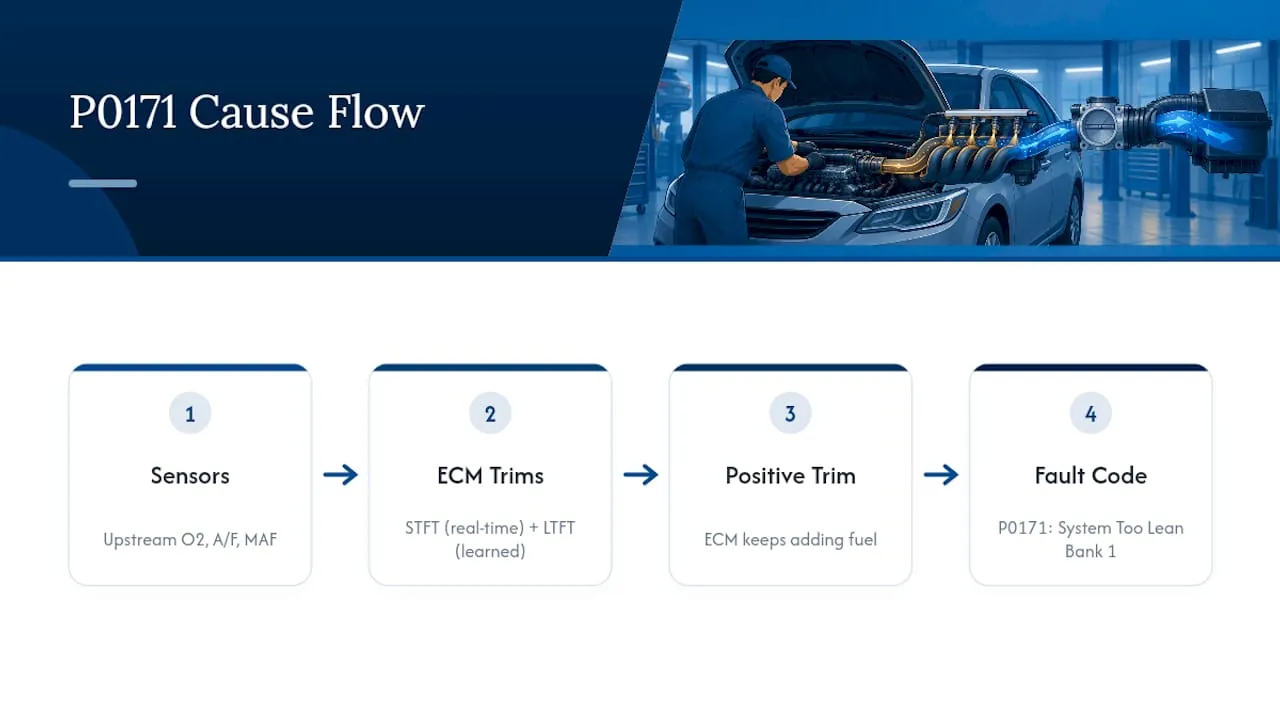
The engine control module tracks two fuel-trim values: short-term fuel trim (STFT) and long-term fuel trim (LTFT). STFT reacts in real time to correct the air-fuel mixture; LTFT is the learned adjustment the ECM applies over time based on repeated STFT corrections. When combined trim values climb too far positive, meaning the system keeps adding fuel to compensate for excess oxygen, the ECM flags a lean condition on Bank 1.
Upstream oxygen or air-fuel sensors feed this loop constantly, and the mass airflow (MAF) sensor tells the ECM how much air is actually entering the engine. If the MAF underreports airflow, or a sensor reports skewed oxygen readings, the ECM’s fuel calculations go wrong even when nothing physical is broken. Toyota service manual documentation for P0171 defines the code as “System Too Lean (Bank 1)” and lays out threshold-based detection tied to engine temperature and freeze-frame conditions, which is why the exact operating state at the moment of the fault matters so much to diagnosis.
What Symptoms Show Up With P0171 on Toyota Vehicles?
Owners usually notice a mix of subtle and obvious signs before or alongside the check engine light coming on.
- Illuminated check engine light, sometimes with no other noticeable change
- Rough or unstable idle, especially at stoplights or in park
- Hesitation or a stumble when accelerating from a stop
- Noticeably lower fuel economy over several fill ups
- A faint whistling or hissing sound near the intake, often a giveaway for a vacuum leak
A flashing check engine light, a strong fuel smell, or a sudden loss of power, signal an active misfire and deserve immediate attention rather than a wait and see approach. Before any diagnosis, it helps to jot down when the symptom occurs, whether it is cold or warm, city or highway driving, and any recent work such as an air filter swap or intake cleaning. That detail often points a technician straight to the cause.
Most Likely Causes of a P0171 Code, Ranked
Most Toyota P0171 cases trace back to a short list of repeat offenders. Working through them in order of probability avoids paying for parts that were never the problem.
- Vacuum or unmetered-air leaks. Cracked intake boots, loose clamps, a leaking PCV hose, or a bad brake booster line let unmetered air into the engine. This is the most common root cause of P0171 on Toyota engines.
- A dirty or contaminated MAF sensor. Oil-soaked aftermarket air filters are a frequent culprit here, coating the sensor element and skewing airflow readings.
- Fuel delivery problems. A weak fuel pump, a clogged filter, a failing pressure regulator, or partially clogged injectors can all starve the engine of fuel under load.
- Oxygen or air-fuel sensor reporting faults, and exhaust leaks upstream of the sensor. A leak ahead of the sensor lets outside air skew the reading before it even reaches the ECM.
- Electrical or learned-value anomalies. Damaged MAF wiring, corroded connectors, or, rarely, an ECM issue that has learned an incorrect baseline.
Pro Tip: Don’t replace the MAF sensor or an oxygen sensor just because P0171 showed up. Pull live grams-per-second data and compare it against expected airflow for that RPM and load first. A sensor that reads plausible numbers is probably not your problem.
How Do You Troubleshoot a P0171 Code Step by Step?
A shop-grade diagnosis starts with data, not a wrench. Guessing at parts is how P0171 repairs turn into expensive trial and error.
- Scan and capture data. Pull STFT, LTFT, freeze-frame data, MAF grams per second or voltage, and upstream oxygen or air-fuel sensor voltages before touching anything.
- Read the fuel-trim pattern. High positive trim at idle that improves once the vehicle is moving usually points to a vacuum leak. Trim that stays high under load points more toward a MAF or fuel delivery issue.
- Inspect physically. Check intake boots, hose clamps, PCV and vacuum lines, the throttle body gasket, and intake manifold gasket surfaces for cracks or looseness.
- Run functional tests. Clean the MAF sensor with a MAF-safe cleaner and recheck readings. Perform a smoke test, or use a propane torch or spray bottle method to locate leaks by ear or by trim response. Measure static and dynamic fuel pressure under load, and check injector flow if the data still points that way.
- Check the electrical side. If sensor data looks erratic rather than simply low, inspect MAF wiring and the O2 heater circuit before condemning the sensor itself.
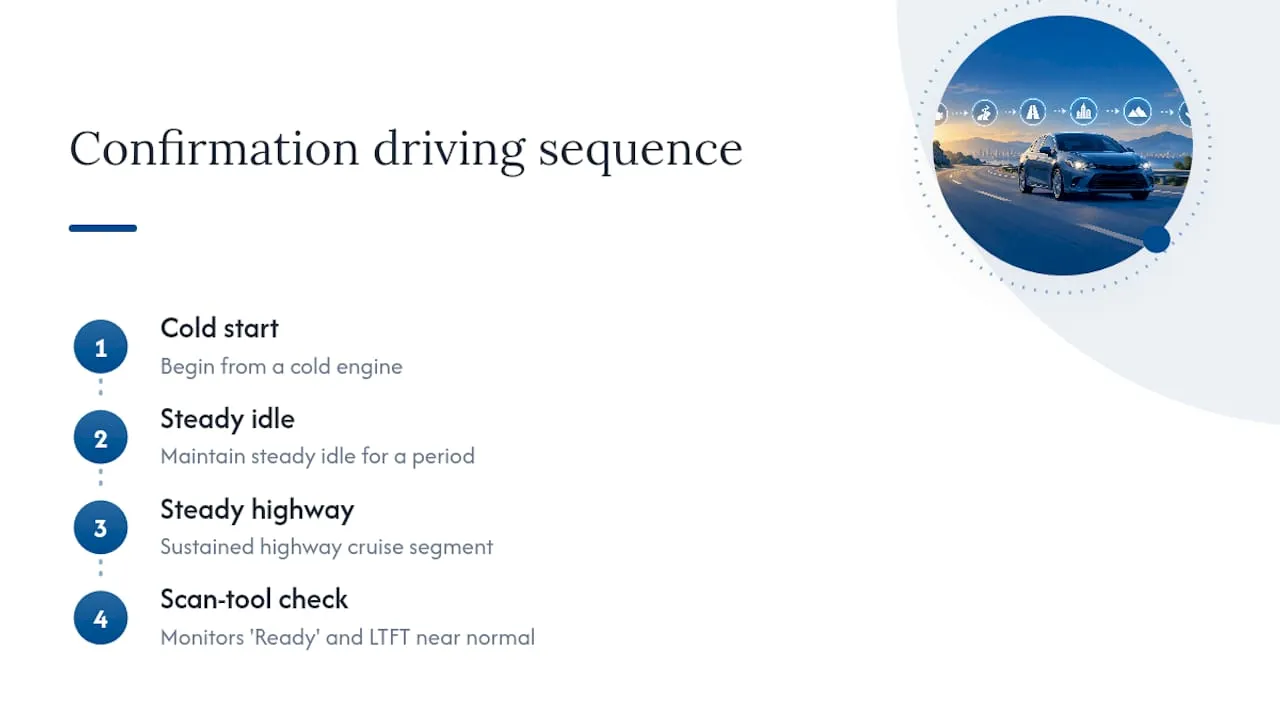
- Verify the repair. Clear the codes, run a full OBD-II drive cycle, cold start through steady highway driving, and confirm the monitors read “Ready” with LTFT settled near zero.
Pro Tip: ASE guidance for fuel-trim diagnostics emphasizes reading multiple data points together rather than any single number in isolation. Combining waveform analysis with physical leak detection is what separates a five-minute fix from a parts-cannon repair.
How Much Does It Cost to Fix P0171 on a Toyota?
Repair costs for P0171 vary widely because the causes themselves range from a ten-dollar hose to a full fuel pump.
- Vacuum hose or intake boot repairs are usually the cheapest fix, with modest parts and labor costs at an independent shop.
- MAF sensor service is inexpensive if cleaning solves it; OEM replacement costs considerably more, so confirming with live data before buying a new sensor matters.
- Fuel pressure repairs start with a diagnostic fee, and the fuel pump, filter, or regulator range widens from there. Pumps tend to cost more because of labor and access time.
- Injector cleaning or replacement, along with oxygen or air-fuel sensor replacement, sit in a broader middle cost band depending on how many need attention.
Cost breakdowns by cause consistently show that diagnostics-first repair avoids the most expensive mistake: replacing a sensor or pump that was reading correctly all along.
Is It Safe to Drive a Toyota With a P0171 Code?
Many Toyotas remain drivable for short trips with a steady P0171 code, but that is not the same as ignoring it. Delaying diagnosis risks a compounding chain of problems: fuel economy drops further, the lean condition can trigger misfires, and prolonged misfires can damage the catalytic converter over time.
A flashing check engine light means an active misfire is happening right now, and that calls for pulling over and arranging a tow or immediate inspection rather than continuing to drive. When in doubt, limit driving to what is necessary and get a scan scheduled.
How Do You Confirm the P0171 Repair Actually Worked?
Clearing the code is not proof the problem is gone. Long-term fuel trim values are learned over time, and they can stay elevated even after the physical cause is fixed, which sometimes tricks an owner into thinking the fix failed when it actually just needs time to relearn.
A proper confirmation follows a driving pattern: a cold start, a period of steady idle, then a steady highway segment, mirroring the Toyota confirmation procedure built into the service manual. A scan tool confirms whether the relevant monitors have gone “Ready” and whether LTFT has settled back toward normal, similar to how technicians verify catalytic converter repairs with waveform data rather than assuming a code clear means the job is done.
Bring Your Toyota to Integrity Auto Inc for P0171 Diagnosis and Repair
Technicians diagnose P0171 using a live-data approach rather than swapping parts until something sticks.
A P0171 diagnostic appointment typically includes a full scan capturing fuel-trim and MAF data, a physical inspection of intake boots and vacuum lines, smoke testing where needed, MAF and oxygen sensor evaluation, fuel-pressure testing, and emissions-related checks when the lean condition has run long enough to raise converter concerns. Bring your Toyota in with notes on when the symptom shows up and any recent maintenance, and you will get a written estimate before any parts are ordered. That approach mirrors how partner guidance on tracking down elusive vehicle issues recommends confirming the source before spending money on a fix. Rather than replacing a MAF sensor or oxygen sensor on a guess, schedule a diagnostic evaluation or explore Independent Toyota Service and Repair to get the fuel-trim data pulled and the actual cause identified first.
Sources
Guidance in this article draws on Toyota service manual DTC documentation, ASE fuel-trim and oxygen-sensor diagnostic resources, and Toyota-specific repair references linked throughout.
- ASE L1 study guide (fuel-trim and diagnostic data)
- P0171 — 2012 Toyota Camry L4-2.5L (2AR-FXE) Hybrid Service Manual | Operation CHARM
- Toyota P0171 Code Explained: Causes, Symptoms & Diagnosis
- P0171 on Toyota: Causes, Fixes & Cost by Model
FAQ
How Do I Fix a P0171 Code on My Toyota?
Start by pulling live fuel-trim data (STFT/LTFT) and MAF readings rather than replacing parts. Most cases trace back to a vacuum leak or dirty MAF sensor, so inspect intake boots, PCV lines, and clean the MAF before considering sensor or fuel-system replacement.
What Causes a P0171 Code?
P0171 is caused by a lean air-fuel mixture on Bank 1, most often from a vacuum leak, dirty MAF sensor, or intake crack. Fuel delivery problems and faulty oxygen sensor readings are less common but still frequent causes.
Can a Dirty Air Filter Cause a P0171 Code?
A dirty air filter alone rarely triggers P0171, but an oiled aftermarket filter can contaminate the MAF sensor and cause it. A clogged filter can also contribute to airflow miscalculations that push fuel trims into lean territory.
Can I Still Drive My Toyota With a P0171 Code?
Short trips are usually fine with a steady P0171 code, but the vehicle should be scanned and inspected soon rather than driven indefinitely. A flashing check engine light means stop driving immediately, since an active misfire can damage the catalytic converter.


