

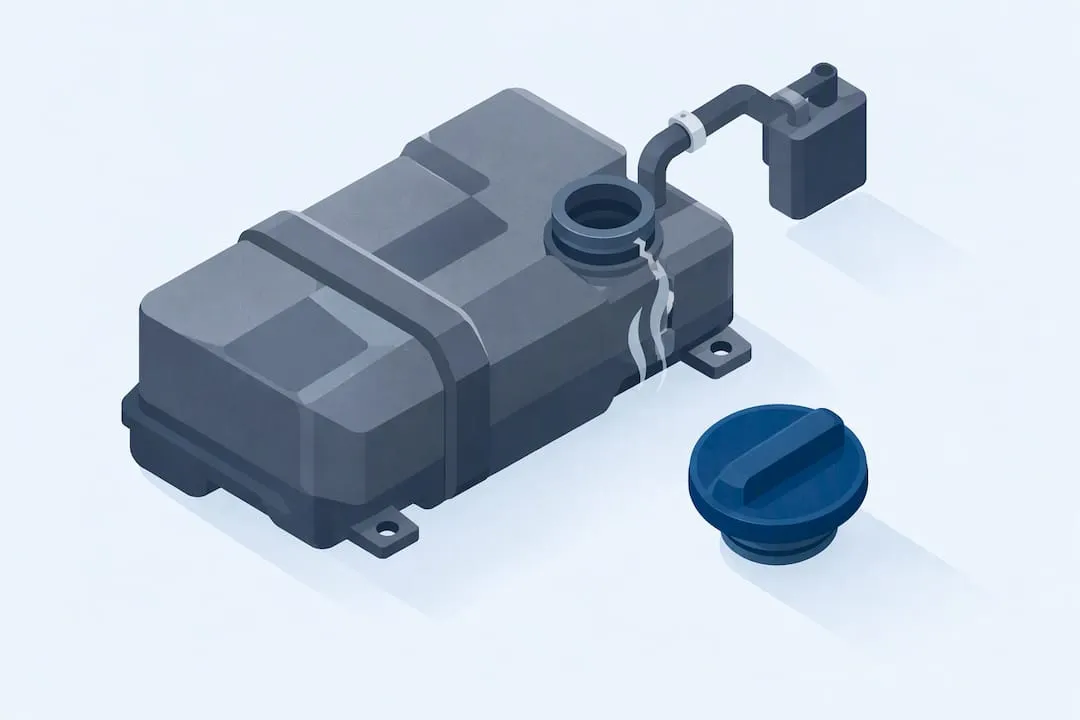
P0456 means the onboard diagnostics system detected a small evaporative emissions leak, most often traced to a loose or worn fuel cap. The vehicle usually stays drivable, but the code can cause a failed emissions test until the leak is found and repaired. Checking and reseating or replacing the fuel cap is the first and most cost-effective step before any deeper diagnostic work.
TL;DR:
- P0456 does not identify a failed part; many 2017 and newer vehicles must detect EVAP leaks as small as 0.020 inches.
- Even when driving feels normal, stored P0456 can leave the EVAP monitor failed or incomplete and cause an emissions inspection failure.
- Start by saving scan data and checking the cap seal and fit, then inspect hoses and test valves before paying for smoke testing.
- Leave smoke or pressure testing to a qualified shop, and keep fuel between one quarter and three quarters full to avoid unsafe or misleading results.
What P0456 actually means
The evaporative emissions system, known as EVAP, captures fuel vapor from the gas tank and routes it through a charcoal canister to the engine’s intake, where it burns during normal operation instead of escaping into the air. A purge valve and vent valve control that flow, and the onboard computer periodically runs a leak test on the whole sealed system.
P0456 does not point to one failed part. It records that a test failed: the system could not hold the expected vacuum or pressure within the time the computer allows, which tells us vapor is escaping somewhere in a sealed loop that includes the tank, cap, hoses, canister and valves. Under the EPA’s Tier 3 evaporative and OBD standards, many vehicles built for the 2017 model year and later are required to detect leaks as small as 0.020 inches upstream of the purge valve, a threshold so fine that it explains why the code can trigger from something as minor as a loose cap.
Related codes share the same family of logic:
- P0442 and P0446 flag leaks or restrictions in overlapping parts of the system.
- P0455 signals a larger leak, easier to pinpoint than the small leak behind P0456.
- P0457 often points specifically to a loose or missing fuel cap.
Symptoms, driveability, and emissions test impact
A small EVAP leak rarely changes how the car drives. Fuel delivery, power and fuel economy generally stay normal because the leak affects vapor containment, not combustion.
That said, a few signs call for closer attention: for a helpful guide on diagnosing interior odor sources, see diagnose the source first to stop car odour for good.
- A noticeable fuel smell near the tank or filler area.
- Any visible liquid fuel leak under the vehicle.
- Additional check engine codes appearing alongside P0456.
- Any change in starting, idling or acceleration, which points to an unrelated problem worth investigating separately.
The more immediate consequence is procedural rather than mechanical. Emissions testing programs check whether the EVAP monitor has run and passed, and a stored P0456 generally means that monitor reads as failed or incomplete, which is enough to fail an emissions inspection even though the car runs fine.
Most common causes of a P0456 small EVAP leak
- Fuel cap and filler neck seal. Worn gaskets, cross-threading or a cap left loose after fueling account for a large share of P0456 cases and are the cheapest to rule out.
- Cracked vapor hoses and quick-connect fittings. Rubber hoses harden and crack with age and heat, and the plastic quick-connect fittings along the vapor lines can loosen or fail to seal fully.
- Purge valve or vent valve malfunction. Either valve can stick slightly open or fail to seal completely, letting vapor or outside air leak past when the system should be sealed.
- Charcoal canister damage. A cracked canister housing or one saturated with fuel is less common but produces the same failed leak test.
- Sensor or monitor faults. A faulty fuel tank pressure sensor can report a leak that is not physically there, though this is the least likely cause and should be considered only after the mechanical checks come up clean.
Step-by-step diagnostics from basic checks to shop-grade tests
A methodical order keeps diagnostic time and cost down, since most P0456 cases resolve at the first or second step.
- Pull and save the scan data. A code reader shows readiness monitor status and freeze-frame data: fuel level, engine temperature and conditions present when the code set, all of which narrow down likely causes before any part is touched.
- Inspect and reseat the fuel cap. Check the sealing gasket for cracks or debris, confirm the threads engage fully, and listen for the correct number of clicks while tightening; replace the cap if the seal looks worn.
- Trace the visible vapor path. Follow accessible hoses and connectors from the tank area to the engine bay, looking for cracked rubber, loose clamps or a fitting that has popped partway off.
- Test purge and vent valve operation. Live scan data shows commanded versus actual valve position, and a simple bench test with vacuum applied by hand confirms whether a valve holds or leaks.
- Run a low-pressure smoke test if the leak stays hidden. Shops introduce a small amount of smoke and mild pressure into the sealed system and watch for it to escape, which finds hairline cracks and pinhole leaks that a visual check misses entirely.
- Use pressure-decay or engine-off natural vacuum testing for confirmation. These methods measure how quickly pressure or vacuum bleeds off inside the sealed system. SAE research on EVAP leak detection shows that results depend heavily on fuel level, orifice size and temperature, so technicians control these conditions before trusting the result.
Pro Tip: Keep the fuel level between a quarter and three-quarters full before any pressure or vacuum test, since a tank that is nearly empty or completely full skews the test and can produce a false reading.
Repair options and typical cost ranges
Repair cost depends entirely on which part in the sealed system has failed, and diagnostic time factors into the total when the leak is not obvious.
- Fuel cap replacement is the least expensive fix and typically installs in a few minutes once the correct part is on hand.
- Hose or connector repair costs more when hoses run near the tank or under the vehicle, since access adds labor time beyond the part itself.
- Purge or vent valve replacement usually requires live-data or bench testing to confirm the fault, which adds diagnostic time on top of the parts and labor for the valve itself.
- Charcoal canister replacement sits at the higher end of the range because the canister is larger, often harder to access and more expensive as a part.
- Smoke or pressure testing adds diagnostic time to the final bill whenever a leak is not visible on inspection, since finding a hairline crack takes longer than replacing a cap.
Preventing repeat codes and knowing when to call a shop
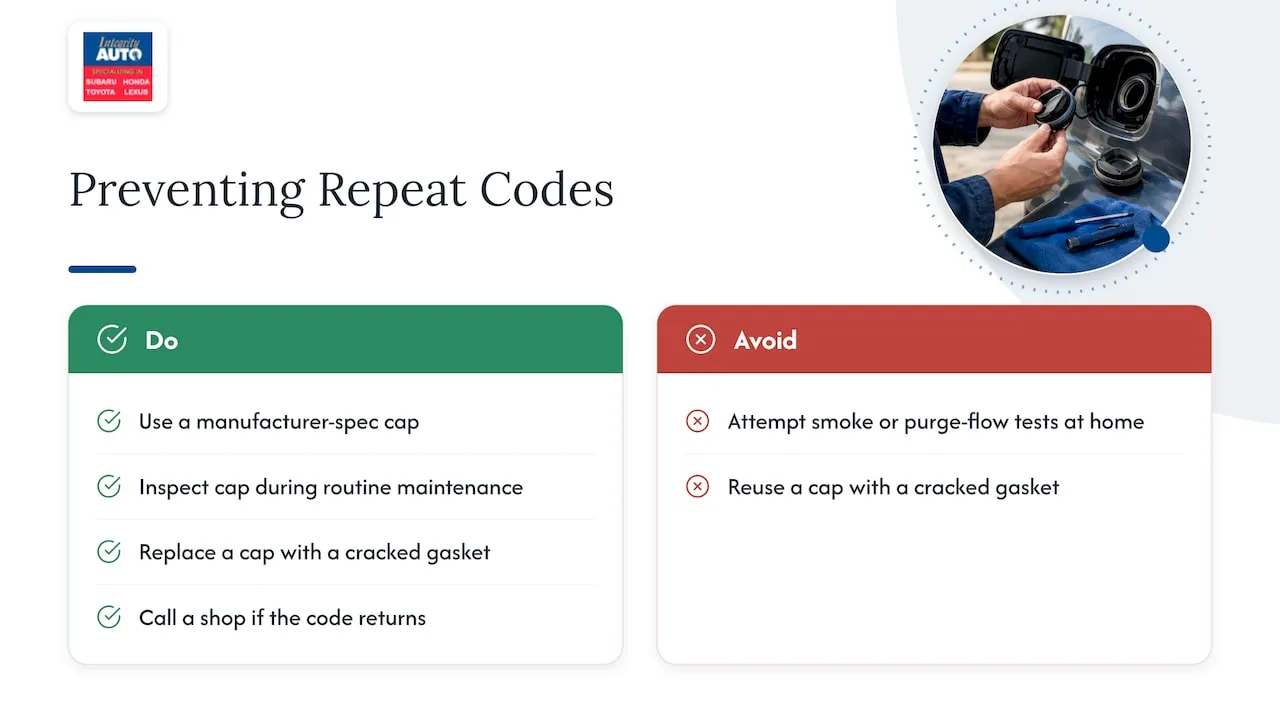
Using a cap that matches the manufacturer’s spec and inspecting it during routine maintenance catches most of these leaks before they trigger a code at all. A cap that no longer clicks properly or has a visibly cracked gasket should be replaced rather than reused.
Smoke and pressure testing should stay with a qualified shop. SAE research on EVAP system fire hazards found that introducing smoke or purge flow into a fuel system can release flammable vapor if done without the right equipment and ventilation, which is a real safety concern for anyone attempting it at home.
Pro Tip: If the code returns after a cap replacement, if there is any fuel odor, or if the vehicle fails an emissions test, professional diagnosis is the faster and safer path forward.
A shop-grade approach to diagnosing P0456
A dependable P0456 diagnosis follows the same order every time: pull and save scan data, check the cap, trace the visible vapor path, test the purge and vent valves, then move to a controlled smoke or pressure test only when the simpler checks come up clean. This sequence matches the detection logic built into EPA OBD requirements and avoids replacing parts that were never the problem.
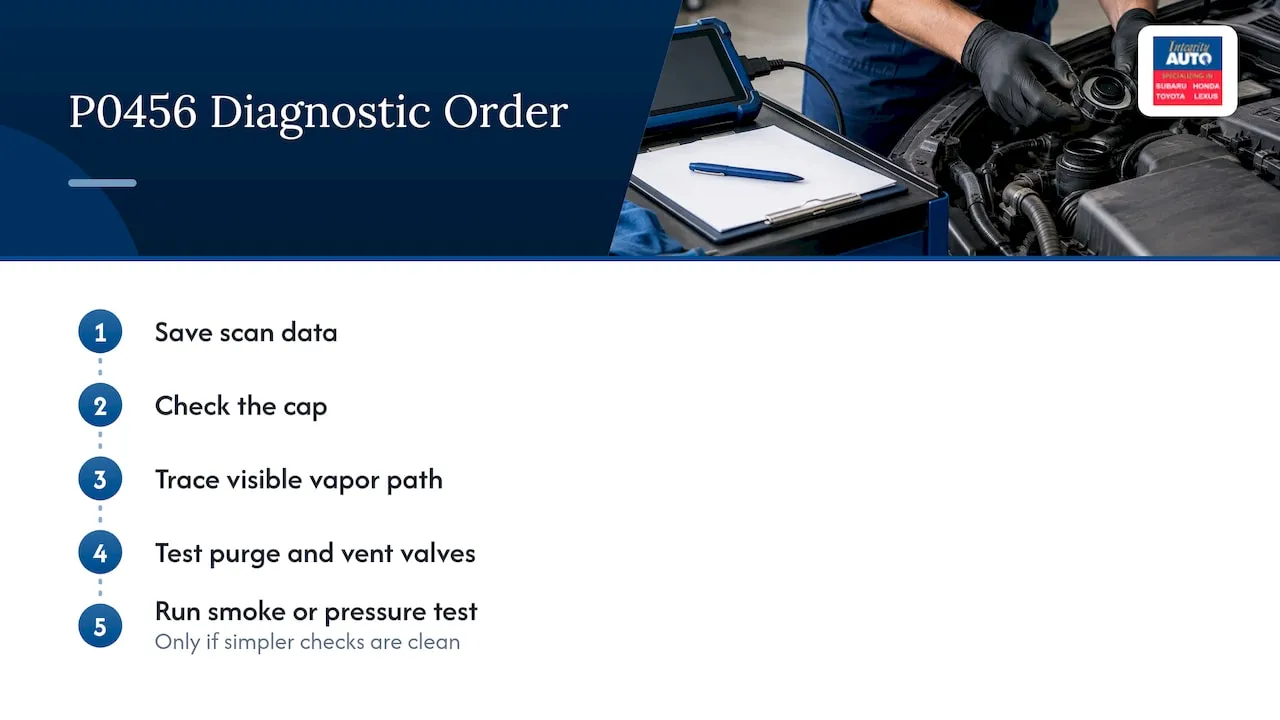
The same workflow, starting with the cheapest likely fix and working toward smoke and pressure testing only when needed, keeps diagnostic time and cost down for the owner. Anyone chasing a persistent P0456 benefits from having the sealed system tested under controlled conditions rather than guessing at parts. For a closer look at how we approach this specific code, see our walkthrough of diagnosing P0456 on Toyota vehicles.
How Integrity Auto handles your EVAP leak
For Toyota, Lexus, Subaru and Honda vehicles, diagnosis of P0456 and related EVAP codes is done following dealership-level procedures but aimed at providing timely and cost-effective service. The diagnostic process starts with the lowest-cost possibility, the fuel cap, before moving to hose inspection, valve testing and smoke testing, to avoid unnecessary diagnostic expenses.
If your check engine light is on for a small EVAP leak or you need emissions testing and repairs to pass a DEQ check, our diagnostic service pinpoints the cause and gets you a clear repair estimate. Toyota owners can also explore our independent Toyota service and repair options for ongoing maintenance beyond this one code. Scheduling a diagnostic appointment can help trace and fix the leak efficiently.
FAQ
How do you fix an EVAP leak that triggers P0456?
Start by checking and reseating the fuel cap, since a worn seal or loose cap causes a large share of P0456 cases. If the cap checks out, a technician traces the vapor hoses, tests the purge and vent valves, and runs a smoke test to find leaks that aren’t visible.
What does a P0455 code mean compared to P0456?
P0455 indicates a large evaporative system leak, while P0456 flags a small one; both come from the same EVAP monitor test but represent different leak sizes. The diagnostic approach is similar for both: check the cap and hoses first, then test valves and run smoke or pressure testing if needed.
How much does it cost to fix a P0456 code?
Cost depends on the cause: a fuel cap replacement is inexpensive, while hose repairs, valve replacement or canister replacement cost more as the part and labor involved increase. Diagnostic time, including smoke or pressure testing, adds to the total when the leak isn’t obvious from a visual check; request a diagnostic estimate for a cost specific to your vehicle.
Can a small EVAP leak be diagnosed without a shop visit?
Checking and tightening or replacing the fuel cap is a safe step anyone can try at home. Smoke and pressure testing require specialized equipment and safety precautions because introducing smoke or pressure into a fuel system can release flammable vapor, so that part of the diagnosis is best left to a qualified shop.
Sources
- Tier 3 Evap/OBD Summary Presentation (March 3, 2016)
- Analysis on Factors Affecting Leak Detection of Vehicle Fuel Evaporative System – SAE 2021


