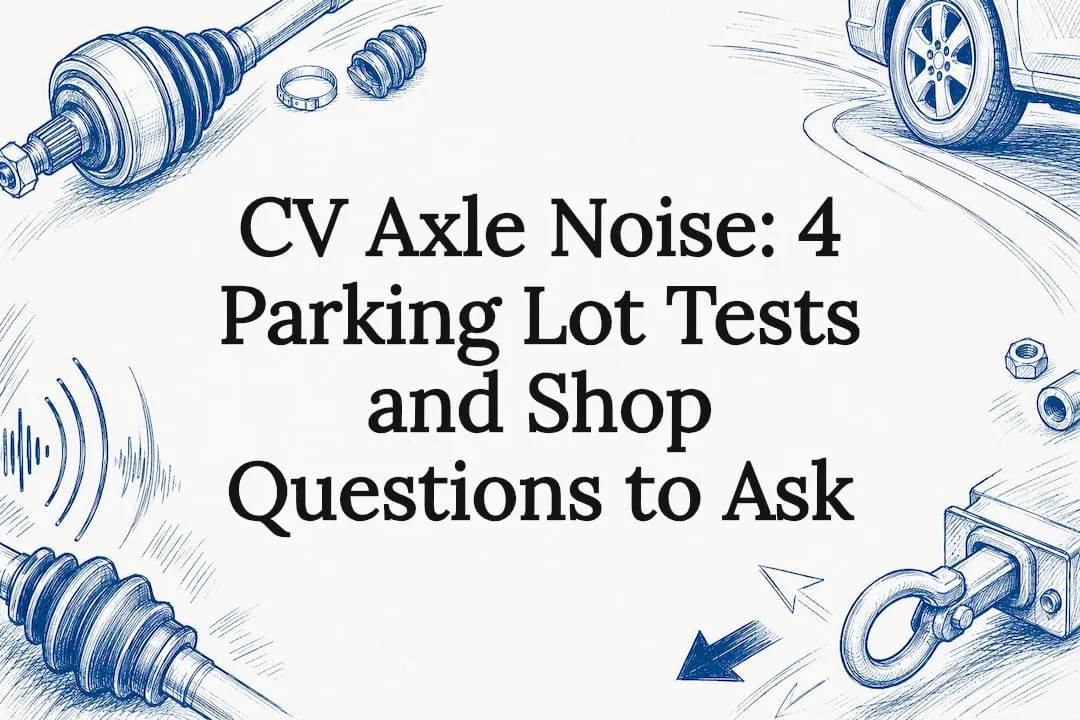
A rhythmic clicking or popping when turning is the clearest sign of a failing outer CV joint, and it means you should avoid sharp, full-lock turns under acceleration until a technician looks at the boot. If you hear clunking on acceleration or feel vibration that grows with speed, that points to a different failure mode and calls for prompt inspection rather than a wait-and-see approach. Either way, stop guessing and get the axle checked before a torn boot turns into a stranded car.
TL;DR:
- Rhythmic clicking or popping during turns indicates a failing outer CV joint, especially under acceleration, and requires avoiding full-lock turns until checked.
- Vibration that increases with throttle input suggests an inner CV joint issue, while noise only during turns points to outer joint wear.
- Steering angle triggers CV noise, whereas speed-related humming suggests a wheel bearing problem, and braking sounds indicate brake system issues.
- Conducting simple parking lot turn tests and visual inspections can help identify CV axle problems before visiting a shop.
- Repair costs depend on the damage extent, with boot-only fixes being cheaper if caught early, and full axle replacements often necessary if the joint shows play or grit.
Table of Contents
- What Cv Axle Noise Sounds Like: Outer Vs Inner Joint
- Cv Joint Clicking Vs Wheel Bearing, Brakes, and Suspension Noise
- How to Diagnose CV Axle Noise Yourself Before a Shop Visit
- When CV Axle Symptoms Mean Stop Driving, and When They Don’t
- Cv Axle Replacement Cost and Repair Options Explained
- Integrity Auto Inc.’s Checklist for a CV Axle Inspection
- Sources
- FAQ
What Cv Axle Noise Sounds Like: Outer Vs Inner Joint
The outer and inner CV joints fail differently, and the sound each one makes tells you which end of the axle is wearing out. A rhythmic clicking or popping when turning is the classic outer joint symptom. It shows up as a tap-tap-tap that speeds up and gets sharper the tighter you turn, especially when you accelerate through the turn. The inner joint behaves differently. It tends to produce a clunk on acceleration or deceleration, along with vibration that builds as you press the gas rather than a hum tied to road speed.
A few other clues help confirm which joint is the culprit:
- Grease sling on the inside of the wheel, tire, or wheel well often means a torn outer boot has been flinging lubricant for a while.
- Pitch that changes with steering angle (louder at full lock, quieter going straight) almost always means outer joint wear.
- Noise tied to throttle load rather than steering angle usually means the inner joint or its connection to the transmission.
Cv Joint Clicking Vs Wheel Bearing, Brakes, and Suspension Noise
Front-end noise has several possible sources, and mixing them up leads to the wrong repair. Wheel bearings typically produce a steady hum or growl that rises and falls with road speed, not steering input, and often changes pitch slightly when you sway the car side to side. That is a fundamentally different pattern than CV joint clicking, which only appears when you turn the wheel.
Use these rough patterns to narrow things down before you call a shop:
- Clicking or popping only while turning: almost always a CV axle issue, specifically the outer joint.
- Humming or growling that tracks with speed, unrelated to steering: points to a wheel bearing rather than the axle.
- Grinding or a pulsing pedal tied to braking: a brake system problem, not a CV joint.
- Clunks over bumps or a steering wheel that feels loose or wanders: suspension or steering components, such as worn tie rod ends or sway bar links.
None of these symptoms overlap much once you pay attention to what triggers them. Steering angle triggers CV noise. Speed triggers bearing noise. Braking triggers brake noise. Road surface triggers suspension noise.
How to Diagnose CV Axle Noise Yourself Before a Shop Visit
You do not need a lift to get a strong read on what is happening under your car. A short, careful test in a parking lot, paired with a visual check, will tell you most of what a technician needs to know before you even book an appointment.
- Run the parking-lot turn test. Find an empty lot and make slow, full-lock turns in both directions, forward and in reverse, while listening closely. Note which side clicks and whether it happens turning left, right, or both.
- Check the boots visually. Look at the rubber boots covering each CV joint, near the wheels and near the transmission. Look for cracks, splits, missing clamps, or grease residue slung onto nearby parts.
- Feel for vibration on a short road test. Drive at a few different speeds and note whether vibration builds with acceleration (inner joint) or stays constant regardless of throttle (more likely a tire or bearing issue).
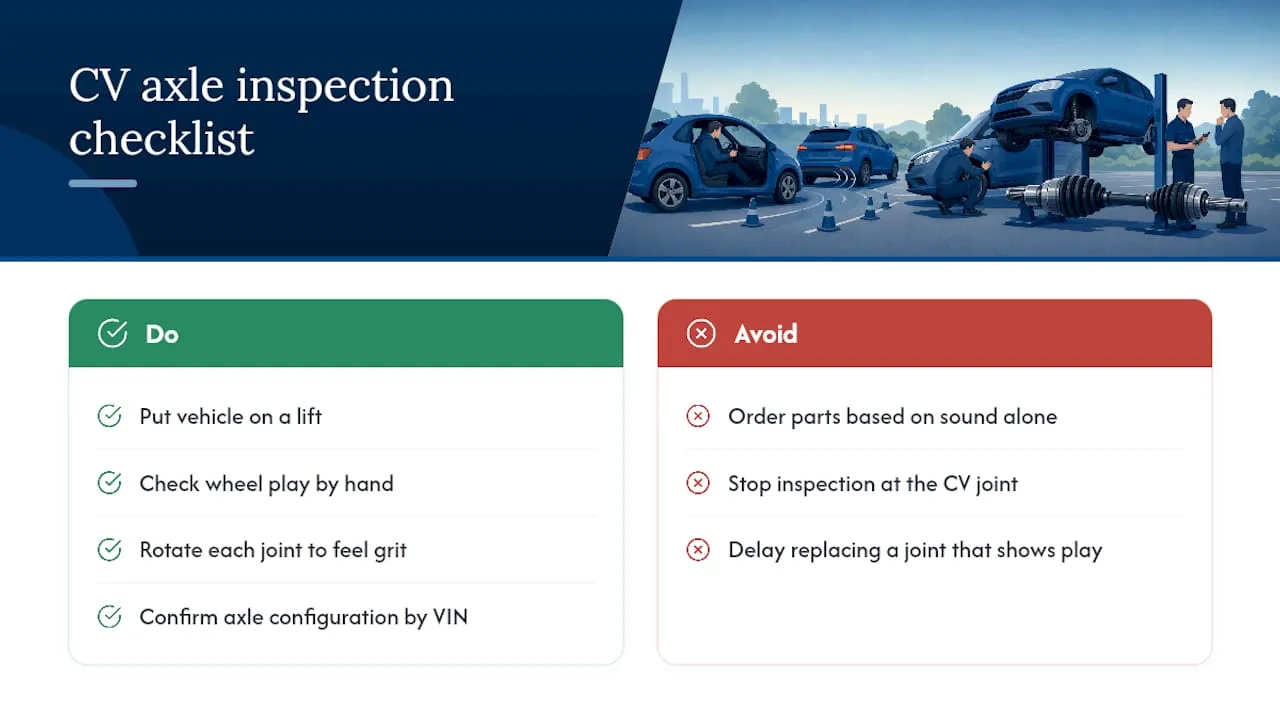
- Ask the shop what they check on the lift. A technician should raise the wheel off the ground, check for play and rotate the joint by hand to feel for grit or looseness, and confirm the correct axle by your vehicle’s VIN before ordering any parts.
Pro Tip: Do the turn test in both directions and at low speed only. Full-lock turns under hard acceleration put maximum stress on a weak joint, and that is exactly when a marginal axle is most likely to bind or separate.
When CV Axle Symptoms Mean Stop Driving, and When They Don’t
Not every CV symptom demands an emergency stop, but some do, and telling them apart matters. A torn boot with no audible noise yet is the mildest case. It calls for scheduling a repair soon, and limited short-term driving is generally acceptable while you arrange it, since catching a torn boot early keeps the fix cheap.
Clicking on full-lock turns is a step up in urgency. Get it looked at soon, and in the meantime avoid cranking the wheel to full lock while accelerating, since that is the exact motion that stresses a worn joint the most. Clunking or vibration under acceleration suggests inner joint wear and deserves prompt attention rather than a “next time I’m near the shop” approach.
Grinding, a sudden loss of drive power, or any sign the axle is separating means stop driving immediately and arrange a tow. A joint that fails completely can seize or come apart entirely, leaving the vehicle immobile or unsafe to steer.
Cv Axle Replacement Cost and Repair Options Explained
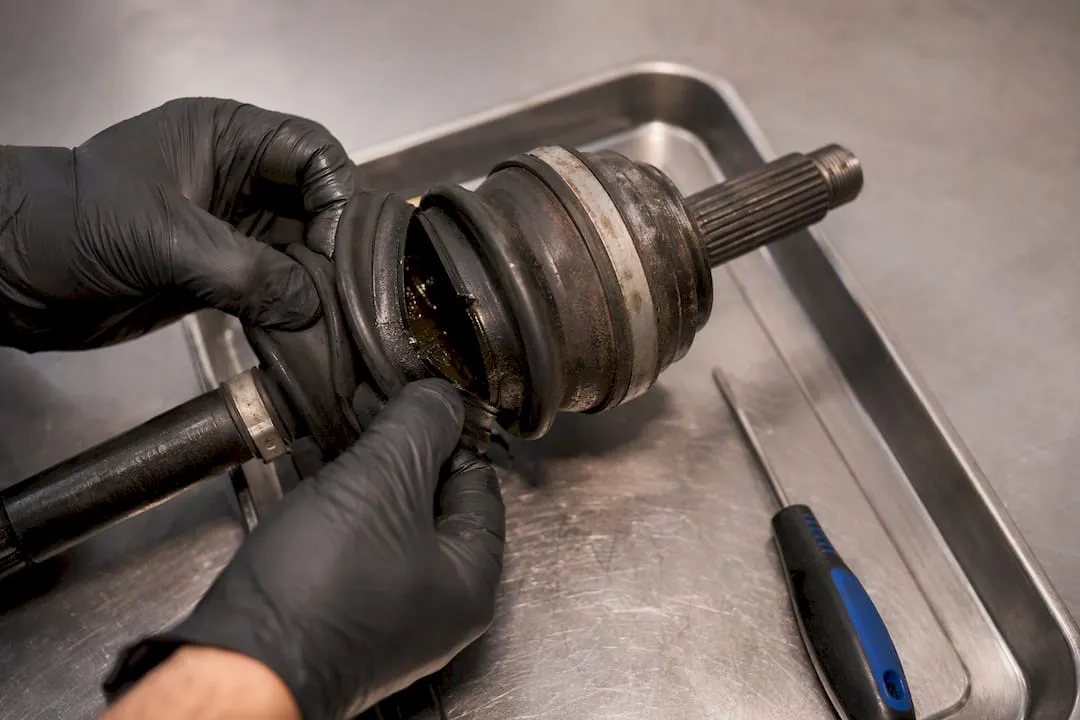
Once a technician confirms a CV joint is worn, you generally have two paths, and which one applies depends on how far the damage has progressed. Boot-only replacement is the least expensive option, but it only works if the joint itself still turns smoothly with no play or grit. Catch a torn boot early, before dirt and moisture get into the joint, and a simple boot swap can be enough.
Once the joint shows roughness or play when rotated by hand, a new boot alone will not fix the underlying problem; the joint needs to come out. That is why most shops now replace the entire axle assembly rather than disassembling and rebuilding the old one. Labor to press out a worn joint, clean the housing, repack it, and install a new boot often costs more than swapping in a preassembled axle, and the finished result tends to be more consistent.
Parts tier is where most of the price variation comes from. Economy aftermarket, premium aftermarket, and OEM axles carry different price points, warranty terms, and failure rates. A cheaper part that fails early can cost more overall once you factor in a second round of labor.
Before agreeing to any repair, it helps to ask for:
- A VIN-based quote so the axle matches your exact vehicle configuration
- The parts brand and tier being installed, and how it compares to aftermarket vs OEM parts generally
- The warranty length on parts and labor
- Whether the quote includes a hub and bearing inspection, since bearing wear sometimes accompanies axle failure
Integrity Auto Inc.’s Checklist for a CV Axle Inspection
A thorough CV axle inspection should never be a guess based on sound alone. Integrity Auto Inc. recommends putting the vehicle on a lift, checking wheel play by hand, rotating each joint to feel for grit or roughness, and confirming the correct axle configuration by VIN before any parts are ordered.
Ask whether the quoted repair covers a hub and bearing check and, where applicable, an alignment check, since a wheel bearing or alignment issue can sometimes ride along with axle wear and get missed if the inspection stops at the CV joint. When a torn boot is caught early and the joint underneath still feels smooth, a boot-only repair may be all that is needed. Once a joint shows play or grit, full axle assembly replacement is the more reliable path, and it avoids paying labor twice.
Vehicle owners in the Portland, Oregon area who want that kind of lift inspection and a clear explanation of parts and warranty options can schedule a repair consultation with Integrity Auto Inc. for Toyota, Lexus, Subaru, or Honda vehicles.
Sources
The diagnostic guidance above draws on established repair industry references covering CV axle symptoms, cost drivers, and shop-level inspection practices, including breakdowns of bad CV axle symptoms and replacement cost, CV joint symptom differences, and current CV axle cost estimates.
For related maintenance topics, see how wheel bearing wear differs from axle failure, and review the trade-offs covered in repair versus replace decisions for aging vehicle components.
- 5 Bad CV Axle Symptoms (and Replacement Cost)
- 4 Bad CV Joint Symptoms
- Quoted $900 for a CV Axle? What It Should Really Cost in 2026 | My Everyday Driver
- CV axle replacement cost — RepairPal
FAQ
What Does a Bad CV Axle Sound Like?
A failing outer CV joint typically makes a rhythmic clicking or popping sound that gets louder and faster during sharp turns, especially under acceleration. A failing inner joint tends to produce a clunk on acceleration or deceleration along with vibration that builds with throttle input.
Is It Safe to Drive With CV Joint Noise?
It depends on the symptom: a torn boot with no noise allows limited short-term driving, but clicking on turns should be addressed soon and grinding, loss of drive, or signs of separation mean you should stop driving and arrange a tow immediately.
How Much Does It Usually Cost to Fix a CV Axle?
Cost varies mainly by parts tier, since economy aftermarket, premium aftermarket, and OEM axles carry different price points and warranty terms, and choosing a cheaper part can lead to repeat labor costs if it fails early.
How Do You Tell a Bad Wheel Bearing From a CV Axle Problem?
A wheel bearing produces a steady hum or growl that rises with road speed regardless of steering input, while a CV axle problem produces clicking or popping specifically when turning the wheel.