Follow your owner’s manual or Maintenance Minder display first. Many newer Hondas will show code “3” when transmission fluid service is due, while older-model guidance points to roughly 24 months or 30,000 miles under normal conditions. Severe driving shortens that window considerably, and using genuine Honda-specified fluid matters more than most owners realize. When in doubt, a qualified technician familiar with Honda procedures can confirm what your specific model needs.
TL;DR:
- Honda’s Maintenance Minder system directs transmission fluid service based on actual driving conditions, which can cause different vehicles of the same model to require service at varying odometer readings.
- Severe driving conditions, such as short trips, towing, or high temperatures, can cut transmission fluid life in half, necessitating more frequent service every 12 months or 15,000 miles.
- Symptoms like dark, burnt-smelling fluid, delayed shifts, slipping, or hesitation often indicate fluid degradation and should prompt immediate inspection regardless of the scheduled interval.
- Many Honda transmissions use sealed systems without accessible dipsticks, meaning level checks typically require professional tools and expertise.
- Using the correct Honda-specified transmission fluid is critical, and better practices favor drain-and-refill methods over full flushes to avoid damage to higher-mileage or sealed units.
Table of Contents
- Honda Transmission Service Interval by Model Year and Type
- What Are the Warning Signs of Bad Transmission Fluid?
- How Do You Check Honda Transmission Fluid Level?
- Do Towing and Short Trips Shorten Transmission Fluid Life?
- What Transmission Fluid Does Honda Recommend?
- Drain-and-Fill vs Flush: Which Service Does Honda Recommend?
- Transmission Service Snapshot: Intervals, Cost, and Timing
- How Often Should You Replace a Honda Transmission Filter?
- Is It Safe to Change Honda Transmission Fluid Yourself?
- How Do You Dispose of Used Transmission Fluid?
- Where to Get Honda Transmission Service Done Right
- Sources
- FAQ
Honda Transmission Service Interval by Model Year and Type
Honda’s recommended transmission fluid interval isn’t a single number. It depends on the vehicle’s age, the transmission design, and how the car is actually driven.
Older Honda models, generally those built before the widespread rollout of digital maintenance tracking, followed a straightforward rule: change the transmission fluid every 24 months or 30,000 miles under normal use. That baseline came from a fixed-schedule era when Honda published maintenance intervals as flat mileage and time targets rather than usage-based calculations, giving owners a simple number to plan around regardless of how the car was actually driven.
Newer Hondas work differently. The Maintenance Minder system tracks engine load, temperature, mileage, and driving patterns, then displays a code on the dashboard when service is due. Maintenance Minder code “3” specifically flags transmission fluid service, and Honda designed the system to reflect actual operating conditions rather than a one-size-fits-all mileage marker. That means two identical Hondas driven differently can hit code 3 at very different odometer readings.
For modern automatics and CVTs, shops commonly see manufacturer-aligned service at ranges of tens of thousands of miles under normal driving, though this range varies by model and should never override what your specific owner’s manual states.
A few practical points worth keeping in mind:
- Check your model-year-specific manual since Honda has adjusted intervals across generations.
- Don’t assume your neighbor’s Accord and your CR-V follow the same schedule.
- Maintenance Minder resets after service, so note your mileage when the work is done.
What Are the Warning Signs of Bad Transmission Fluid?
Healthy Honda transmission fluid is typically red or pinkish and mostly translucent. Once it turns dark brown or black, or starts to smell burnt, the additive package has broken down and the fluid is no longer protecting internal components the way it should.
Watch for these signs:
- Fluid that looks dark brown, black, or cloudy instead of red or pink
- A burnt smell rather than the faint sweet odor of fresh fluid
- Metal particles or debris visible on the dipstick
- Delayed engagement when shifting from park into drive
- Slipping, rough shifts, or noisy gear changes
- Shuddering or hesitation in CVT-equipped models
Pro Tip: If you notice CVT shudder, especially during light acceleration from a stop, don’t wait for your next scheduled service. That symptom often signals fluid degradation that’s already affecting the belt-and-pulley system’s ability to maintain proper friction.
These symptoms usually mean the fluid’s friction modifiers and detergents have depleted faster than expected, which raises the risk of internal wear that a simple fluid change can no longer fix.
How Do You Check Honda Transmission Fluid Level?
Checking transmission fluid on a Honda with a dipstick takes a few minutes, but the process only gives an accurate reading when followed correctly.
- Warm the engine to normal operating temperature. Some manuals recommend a short drive first.
- Park on level ground and let the engine idle, then shut it off and wait 60 to 90 seconds before checking.
- Locate the transmission dipstick, pull it out, wipe it clean with a lint-free cloth, and reinsert it fully.
- Remove it again and read the fluid level against the HOT-side marks, not the cold marks.
- If the level sits below the lower HOT mark, add the Honda-specified fluid in small amounts until it reaches the upper mark.
This procedure follows Honda’s own dipstick and checking guidance, which specifies the 60 to 90 second wait time for an accurate reading. Not every Honda has a user-accessible dipstick, though. Many CVT models use a sealed system with no owner-serviceable check point, which means level verification requires a lift and a technician. If your model falls into that category, your manual will say so explicitly, and attempting to force a check without the right tools can introduce contamination.
Do Towing and Short Trips Shorten Transmission Fluid Life?
Yes. Stop-and-go traffic, frequent short trips, towing, hilly terrain, and extreme heat all count as severe driving conditions, and each one accelerates fluid breakdown faster than steady highway miles.
Short city trips are particularly hard on fluid because the transmission never gets enough sustained running time to stabilize at optimal temperature, which creates more thermal cycling and shear stress than an equivalent stretch of highway driving. Under these conditions, Honda’s own service documentation recommends tightening the interval:
- Severe driving examples call for service every 12 months or 15,000 miles on many older models.
- High-heat or high-speed driving, above roughly 95°F, can call for a 24,000 mile or 24 month interval instead of the standard 30,000 mile mark.
- Owners who tow trailers or regularly climb steep grades should treat their vehicle as a severe-use case even if daily mileage looks modest.
CVT-equipped Hondas deserve extra attention here. The belt-and-pulley design generates more friction than a conventional automatic, which speeds up additive depletion and makes CVT fluid health more sensitive to neglect.
What Transmission Fluid Does Honda Recommend?
Honda specifies exact fluid types for each transmission family, and substituting the wrong one can affect shift quality even if the fluid technically fits.
Common Honda specifications include:
- ATF-Z1 and DW-1 for many automatic transmissions
- HCF-2 for certain CVT applications
- Honda MTF for manual transmissions
Honda’s own fluid specification guidance notes that DEXRON III can serve as a temporary substitute in some older models when genuine fluid isn’t available, but the manual is clear that owners should refill with genuine Honda fluid as soon as practical. That’s because Honda’s friction modifiers are formulated for a specific shift feel, and continued use of substitute fluid can affect how smoothly the transmission shifts over time.
The safest way to confirm the correct fluid for your specific model is to check the owner’s manual or a dealer parts lookup rather than relying on a generic “universal ATF” label at a parts store.
Drain-and-Fill vs Flush: Which Service Does Honda Recommend?
A machine flush cycles fluid through the entire system for a more complete exchange, but it also pushes more force through aging seals and lines.
For many Honda models, Honda’s service procedures favor repeated drain and refill cycles, where a shop drains, refills, drives the vehicle briefly, and repeats the process to more thoroughly displace old fluid. This method is often preferred over a single-pass flush, especially on higher-mileage vehicles where a full flush risks dislodging built-up deposits that were otherwise not causing problems.
- Drain-and-fill: lower cost, partial fluid exchange, lower risk on older transmissions
- Repeated drain-and-refill cycles: more thorough, Honda’s documented preference for many models
- Machine flush: complete exchange, best reserved for well-maintained transmissions with clean fluid history
Pro Tip: If your Honda has unknown fluid history and higher mileage, ask your technician about a drain-and-refill sequence before jumping to a full flush. It’s a gentler way to reset fluid condition without stressing aging seals. Working with a shop experienced in automatic transmission flush procedures and Honda-specific service steps helps ensure the right method gets used for your vehicle’s condition.
Transmission Service Snapshot: Intervals, Cost, and Timing
Here’s the quick version for planning purposes:
- Older models, normal driving: roughly 24 months or 30,000 miles
- Severe driving conditions: roughly 12 months or 15,000 miles
- Modern automatics and CVTs: often 40,000 to 80,000 miles, but defer to Maintenance Minder code 3 or your specific manual
- Typical shop visit: a basic drain-and-fill often takes under an hour; repeated drain-and-refill cycles or CVT-specific procedures can take longer
Costs vary by shop, region, and transmission type, so ask your service provider for a written estimate before work begins rather than relying on a generic online figure. Your next step is simple: check your owner’s manual, look for a Maintenance Minder code 3 on your dashboard, or schedule an inspection if you’re not sure which category your driving falls into.
How Often Should You Replace a Honda Transmission Filter?
Not every Honda transmission has a serviceable filter, and that single fact confuses a lot of owners.
Many modern Honda automatics and CVTs use a screen-type filter integrated into the transmission pan or valve body rather than a separate, easily swapped cartridge filter like an engine oil filter. On models where this screen is accessible, technicians typically inspect and clean or replace it during a more involved service, such as a pan drop or a repeated drain-and-refill cycle, rather than on every routine fluid change.
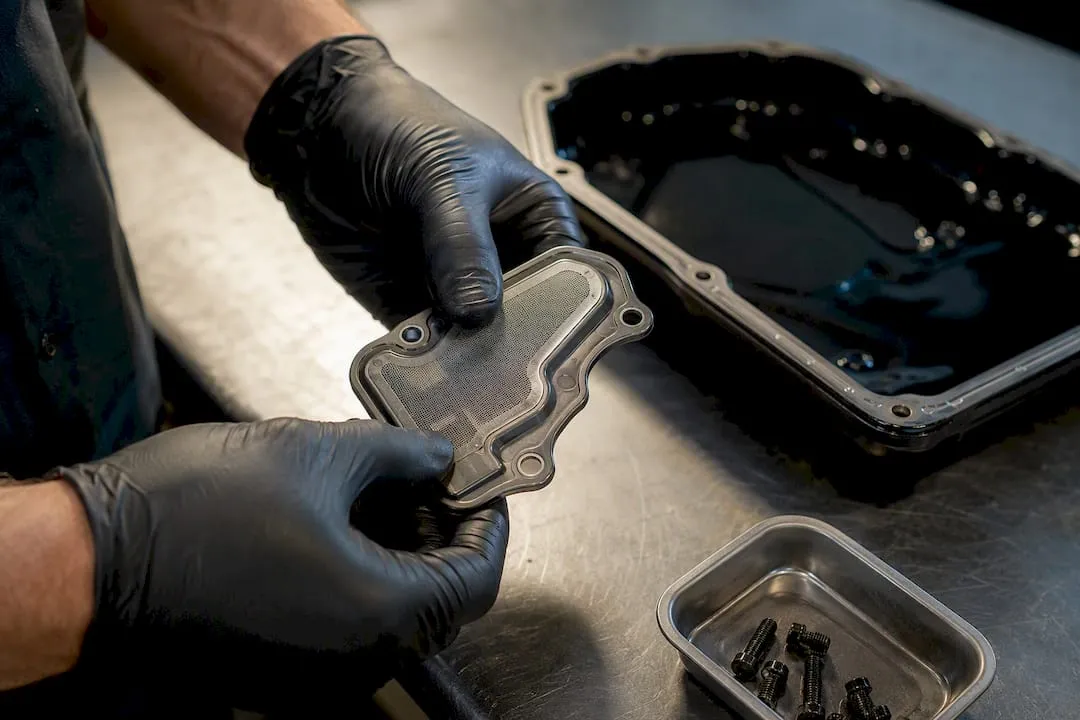
For vehicles that do have a replaceable filter, service typically lines up with major transmission fluid intervals rather than a separate schedule. That means if your Honda calls for fluid service at 30,000 miles under normal conditions, a filter inspection often happens at the same visit rather than in between. Some CVT models have sealed transmission cases with no owner-accessible filter at all, which puts the responsibility on a technician equipped to open the case safely.
The clearest way to know what applies to your Honda is checking the model-specific service manual or asking a technician to confirm whether your transmission includes a serviceable filter during the next scheduled fluid change. Guessing here risks either unnecessary labor costs or skipping a step your transmission actually needs, so this is one detail worth confirming rather than assuming based on what a different Honda model requires.
Is It Safe to Change Honda Transmission Fluid Yourself?
DIY transmission fluid changes are possible on many older Honda models with an accessible dipstick and drain plug, but the process carries real risks if skipped steps or wrong fluid choices go unnoticed.
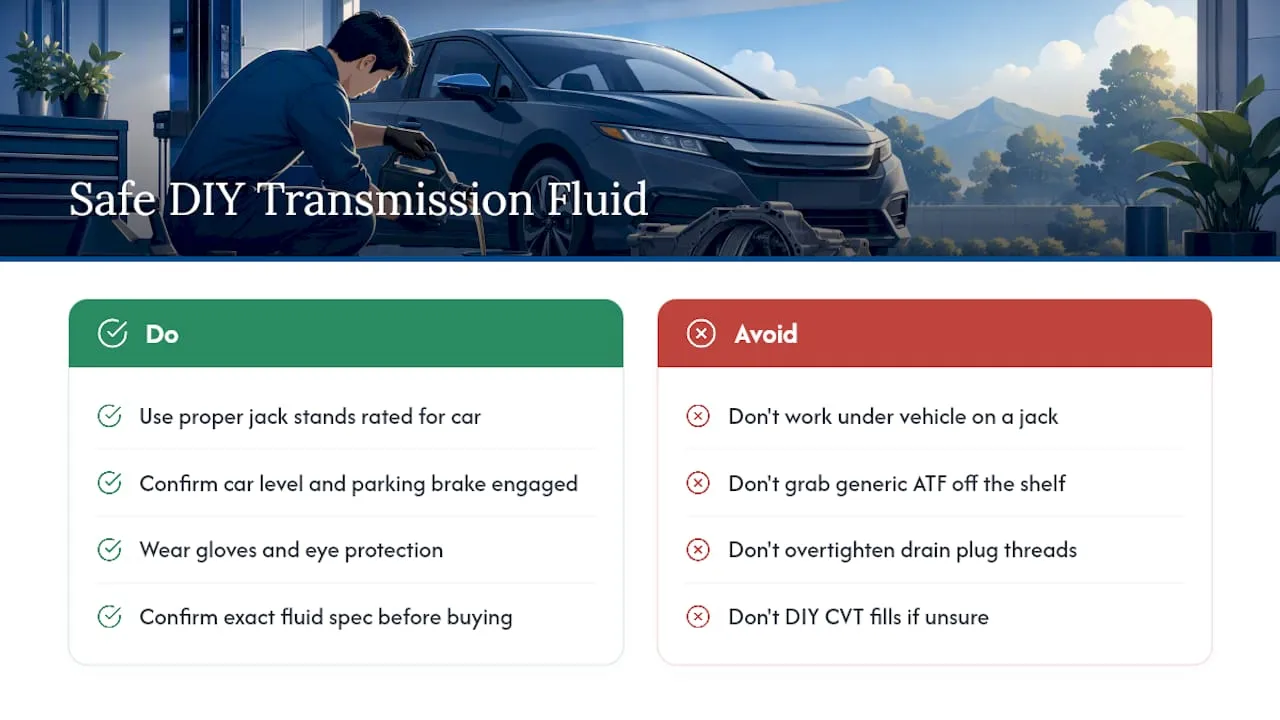
Start with the basics: never work under a vehicle supported only by a jack. Use proper jack stands rated for the vehicle’s weight, and confirm the car is level and the parking brake is engaged before going underneath. Transmission fluid drains hot in many procedures, so wear gloves and eye protection to avoid burns or splashes.
Confirm the exact fluid specification before buying anything. As covered earlier, Honda transmissions require specific fluids like ATF-Z1, DW-1, or HCF-2 depending on the model, and grabbing a generic ATF bottle off the shelf can lead to shift quality problems down the road. Double-check the drain plug torque specification in your manual. Overtightening can strip the pan threads, while undertightening risks a leak that shows up days later.
For CVT-equipped models, DIY service is riskier. Many CVTs use sealed systems without a simple dipstick check point, and getting the fill level wrong on a CVT can cause noticeable performance issues or damage that’s expensive to correct. If your Honda falls into that category, or if you’re not confident identifying the correct fluid and fill procedure, this is a job better handed to a technician with the right lift and Honda-specific service information.
How Do You Dispose of Used Transmission Fluid?
Used transmission fluid is classified as hazardous waste in most areas, and pouring it down a drain, into soil, or into regular trash is both environmentally harmful and often illegal.
The fluid contains heavy metals, degraded additives, and petroleum byproducts that don’t break down safely in soil or waterways. Once contaminated, it can affect groundwater and local ecosystems if disposed of improperly. Most auto parts stores that sell transmission fluid also accept used fluid for recycling at no cost, and many municipal household hazardous waste facilities take it as well.
If you’re changing fluid yourself, collect it in a clean, sealed container labeled clearly, and never mix it with other automotive fluids like coolant or oil, since mixed fluids are harder to recycle and may not be accepted. Local auto parts retailers and quick-service shops typically have collection programs already in place, so calling ahead to confirm they accept transmission fluid specifically saves a wasted trip.
Shops that perform transmission service professionally are already set up for compliant recycling and disposal, which is one more reason DIY changes on newer or CVT-equipped Hondas often make more sense left to a shop with the right systems in place.
Where to Get Honda Transmission Service Done Right
Manufacturer-recommended maintenance only works when it’s actually followed, and that’s the gap Integrityautoinc closes for Honda owners who want dealership-level accuracy without the dealership price tag or the upsell pressure.
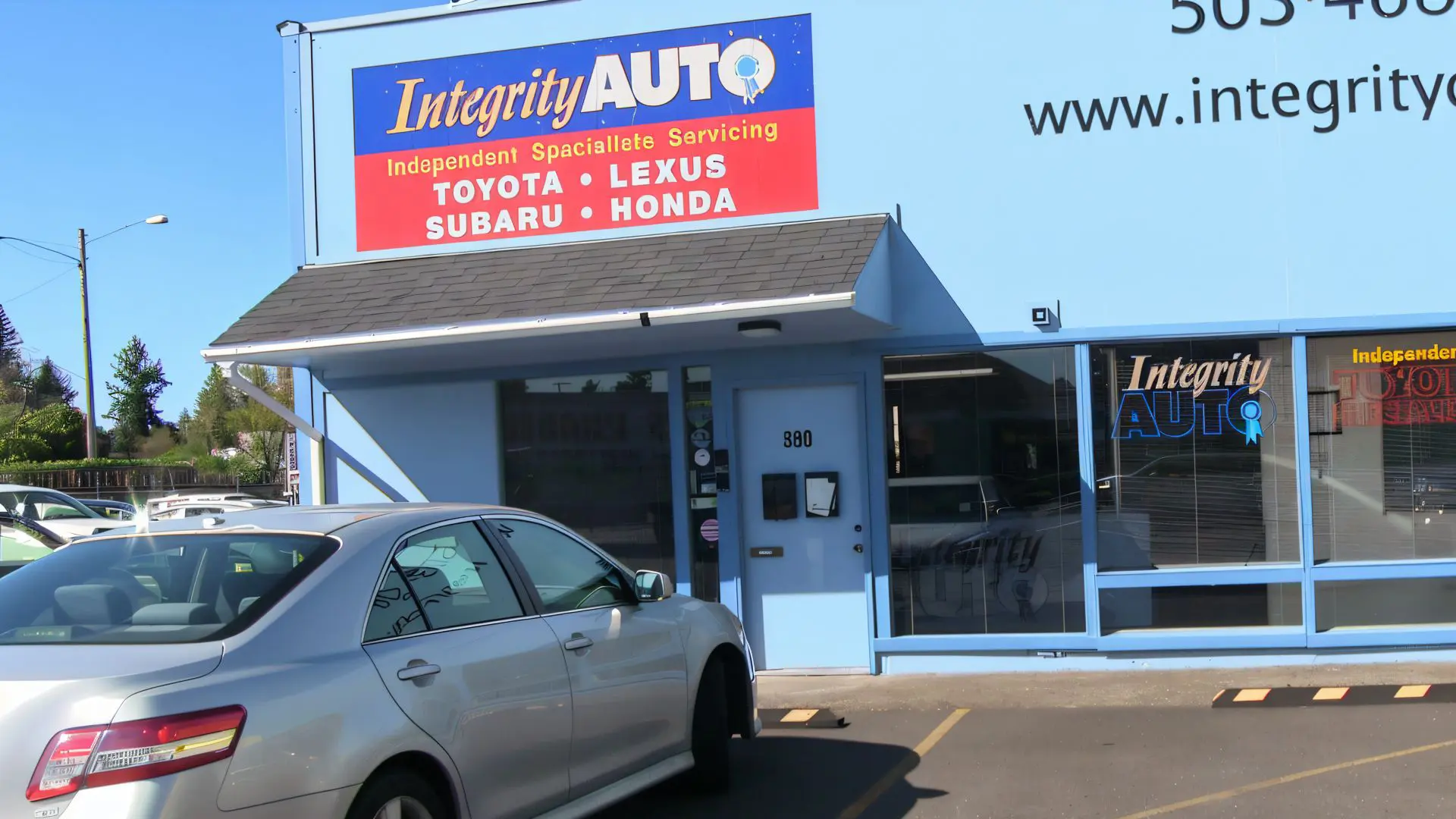
A transmission service visit includes a fluid condition inspection, a level check against Honda’s specifications, and either a drain-and-refill or a manufacturer-specific procedure depending on what your model and mileage call for. Technicians follow Honda’s documented guidance on fluid type, interval, and service method rather than defaulting to a generic one-size-fits-all approach that ignores model-year differences. That distinction matters most on CVT-equipped Hondas, where the wrong fluid or an incomplete fluid exchange can shorten the life of a transmission that’s expensive to replace.
The Honda Services & Repair page covers manufacturer-recommended scheduled maintenance, transmission services, and CVT-specific service for Honda owners. If your dashboard is showing a Maintenance Minder code or your owner’s manual interval is coming up, scheduling an inspection is a way to confirm exactly what your vehicle needs before a minor service item becomes a major repair.
Sources
Model-specific details always take priority over general guidance, so verify your own vehicle’s requirements directly.
FAQ
Is 100,000 miles too late to change transmission fluid?
It’s later than ideal, but not necessarily too late if the fluid still looks reasonably clean and the transmission shifts normally. A technician should inspect the fluid condition before deciding whether a standard service or a more cautious repeated drain-and-refill approach makes sense.
Why do mechanics say not to change transmission fluid on high-mileage vehicles?
Some mechanics hesitate on very high-mileage transmissions because a full flush can dislodge deposits that were otherwise not causing problems, potentially exposing worn components. This is exactly why Honda’s documented preference for repeated drain-and-refill cycles over a single aggressive flush matters on older vehicles.
How late is too late to change CVT fluid?
There’s no universal mileage cutoff, but waiting until you notice shuddering or hesitation means the fluid has likely already degraded enough to affect performance. CVT fluid health depends heavily on the belt-and-pulley friction characteristics, so earlier service tends to protect the transmission better than waiting for symptoms.
Do I really need to use genuine Honda transmission fluid?
Honda’s own documentation allows DEXRON III as a temporary substitute in some older models, but recommends refilling with genuine Honda ATF as soon as possible for correct shift quality. Long-term use of a substitute fluid can affect how the transmission shifts, so matching the manufacturer specification is the safer long-term choice.
How do I know if my Honda needs transmission service now?
Check your dashboard for a Maintenance Minder code 3, which indicates transmission fluid service is due, or consult your owner’s manual for your model’s mileage and time interval. If you notice dark fluid, a burnt smell, or shifting issues, schedule an inspection at a shop like Integrityautoinc rather than waiting for the next scheduled interval.