

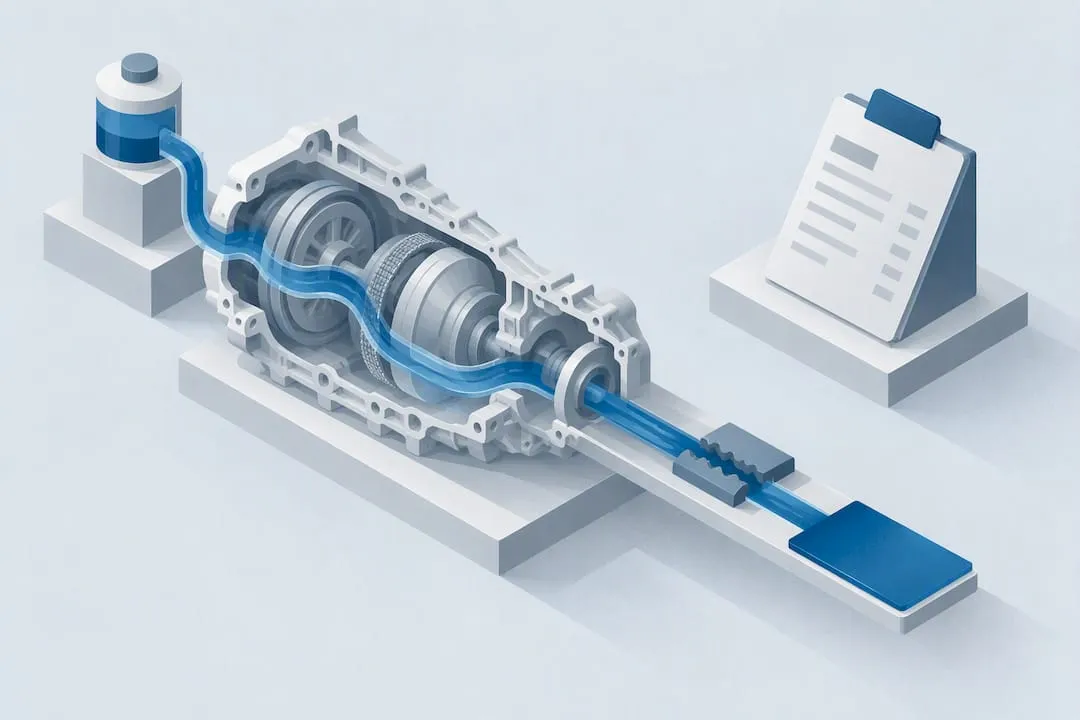
Most Honda CVT judder points to fluid condition or progressive internal wear. The practical first step is to check the CVT fluid and schedule a diagnostic, since a correct CVT fluid service often resolves early judder. Software or TCU issues are a less common but real factor on some model years, and factory Maintenance Minder guidance exists for a reason: fluid condition drives most of these cases.
TL;DR:
- Loss of propulsion, delayed acceleration, a burning smell, or any transmission warning light warrants diagnosis before the next drive, not a wait and see approach.
- Before your appointment, record when judder occurs, inspect fluid color and odor using the manual’s procedure, and bring any OBD II scan codes.
- Honda’s specified CVT fluid and proper fill level are essential; a drain and fill or flush may help contamination but cannot reverse internal wear.
- Towing, mountain routes, and sustained slow driving under heavy loads raise transmission heat, so schedule service sooner even without a Maintenance Minder alert.
- Start with diagnosis: software updates are usually least costly, fluid service costs more, and valve body or transmission replacement costs the most.
How to recognize CVT judder and when it’s urgent
CVT judder typically feels like a shudder or light vibration during takeoff or gentle to moderate acceleration, and it often shows up only once the transmission has warmed to operating temperature. It can resemble a stutter rather than a smooth power delivery, which is different from an engine misfire (which usually happens at idle or under load regardless of transmission temperature) or a wheel vibration (which tends to scale with road speed rather than throttle input).
A few signs mean the judder has moved from annoying to urgent:
- Sudden loss of propulsion or a delayed response when pressing the accelerator.
- A burning smell, which can indicate overheated or degraded transmission fluid.
- A check-transmission light, Maintenance Minder alert, or malfunction indicator lamp turning on.
Any of these warrant a diagnostic appointment before the next drive rather than after.
What mechanically or electronically causes a judder in Honda CVTs
A handful of underlying problems produce the same judder symptom, which is why a proper diagnostic matters more than guesswork.
- Worn or glazed belt/chain and cone surfaces, which reduce the smooth, continuous friction transfer a CVT depends on.
- Degraded CVT fluid, where heat breakdown or clutch material contamination changes friction characteristics and disrupts how the transmission manages power delivery.
- Torque converter clutch or valve body problems, along with worn engine or transmission mounts, which can produce vibrations that feel like judder but originate elsewhere.
- Software or TCU monitoring issues on certain model years.
On that last point, Honda issued a product update for the 2016 HR-V addressing a CVT software monitoring concern tied to internal fluid pressure detection, which could affect how early belt problems were flagged. When a model has an associated technical service bulletin like this one, a dealer or qualified shop can check for the update before recommending more invasive work.
Statistic Callout: Owner and forum reports commonly describe CVT fluid flushes resolving or reducing judder symptoms, though outcomes vary depending on how much internal wear has already occurred.
Safe at-home checks to gather useful information before visiting a shop
Before booking an appointment, a few simple checks can save diagnostic time and help a technician narrow down the cause.
- Check the CVT fluid level and color following the owner’s manual procedure, since some Honda models specify checking hot versus cold; note any burnt smell or a color shift toward dark brown or black.
- Write down exactly when the judder occurs: cold start versus warmed up, light acceleration versus hard acceleration, in Eco or Sport mode, and whether it happens under load like towing.
- Use an OBD-II reader to scan for transmission-related codes, and bring that printout to the shop.
- Review the Maintenance Minder display for any active codes, and only reset it after service has actually been performed.
Pro Tip: Keep the old fluid sample and a photo of its color if you drain any yourself, since that record can help a shop confirm whether contamination is the cause.
What to expect from a CVT fluid change, service types, and realistic outcomes
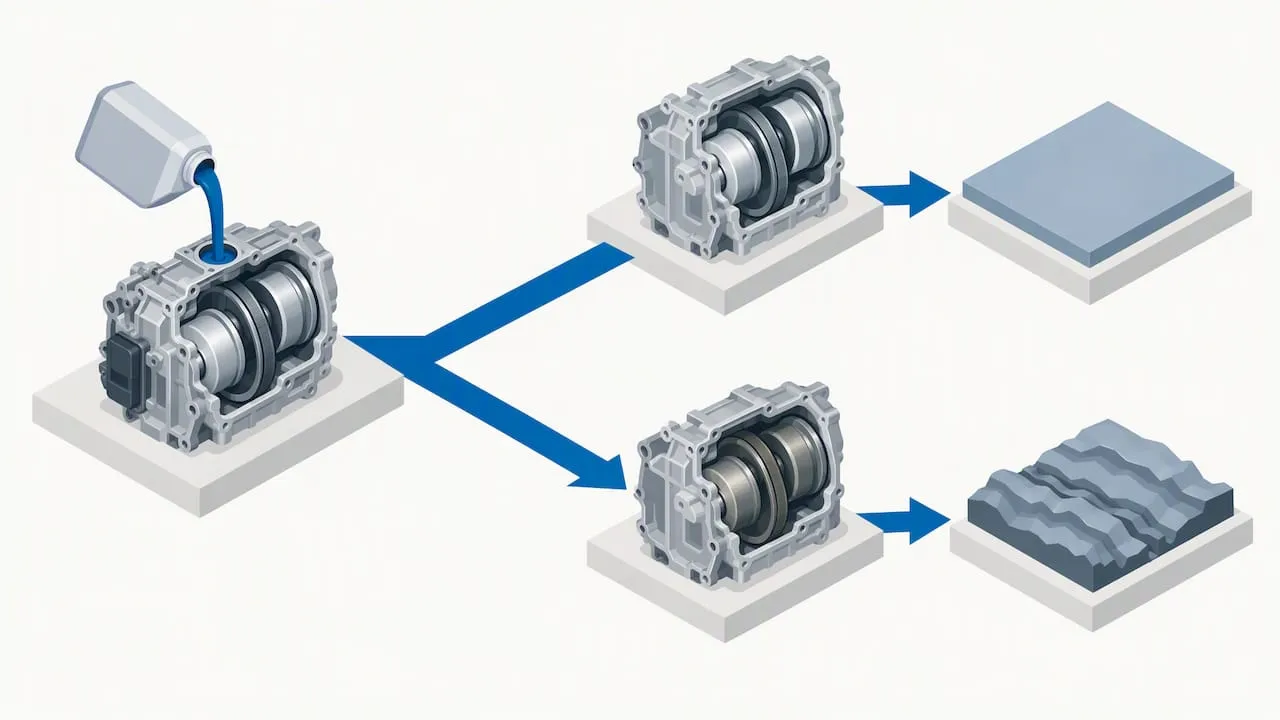
Shops generally offer three levels of CVT fluid service: a simple drain-and-fill, which replaces most but not all of the fluid; a full exchange or flush, which cycles fluid through the cooler lines for more complete replacement; and a serviced change paired with a filter or screen inspection where applicable.
Using Honda-specified CVT fluid matters more here than with conventional automatic transmissions, since the friction modifiers in CVT fluid are tuned for belt and cone contact and for torque converter clutch (TCC) engagement. Incorrect fluid or an imprecise fill level can leave judder unresolved even after a service.
- A fluid service commonly restores smooth operation when the cause is degraded or contaminated fluid rather than worn hardware.
- When belt, cone, or chain wear has already progressed, a fluid change may only delay the need for a rebuild or replacement.
- Shops typically confirm success with a road test at operating temperature, a fluid level recheck, and a follow-up symptom log.
| Service type | What it replaces | Typical use case |
|---|---|---|
| Drain-and-fill | Most of the fluid in the pan | Routine interval maintenance |
| Full exchange/flush | Nearly all fluid via the cooler lines | Judder suspected from degraded fluid |
| Serviced change with inspection | Fluid plus a check of filter/screen | First response to judder symptoms |
Owners planning a CVT fluid service can expect the shop to walk through which of these applies to their symptoms before starting work.
Diagnostic and repair paths with ballpark cost ranges
Most shops start with a diagnostic appointment that includes a test drive, an OBD-II scan, and a fluid inspection, which typically carries its own fee separate from any repair.
From there, costs scale with what the diagnostic finds:
- A software or TSB update, when applicable, is usually the least expensive fix since it involves no parts replacement.
- A fluid service sits in the moderate range and is often the first repair attempted for judder.
- Valve body or TCU repairs cost more than a fluid service but less than replacing the transmission outright.
- A remanufactured or replacement CVT is the highest-cost option and is typically reserved for confirmed internal wear.
Warranty coverage, open product campaigns tied to a TSB, and parts availability for a specific model year can all shift these numbers, so it’s worth asking a shop directly whether any of those apply before approving work. More on repair-first approaches to transmission problems is available on our transmission repair guidance page.
When continued driving is acceptable and when it creates serious risk
Mild judder with no loss of power and no warning lights is generally tolerable for short trips while an appointment is arranged, but it isn’t a reason to put off service indefinitely.
Statistic Callout: Forum and shop reports consistently describe judder as a symptom that can precede more serious internal wear, since the same friction breakdown that causes the shudder also accelerates belt and cone damage over time.
A few conditions raise the stakes:
- Towing or carrying heavy loads increases transmission temperature and friction demand.
- Mountain or sustained low-speed, high-load driving accelerates fluid breakdown faster than flat highway miles.
- Repeated high-heat operation can shorten the safe interval between fluid services even when the Maintenance Minder hasn’t flagged it yet.
Under any of those conditions, moving up the appointment is the safer call rather than waiting for the symptom to worsen.
What an independent specialist like Integrity Auto Inc will inspect and recommend
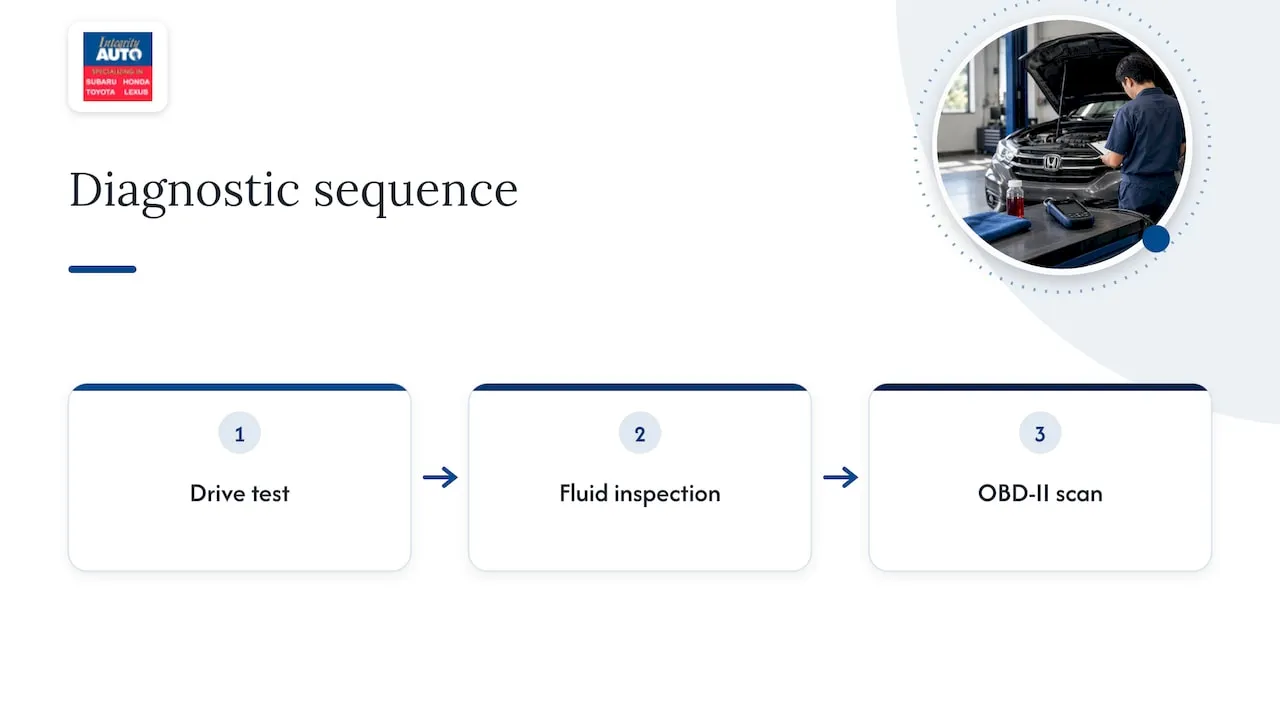
A thorough CVT diagnostic generally follows a set sequence: a symptom interview, a drive test, a fluid sample and color check, an OBD-II scan, pressure and temperature checks, and an inspection of mounts and driveshaft components that can mimic judder.
- A shop will usually recommend fluid service first when fluid condition and OBD-II data point to contamination or heat breakdown rather than mechanical wear.
- More invasive repair gets recommended when pressure testing or a physical inspection shows belt, cone, or valve body wear that fluid alone won’t fix.
- A transparent estimate should include labor hours, a parts list, and warranty terms before any work begins.
As independent Honda specialists, we built our approach around factory-schedule familiarity and long-term relationships with the owners who trust us with these decisions, rather than a one-time transaction.
Why Integrityautoinc is the next step for Honda CVT judder
We offer Honda Services & Repair built around the same factory-scheduled maintenance intervals your Maintenance Minder follows, which means our CVT diagnostic and fluid service recommendations are grounded in what Honda actually specifies for your model and driving conditions rather than a generic flush.
For owners who’ve noticed judder during acceleration, we start with the same diagnostic sequence outlined above: a drive test, fluid inspection, and OBD-II scan, so the recommendation you get (whether that’s a fluid service or a deeper repair) is based on what’s actually happening in your transmission. We use OEM parts and back our work with warranties, and we treat every CVT concern as the start of an ongoing relationship rather than a single visit.
If your Honda is showing signs of judder, explore our Honda Services & Repair page to see what a CVT diagnostic appointment with us includes, or reach out to get an estimate before the symptom progresses.
FAQ
Why does my CVT transmission shudder when accelerating?
Shuddering during acceleration usually traces back to degraded or contaminated CVT fluid losing its friction control, or to early wear on the belt, chain, or cone surfaces. On some model years, a software monitoring issue tied to internal fluid pressure detection has also been identified as a contributing factor.
What are common CVT issues in 2016 Honda CR-Vs?
The 2016 model year lineup saw a documented CVT software monitoring update for the related HR-V platform, addressing how the system tracked internal fluid pressure. Beyond software, fluid degradation and belt or cone wear remain the most commonly reported causes of judder across Honda CVT-equipped models from that era.
How much does it cost to fix a CVT judder?
Cost depends entirely on the cause: a software update is typically the least expensive option, a fluid service falls in a moderate range, and valve body repair or a remanufactured transmission costs considerably more. A diagnostic appointment, which includes a test drive, scan, and fluid inspection, is the starting point for narrowing down which repair path applies.
How often should Honda CVT fluid be changed?
Honda’s Maintenance Minder system adjusts the interval based on driving conditions, and owner documentation notes that mountainous, low-speed, or high-temperature driving can require more frequent changes than the standard interval. Towing and sustained heavy loads have the same effect, according to CR-V maintenance guidance.


