
A vehicle can pass DEQ in Portland with a limited number of “not ready” monitors, but the allowed count depends on model year and fuel type, and catalyst or evaporative monitors tied to a prior repair must show ready before a retest. Check your vehicle’s model year against the rule before testing, and if a monitor still shows not ready, the drive-cycle checklist below usually resolves it.
Table of Contents
- Oregon rules: how many unready monitors are allowed
- What ‘not ready’ actually means for your car
- Getting your monitors ready before test day
- What happens after an unready result or a fail
- Portland practicalities: stations, fees, and timing
- Shop-level diagnostics for readiness issues
- How Integrity Auto Inc supports your DEQ retest
- Sources
- FAQ
Oregon rules: how many unready monitors are allowed
Oregon’s OBD test does not require every monitor to read ready. OAR 340-256-0355 sets specific limits by model year and fuel type. Gasoline vehicles from 1996 through 2000 may have up to two unready monitors and still pass. Gasoline vehicles from 2001 and newer are allowed only one. Diesel vehicles from 1997 through 2008 must show every monitor ready, with zero unready monitors permitted, while diesel vehicles from 2009 and newer get some room, allowed one unready monitor.
There is an exception that catches a lot of Portland drivers off guard. If a vehicle previously failed with a catalyst or evaporative system trouble code, OAR 340-256-0355 requires those specific monitors to read ready before DEQ will accept a retest, regardless of how many unready monitors the general allowance permits. A car that qualifies for one unready monitor under the standard rule still fails the retest if that one unready monitor happens to be the catalyst monitor tied to the earlier fault.
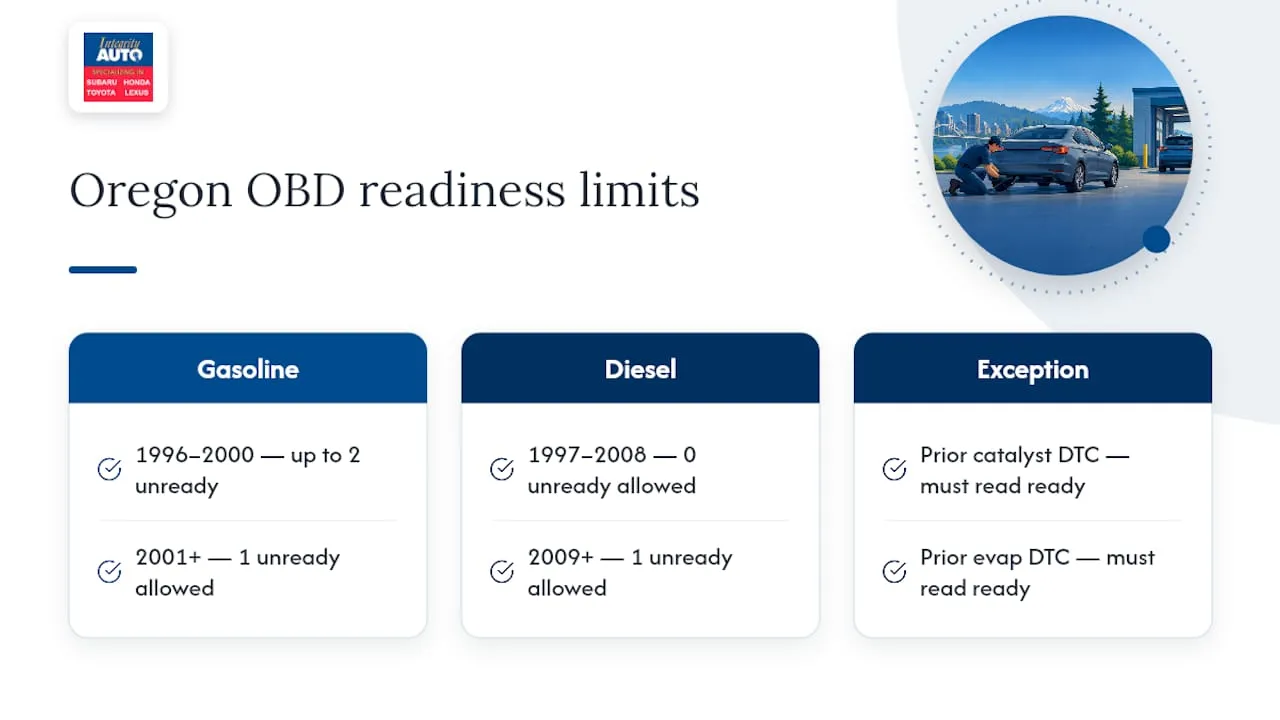
Before heading to a station, confirm your vehicle’s model year and fuel type against these thresholds. A 2003 gasoline sedan has far less room for error than a 1998 model, and mixing up the categories leads to an avoidable trip back.
What ‘not ready’ actually means for your car
Readiness status refers to whether your vehicle’s onboard computer has finished running its internal self-tests on a given emission control system. According to Oregon DEQ’s OBD FAQ, these self-tests, called monitors, cover systems like the catalytic converter, evaporative emissions, oxygen sensors, and misfire detection. A monitor showing “not ready” is not the same as a failure. It simply means the computer has not yet gathered enough data under the right conditions to reach a verdict.
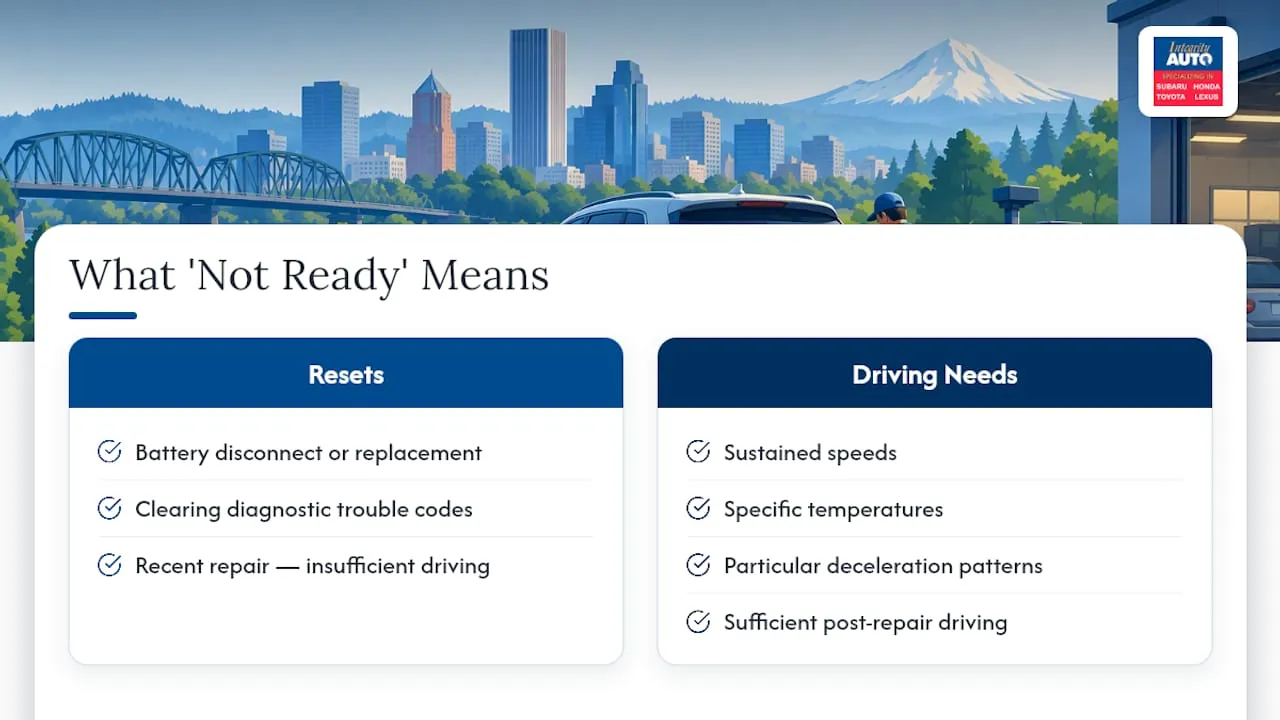
Several everyday events reset monitors to not ready; for guidance on safe procedures like battery disconnects and the effects on monitors, see clean engine bay: safe steps and ceramic protection. Disconnecting the battery, whether for a repair or to replace the battery itself, wipes the stored readiness data. Clearing diagnostic trouble codes after a repair does the same thing, and a recent repair often leaves monitors unready simply because the car has not been driven enough afterward to let them recomplete.
The OBD test itself works by reading these self-test results directly from the vehicle’s computer rather than measuring tailpipe output the way older tests did. That direct approach, per DEQ’s OBD FAQ, makes it more effective at catching current malfunctions, but it also means the computer needs specific driving conditions, sustained speeds, particular temperatures, certain deceleration patterns, to complete each test.
Getting your monitors ready before test day
Manufacturers define their own drive cycles, and the exact sequence varies by make and model. That said, most readiness routines share common elements you can complete in normal driving:
- Start with a cold engine and let it idle briefly before moving.
- Drive at a steady highway speed, generally 45 to 65 miles per hour, for 10 to 15 minutes.
- Vary your speed with several gentle accelerations and decelerations rather than holding one constant speed the entire time.
- Include a few stop-and-go segments with idle time, since some monitors, like evaporative and oxygen sensor tests, need specific idle and load conditions.
- Avoid shutting the engine off between segments, since some monitors require the drive cycle to run without interruption.
Beyond driving, a short mechanical check before you leave the house catches most avoidable unready results. Confirm the check engine light is off, the gas cap is on securely, the battery tests healthy, and no pending repairs or recently cleared codes remain unaddressed.
Timing matters as much as the drive itself. DEQ recommends testing early in your renewal window rather than waiting until the deadline, since an unready result still leaves time for another attempt. Once you pass, your certificate stays valid for 180 days, per DEQ’s testing guidance.
Pro Tip: Ask your technician for the manufacturer-specific drive cycle for your exact repair, since a generic highway drive does not always satisfy the catalyst or evaporative monitor on every model.
What happens after an unready result or a fail
An unready result is not the same as a failure, and Oregon does not charge you for either outcome. DEQ’s testing guidance confirms the fee applies only when your vehicle passes.
If the unready result involves a catalyst or evaporative monitor tied to a code that caused a prior failure, OAR 340-256-0355 requires that monitor to read ready before a retest counts. General unready allowances do not override this rule.
Your next move depends on what triggered the result. If no repair was involved and a monitor simply reset from a battery disconnect, a week of mixed city and highway driving is often enough to complete the outstanding monitors. If a repair replaced parts related to the catalyst or evaporative system, expect the drive cycle to take longer, sometimes several days of varied driving, since those monitors need sustained conditions to finish. If the check engine light stays on through that period, stop driving cycles and schedule a diagnostic appointment instead, since an active fault will keep resetting the test.
Portland practicalities: stations, fees, and timing
Portland area DEQ stations charge $25 for the test, and that fee applies only when the vehicle passes, according to DEQ’s testing guidance. A passing certificate stays valid for 180 days. You do not need special paperwork for the emissions test itself, though bringing your DMV renewal notice speeds up the registration tag process at the station.
DEQ’s Portland area station page lists hours and contact numbers for each location, and it is worth checking before you go since testing boundaries determine whether your specific address requires testing at all.
DEQ advises testing as soon as your renewal notice arrives rather than close to the deadline. That buffer matters most for owners dealing with unready monitors, since it leaves room to drive, retest, or get repairs done without risking a lapsed registration.
Shop-level diagnostics for readiness issues
When a monitor will not clear through driving alone, a qualified shop can narrow down why. Integrity Auto Inc works with Toyota, Lexus, Subaru, and Honda vehicles in Portland and approaches readiness problems through OBD diagnostics that read stored and pending codes, identify which system is affected, and build a repair plan around the specific fault rather than guessing.
Targeted repairs commonly involved in readiness failures include oxygen sensor replacement, gas cap or evaporative system seals, and catalytic converter issues. After a repair, the shop can run a post-repair verification drive to confirm the affected monitor completes before you head back to a DEQ station.
Bring the vehicle in when the check engine light stays on, when a fault seems intermittent, or when you cannot safely complete the highway and idle segments a drive cycle requires. Related guidance on what causes a car to fail an emissions test and check engine light diagnosis covers the diagnostic process in more detail.
How Integrity Auto Inc supports your DEQ retest
The shop handles DEQ diagnostics, emission-related repairs, and readiness preparation for Toyota, Lexus, Subaru, and Honda owners in the Portland area. Diagnostic work uses the same OBD data DEQ stations read, which means diagnoses map directly onto what will show up at the test.
Portland owners dealing with a stubborn not-ready monitor or an active check engine light have a few paths forward:
- Schedule emission testing and repairs to address the underlying fault before your next DEQ attempt.
- Request a diagnostic appointment to identify exactly which monitor is affected and why.
- Ask about DEQ-related repair services built specifically around Toyota, Lexus, Subaru, and Honda systems.
Contact Integrity Auto Inc to book an inspection before your renewal deadline arrives.
FAQ
What does it mean when my car’s emissions monitors say they’re not ready?
It means your vehicle’s computer has not finished running its internal self-tests on a particular emission system, often because the battery was disconnected, codes were recently cleared, or the car has not been driven enough since a repair. It is not the same as a failed test, according to DEQ’s OBD FAQ.
Can I go to DEQ without paperwork in Oregon?
You do not need specific paperwork for the emissions test itself, though bringing your DMV registration renewal notice helps speed up the registration tag process at the station, per DEQ’s testing guidance.
How long is a DEQ test good for in Oregon?
A passing DEQ certificate is valid for 180 days in the Portland area, according to DEQ’s testing guidance. Testing early in your renewal window leaves room to address any unready monitors before that period runs out.
How many unready monitors are allowed to still pass?
The allowance depends on model year and fuel type: gasoline vehicles from 1996 to 2000 may have two unready monitors, gasoline vehicles from 2001 onward are allowed one, diesel vehicles from 1997 to 2008 must have zero, and diesel vehicles from 2009 onward are allowed one, per OAR 340-256-0355. Catalyst and evaporative monitors tied to a prior failed code must be ready regardless of this general allowance.
What should I do if my check engine light stays on after clearing codes?
A check engine light that returns after clearing codes usually means the underlying fault was not resolved, and driving cycles will not clear the monitor while the fault is active. At that point, a diagnostic appointment at a qualified shop, such as the one described on Integrity Auto Inc’s DEQ diagnostics page, is the more reliable next step.


